
The Ancient Cache
During WWII, a teenager makes a discovery thousands of years older than the country he calls home.

It rained hard that night. Flashes of lightning stole through Marcel’s window and illuminated the intricate floral wallpaper around his narrow bed. In the dark, his anxiety distorted the vertical patterns into columns of Nazis, bearing down on him from all angles.
He tossed and turned, his skinny knees knocking against the rails of the bedframe. Each time was a pointed reminder that he was not at home; that things were not as they should be.
At seventeen, Marcel was wise enough to know that 2-D Nazis in the wallpaper were a figment of his imagination. But he was also wise enough to know that 3-D Nazis really had marched down the Avenue des Champs-Élysées that summer, forcing his family to flee Paris for the countryside.
Marcel pressed his face against the cool glass of the window pane. Down below he watched the rain fall on the corrugated roof of the shed. To his surprise, he saw two small circles of light appear on the ground, multiplied tenfold by shimmering reflections in the puddles.
A motorcycle. Two figures climbed off of it, one in a leather jacket, the other in a wool coat. The latter carried a bundle over his shoulder.
Marcel saw his father run out and wave them into the shed. The strangers left a few minutes later. His father came back into the house. Marcel leapt under the covers.
The next day Marcel took Robot, the family beagle named for his metallic bark, for a walk. He stopped at the shed and investigated, but he found no trace of any delivery. Had it just been a dream?
On the way to a nearby forest, where Marcel and Robot were making routine sallies, the pair passed a dairy farmer listening to the radio. The voice reported that registration with the Compulsory Work Service was now mandatory for all able-bodied Frenchman.
The previous night’s storm had left the forest in a sorry state. The path Marcel had been bushwhacking for several days was still intact, but fresh devastation was all around. He took Robot in his arms while climbing a steep bank, his boots pressing into the mud.
As he crested the top he saw an enormous uprooted oak tree. It resembled a woman in a hoopskirt who had slipped on the sidewalk and gone heels up. The result of a mudslide, Marcel thought.
Robot barked. Marcel put him down and the dog dashed into a nearby thicket. Out the other end came a rabbit, and with Robot hot on its heels, the rabbit leapt into a hole under the roots of the upturned oak. Robot dove in after it.
“No! Robot!” Marcel shouted, “Robot, come back!”
Cursing his dog and himself, Marcel crouched over the hole and began to dig. Chunks of earth broke away with ease, and Marcel soon discovered, to his amazement, that the hole went far, far deeper than it ought to.
Lying down with his back against the wet ground, Marcel kicked his rain boots through and, wishing himself and Robot good luck, pushed in. He felt his stomach drop as he slid down several feet before hitting hard ground.
In the pitch black, Marcel found that not only could he stand fully upright, but he could jump and not even touch anything with an outstretched hand. He lit a match – his only one – and felt his way over to a wall.
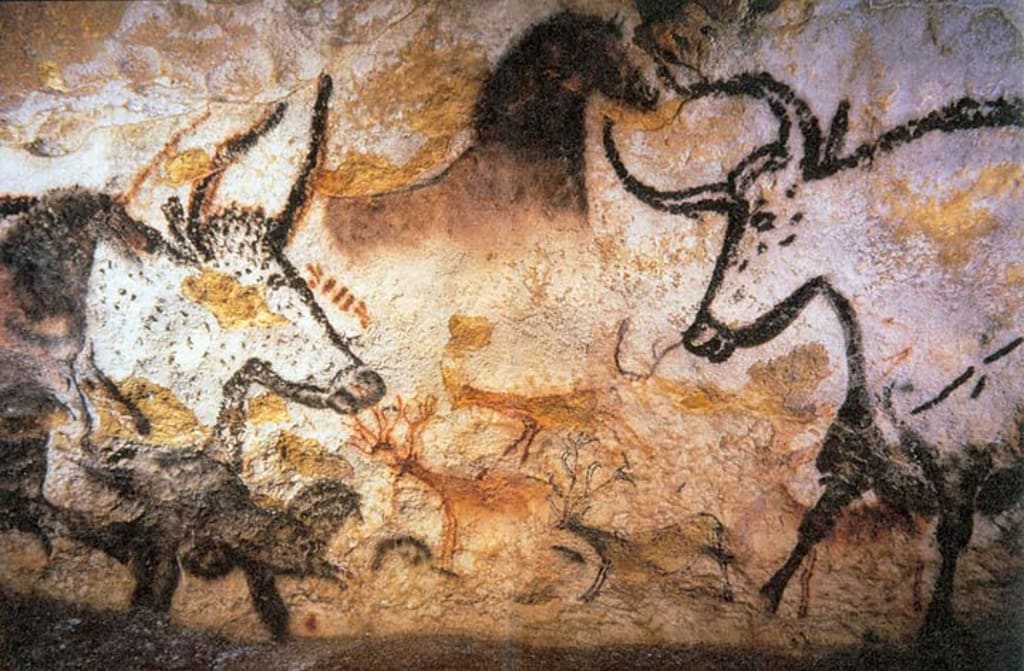
A thick red smear glistened. In a long, deliberate stroke it swept up and out of sight. As Marcel followed it with the flickering tip of the match, he saw that it formed into a two hooved legs, and then, reaching what seemed to be the head, Marcel saw what appeared to be two flared nostrils, each one as wide as a wine barrel. He gasped and his breath extinguished the match.
A metallic bark echoed through the cave. In an instant Robot was back in his arms. He threw a leash around the dog’s neck, climbed out of the cave and hurried back to the village.
He went to the local mechanic, Gustave, whose garage was on the edge of town. The stout and amiable Gustave was a friend of Marcel’s father, and Marcel hoped he could borrow a flashlight from him.
As Marcel crossed under the garage door and felt the cool air of a metal fan blow against his face, he noticed a motorcycle leaning against the wall. Gustave’s voice carried from the back room.
Marcel announced himself; Gustave poked his head out into the doorway and flashed a toothy grin. The boy wasted no time in asking if he could borrow a flashlight. Before the mechanic could respond, two men followed him out into the garage.
They went outside and smoked and talked. They were Germans. Suddenly, Gustave was wrapping Marcel in a hug so tight that the boy thought his spine might snap.
“New policemen,” Gustave whispered. He let Marcel go and fetched a flashlight. After handing it over, Gustave asked why he would need a flashlight at this time of day.
The Germans turned to them, apparently to hear the answer. Marcel made the mistake of glancing at them. On their chests they wore silver eagle pins. Marcel edged toward panic, but soon found the words he needed. He said that he was helping his father fix something in the attic and the light was out.
“Ah,” Gustave said, “Tell him I said there’s nothing more permanent than a temporary solution.”
The Germans went back to their own conversation. Marcel was eager to return to the cave and explore it with the flashlight, but he felt their eyes on him as he left the garage. Since Robot was hungry, he decided to head home and return to the cave with the flashlight tomorrow morning.
As he walked through the village, he wondered whom he should tell about his discovery first, and how, and what would happen if the word got out. He had only seen cave drawings like this once before, in the Muséum national d'Histoire naturelle. Finding a new one could put his name in the newspapers – maybe even the history books.
But then his chest tightened. He remembered his mother tearing a newspaper in half after reading reports of Nazi generals crating art from the Louvre and sending it back to Berlin. He pictured Nazi soldiers blowing a hole in the hillside and marching into the cave to take the painting. If he got any credit at all, Marcel thought, it would probably be with a silver pin in the shape of an eagle.
At the dinner table, Marcel ate nothing. He was tortured by his secret. His mother pestered him about what he did all day, if anything happened to spoil his appetite. As he opened his mouth to respond, not knowing what would come tumbling out, they heard a knock on the door.
His father answered it. He spoke briefly with two men. Returning to the table, he said it was nothing. New village officials making introductions.
“Germans,” he said.
Marcel’s mother took his sister away for a bath. Marcel washed up in the kitchen while his father went to smoke a cigarette.
“Marcel, do you have any matches?” he asked.
Before Marcel could answer, his father’s fingers were digging into his jacket pocket. He returned to the kitchen with the flashlight.
“What is this doing in your coat?”
With soapy suds covering his hands, Marcel faced his father. He imagined himself regaling his father with the whole tale – the whole truth. He saw the two of them adventuring into the cave together and then reporting the discovery to the local university, as he was certain his father would want to do. It filled him with happiness.
But he knew that things were different now. Instead, Marcel saw columns of 2-D soldiers joining the bulls on the cave walls, gunning them down in cold blood, carving them up, carting them off. He agonized while his father grew impatient.
“Marcel, why do you have this? Speak.”
“I went by the garage on my walk,” Marcel said, deflating. “Gustave gave it to me, he said to study how it works. That men should know these things. I didn’t want to be impolite.”
The father scrutinized the son, then rolled his eyes. “Gustave is a funny one, eh?”
Marcel turned back to the sink and washed the soap off of his hands.
That night he didn’t sleep at all. He listened at his bedroom door. Nearing one a.m. he heard footsteps. Voices in the kitchen. The smell of cigarette smoke. He crept into the hallway.
His father was arguing with another man about where to put something. His father insisted that he would not have any of it here, not anymore. The other man tried to persuade him. He said his garage was being watched now; he suspected before but now he was certain.
“Gustave,” Marcel whispered to himself. His knee bumped against the wall.
In a flash, chair legs scraped the floorboards and a hand grasped Marcel’s shirt. His father yanked him into the kitchen. His face was red with fury.
“How dare you, Marcel?! Shame on you, boy.”
Gustave put up his hand. “The world is changed, my friend. France needs her young men far more than she needs us. Let him stay.”
“War doesn’t make boys men,” Marcel’s father said, “it makes men dead.”
Marcel, sensing an opportunity, blurted out, “I found a hidden cave. It’s a perfect hiding place, out in the forest. If you want I can show it to you. Please.”
His father released him. Marcel recounted his entire discovery and the men exchanged cryptic glances. His father told him to go get the flashlight. When he returned to the kitchen, the men were putting on their coats.
“Okay, young man,” Marcel’s father said. “Take us.”
A marmalade moon hung in the sky over the uprooted oak. Marcel went into the cave first. He helped his father through the hole and together they helped Gustave. When all three men were inside, Marcel flicked on the flashlight.
“Mother of God,” Marcel’s father said, crossing himself.
The cone of light danced across the walls of the cave. It was more extensive and amazing than Marcel could have imagined. Every inch of stone was covered with beautiful, intricate, ancient cave drawings, all of them depicting the same thing: charging bulls.
Some of the bulls were as small as Marcel’s hand, others were life-size. All were running in the same direction, in one great big stampede, away from the hole they came through and deeper into the abyss.
Years later, after the war, tour guides would lead thousands of visitors from around the world through this cave. But on that night, the first night, it was excavated by flashlight. Not for archeological worth but for storage capacity. Satisfied, the three climbed out through the hole.
“He that bulls the cow,” Gustave said.
Marcel and his father waited together in the dark for several hours, saying a little, thinking a lot. Eventually they heard cracking branches and footfalls. Marcel stood on the oak and signaled with the flashlight. Five figures appeared in the darkness, arms laden.
Marcel turned on the flashlight. Gustave and four other men were carrying rifles, pistols, bandoliers, and cases of ammunition. Marcel and his father helped them smuggle everything into the cave, piling it under the watchful eyes of the bulls, which one of the men said the ancients had called aurochs. When the last of the cache was safe inside, they all parted ways to avoid attention. Father and son walked back to the village together.
“Who were they?” Marcel asked.
“They are part of a new local organization.”
The sun began to peek over the horizon behind them.
“Are we?” Marcel asked.
After a moment, he felt his father’s hand on his shoulder.
“We are now,” he said.
About the Creator
E. Haughie
I'm a dual citizen of the U.S. and the U.K. and an incoming first-year law student at the University of Michigan. I've been writing short stories, screenplays, and comedy sketches since I was old enough to hit ctrl+S.
Enjoyed the story? Support the Creator.
Subscribe for free to receive all their stories in your feed.
Comments
There are no comments for this story
Be the first to respond and start the conversation.