
The Amphitheatre of Forgotten Voices
Beyond the flood bank lies a place where memories refuse to die.

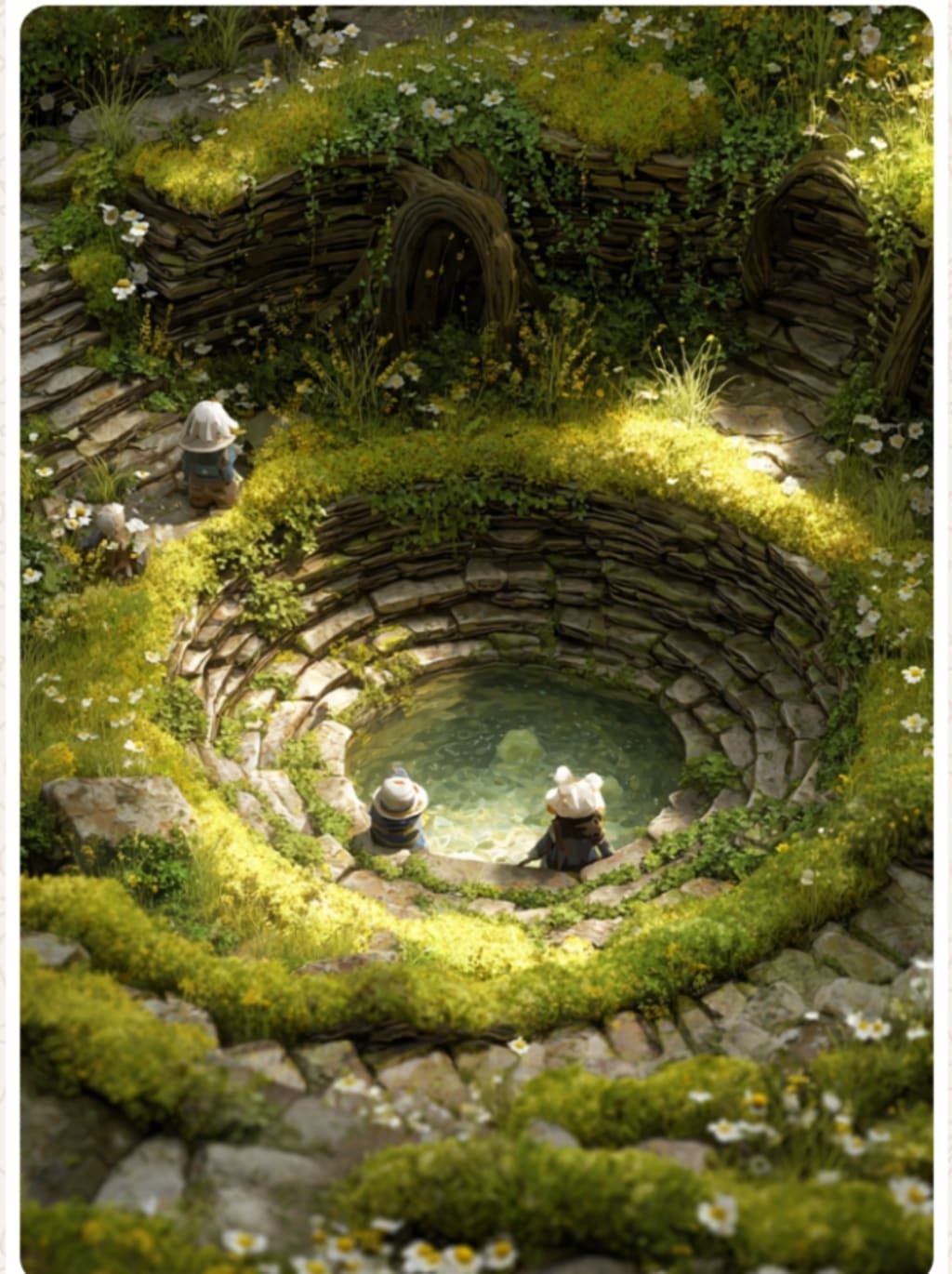
Inspired by the excerpt from "The Amphitheatre" by Hannah Moore, here is an original story of more than 600 words that expands upon the imagery and atmosphere of the poem. Writing The Amphitheatre I had tumbled down off the flood bank without meaning to. One moment I was following the narrow path that skirted the river, listening to the rustle of reeds and the distant call of water birds, and the next my foot slipped on wet grass. I slid several feet down the steep embankment until I came to rest among a tangle of roots protruding from the soil. For a while I simply sat there, breathing hard. My soles pressed against the thick roots of plants that anchored the mounded earth. They twisted around one another like ancient fingers gripping the hillside, refusing to let the river claim another piece of land. Above me, the sky was pale blue, streaked with clouds moving lazily eastward. The flood bank blocked the view of the road and the nearby village. Down here, hidden by willow branches and tall grasses, I felt as though I had slipped into another world. Then I heard voices. At first I thought they belonged to hikers passing along the path above. But the voices seemed to come from somewhere deeper within the bank itself. They were soft and overlapping, speaking words I couldn't quite understand. Curiosity outweighed caution. I followed the sound, pushing through brambles and ducking beneath hanging vines. After a few yards, the vegetation opened unexpectedly. Before me lay a natural amphitheatre. Its walls were formed by curved ridges of earth covered in moss and wildflowers. Stone slabs protruded from the slopes in semicircular rows, creating the appearance of seats carved by invisible hands centuries ago. At the center was a circular patch of smooth ground where sunlight pooled like liquid gold. No map had ever mentioned this place. No one in the village had spoken of it. Yet it felt impossibly old. I stepped cautiously into the center. The voices ceased. Silence settled around me, thick and expectant. Then a breeze drifted through the amphitheatre, carrying the scent of damp leaves and river water. The grass swayed. Shadows shifted. And suddenly, people appeared. Not people of flesh and blood, but translucent figures shimmering in the sunlight. An old woman wrapped in a shawl. A young soldier with mud-stained boots. A child clutching a wooden toy horse. A fisherman holding a net over his shoulder. They sat quietly upon the stone seats, watching me. Fear should have sent me running. Instead, I felt an overwhelming sadness. These figures did not seem threatening. They seemed forgotten. The old woman rose first. She moved toward me with slow, deliberate steps. "Do you hear us?" she asked. Her voice sounded like leaves brushing together in autumn. "I do," I whispered. She smiled. "Then our stories may yet survive." Before I could reply, another figure stood. The soldier. "I left home at seventeen," he said. "Promised my mother I would return before the harvest. I never did." His image flickered. "I want someone to remember that I loved music more than war." Next came the fisherman. "I spent forty years on the river," he said. "I knew every bend, every hidden current. When I died, my sons sold my boat within a week. No one remembers my songs." One by one they stepped forward. A baker who dreamed of becoming a painter. A widow who secretly wrote poetry every night. A boy who saved a drowning dog and never told anyone. Ordinary people. Lives overlooked by history. Dreams unfinished. Acts of kindness unseen. Regrets unspoken. They had gathered in this strange amphitheatre because stories needed listeners. Without listeners, memories faded. Without memories, people disappeared entirely. Hours seemed to pass. Perhaps days. I listened until my legs grew stiff and my throat dry. When the last spirit finished speaking, a young girl approached me. She could not have been older than ten. She carried a bouquet of wild daisies. "My name was Clara," she said. "I wanted to be a teacher." She looked down. "But I became ill before I could grow up." She handed me the flowers. "Will you remember us?" Tears stung my eyes. "Yes," I said. "I will." The girl's smile brightened the entire amphitheatre. Then the figures slowly returned to their seats. The sunlight dimmed. A gust of wind swept across the clearing. And they were gone. Only silence remained. I climbed back toward the flood bank, clutching Clara's daisies. When I reached the top, the afternoon sun hung low in the sky. The village church bell rang four times. Had I truly spent only a few hours there? I looked back. There was no opening among the trees. No stone seats. No amphitheatre. Only tangled undergrowth. For weeks I wondered if exhaustion or imagination had deceived me. Yet the daisies never wilted. They remained fresh in a glass vase beside my window. And so I began to write. Every evening after work, I recorded the stories I had heard. The soldier who loved music. The fisherman who sang to the river. The widow who hid poems beneath loose floorboards. Little Clara, who dreamed of teaching children to read. Page after page filled my notebooks. Eventually, I understood why the amphitheatre existed. It was not built for performances. It was built for remembrance. For every person whose life seemed too small for history books. For every voice nearly swallowed by time. Somewhere beyond the river, hidden beneath roots and moss, the amphitheatre still waits. And perhaps, on a quiet afternoon, someone else will stumble down the flood bank, place their feet against the roots that hold the earth together, and hear the whispering voices asking only one thing. Remember us.
About the Creator
Amir Khan
I share simple knowledge about online earning, freelancing, and personal growth for beginners around the world.
Enjoyed the story? Support the Creator.
Subscribe for free to receive all their stories in your feed.
Comments
There are no comments for this story
Be the first to respond and start the conversation.