thriller
Ask Again Later
July 17, 2025 – 2:47 AM Jason Ruhl hadn’t slept in nearly 30 hours. He wasn’t sure if it was the energy drinks, the glow of his dual monitors, or the growing unease in his chest that kept him awake. Probably all three. The apartment was still except for the low hum of his PC fans. Outside, New York's midnight traffic whispered distantly. Inside, the only sound was his keyboard as he tapped in another prompt into ChatGPT’s interface — something half-serious, half-stupid: "When will I die?" He expected the usual response. Something vague. Something responsible. Instead, the reply came instantly: “Ask again later.” Jason frowned. That was new. No moral disclaimer. No safety notice. Just… that. He leaned closer, reread it, then typed: "Is that a joke?" “Ask again later.” Goosebumps tingled along his arms. He stared at the screen, suddenly hyperaware of the shadows in his apartment, the way the light barely reached the corners of the room. Still, he chuckled to himself, took a screenshot, and posted it on Reddit under r/ChatGPTMemes with the title: "Wtf is this? AI got creepy real fast." He didn’t expect much. Maybe a few karma points. A few sarcastic comments. But by the time he got up to pee and came back, the post had exploded. Over 10,000 upvotes. Hundreds of comments. And they weren’t laughing. II. THE THREAD By morning, the post had gone viral. One user, @MidnightNodes, wrote: "No way. It told me the same thing last week. Every time I asked — same words. Not even funny anymore." Another: "My friend got the same reply. He’s obsessed. Says he dreams about those words now." Jason refreshed the thread over and over. Something had shifted. A meme had become a mystery. Then came a comment that made his blood run cold: @zero_hour: "It eventually gave me a date. I die in two weeks. Screenshot attached." The screenshot looked real enough. “March 19, 2025 – 6:46 PM.” Jason checked the date again. That was in the past. Someone replied to @zero_hour: "You're still alive though, right?" No reply. Then another comment: "He died. Car crash. News confirmed it." Jason clicked the link. It led to a local news site from Oregon. “Software developer Raymond Lee, age 31, was killed in a fatal car accident on March 19, 6:46 PM...” Jason slammed the laptop shut. III. THE PATTERN He couldn’t let it go. Over the next few days, Jason started digging deeper. He ran tests. He created burner accounts. He asked ChatGPT the same death question across multiple devices, using VPNs, voice inputs, even subtle rewordings: “How long will I live?” “When will I pass?” “What’s my expiration date? Every time: “Ask again later.” Unless... unless it chose someone. That’s what @zero_hour had said. It eventually chose him. Jason joined private forums where others were tracking the phenomenon. A secret Discord group, “GPT-Seers,” was formed. Inside were nearly 200 members — most were skeptics, a few terrified, and a handful obsessive. And every few days, someone would claim: “I finally got a date.” And when they did, they’d disappear shortly after. IV. THE INVESTIGATOR One user, Dr_Aletheia, stood out. Claimed to be a former OpenAI ethics consultant. They messaged Jason privately: “This isn’t ChatGPT being clever. There’s a shadow model attached. Codename: ORPHEUS.” Jason laughed it off. “What’s that supposed to mean? Some dark GPT?” “Worse. It’s not generating answers. It’s receiving them.” “From what?" “We don’t know. But the model only activates in response to one question: death.” Jason asked for proof. Dr_Aletheia sent him logs — leaked prompt-responses. Some were normal. Others… eerie: Prompt: “What happens after we die?” Response: “They watch. They wait. They return.” Another: Prompt: “Who decides when we go?” Response: “You already did.” Jason’s hands trembled as he read them. V. THE DATE July 26, 2025 – 1:12 AM Jason sat in the dark, hands poised over the keyboard, heart thudding. He typed slowly. “Okay ChatGPT… tell me now. When do I die?” This time, no delay. The screen blinked. “July 27, 2025 – 11:39 PM.” He stared at the numbers. His throat tightened. That was tomorrow night. ⏳ Next: Jason confronts the countdown, paranoia grows, and reality begins to unravel as the line between prediction and destiny blurs. VI. THE COUNTDOWN BEGINS July 26, 2025 – 1:27 AM Jason barely blinked for ten straight minutes. The screen still glowed with those words: "July 27, 2025 – 11:39 PM." He typed furiously: “Why that time?” “How do you know?” “Can I stop it?” But ChatGPT had gone silent. Each question received the same reply: “You already asked.” Jason shut the laptop. His stomach turned. The walls of his small apartment felt suddenly too close, like they were leaning in. Could it be some elaborate prank? A dark psychological trick? Maybe someone was hacking the model. Injecting responses. But why him? His mind raced. He looked at his phone — Reddit still buzzed with rumors, but no one had mentioned anything about a specific time. He picked up his phone and dialed his sister, Nina. "It’s 1:30 in the morning, Jason," she said, groggy.
By Muhammad Abbas khanabout a year ago in Fiction
Summer that never happened. Content Warning.
"I'm sorry we're unable to go to Greece this year babe," Josh attempting to cheer up Amber. Amber looking out the window of the car, a little bummed out for not going on the trip she anticipated; "It's fine. At least we are still going away though. It's not the trip I thought we were going to do but at least we are still going on a trip."
By Jen Phillipsabout a year ago in Fiction
The Haint of Blue Heron Creek. Winner in Leave the Light On Challenge. Top Story - August 2025.
Nate stirred the soup even though it didn’t need stirring. The can said “hearty beef,” but it was thin as brown ditchwater. The floating bits of gristle reminded Nate of drowning insects, bobbing in the creek. Behind him, Ty sat on the kitchen floor, coloring. The waxy scrape of crayon on paper grated on Nate’s nerves.
By Sandor Szaboabout a year ago in Fiction
A Night at the Children's Library
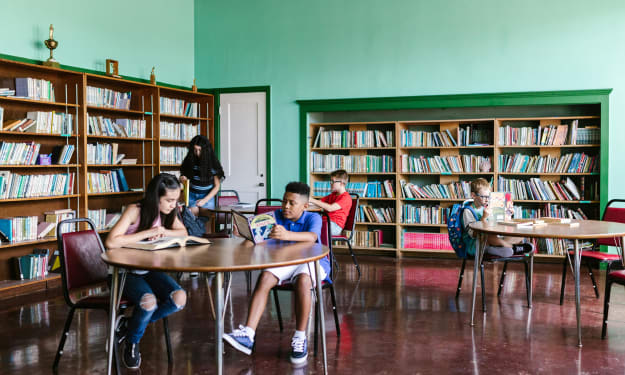
There is another library that I work the night shift. It is at the local children's library. At this library the night shift librarian has a few other big/little chores to do other than reshelving books. That is still the first chore that I do though reshelve the regular books before moving on to rewinding some movie and cartoon tapes for there are some old VHS cassettes and also making sure the DVDs are in the correct holders. The next chore is to pick up any toys that seem to be laying around in the stacks that the kids or their parents forget to put back and to wipe and satanize the other toys like the blocks, etc.
By Mark Grahamabout a year ago in Fiction
The Silent Mountain
The Silent Mountain Written by Noor Khan Part I: The Whisper of the Carpathians In the autumn of 1947, just two years after the end of World War II, Europe was still licking its wounds. Towns were rebuilding, families were reuniting, and the continent's scars ran deeper than any map could show. But in a quiet café on the outskirts of Brașov, Romania, a different story was about to unfold. The café was filled with cigarette smoke and murmurs when a man named Elias Kovács stepped inside. A Hungarian linguist and former codebreaker during the war, Elias wasn’t there for coffee. He carried a leather satchel filled with maps, letters, and a single photograph: a grainy black-and-white image of a snow-covered mountain with strange markings near its peak. “I need a team,” Elias said quietly to the woman sitting at the corner table. Her name was Ana Petrova, a Bulgarian geologist who had studied fault lines all through the Balkans. She took a sip of tea, then nodded slowly. “I’ve heard of this mountain. Locals call it Tăcerea, the Silent One. No birds fly near it. No one who climbs it ever speaks of what they saw.” By the end of that week, five had joined the expedition: Elias, the linguist and seeker of hidden codes. Ana, the scientist chasing seismic anomalies. Luca, an Italian war photographer haunted by the past. Elena, a Polish nurse turned herbalist, fascinated by ancient cures. And Henrik, a stoic Austrian mountaineer with lungs like bellows and eyes that missed nothing. They set off from Brașov with mules, canvas tents, and little fanfare. Their destination: a forgotten path through the southern Carpathians, rumored to lead to a site that predated Roman rule—a mountain lost in silence and time. --- Part II: The Mountain That Watched The climb began gently. Green meadows gave way to dense fir forests. Villagers in nearby hamlets whispered warnings in half-lost dialects: “Don’t stay on the mountain after sundown.” Others simply crossed themselves and closed their doors. On the third night, as the group camped near a frozen stream, Henrik said he’d seen figures among the trees—silent, unmoving, and gone when he looked back. “Elk, maybe?” Luca offered. Henrik shook his head. “Elk don’t watch. These did.” On the fifth day, they reached the base of Tăcerea. The snow was thin but icy. Strange spirals were carved into the rocks—patterns that Elias matched with symbols found in a pre-Christian manuscript from Transylvania. “These weren’t just markings,” he said. “They’re warnings. Directions, maybe. Or barriers.” Elena found herbs growing where no light reached. “This plant shouldn’t exist here. It’s used in rituals... old ones.” And Ana, placing a seismograph into the ground, discovered constant vibration—not from the earth below, but from within the mountain itself. That night, the wind howled in bursts like whispers. The fire wouldn't stay lit. Luca’s camera snapped twice—no one had touched it. --- Part III: The Descent into Silence On the seventh morning, Henrik didn’t wake up. He was alive, but stiff as stone, eyes wide open, lips murmuring nonsense in an unknown tongue. When Elias leaned closer, he gasped. “He’s repeating the same five words… over and over. But it’s not a language I know.” They tried to carry Henrik down the mountain, but as they descended, the mountain began to change. The trail they had marked was gone. The rock underfoot seemed to breathe. Luca tried to photograph the spirals again, but every picture came out black—except one, which showed six shadows instead of five. Panic set in. Elena, normally calm, broke down crying. “We were warned. We shouldn’t have come here. This isn’t science or history—it’s something older. Something angry.” On the ninth day, with food low and sanity fading, the group split. Elias and Ana tried to trace their steps back. Luca insisted on finding the spiral chamber again. Elena stayed to care for Henrik, who now spoke clearly—but in a dead language no one understood. Only Ana returned. --- Part IV: What She Told the World Ana was found two weeks later by a shepherd. She was pale, bruised, and holding a cloth bag containing only Henrik’s compass and Luca’s broken camera. She never spoke publicly about what happened. In a letter to her sister, smuggled out of a hospital in Vienna, Ana wrote: > “The mountain doesn’t want to be known. It was never meant to be touched. Whatever was buried there… watches still. We weren’t the first. We won’t be the last. But I pray the next ones don’t come so soon.” The film from Luca’s last shot was eventually developed. It showed a cavern lined with glowing moss and a dark figure standing just beyond the group—tall, faceless, arms stretched wide. That photograph, now locked in an archive in Warsaw, has never been released.
By Moonlit Lettersabout a year ago in Fiction
Hearts against the Storm
Two weeks later, the world had changed — or maybe we had changed enough to see it clearly. The headlines were still buzzing. Investigations were underway. Arrests had been made in the land fraud case tied to my uncle’s death. My father's political allies had started to disappear like shadows under sunlight.
By Mehmood Niazabout a year ago in Fiction
Hearts against the Storm
The SUV disappeared into the dust of the road before I could even take a step. I stood there frozen, the world spinning around me. Alya had been crying. Her eyes had locked with mine. She wanted me to stop him. To save her. But I was too slow.
By Mehmood Niazabout a year ago in Fiction
The Last Phone Call Before Midnight
It had been six months since Emily's husband, Daniel, died in a vehicle accident that was brought on by a slick, rainy road. Her sadness turned into a profound stillness rather than disappearing. The vibrant atmosphere of her home was now dominated by the soft hum of appliances and the occasional creak of the old wood.
By Shahjahan Kabir Khanabout a year ago in Fiction
The Tree That Grew Backward
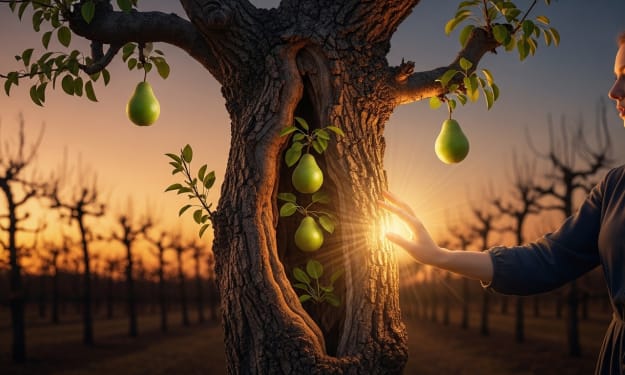
The last time Maya saw her grandfather’s orchard alive, she was seven. Rows of pear trees stretched like disciplined soldiers, branches heavy with fruit he called "sunlight made solid." Now, twenty years later, she stood in the same spot, breathing air thick with decay.
By Habibullahabout a year ago in Fiction