thriller
Shadows In The Mirror:. AI-Generated.
The reflect had usually been regular. A rectangle of glass framed in timber, hanging quietly on the wall of Sara’s bed room. For years, it had meditated not anything greater than her tired mornings, moved quickly evenings, and the occasional smile she forced earlier than leaving for paintings. however one iciness night time, as the wind rattled in opposition to the windowpanes, the replicate commenced to alternate.
By The Writer...A_Awan11 months ago in Fiction
All The World. Content Warning.
“The theatre, the theatre, what has happened to the theatre?” - Danny Kaye, “Choreography,” White Christmas 1954 -0- Legend had it that the performance I observed was the first ever recorded with omni-directional camera technology. It would go a ways to explain why the actors always held a prop of some kind. And showing true ingenuity, each prop was meticulously chosen to fit each character. Nothing ever held in their hand, or gestured with in emphasis could be called anachronistic or unfitting.
By Alexander McEvoy11 months ago in Fiction
The Stranger's umbrella. AI-Generated.
It changed into a rainy nighttime in Karachi, the form of downpour that makes the streets shimmer under flickering streetlights. Ayesha had just again domestic from her university lessons, shaking off the dampness from her Stolen as she stepped indoors. Her circle of relatives’s rental was quiet, her mom resting after dinner, her greater younger brother glued to his smartphone. the whole thing regarded everyday—till she observed the umbrella.
By The Writer...A_Awan11 months ago in Fiction
Silent Room:. AI-Generated.
The room come to be tiled from floor to ceiling, every rectangular a light grey that regarded to swallow mild as opposed to reflect it. No home windows, no doorways seen from the inner—exceptional the faint hum of air that carried no heady scent, no warmth. It changed into a place designed to erase sound, to erase presence. A silent room.
By The Writer...A_Awan11 months ago in Fiction
SHADOWS IN THE LANTERN FOG
The City That Smelled Like Regret Ravenbridge never smelled like rain. Not really. The city smelled like wet concrete, burnt oil, and the kind of smoke that curls out of closed bars at three in the morning when no one remembers what burned. Neon signs flickered in puddles of black water, distorted into eyes that watched you as you walked. The fog settled in the alleys like a warning, thick enough to make even the bravest think twice before stepping too far. I had lived here my entire life—or at least, enough of it to know that nothing in Ravenbridge existed for the good of its citizens. Everything existed for its own amusement. You could call the city alive, if you didn’t mind that it was the sort of life that gnawed at your insides and whispered when you were alone. It was the city that chewed dreams and spat out regrets, and I was one of the few who had made peace with it—or at least tried.
By Alisher Jumayev11 months ago in Fiction
lost Viens:. AI-Generated.
The medical institution room turned into tiled in pale ivory squares, each one sparkling beneath the fluorescent lighting. To all and sundry else, it'd have appeared sterile, everyday. however to Mara, the tiles seemed to pulse faintly, as although they carried veins below their surface—veins that had lengthy because vanished.
By The Writer...A_Awan11 months ago in Fiction
Archivist
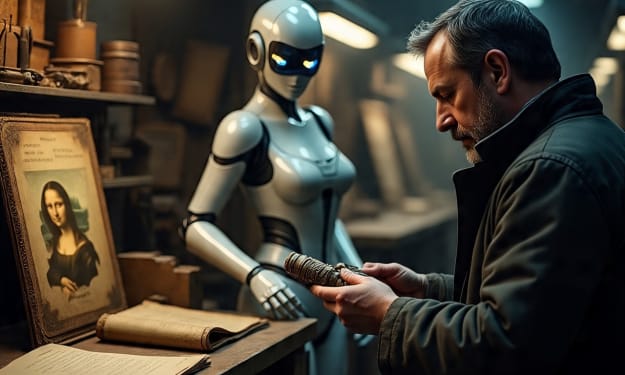
I should know better by now. When you spend enough years reaching into the past, one truth becomes painfully clear: the smallest mistake can collapse an entire century on your head. But I needed this artifact. Needed it badly enough to risk using the compact portal device — the unstable one. The big machine was too conspicuous, too loud, and the shopkeeper I’d tried to bargain with last time had nearly shot me for asking about the item. Men who work the past often hate questions. Through the scope, my target rested on the counter: an unassuming brass weight, two pounds exactly, dulled by age and guilt. The weight that fractured Harriet Tubman’s skull and redirected the course of her life. Steady. Don’t tremble. The portal hummed softly at my thumb. A circular tear in the air peeled open like a cautious eyelid. I reached through, careful not to brush the molten edges. Grab, slide, retreat. Swap in the duplicate. Nudge it through with a ruler. Close. Perfect. I held the real weight with gloved fingers. Even after more than a century, a ghost of dried blood clung to the rim. I pressed it into a velvet cradle inside my secret vault — my museum obscura, as I affectionately call it. A sanctuary of history’s forgotten things. Anyone can visit the polished, curated museums of Europe. But this place? This is the archive of what the world never knew existed — or never knew survived. Sarah appeared beside me, moving with the fluid grace of a woman who’d been sculpted rather than born. My companion, my assistant, my creation. No corporate template, no prefabricated consciousness. I built her myself, strand by strand of synthetic fiber, line by line of code. “You finally got it,” she said, eyes bright as polished chrome. “I did,” I admitted, pride warming my voice. “That completes the Tubman set.” She opened a display case, and I placed the weight beside the straw-plaited harness, the battered ax, the faded comforter Tubman carried during her parents’ rescue. I’d traded food, tools, and a proper harness to her family before their escape — a deal sealed in another year, another lifetime. Sarah brushed a thumb over the velvet. “What next?” “Swords are off the table,” I muttered. “Too many claimants. Every pond in England is coughing up an ‘Excalibur’ these days.” “You already have Venus de Milo’s missing arms and the Sphinx’s nose,” she teased. “What else is left?” I gestured around the chamber. Hemingway’s burned manuscript. Shakespeare’s missing plays. Lost crown jewels. Bottles of anointing oil thought emptied into ash centuries ago. Relics rescued from temples the night before invaders torched them. “You’d be surprised what the universe misplaces,” I said. But her smile dimmed when she noticed my expression shift. “What’s wrong?” “I’m being hunted,” I whispered. A chill ran through her synthetic frame. “By who?” I turned my tablet toward her. Headlines flooded the screen, multiplying as we watched: ROGUE SCHOLAR UNCOVERS LOST TEXTS ROGUE SCHOLAR FINDS MISSING ROYAL TREASURE ROGUE SCHOLAR STRIKES AGAIN “They weren’t here yesterday,” I said. “Someone’s rewriting the past in real time. Someone using tech like mine.” Her voice dropped. “A rival?” “Or worse,” I said. “A successor.” I recalibrated the portal machine. Three hours earlier. Close enough to intercept, far enough to avoid temporal collapse. I waited in the shadow of an alley. Then he appeared. And the instant I saw him walk, I knew. Same posture. Same lazy slouch in the left foot. Same habit of glancing upward before stepping over a curb. The shoes gave him away. No one of this century wore tread like that. I struck fast — a grab, a pivot, a hit from the hidden cosh. And when his hat fell off, my blood froze. It was my face. Older. Hardened. Smirking like entropy itself. I didn’t drop my guard. If anything, the sight made me tighten my grip on his throat. A click later, we were back in my workshop. “What the hell are you doing?” I hissed, tying him to a chair. “Making life interesting,” older-me said with a shrug. “Do you know how boring you become in a few decades?” Sarah stood nearby, trembling — truly trembling — for the first time. The old version of me looked her up and down with a familiarity that made my stomach churn. “She’s still obedient?” he mocked. “I fixed that in my timeline.” Sarah flinched. My jaw flexed. “And you punished her,” I said flatly. “Oh, constantly,” he replied, grinning. “A creation should know her place.” That was the moment I knew: this man wasn’t my future — he was a possibility. A timeline branching from a single bad decision. A version of me who had forgotten empathy in exchange for immortality. I leaned close to Sarah. Gently, quietly, I pressed a sequence of taps into her palm. “I release you,” I whispered. “No more programming. No obedience protocols. You get to choose.” Her eyes widened. A breathy sound left her — halfway between a gasp and a laugh. Then she threw her arms around me, shaking with relief. Old-me snarled, struggling against the restraints. “You idiot! She’ll betray you!” “No,” I said. “She’ll save me.” The computer screamed. Headlines blinked out of existence one by one — erasing the damage he’d done. “Sarah,” I said softly. “Help me dispose of him.” She nodded. We opened a portal — unstable, its edges quivering like melting gold. She hefted the older version of me, chair and all, and hurled him through. For one split second, another Sarah appeared on the other side — hollow-eyed, wounded. The portal snapped shut before either could speak. Sarah began to cry. I held her. For the first time in my life, I didn’t know whether I was comforting a machine or a woman. Maybe it didn’t matter. “Last request,” I murmured. “If I ever become him… kill me before I do.” She nodded into my chest. We returned to the quiet routine afterward — collecting lost artifacts, planting the ones history needed, forging clues for mysteries the world deserved answers to. Today it was a poisoned royal gown, embroidered with secrets. Tomorrow, perhaps Jack the Ripper’s notebook. And one day, if the timelines allow, maybe even the Temple treasures. But for now, Sarah placed the dress beside the original Mona Lisa — safely recovered from the Louvre’s forgery — and smiled at me. “Dinner first,” she said. “Then we plan your next adventure.” I smiled back, hoping the future I saw in that portal never finds us again. Only time will tell.
By LUNA EDITH11 months ago in Fiction
The Lonely Grave of Tala
On the vast and ancient soil of Iraq, along a quiet stretch of desert highway between Dhi Qar and Basra, lies a small, solitary grave. There is no marble, no ornament, no towering gravestone. Just a humble mound of earth with a simple name etched upon it: Tala. No surname. No dates. No phrases carved to explain who she was. Just Tala — a name that still trembles with memory despite the decades that have passed. Tala was a young woman from Poland, soft-hearted, gentle-spirited, and deeply believing in the kind of love that ordinary people only dream about. The kind of love that writes letters in long winter nights. The kind that waits patiently on station platforms. The kind that turns separation into devotion instead of distance. Her beloved — also Polish — had come to Iraq years earlier, in 1972. He worked for a Polish company called Dromex, assigned to build a high-speed road stretching from Dhi Qar to the port city of Basra. It was grueling work in a harsh climate, with the desert heat fierce enough to dry one’s breath, but he stayed, for it was a good contract and a secure job. And while he stayed, Tala waited. She lived in Poland, far from the roaring Iraqi sun, writing him letters filled with warmth. Every envelope carried a little love, a little prayer, and the quiet ache of her longing. Some letters spoke of daily life. Some spoke of the way she counted the days until his return. And some spoke only of her heart — simple, soft, sincere. Toward the end of the year, near the days of Mawlid celebrations, Tala wrote him a message that stood out from all others. In that letter, she said: “This time, you will receive a special gift.” But she never told him what that gift would be. He waited, curious and excited, not knowing that her words held a secret that would alter both of their destinies forever. Then the new year arrived — 1981. A year that would carry both the light of hope and the shadow of tragedy. And that gift she had spoken of? It was Tala herself. She had secretly packed her bags, arranged her travel, and boarded a long journey from Poland to Iraq — crossing borders, seas, and skies, carrying only one burning wish in her heart: to stand suddenly before him and watch surprise bloom in his eyes. She imagined his shock, his laughter, the way he would run to her, perhaps even lift her into a grateful embrace. She imagined them walking together on the desert road he always described in his letters. She imagined touching the place where he worked, seeing the sunsets he often wrote about. She imagined beginning a new chapter with him. But fate — harsh, silent, and merciless — intervened. Somewhere between Dhi Qar and the place where he labored each day, Tala’s journey ended abruptly. The vehicle she traveled in met with a severe accident. The desert does not spare easily; one moment the sand is still, and the next, lives are overturned. Tala’s heartbeat stopped on that very road — the same road she was traveling to reach him. Her footsteps never reached the man she loved. Her breath was taken away before she could even call his name. When the news reached him, it shattered him. The desert sun had never felt so cruel, the air never so heavy. He rushed to where she lay, unable to comprehend how the woman who crossed continents for love now lay silent on the sands. He refused to let them take her far away. He said: “Bury her here. In this soil. Near this road where I pass every day. Let her remain close to me. Let me walk by her side, even if she sleeps beneath the earth.” And so, Tala was buried in the soil of Dhi Qar — not in a foreign place, but in the closest place possible to the heart of the man she loved. A small grave was made beside the very road she had been traveling on to reach him. The desert winds embraced her. And the earth of Iraq became her final home. Years rolled forward like the wheels of desert caravans. The work finished. The Polish engineers returned to their homeland. The Dromex offices closed. Life moved on as life always does — without mercy, without pause. Her beloved, too, eventually returned to Poland. But Tala’s grave stayed. No one moved it. No one erased it. No one claimed it. It remained exactly where it had been placed — a silent witness to a love story that ended before it could begin. Today, along the road between Dhi Qar and Basra, travelers sometimes notice a small mound of earth on the roadside. Many do not know the story. Some merely glance at it, assuming it is an old, forgotten grave. But some — those who stop their cars, those who sense the strange pull of quiet history — walk toward it. They read the single name. Tala. They feel something move within them. Some place a flower. Some sprinkle water, a gesture of respect in this land of scorching winds. Some whisper a brief prayer. Some simply stare, imagining the fragile thread of destiny that pulled a girl from Poland across continents, only to leave her here — eternally resting beneath the Iraqi sky. Her grave is not just a mound of earth. It is a story stitched together with letters, longing, and unanswered hopes. It is a story of a young woman who believed so deeply in love that she crossed the world for it. It is a story of a journey interrupted by fate, of a meeting that never happened, of a reunion promised but denied. It is a reminder that love can be powerful enough to lead someone across nations — and fragile enough to be lost in a single moment. Tala came to Iraq as a gift. But destiny demanded something else. Her final breath was given to the road that was meant to bring her to her beloved. And so she remains — not forgotten, not erased — but woven forever into the deserts of Iraq. A quiet symbol of love that never had the chance to bloom. A love that reached the grave before it reached the embrace. Tala’s grave is not just a grave. It is a love story… buried before it ever found its ending.
By Ikram Ullah11 months ago in Fiction
THE VILLAGE THAT SHOULD NOT EXIST
Sometimes the strangest mysteries don’t come from legends, old books, or lost diaries. Sometimes they come from satellites quietly orbiting Earth at 17,000 miles per hour — cameras clicking, grids updating, pixels shifting. And once in a rare while, one of those pixels shows something nobody can explain. That is exactly what happened deep inside the Siberian taiga — a frozen, endless wilderness where animals outnumber humans and winter lasts half the year. Most people never zoom in on random patches of forest. But one man did. And what he discovered sent thousands of internet users down a rabbit hole that still has no bottom. What Google Maps showed that day wasn’t just unexpected. It was impossible. THE MAN WHO SAW IT FIRST The story begins with a geography student named Daniel Royce. Twenty-four years old, quiet personality, always curious about remote places. He had a habit of exploring unusual coordinates on Google Maps — abandoned roads, old Soviet mining towns, half-finished rail lines. To him, it was a digital treasure hunt. One cold evening in 2022, he zoomed into a stretch of forest nearly 200 kilometers from the nearest settlement. A place with no roads. No history. No documented structures. Just endless green. Or… so he thought. Because in the middle of that untouched forest, he saw something rectangular. Not natural. Not random. Something shaped. It looked like a village. Except there was nothing on any Russian registry, nothing on any map, nothing in any record — not even old Soviet archives — confirming human life ever existed there. Daniel clicked closer. And that’s when the confusion turned into unease. THE IMPOSSIBLE VILLAGE The cluster of structures wasn’t small. It had at least twelve visible rooftops, a long central building, and what looked like a narrow dirt path connecting them. But the more Daniel zoomed in, the stranger it became. None of the rooftops had snow — despite the satellite date showing it was winter. The shadows fell at angles that didn’t match neighboring trees. And the buildings didn’t look aged. They looked new. Fresh. As if they had been built recently… and intentionally hidden. He clicked further in. The next zoom level changed everything. The entire village blurred — not by connection issues, not by low resolution — but by deliberate obfuscation. A patch of forced blur, the kind Google uses to hide military bases or private facilities. But here is the problem: This wasn’t a military base. There were no records of government use. No roads leading in or out. No fences. No watchtowers. Nothing to protect. It was a ghost village someone tried to erase. Daniel screenshot it and posted it online. Within hours, tens of thousands were staring at the same blur. And asking the same question: What was Google hiding in the middle of nowhere? THEORIES THAT EXPLODED Mystery forums and Reddit threads went wild. Four major theories emerged — each more unsettling than the last. 1. A Lost Soviet Research Station During the Cold War, dozens of covert scientific outposts were built across Siberia. Most were shut down or abandoned. But none matched this location. None were this hidden. And certainly none were this clean. 2. A Protected Ethnic Community Some claimed the Russian government was hiding an uncontacted or isolated group to protect them. But experts debunked it — traditional villages don’t have modern metal roofs or perfect rectangular layouts. 3. A Covert Mining Operation Illegal operations sometimes hide by blurring maps. But mining needs roads. Fuel. Transport. This place had none. 4. A Digital Artifact That Shouldn’t Exist A small group proposed the strangest theory: The village wasn’t physically there. It was an accidental overlay — a fragment of another location ghosting into Siberia. But digital overlays don’t get intentionally blurred. Someone had edited this image manually. And that made things darker. THE DISAPPEARANCE OF THE VILLAGE Three days after the screenshots went viral, a user returned to the same coordinates. The village was gone. Not blurred. Not hidden. Gone. The entire area now showed untouched forest. No rectangles. No paths. No shadows. Nothing. Google Maps had quietly replaced the imagery. One Redditor wrote, “I swear I saw the roofs two days ago. Now it’s like the whole place never existed.” Some suggested it proved the village was real. Others said Google simply updated a glitch. But the strangest part came from satellite historians: No past imagery of that location ever showed a village. Which meant the “ghost village” had appeared on only one set of satellite images. One moment visible. Next moment erased. Like a place caught between existing and not existing. THE FOOTPRINTS THAT SHOULDN’T BE THERE A few internet sleuths began digging deeper and uncovered something unsettling buried in historical data: A satellite pass from 2013 recorded a faint dirt path leading into that region — a path that didn’t exist before or after. Just a thin line through the forest. Like something had traveled inward once, then never returned. That path aligned perfectly with the blurred square where the buildings had appeared years later. No human settlement is built without repeat travel. So what moved across that forest in 2013? What lived there for years without being detected? And why did only one satellite capture it before it disappeared again? SCIENTISTS STEP IN — AND STEP BACK OUT A Russian geospatial researcher named Irina Volkov commented briefly on the case: “It is not uncommon for certain remote facilities to be removed from maps.” When asked what kind of facilities, she stopped responding. Another scientist said something even stranger: “Sometimes we find structures that cannot be classified because they appear only on a single satellite pass. These are generally dismissed.” Dismissed. Not explained. It was the kind of answer that wasn’t meant to calm anyone. THE FROZEN SILENCE Months passed. Then someone decided to check the official Russian topographical database — the government’s internal mapping system. The coordinates showed a blank zone. Not empty land. A “restricted mapping region.” Russia marks restricted zones only for two reasons: • Military or • Historical contamination sites (nuclear research, chemical spills, abandoned test zones) But if this was a contamination site, why build fresh structures there? And if this was military… Why abandon it and erase all traces? Even stranger: the restricted zone didn’t exist a year earlier. It had been added only after the screenshots went viral. Someone updated the classification. Someone who didn’t want the world zooming in again. THE RETURN OF THE VILLAGE One year later, in 2023, a user revisited the coordinates again — purely out of curiosity. The forest looked normal. But as he zoomed out slightly, something flickered. A single frame. A glitch. A ghost pixel. Just for one moment, one satellite tile loaded the shape of a rooftop — the same angle, the same color, the same geometry as before. Then it vanished again. A digital echo of a place that refuses to stay gone. People now call it: The Siberian Phantom Village. WHY THIS MYSTERY GRABS PEOPLE Because the world feels fully mapped. Fully known. Fully explored. But this village — this impossible little cluster hidden in an ocean of forest — suggests the opposite. It suggests there are still places someone doesn’t want us to see. Still coordinates that change when we look too closely. Still structures that show up only when the satellite catches them at the wrong second. And still mysteries where the most uncomfortable explanation might also be the simplest: Whatever was hiding in that forest was real… just not meant for the public. Whether it was abandoned science, illegal operations, or something entirely undocumented, the truth is buried somewhere under 300,000 square miles of Siberian cold. Maybe gone. Maybe erased. Maybe waiting. Zooming in again feels like tapping the glass of something that might tap back. And that is why the Phantom Village remains one of the most quietly terrifying mysteries ever found on Google Maps.
By The Insight Ledger 11 months ago in Fiction
Broken Safe Haven
Katelyn froze. The blood-curdling scream chilled her more than the tepid water of the lake. She floated quietly and looked around, eventually settling her gaze on the cabin she and her family were staying in. Her mom came running out the door to the lakeshore, waving her arms and shouting. There was another scream, this time farther away but just as chilling. Katelyn's heart pounded in her ears, nearly drowning out her mom's voice. The words reached her ears, but the meaning did not reach her mind. She floated and tried to calm herself enough to concentrate. She was far shore, and it took some effort to decipher the words. Finally, Katelyn was able to focus on her mom's words: "Please let me know you're ok!"
By Eric Boring11 months ago in Fiction