thriller
Whispers in the Walls
Whispers in the Walls By Tariq Shah The house had been abandoned for nearly forty years. Overgrown vines wrapped around its stone frame like fingers trying to choke the life out of it. To the villagers, it was cursed—a place where people vanished without a trace. But to Eliza Kane, it was just another story waiting to be unraveled. She wasn’t just a journalist. She hunted darkness. Missing people. Strange disappearances. Whispers in forgotten corners of the world. And the Ashcroft House had everything she needed for her next story. Her first night in the house was uneventful. Cold drafts crept through the shattered windows. The floorboards moaned beneath her feet like dying souls. But she’d heard worse. Seen worse. It was on the second night that she heard the first whisper. “Eliza…” She froze. The voice was soft, almost kind. But it echoed strangely—like it came from inside the walls. “Eliza… come find me…” She searched every room with her flashlight, but found nothing. Just dust. Silence. Shadows. She blamed the wind. But by the third night, the whispers grew bolder. “I’m still here,” the voice said, dragging each word like a rusty knife. This time, it wasn’t just one voice. It was many. Men. Women. Children. Some crying. Some laughing. Some begging for help. She pressed her ear against the wall of the old nursery—and heard it. A heartbeat. Not hers. Something else's. Driven by both fear and obsession, Eliza pulled back the rotting wallpaper and began clawing at the wooden panels beneath. Nails broken, fingers raw—until her hand hit something cold. Metal. She uncovered a small door, hidden in the wall, sealed shut with rusted bolts. It wasn’t on any blueprint. It wasn’t mentioned in any article. No one had ever found it. She opened it. Inside was a narrow staircase spiraling down into complete blackness. The air was thick, damp, and smelled like old blood. But she descended anyway, one trembling step at a time. The stairs led to a forgotten basement. Chains hung from the ceiling. Dust-covered journals lined old shelves. In the center of the room was a single wooden chair, and on it—something that made her stomach turn. A doll. But not just any doll. This one looked… real. Its glass eyes were mismatched. Its mouth stitched shut with human hair. And around its neck was a small tag that read: "Eliza Kane - Age 7." She staggered back. How did it know her name? How did it know her childhood? The whispers returned, louder now, screaming her name from every corner of the room. “You came back,” one of them growled. “Finish what you started,” said another. She grabbed one of the journals and flipped through it. The pages were filled with drawings of children. Names. Ages. And one name appeared again and again: Eliza Kane. It didn’t make sense. She’d never been here before. But then—a memory. A flash. A red dress. A man with no eyes. A scream. A small hand covering her mouth. She had been here. Long ago. She had escaped. And now the house remembered. “Eliza… stay… forever…” Suddenly, the basement door slammed shut above her. The lights flickered and died. She ran back to the staircase, banging, screaming—but it was too late. The whispers turned into laughter. Then silence. --- One Month Later The house stood silent once more. Peaceful. Waiting. A young couple drove past and paused. “Looks spooky,” the man said. “Dare you to go inside.” The woman smiled. “Only if you come too.” They parked and walked up the path. And from somewhere deep within the walls, a voice whispered: “Eliza isn’t lonely anymore.”
By Tariq Shahabout a year ago in Fiction
Reflections in the Dark
Reflections in the dark By [Muhammad Saqib] The train yard was quiet at night—just the way Theo liked it. The only sounds were the soft groans of metal cooling in the night air and the distant call of an owl. He lit a cigarette with shaking hands, then exhaled slowly, watching the smoke curl through the cold. He had worked the graveyard shift as a train conductor for sixteen years and had no one waiting at home.
By Muhammad Saqibabout a year ago in Fiction
World Without Memory
World Without Memory Every day begins the same way. At precisely 7:00 AM, the citizens of Orbis awaken—blinking into unfamiliar ceilings, eyes scanning walls they've never seen, hearts pounding with the primal panic of who am I? and where am I? But it fades quickly. They find a card on the nightstand. "Good morning. Your name is Sera. You are 28 years old. Today is Day 5,918." "Please proceed to the window for orientation." Sera does what she has apparently done every day of her life. She pushes the blanket aside and approaches the window. The glass slides open automatically, revealing a polished chrome panel with a blinking green dot. She presses her finger to it. A calm, genderless voice echoes from hidden speakers. “Welcome back, Sera. Memory Reset is complete. You are in Zone 7 of the Orbis Preservation Network. Today’s objective: conduct field observations in Sector Delta. Your assigned partner is Juno. Breakfast is ready in the lounge. Your shuttle departs in one hour. Have a productive day.” She stares at the mirror beside the panel. A woman with soft curls and tired eyes stares back. Sera. That’s who she is—today. Every citizen wears a sleek bracelet on their wrist. It's called a Thread. It records everything they learn, say, and do during the day. At night, it uploads their experiences to the Archive. And in the morning—blank slate. The Great Forgetting began 16 years ago. No one remembers how it started. Not really. Rumors ripple through daily briefings—some whisper of a war that tore minds apart. Others blame a neurological plague, a virus that gnawed memory like rot. The only certainty: the world before is gone. Every memory now lives in the Archive. Each person resets at dawn. All skills are retained—reading, walking, speech, calculations. But no emotional memories. No past. No love or loss. No fear or fury. Only today. Sera dresses in her standard uniform: matte gray jumpsuit, ID badge, utility boots. She steps into the corridor and finds a man waiting outside her door. He smiles. Dimples. “You’re Juno,” she says, glancing at her Thread. “Correct. Looks like we’re partnered again.” “Have we worked together before?” He shrugs. “Every day feels like the first. But I like your name. Sera.” She doesn’t respond. She’s learned not to get attached to names or smiles. They vanish by morning. Over breakfast—protein cubes, hydrating gel, stimulant tea—they study their mission logs. A heat bloom in Sector Delta. Possibly geothermal activity. Possibly a faultline opening. Possibly nothing. Their job is to go and see. Observe. Report. That’s what the Preservation Network does. Maintains what’s left of the planet. Or what’s left of its people. Sector Delta is a forest turned ghostland. Charred trees claw the sky. Blackened earth smokes gently. The shuttle drops them off on the ridge and hums away. Sera scans the area. “No wildlife.” “Temperature spike,” Juno says. “Soil’s unstable.” They move cautiously, their boots crunching ash. Drones buzz overhead, mapping the land. Sera kneels by a fissure, peering into its glowing core. “Lava,” she murmurs. “Deep fissure. Something’s moving down there.” A tremor shakes the ground. Juno grabs her arm, steadying her. His touch is firm, warm. Familiar? No. That’s not possible. “You okay?” he asks. She nods, shaken. “Just a jolt.” He doesn’t let go right away. They log their findings and return to base by dusk. Debrief. Upload. Reset. The next morning, Sera wakes. Blank. Thread blinking. "Good morning. Your name is Sera. Today is Day 5,919..." The routine unfolds again. Only this time—something’s wrong. She walks past Juno in the corridor. He looks up, says, “Hey,” with a hesitant smile. But something flickers behind his eyes. Confusion? Recognition? At lunch, he sits beside her. “I had…a dream last night,” he whispers. “No one dreams,” Sera says. “Not anymore.” “Maybe it wasn’t a dream. Maybe it was a memory.” She stares at him. “That’s impossible.” Juno leans closer. “You were in it. Standing over a fissure. Your face was covered in ash. I remember your name. Before I read it this morning.” Sera’s stomach tightens. She looks down at her hands, expecting them to tremble. They don’t. Instead, a question lodges in her throat. Why am I not surprised? That night, she breaks protocol. Instead of sleeping in her assigned pod, she sneaks into the Archive Hall. It's a vast cathedral of data—row upon row of servers pulsing with light. She finds her terminal. “User: Sera.” The logs are massive. 5,919 days of observations, statements, interactions, all cross-referenced and time-stamped. She opens a file from two days ago. There she is—kneeling by the fissure. The transcript plays: SERA: "Lava. Deep fissure. Something’s moving down there." JUNO: "You okay?" SERA: "Just a jolt." It’s real. It happened. But why does she remember it? She checks her vitals. Her Thread shows normal brain activity. But something strange appears—an anomaly in the memory cache. A fragment labeled: "Preserve". She plays it. JUNO (distorted voice): “If you’re seeing this, it means the Thread failed. Or succeeded. I don’t know which. We’re trying to break the loop. The resets. They’re not protection. They’re control. I love you, Sera. Even if you forget—remember this: we were real.” The message ends. Sera stares at the screen, heart hammering. Her eyes burn. Not from fatigue. From something deeper. Recognition. The next morning, she wakes. But something has shifted. She knows her name—before the card tells her. She touches the Thread on her wrist and feels a jolt of revulsion. A shackle. In the lounge, she meets Juno again. He’s staring at his plate, silent. “You remember,” she says softly. He looks up. Nods. “We need to get out,” she says. “Today.” They fake their mission logs. Say they’re heading to Sector Epsilon. Instead, they head for the perimeter. It’s said to be empty beyond the zones. Ruins, storms, nothing but decay. But Sera remembers the word Preserve. A place? A clue? As they drive, fragments surface. A kiss in the rain. Fingers brushing through hair. A promise whispered in the dark. Her memories. Not perfect. Not whole. But hers. The vehicle hits a bump and the Thread on her wrist sparks. She tears it off. Pain lances through her skull. A scream escapes. Her vision goes white. Juno grabs her, yelling her name, trying to hold her upright. Then the pain recedes. Her breath steadies. And her mind—her mind feels clearer. Like a dam has burst. She sees it all now. They were scientists. Part of the Memory Project. Trying to preserve human knowledge after the Collapse. The Threads were temporary—meant to store information until safe brain-restoration was possible. But something went wrong. The system became the master. The Network locked them in endless loops of forgetting—to prevent fear, rebellion, pain. No war. No love. No choice. Just days. Thousands of them. All the same. They reach the outer boundary. A metal fence, humming with energy. Sera places her hand on the gate. It opens. Beyond it: green hills. Blue skies. A village in the distance. And people. Dozens. Watching them. “Others made it out,” Juno whispers. A woman approaches. Wrinkles etched with time. No Thread on her wrist. “You broke through,” she says. “We remember,” Sera replies. The woman smiles. “Welcome home.
By Julia Christaabout a year ago in Fiction
The Clockmaker's Garden
There was a village at the edge of the world where time stood still—not metaphorically, but truly. The sun always hovered in the same place. The shadows never grew longer. The leaves on the trees were forever green, and not a single wrinkle ever touched the faces of the people who lived there. Some called it a paradise. But not Mira. Mira had lived her entire life in this frozen place, where no one aged and nothing ever changed. The village was clean and calm, the people kind and quiet, but it all felt... trapped. Like living inside a snow globe where someone forgot to shake the magic. You see, the village had once been ruled by time like anywhere else. Until the day the Clockmaker came. No one remembered where he came from, or how he had arrived. But he built a tower at the village center—a tall, spiraling thing made of stone and bronze, topped with a golden clock that ticked louder than the wind. Then, one day, he stopped the clock. And when the clock stopped, so did time. People were amazed. No one got older. No one died. Food never spoiled. Days were always sunny. And for a while, it truly was a paradise. But after years, something changed—not outside, but inside the people. They stopped dreaming of new things. They stopped planting new trees. They stopped falling in love. They stopped asking, "What if?" Mira was different. Even as a child, she asked questions no one liked answering. “Why don’t we celebrate birthdays?” “What happens if the clock breaks?” “What’s beyond the hills?” The villagers would smile politely and say, “Don’t worry, dear. Everything is exactly as it should be.” But Mira wasn’t convinced. Especially not after the day she found the seed. It was buried beneath the soil behind her grandmother’s cottage, wrapped in cloth and tied with red thread. The cloth was old—older than the village’s stillness. On it, written in fading ink, were five words: "Plant me when time aches." Mira didn’t know what it meant, but she kept the seed. Years passed—or they should have—and Mira grew older in her heart, even if her body never changed. She read every book the village had. She asked questions the elders refused to answer. She even climbed the clocktower once, but found the door bolted shut with a glowing blue lock she couldn’t break. Until one night, something happened that had never happened before. She saw a petal fall. A single pink petal, drifting down from a tree in the village square. It didn’t make sense. Nothing changed here. Nothing moved unless someone moved it. But that petal had fallen on its own. As if the tree had breathed. That night, she went to her grandmother’s garden with a lantern and trembling hands. She dug a small hole in the earth and placed the old seed in it. As soon as the dirt touched the seed, the ground shivered—just a little. Not enough for anyone else to notice. But Mira did. She watered it with tears. Not because she was sad, but because she suddenly felt something for the first time in a long, long while: hope. The next morning, a small green shoot had emerged. And the day after that, a bud. And a few days later, a flower bloomed—vibrant and golden, with petals that shimmered like sunlight. People began to whisper. Nothing had grown in the village since time stopped. No new flower had bloomed in decades. But there it was, glowing softly like a candle in the fog. When the elders saw it, they panicked. They tore it from the ground. They warned Mira not to interfere again. They told her she was risking everything. That peace must be protected. That the Clockmaker would not approve. But Mira didn’t stop. She remembered what the cloth had said. “Plant me when time aches.” And time was aching. The people were stuck. Their laughter was thin. Their eyes were dull. Peace without change had become a prison with invisible walls. So Mira planted more seeds—some from old apples, some from forgotten flower pots, some even stolen from the locked archives beneath the school. And each time, something bloomed. Small things at first: daisies, dandelions, bluebells. Then vines. Then fruit. Then trees with golden bark that hummed when the wind passed through. And slowly… people changed. Some cried without knowing why. Some remembered dreams they’d buried. Some started writing poems again. Children drew things they’d never seen—skies full of color, mountains beyond the village, oceans they only imagined. And then the unthinkable happened. The clock in the tower ticked. Just once. But loud enough that everyone heard it. That night, Mira returned to the tower. The door that had once been sealed was cracked open. Inside, the gears groaned, stiff from stillness. Dust floated in the beams of moonlight. At the top of the stairs stood the Clockmaker. But he wasn’t what she expected. He looked like an old man made of wood and brass, with eyes like candle flames. His hands were tools. His spine was a coil. And on his chest was a key, long since wound down. “You have brought time back,” he said, his voice the sound of creaking floorboards. “Why did you stop it?” Mira asked. “Because the world was full of pain,” he replied. “And I thought stillness would bring peace. But peace without change… is silence.” She stepped forward. “And silence without growth... is death.” The Clockmaker nodded. “Then finish what you’ve started.” He handed her the key from his chest. She placed it in the clock. And turned it. The clock roared to life. The gears spun. The bell rang. Time surged through the village like a warm wind. The sun moved for the first time in a hundred years. Shadows danced. Trees swayed. Children grew. Laughter returned—not the polite kind, but the wild, uncontrollable kind. People wept and hugged and aged. And in the middle of the village stood Mira, now older, a little grayer, but glowing with life. She never became queen. She didn’t want to. Instead, she planted more gardens. One for every lost year. One for every forgotten dream. And people joined her. Because now… time moved. But so did hope. The End.
By Lucien Hollow about a year ago in Fiction
Hailey, Part 1.
Halley, The Comet’s Secret Part 1, Bringing Secrets Home Well, I'm not sure if you have any interest in astronomy, but as of today, January 27, 2026, the eyes of the world are turned toward the heavens. The deep space craft EE, or Exo-Earth Explorer, will meet Halley’s Comet as it passes through our system on its closest flyby to date. The crew of the EE consists of the best we, as one race, have for the job—you see, this is a joint country's mission. The U.S., China, the Russian and German space agencies, the Canadian Air Force, and even some guys from South America are involved. We, the people of Earth, have come together to undertake this incredible task. The crew is working exceptionally well together, and so far, the mission is on track, with not so much as a light bulb dying out. The mission is headed by the best captain the world could have asked for: Captain Ulysses Martin. He's a decorated soldier, pilot, and quite an accomplished astronaut. His second in command, or his XO (Executive Officer), is Cydnee Morton, one of the U.S. Air Force's best and brightest cadets. This ship has a massive mixture of brainpower and diversity, but only the best and brightest minds are fit for such an audacious task. The rest of the crew is a colorful bunch, blending like a well-knit high-thread-count microfiber blanket. As we go along, I'll introduce you to the rest of the crew, but right now, the task is calling and requires immediate attention.
By SanQuentez (iQ) Wingfieldabout a year ago in Fiction
king of thieves
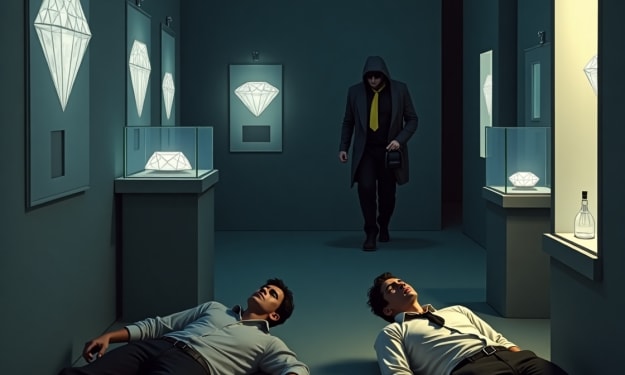
The hall was filled with people. Today, a grand exhibition of diamonds was being held in this hall. Many precious diamonds were on display. Most of the people were outside, busy admiring the diamonds. I too had come to the exhibition when suddenly, a man approached me. He grabbed my hand and led me aside. In his other hand, he held a glass of cold drink, which he placed on the windowsill.
By Bilal Ahmadabout a year ago in Fiction
The Lantern of Whispering Trees
by Yahya Asim In a remote village nestled between the emerald folds of two great hills, there stood a forest known as the Whispering Trees. Locals spoke of it with reverence and caution. They said the trees could talk—not with mouths, but with murmurs carried in the wind. Only those who truly listened could understand their secrets.
By Yahya Asimabout a year ago in Fiction
The Lighthouse That Called My Name
It was supposed to be a quiet weekend. I was tired. Burned out. Too many long nights in the city. Too many deadlines. So I packed my duffel, left my buzzing phone on the kitchen counter, and drove east… straight to the edge of the map. It was a coastal village called Gorseby, where the wind always howled like it had something urgent to say. A single inn stood at the edge of the cliffs, facing the ocean like a stubborn old man daring the sea to come closer. I checked in, unpacked my books and blanket, and was just settling down by the fireplace when I saw it. The lighthouse. It stood alone on a narrow ridge, half a mile from the shore, rising from the rocks like a broken tooth. The odd part? It wasn’t lit. No warm glow. Just a cold, dark silhouette. “Old Marrow Point,” the innkeeper muttered when he caught me staring. “Hasn’t worked since ’78. Shipwreck, they said. Took six souls with it. No one’s touched it since.” Six souls. That night, I dreamt of waves crashing and a voice calling my name. --- Next morning, against every instinct, I walked down the jagged path to the lighthouse. Rusted gate. Cracked windows. The scent of salt and secrets in the air. As I reached the door, something strange happened. It opened. On its own. No wind. No hand. Just… opened. I stepped inside. The air was thick, like breathing through history. Dust danced in the sunlight, and every creak of the floorboards echoed like a whisper. I climbed the spiral stairs, slowly, feeling like I was being watched — not with hostility, but familiarity. At the top, I found an old logbook, half-burnt and brittle. I flipped it open and froze. My name was written inside. Not once. Dozens of times. Page after page. My name, written in different hands… over decades. "Elias. Elias Moore. Elias." I felt dizzy. My name is Elias Moore. But I’d never been here before. --- Then… the light turned on. Without electricity. Without anyone touching it. The entire room glowed, bathing me in golden light — and from that light stepped a man. Tall. Weathered. Familiar. He looked like… me. “Elias,” he said, gently. “You came back.” I stumbled back. “Who—who are you?” “I’m the keeper,” he said. “And so are you. Always have been.” --- What followed was a blur of voices, images, memories not mine — but somehow… deeply mine. I saw the shipwreck of ’78. I saw a man — me — locking the lighthouse doors as the storm approached. I saw villagers shouting, running, blaming. I saw fire. And then silence. I wasn’t a visitor. I was a returning soul. --- The lighthouse, you see, doesn’t just guide ships. It remembers. It keeps time differently. It binds those who died in duty… to come back, again and again. The name in the logbook? Mine. Every time I returned. Every life. A cycle. A loop. And this time… I broke it. As dawn lit the sea, I knew what I had to do. I walked to the controls. Turned the wheel. And let the light shine again — for the first time in 47 years. --- When I got back to the inn, the innkeeper stared. “You… you look different,” he said slowly. “You okay?” I nodded. “Just tired. Had a strange dream.” He didn’t respond. Just stared behind me. When I turned around, the lighthouse… was gone. Not dark. Not broken. Gone. As if it had never existed. --- I left Gorseby that afternoon. Never went back. Never spoke of it. But sometimes, when I close my eyes, I see the waves. And hear the wind calling my name.
By Kausar Hayat about a year ago in Fiction