Stream of Consciousness
The Girl Behind the Door
1. The Whispering House In the overlooked town of Elmbrook—where the wind murmured like a overlooked bedtime song and the crows roosted like prophets—stood an ancient, exhausted house. It had no title, but everybody called it The Wilt House. Children strolled quicker close it; older folks whispered supplications; and those who had once challenged to trespass carried their hush like a mystery curse.
By Muhammad Abdullahabout a year ago in Fiction
The Man Who Sold Regrets
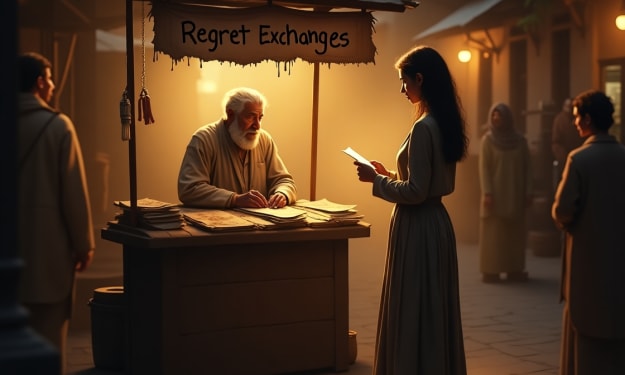
The Man Who Sold Regrets by (Mukhlis safi) In a cramped corner of the old bazaar, nestled between a spice seller and a cobbler who never smiled, was a stall so plain most walked past without noticing it. Its banner, dusty and frayed, read only:
By NASRULLAH MUKHLISabout a year ago in Fiction
How to Open Up to a Big Sister
1. Understanding the Distance: Acknowledge the Pain Without Judgement Growing up without the presence or support of a big sister can leave emotional gaps that are difficult to articulate. Older siblings often carry symbolic weight—they are protectors, guides, and sometimes even role models. When that expectation is unmet, it leads to confusion, resentment, or a silent longing for connection. Before you can open up to her, it's important to first explore your own feelings about the past. Were you hurt because she didn’t come to your school events? Did you feel alone during family crises because she seemed emotionally or physically absent? Understanding the specifics of your experience, rather than burying the emotion, is a vital step toward meaningful communication. It’s also crucial to recognize that her absence may not have been intentional. Perhaps she was going through personal struggles of her own—dealing with mental health issues, academic pressures, or family expectations that took her away from her younger siblings emotionally. Or maybe she simply wasn’t mature enough at the time to handle the role she was meant to play. This does not erase your pain, but it does open the door to a more balanced perspective. By removing the weight of harsh judgment, you allow yourself the chance to approach her not with blame, but with the desire to heal. This shift in mindset sets the stage for a more productive and empathetic conversation. 2. Preparing Emotionally: Define Your Intentions and Set Boundaries Before initiating the conversation with your sister, it helps to reflect deeply on what you hope to achieve by opening up. Do you want closure about the past? Are you hoping to rebuild a stronger bond moving forward? Or do you simply need to express feelings that have been bottled up for too long? Being clear with yourself will give your conversation focus and help avoid veering into territory that could reopen old wounds without resolution. It's also essential to prepare for the possibility that your sister may not respond the way you want her to. She may feel guilty, become defensive, or even deny your experience. Preparing yourself for these reactions allows you to stay grounded and avoid being blindsided. Equally important is setting emotional boundaries. Make a conscious decision about what you're willing to share and what you’d rather keep private. You don’t have to bare your soul all at once. Vulnerability is not about dumping years of pain in one go—it’s about opening the door just enough to let the light in. Perhaps start by discussing a single incident or a general feeling you’ve carried with you, and observe how she responds. If she shows openness, kindness, or even regret, you can gradually reveal more. If not, you’ve still taken an important step in honoring your truth. Either way, by clarifying your intentions and limits, you’ll approach the conversation with more confidence and emotional safety. 3. Choosing the Right Setting and Language: Start Soft, Stay Honest The timing and environment in which you open up to your sister can make a significant difference. Avoid doing it during a rushed moment, family gathering, or high-stress event. Choose a neutral, quiet setting where both of you can be physically comfortable and emotionally present. A walk in a park, a calm café, or a private chat over video call—whatever feels safest for you both. Begin the conversation gently. Start by expressing appreciation for the chance to talk, or even acknowledge that it’s not an easy topic for either of you. Using soft, non-accusatory language helps lower her defenses and encourages her to listen more attentively. Use “I” statements rather than “you” statements to express your emotions. Instead of saying, “You were never there for me,” try saying, “I often felt alone growing up, and I struggled with not having you around.” This shift in language places the emphasis on your experience rather than casting blame. The goal here is not to guilt her into an apology, but to invite her into your world—a world she may not have realized she was absent from. Also, be patient with pauses, silence, or emotional responses. Opening up is not a monologue—it’s an emotional dance. Allow her to process what you’re saying, and give her the chance to respond in her own way and time. 4. Dealing with Responses: Embracing Disappointment, Hope, or Reconnection Your sister’s response can range from heartfelt understanding to complete denial. She may apologize with sincerity, offering insights into her own struggles and perhaps expressing regret for her absence. This outcome, while ideal, is not guaranteed. She might respond with defensiveness, saying things like, “You’re overreacting,” or, “I didn’t even know you felt that way.” If that happens, it can feel like your emotional vulnerability was wasted, but it’s important to remember that people can only meet you as deeply as they’ve met themselves. Her inability to accept your feelings doesn’t invalidate them. If her response is dismissive or cold, you are still in control of how you choose to heal. You may need to grieve the relationship you hoped to have with her. This is a valid and necessary part of the process. Closure doesn’t always come through resolution—it often comes from recognition. If, however, your sister is open to further conversation, or expresses a desire to reconnect, then you’ve both been gifted a chance to rebuild a relationship that was once fractured. This will take time, effort, and continuous honesty. Perhaps you can begin with small, consistent steps—shared activities, text messages, or just learning more about each other’s present lives. Reconnection after emotional distance is never immediate, but it is possible with mutual care and patience. 5. Moving Forward: Healing as a Personal and Shared Journey Whether or not your sister responds the way you hoped, opening up is a powerful step toward healing. It reflects courage, emotional maturity, and a willingness to confront pain rather than suppress it. Healing is never linear—it comes in waves. Some days you may feel lighter, having voiced your truth; other days, old wounds may sting anew. Be gentle with yourself during this process. Seek additional emotional support if needed—therapy, journaling, or conversations with trusted friends can help you navigate the aftershocks of vulnerability. If a new relationship with your sister begins to bloom, celebrate the small wins. Every moment of shared laughter, every message exchanged, is a step toward a bond that didn’t exist before. And if that relationship remains distant, know that you’ve done your part in extending an olive branch. Opening up isn’t about changing the past—it’s about making peace with it. You’re not just reaching out to her—you’re reaching inward, reclaiming your narrative, and choosing to live authentically. Regardless of how she responds, your journey toward healing and self-expression is already a powerful act of transformation.
By Dipayan Biswasabout a year ago in Fiction
The Me I Left Behind
She didn’t have a name, but I knew exactly who she was. She was not a ghost. She was not a dream. She was just a version of me that used to take up all the space in my head. The voice that questioned everything. The feeling that kept me walking on eggshells in rooms where no one was even looking. I thought I’d left her behind a long time ago—buried somewhere under progress, therapy, and hard-won self-respect.
By Annie Edwards about a year ago in Fiction
The House at the End of Memory
I was eleven the first time I saw the house. It perched at the end of a road swallowed by trees, a path my grandmother told me never to follow. “Where the branches hush the world,” she’d whisper, “some silences carry echoes louder than screams.”
By Muhammad Abdullahabout a year ago in Fiction
The View from Up Here
Looking out over the horizon, I yet again wonder what I'm doing here. I don't mean here on Earth in that metaphysical, dark way. I just mean here, at this cliff, watching this beautiful sunset. The colors are blossoming in vibrant hues of purples, pinks, oranges, and yellows. I could almost convince myself it was a painting in a museum. It's the most beautiful thing I've ever seen, and I don't know how I was lucky enough to stop and see it unfold before me.
By Kristen Barenthalerabout a year ago in Fiction
The Boy Who Sold Silence
In a quiet village at the foot of the Himalayas lived a boy named Arin. He never spoke a word—not because he couldn’t, but because he chose not to. People thought he was strange. They whispered, “Maybe something is wrong with him.” But Arin smiled through it all, never once defending himself, never once explaining. Instead of speaking, Arin listened. He noticed the way the wind changed before a storm, how birds flew low when rain was near, and how the old woman next door cried at night when no one was watching. He observed more in silence than others did in noise. One day, the village faced a great crisis. The river that brought them water had changed course. The leaders argued. The farmers panicked. The people shouted, blamed, and demanded answers. But no solution came. Arin stood up, walked to the edge of the dried river, and simply started digging. No speech, no plan, just a small boy with a shovel. At first, people laughed. Then one by one, they joined him. A week later, the river flowed again — redirected by silent determination. That night, the elders asked Arin why he never spoke. He wrote on a stone: “When you stop talking, you start listening. And when you listen, you understand.” The village never forgot the boy who sold silence — and gave wisdom in return. --- Message: In a world full of noise, sometimes the quietest hearts carry the strongest voices. ---
By Latif Darikhail about a year ago in Fiction
My Grandmother’s Mirror Only Reflects the Dead
The Mirror’s First Secret I almost sold the mirror the day after Grandma Lillian’s funeral. It was an ugly thing—a heavy oak frame carved with twisting vines, the glass smoky with age. But Mom insisted: "She wanted you to have it. Said it was special."
By MUHAMMAD Abbasabout a year ago in Fiction
We Fell in Love Between the Pages
It began, as the best stories often do, in a bookstore. I had just moved to the city, the kind of move you make when you're not sure what you're running from or chasing. A fresh start, I told myself. I wandered into a little secondhand bookstore tucked between a laundromat and a coffee shop. It wasn’t anything special at first glance—dusty shelves, faint smell of paper and cinnamon—but something about it felt like home. I didn’t know then that he would be there. That he always came on Saturdays. That he had a favorite spot, tucked in the back corner beneath the poetry section, where he’d sit on the floor with a stack of books like he was building a fortress made of words. I noticed him before he noticed me. He had messy dark hair that refused to stay put and glasses that kept sliding down his nose. He was completely absorbed in his book, lips moving slightly as he read—Shakespeare, I think. Something about sonnets and stars. I didn’t say anything, just watched for a moment longer than I should have, then found a book of my own and curled up on the armchair near the window. The second time we crossed paths, I was the one reading Neruda. He glanced at the spine of my book as he passed by and said, “That’s my favorite poem.” I looked up, startled. “Which one?” “Tonight I Can Write the Saddest Lines,” he said. Then, without asking, sat across from me and quoted the first line. “‘Tonight I can write the saddest lines. Write, for example, ‘The night is starry and the stars are blue and shiver in the distance.’” He smiled, as if the words were his own. I smiled back, despite myself. We didn’t exchange names that day. But after that, we kept meeting there. Saturdays turned into habit. We began talking about books, always books—Tolstoy, Angelou, Plath, Márquez. He’d recommend something, and I’d come back the next week with thoughts scrawled in the margins. I’d lend him my copies, and he’d return them with pressed flowers tucked between the pages and underlined phrases like hidden confessions. Eventually, it became more than literature. He told me about his late nights writing poetry and the dog he missed back home. I told him about my childhood in a small town where stories were the only escape, how my parents used to fight in the next room and I’d bury myself in novels to drown it out. Still, we never met outside the bookstore. It was like we had built our own little world between the pages—untouched by reality, suspended in ink and time. I wasn’t sure when it turned into something more. Maybe it was the way he looked at me when I laughed at a line from Austen. Or the way he always remembered how I took my coffee—black with one sugar, no cream. Or maybe it was the note he left inside a dog-eared copy of Jane Eyre. “If we’re both fiction, I’m glad you’re the chapter I got to live in.” I didn’t say anything that day. I read the note, closed the book, and walked out of the store with my heart louder than the city traffic. The following Saturday, I didn’t go. I was afraid, I think. Of what it meant. Of what we were outside of that space. But he showed up at my door that evening, holding the book and looking like he’d read a sad ending. “How did you find me?” I asked, breathless. “I asked the bookstore owner. He said you left your number on your membership form.” I stood there, unsure of what to say. He handed me the book. “I didn’t mean to scare you.” I opened it. There was a new note inside. “Love is not limited to chapters. It spills over margins, scribbles into the real world. Maybe we can, too.” I looked at him. “What if the real world ruins us?” He smiled. “Then we rewrite.” And just like that, I fell in love with him again—not between the pages, but in the space beyond them. In the way he waited. In the way he hoped. In the way he believed that stories didn’t have to end where the book closes. Now, years later, our apartment is filled with books—some old, some new, some with scribbles in the margins and little drawings only we understand. On our wedding day, he read from Neruda again, and I finally underlined the lines that had defined us all along. “I love you without knowing how, or when, or from where. I love you simply, without problems or pride: I love you in this way because I do not know any other way of loving.” And so we keep reading. Keep writing. We fell in love between the pages— and built a life in the lines that followed.
By Azmat Roman ✨about a year ago in Fiction
The Man Beneath the River
Ben woke up gasping. The faucet was still running. That awful sound of dripping water, echoing like laughter through the pipes. His father used to say it was the river trying to whisper back. Whispering all the sins Ben had swallowed and never spat out.
By Muhammad Abdullahabout a year ago in Fiction