Short Story
"Promotion"
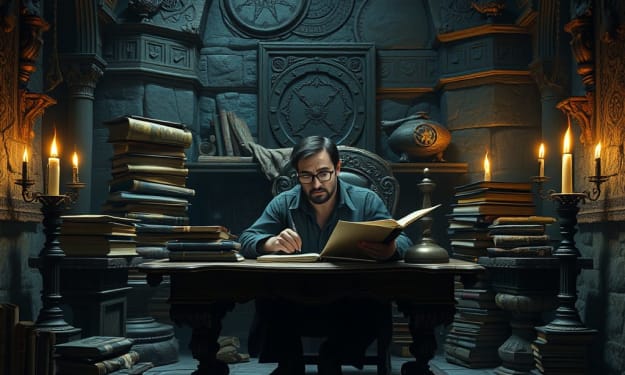
Eugene sat hunched at the tiny desk in the corner of the cramped and threadbare bedroom. His fingers swooped and pecked at the chunky, cream coloured keys. He peered through round little spectacles at the fuzzy looking screen, which bore the legend, CURRICULUM VITAE. He snorted at that, bent his head, and jabbed at the keyboard. The clacking sounded loud in the still room. In fact, it felt as if the noise were rattling through the huge, creaky house, un-dampened by all the heavy drapes and tapestries. He winced, and poked again, more quietly. His fingernails were bitten short. He had no idea how to do this. It had been a long time since he had dipped a toe in the job market. He wasn't even sure people even used CVs anymore. His mobile phone buzzed in his pocket. He pulled it out, and checked it. It was a text message from his current employer, who was supposed to be sleeping in another part of the house, and who had extremely keen hearing. WHAT ARE YOU DOING STOP THAT INFERNAL CLATTERING Eugene winced again, guilt pinching at him with sharp fingers. The boss would have had to get up to get his phone, an ancient Nokia like the one he insisted Eugene have. He'd be cross about that, and would be unbearable after disturbed rest. Eugene tried to pass his fingers even more softly over the keyboard. His employer wasn't shouting at him. At least, probably not. He rarely sent messages at all, being generally distrustful of technology, but when he did, they were always like that. Gruff, all in capitals, and lacking in punctuation. He seemed to think it was a kind of telegram, something he considered "new-fangled modern rubbish", and he structured the text accordingly. It had taken Eugene ages to get him to quit putting the word STOP in there after each sentence. Phone calls were worse. The silly old sod yelled into his ear every time, no matter how patiently Eugene explained he didn't have to. Eugene rubbed his eyes, which were itching and stinging from tiredness, and from staring at the decrepit monitor. He shifted on the rickety little chair, buttocks aching.
By L.C. Schäfer2 years ago in Fiction
The Drowned Ones
The sun hung low over Silverdeep Lake, painting the still water with streaks of orange and crimson. A group of friends had arrived that morning, eager to spend their summer vacation far from the noise and stress of the city. The lakefront cabin they rented stood in the middle of nowhere, surrounded by dense forest and a heavy quietness that felt peaceful—at first.
By V-Ink Stories2 years ago in Fiction
Endless Summer
The sun never set on Seabreeze Cove. It was a perfect summer day—every single day. Warm golden sands stretched as far as the eye could see, waves lapped gently at the shore, and the air smelled of salt and sunscreen. For a group of six friends, it had started as the best vacation of their lives.
By V-Ink Stories2 years ago in Fiction
The Forgotten Carnival
It arrived without warning. One night, an empty lot on the outskirts of town lay barren, overgrown with weeds and forgotten by time. The next morning, a carnival stood in its place. No one saw it being built. No trucks. No workers. Just a towering Ferris wheel, a sprawling funhouse, and rows of striped tents beckoning with the promise of wonder.
By V-Ink Stories2 years ago in Fiction
Echoes of the Island
The ocean shimmered under the golden glow of the setting sun, waves lapping gently against the dock as the boat pulled away, leaving the group of tourists alone on the secluded island. The air smelled of salt and ripe fruit, the perfect vision of paradise.
By V-Ink Stories2 years ago in Fiction
Firelight Festival
Every summer, the town of Black Hollow came alive for the Firelight Festival. Lanterns bathed the streets in golden hues, fireworks crackled overhead, and the scent of roasted food filled the air. Outsiders called it charming, magical even. But for the townsfolk, it was a grim necessity.
By V-Ink Stories2 years ago in Fiction
The Story of Raghu the Robber
The Story of Raghu the Robber About 200 years ago, it was not four words for a girl to get married. Not for the ordinary Bengali family because the groom has to pay a huge dowry to get married. At that time, a poor Brahmin is giving his daughter in marriage. The groom arrives, but the problem is that the father of the other bride could not raise fifteen rupees. He is calling God in his mind that the girl should not be lagnabhrashta because if the groom's side refuses to get married without the fear not being unfounded, as soon as the groom heard that the forest money had not been raised, they started the patience to return from the Brahmins hand and foot.At that time, a tall, broad, dark man appeared, his long stick in his hand, with a terrible look. He shouted to the groom, Go to the wedding quietly, otherwise I will keep everyone here with the boat. Knowing his identity, the groom's jump was extinguished; they trembled with fear, and the man gave fifteen to the girl's father and said, I am Raghu. I am a dacoit. I will not allow my sister's marriage to be stopped while I am The story is spread all over Bengal about Raghu the dacoit; his fear of the tiger used to drink water in a ghat in the cow; his dominance was so much that The name of Raghu the robber had reached the Queen of England, just as the condition of the oppressive landlords and English Sahibs had become very bad for this Raghu robber. On the one hand, he became a god to the poor, but who was the most famous robber in the list of robbers of Bengal? How Raghu Dacoit became a small farmer's son, became a robber, and Raghu Dakat's story in today's episode with all the thrilling robbery stories of Raghu Dakat. The story of dacoits is nothing new in our history. Maharishi Valmiki, the author of the Ramayana, was Ratnakar Dusseus in his early life. The story of many notorious robbers is heard; some of them are famous or notorious robberies, looting others' property, murder, injuries, but some have given that wealth to the poor people, standing beside them in their danger, their God just like Robin Hood in medieval Europe, who looted the luxurious oppressive landlords and gave away their property. Among the poor, the robbers of Bengal were somewhat similar to the time we are talking about, and one of them is Raghu Dakat. When you sit down to name the dacoits of Bengal, the first name that comes to mind is the name of one or twoHe was a born Raghu Dacoit's real name was Ghosh, but no one can say where he was born in Bengal specifically. Many say he was a man from Kolkata who used to commit robbery in different areas of Hooghly, Nadia, North 24 Parganas, and South 24 Parganas, and according to some, he was from the Barasat or Saptagram area. Robbery was a family livelihood at that time, but Raghu was not a robber by birth. At the end of the eighth century, the English government centered on indigo cultivation. The oppression peaked when those who did not cultivate indigo, according to the English, were taken to Nilkuthi by men and women. One such farmer was Raghu's father, who refused to cultivate indigo, was picked up by the English, and Raghu's father died of that torture, and in this incident, Raghu was always good at playing sticks; he was added to some other Damal boys, and they started burning the huts of the oppressive indigo one after the other to take revenge, looted the houses of the oppressive zamindars, and the money was among the poor. Thus was born out of the accumulated anger of British oppression in subjugated India. Raghukat's gang became the terror of the moneylenders and the anti-British revolutionaries. They suddenly looted but did not loot at the time of looting; they would inform in advance by letter at what time the robbery would take place, but still no one could touch their ticket. Raghu was fed up with the robbers' harassment. Special departments were formed in the police station to catch robbers, but no one could afford to catch Raghu's gang. Raghu became the god of the poor. Raghu sends the thread of Tarkaratna's son, saying that Namo Namo in the face of the char should not be cured. Thakur does not think about the expenses, demands five thousand rupees, demands five thousand rupees, the king's rent for the Brahmin goes to the widow's house, sells, and suddenly raids Dewanji's house and repays the debt. Raghu says that you have given many poor people; let the evasion be light; its burden is prevalent; there are many such stories. Raghu told the story of the robbery in the house of Binod Babu, the zamindar of Naihati, in the name of robbery. If you do not remember the mountain of robbers in Bengal, then the episode will be linked to the description after the video. In addition to the house of the householder, this gang of Raghu robbers used to rob elsewhere, such as the ship that used to come to the port of Saptagram, which was in the clutches of Raghu robbers. A village in this Saptagram was called Basudebpur; it was around the jungle of Debipur. This is where the robbers hid in the dense forest. Those who went on the way to Tribeni used to fall. Raghu was in the grip of robbers. Many said that Raghu was a robber, so Bidhubhushan Ghosh's house was in Bagdi Jaipur village, north of Tribeni, where Raghu sometimes lived in the day. In the afternoon, he used to work as a general field laborer, and at night he used to go out to rob as a robber. In the campaign, Raghu Dacoit himself was a devotee of Kali. Before committing the robbery, the robbers used to bathe and worship the mother with blood. The robbers came out of the middle of the forest of Debipur. Near the robbery, Raghu Dakat was set up in the middle of the forest of Debipur. It is said that he saw Mother Kali in a dream and got a Kali idol from the bottom of the pond. That temple is still there. That temple is still famous as Siddheswari Kali Temple, although by the genealogy, Raghu Datakats were Vaishnavas, but it was Sakta that Mother Kali was worshiped every new moon day or not. There was a story about the fact that there was a human sacrifice on the day of Kartik Amavasya. Mother will be worshiped, but Raghu did not get any sacrifice on that day. Suddenly he saw a saint walking towards Triveni; the robbers caught him. According to the rules, he was bathed, clothed in blood, and arrangements were made for sacrifice in front of Mother Kali in the woods. The saint said that he is also a devotee of Mother Kali, so before death, he wants to sing Shyama Sangeet once. He was given that opportunity as he wished, and the saint sang, Oh, in my time of danger, Brahmamayi was the saint himself. It is said that on that day Mother Kali herself appeared in Ramprasad Raghu Datat, and since then she has never been a human sacrifice again. Even today, Jhak Sacrifice is done in the Siddheswari Temple. These Raghu Robbers used to worship Mother Kali. They also respected the girls very much. During the robbery, they used to take special care so that there was no harm to the girls of the house. I know how many poor people he has fed. I do not know how many girls he has saved from the breakdown of marriage.
By ANIMESH BHOWMICK2 years ago in Fiction