Short Story
Pen and sword
In the afternoon, an argument was going on between Arif and Bithi. The subject of the argument was Asi and Masi, that is, the sword and the pen. Arif was saying that the sword is bigger. Bithi was saying that the pen is bigger. Arif was turning his hand in the position of holding a sword and saying, "I will cut off your head with one blow with the sword. Can you stop me with the pen?" The younger daughter Bithi cried at this behavior of her brother and said: If you insult me? You will. How can those who look down on the pen value a human being? I had overheard some of the argument between the two siblings. As soon as I entered the room, they caught me off guard. Both of them asked almost simultaneously: Is the pen greater or the sword greater, father? I did not give a verdict in either direction. I am just telling a story. I am presenting that story to you. The Mughal Emperor Shah Jahan was the emperor of Delhi at that time. The emperor had an office where soldiers were paid their wages. The man who paid the wages was called a munshi. That day, the munshi was very busy with his office work. At that time, a soldier arrived like a storm. For some reason, he was late in collecting his wages.
By Md Ariful Islamabout a year ago in Fiction
Buddus`s Father
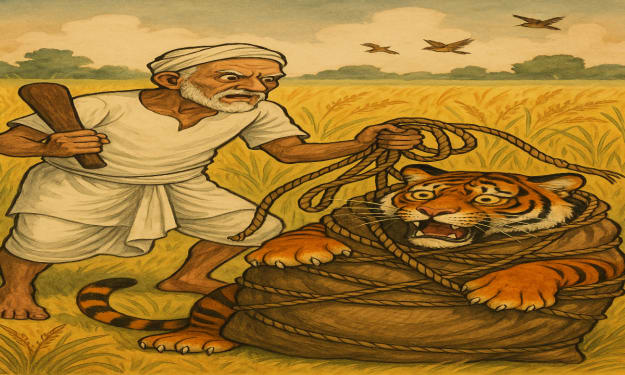
Once there was an old farmer named Buddhu's father. His paddy fields were ripe, and flocks of weaver birds came and feasted on his rice. To chase them away, Buddhu's father made a clapper (a kind of noise-making tool). But even the sound of the clapper didn’t scare the birds away.
By Alomgir Hossainabout a year ago in Fiction
10 Beautiful Love Facts That Will Melt Your Heart
💌 Introduction: Love isn’t always loud. Sometimes, it’s the quiet heartbeat in the background of life — a hand held in silence, an “I miss you” left unsaid, or a smile that says “I’m here.” In a world full of noise, real love still whispers, and those whispers hold truths that touch the soul.
By Silent Tearsabout a year ago in Fiction
The Last Ride of John. Content Warning.
I learned this morning that John had died in a car accident while returning home form work the previous day. I had not spoken to John much, but I remembered him because of his innocent appearance. This bad news shook my heart.
By Rohitha Lankaabout a year ago in Fiction
The Last Letter
Suddenly, it started raining. Mr. Firoz liked the rain. Whether it came suddenly, silently, or with grand thunder and fanfare — he liked it all the same. He walked into the living room with a cup of tea in hand. He pulled the curtain over the window. Though the rain wasn’t too heavy, he found it quite pleasant.
By Abdul Wahababout a year ago in Fiction
The Quiet Ant
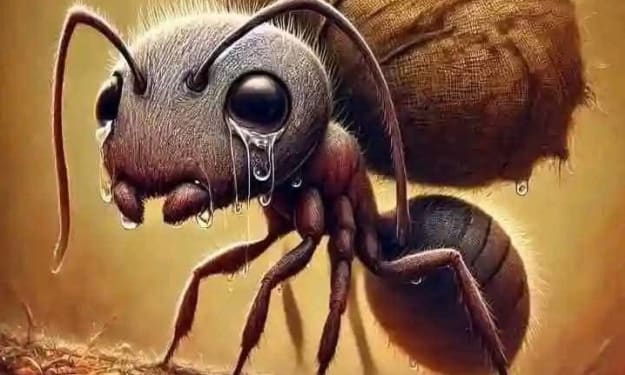
The Ant Who Carried Too Much There once lived a small ant in a thriving ant colony beneath the roots of an old tree, neither the fastest, the strongest, nor, by far, the cleverest of her kind. She did not construct the tallest towers or plow the deepest tunnels. She did not race or solve puzzles. Still, she had something lost that never, ever went away.
By Rohitha Lankaabout a year ago in Fiction
The Egg That Wasn't
Marigold “Mari” Puddlewhistle had lived her entire life in the town of Peepwillow, a place so obsessed with Easter that they left their pastel bunting up year-round. Their post office smelled faintly of marshmallow, and every address came with an automatic subscription to “The Bunny Bulletin.”
By Elendionneabout a year ago in Fiction
“The Child Who Never Grew Old”
In the quiet village of Elmsworth, nestled between thick forests and sleepy hills, time moved slowly — but steadily. Children grew, trees shed their leaves, and wrinkles deepened with each passing year. Except for one child. His name was Eli. For as long as anyone could remember, Eli had lived in the village. He looked no older than seven — small, curious eyes, a mop of chestnut curls, and a wide smile that never seemed to fade. Some claimed he was the child of a reclusive traveler. Others whispered he’d been abandoned by faeries. But no one could deny the truth: Eli had never aged. Not a day. Mrs. Callahan, the oldest resident in Elmsworth, once showed her black-and-white photo from 50 years ago — and there, in the corner, stood Eli, holding a balloon, looking exactly the same. “It's a trick,” people said. “Maybe a grandson who looks just like him.” But when pressed, no family came forward. And Eli… well, Eli just kept playing with the other children. Every generation knew him. He played hopscotch in the ‘80s, video games in the 2000s, and VR by 2040. His playmates changed, grew up, moved on. He remained. It was the town’s unspoken rule not to question him. Until one day, a journalist named Clara came to Elmsworth. She was chasing a story about “the boy who defied time.” She came with cameras, notebooks, and a skeptic's heart. When Clara met Eli, he greeted her kindly. “Are you here to ask how old I am?” he said with a grin. She chuckled. “That obvious?” He nodded. “Everyone wants to know. Even me.” Clara spent weeks in the village. She spoke to elders, combed records, and followed Eli discreetly. He never left the village borders. He never got sick. He never changed. Then one evening, Clara found a strange journal buried behind the village library. It was wrapped in worn leather, sealed with a wax mark — a circle with an eye in its center. Inside, the entries began: “Year 1: I chose the village because it was quiet. I wanted peace. They think I’m a child. I let them. It’s easier this way.” “Year 64: The experiments worked. My body remains still. But my mind… it’s tired.” “Year 105: I’ve seen generations rise and fall. They live so quickly. I envy their endings.” Clara’s hands trembled. This wasn’t a child. The next entry read: “Year 172: If you’ve found this, then I am still here. Or worse… I am not.” She confronted Eli the next day. His smile was smaller now. Quieter. “I wrote that journal,” he said, looking up at her with eyes too wise for his face. “You’re not seven,” Clara whispered. “I was,” he nodded. “Once. A long time ago. I was a scientist… or a magician, depending on who you ask. I discovered something. A way to pause aging. I tested it on myself.” “Why?” “At first, curiosity. Then fear. And now…” He looked toward the horizon. “Regret.” Clara sat beside him on the bench. “Why stay here?” “Because this place remembers. And because maybe… I hope someone will figure out how to help me stop being what I’ve become.” “Have you ever tried ending it?” she asked gently. “I’ve tried everything,” he said. “But the body doesn’t break. Time doesn’t move for me. I’m… stuck.” The story went viral. Scientists, priests, journalists — they all came. But no one could explain Eli. Nothing changed him. Not medicine. Not rituals. Not even time. Eventually, the world moved on. But Clara didn’t. She stayed in Elmsworth. She aged. She married. She wrote books. She raised children — who all played with Eli. And one day, when Clara was old and frail, she whispered to him, “You gave me the greatest story. But I’m sorry you’re still writing yours.” Eli smiled. This time, with sadness. When Clara passed, Eli stood by her grave alone. A tear ran down his cheek — not of sorrow, but of longing.
By Tanveer Ahmadabout a year ago in Fiction