Short Story
"Room 27: Where Forgotten Voices Leave Letters Behind"
No one ever stayed long in Room 27 at Grayhill Hospice. It had become more than just a hospital room – it was a whisper, a legend. Some nurses claimed the room healed people miraculously, while others swore it hastened their passing. But one thing everyone agreed on: the letter. Every single patient who left Room 27, either by recovery or death, left behind a handwritten letter. The mystery surrounding the letters was palpable. No cameras ever captured anyone writing them, and despite efforts to investigate, no one could explain how they appeared. Maintenance staff tried changing the bulbs, rewiring the circuit, and even switching out the smoke detector that blinked at odd hours, but nothing changed. The letters kept appearing. That was until Aaron came. He was just 17 years old, diagnosed with terminal leukemia. His mother had passed away two years earlier from breast cancer, and his father had vanished entirely after her funeral. With no relatives to claim him, Aaron was left alone, with only a worn-out backpack, a few t-shirts, and a leather-bound notebook filled with scribbles, titles, and unfinished stories. Aaron's dream was simple: "Write one thing the world would remember." When he was wheeled into Room 27, he didn't cry or beg. Instead, he asked the nurse, Elaine, one question: "Will someone remember me when I'm gone?" Elaine paused, taken aback by the depth of his question. She had seen tough patients crumble and hopeless ones smile, but Aaron was different. There was a light behind the weariness in his eyes. "I will," she finally whispered. "And maybe more than just me." Aaron nodded and opened his notebook, beginning a journey that would change his life and the lives of countless others. He spent his days writing – pages and pages of stories about starships that ran on memories, lonely wolves searching the sky, and children who talked to the moon. His fingers trembled, his skin faded, but his words grew stronger. Some nights, Elaine would sit beside him, listening as he read his tales aloud. His voice was soft, but certain. "Even if no one reads this," he said once, "I wrote it. And that's enough." But Elaine knew better. She knew stories had power – they reached places medicine couldn't, lighting candles in the darkest corners of the mind. One stormy night in late November, lightning split the sky, and the hospice lost power. Generators kicked in, except for Room 27. It glowed with a soft, golden light that spilled from beneath the door. No one could explain it – no electrical source, no candles. When Elaine opened the door, her breath caught. Aaron was awake, smiling – not at her, but at the empty chair near the window. "She's here," he said, his eyes wide but calm. "She says she never left me." Elaine turned to the chair, saw nothing but the light, and in that moment, she believed him. He closed his eyes, and that was his last breath. The next morning, next to his still hand, was an envelope – cream-colored, thick paper, with fresh ink on the front: "To the one who feels forgotten." Elaine held it to her heart before opening it, her eyes welling up with tears as she read the letter. "Dear soul, You think you're invisible. You're not. I was like you – lost, scared, unimportant. But I learned something in Room 27: Even if your voice cracks, the world still listens. You are not your illness. Not your sadness. Not your mistakes. You are your dreams. Your love. Your light. Tell your story. Whisper it, shout it, write it. Someone will hear. And someone will never forget." Elaine read that letter aloud at Aaron's small memorial, and within 48 hours, the video had over 2 million views online. Letters poured in from strangers, teenagers, parents who had lost children, and children who had lost hope. Schools read it aloud, counselors used it in therapy, and a filmmaker in Canada turned Aaron's story into a short film titled Light from Room 27. A foundation was created – The Room 27 Project – to help terminally ill teens write and publish their stories. Elaine runs it to this day, ensuring that Aaron's legacy lives on. Each letter left behind is scanned, archived, and read by thousands, bringing tears, smiles, and connection to those who read them. Room 27 is no longer just a room – it's a place of peace, purpose, and parting gifts. Every patient leaves behind a letter now, each one placed in a growing library labeled "Voices Never Forgotten." Visitors come from other cities, students write essays about it, and poets leave verses on the wall outside. Last winter, a girl named Mia, age 12, left a note behind
By Jamil Khan about a year ago in Fiction
When the Sky Burns
The world sat breathless, like a candle in a storm — glowing, trembling, moments from being snuffed out. No one said the word, but everyone felt it: nuclear. It hovered above cities like a ghost in daylight — too real to ignore, too terrifying to name. On the surface, life persisted: people walked their dogs, brewed their morning coffee, scrolled endlessly through headlines and half-truths. But beneath the routine, there was a crackling tension in the air — like dry grass just waiting for a spark.
By Md. Hasibul Hasanabout a year ago in Fiction
The Choice of the Soul. Content Warning.
Dr. Lynsey Aldred was the first person to map the soul. Not metaphorically, literally. Through a miracle of quantum neurology and deep-conscious resonance imaging, she traced what she called the Soul's Echo Vector. A measurable wave signature that escapes the brain at the moment of death. It was no more than a flicker at first, a blip across the screens. But, Lynsey followed it through data, repetition, pattern, and noise.
By Daniel Millingtonabout a year ago in Fiction
The Last Train to Yesterday: A Journey to Reverse Time
Rohan stood on the deserted platform, the fog curling around his feet like ghostly whispers. His watch read 11:57 PM, and the clock above the ticket booth ticked loudly in the silence. He glanced at the old, rusted sign that read Platform 9¾ - The Last Train to Yesterday. It had always been a myth, a story his grandfather used to tell him, but here it was, standing before him in all its eerie glory. He had heard the stories: a train that only appeared once every ten years, at midnight, and if you boarded it, you could go back to one specific day in your life. Rohan knew exactly where he wanted to go—two years back, to the night of the accident that had changed everything.
By Masih Ullahabout a year ago in Fiction
"The Great Goat Escape of Maple Street"
It all started on an otherwise normal Saturday morning on Maple Street. Birds chirped, sprinklers hissed, and Mr. Jenkins, in his trademark Hawaiian shirt and unmatched socks, was out trimming his overgrown rosebush like he was Edward Scissorhands after five espressos. But then came the goat. No one knew where it came from. One moment, everything was quiet, and the next—BAAAAAA—a goat with one lazy eye and a mischievous grin came trotting down the street like it owned the neighborhood. Mrs. Carmichael screamed so loud her cat fainted. The goat stopped, blinked slowly, and then proceeded to eat the "For Sale" sign on the Thompson's lawn. Mr. Thompson came out, saw the goat, and muttered, "Not again," before walking back inside to retrieve a broom like he was about to duel the creature. Now, a sane goat might be scared off by a broom. Not this one. It took it as a challenge. The moment Mr. Thompson approached, the goat lowered its head and charged—not at him, but at the inflatable pool flamingo in their yard, launching it three feet into the air like it was the goat's lifelong enemy. By now, a crowd had gathered. Kids cheered. Adults gawked. Old man Murray pulled out his ancient camcorder and shouted, “This is going on YouTube!” even though no one had the heart to tell him it wasn’t 2008. Then came little Timmy. Timmy, age seven, believed he could talk to animals ever since he watched Dr. Dolittle twice in a row. He stepped forward, arms outstretched, and said, “I got this.” The crowd parted like he was Moses. He walked up to the goat, knelt, and whispered, “We come in peace.” The goat responded by licking his forehead and stealing his sandwich. Chaos followed. The goat took off like a rocket, sandwich still dangling from its mouth, and the entire neighborhood followed. Mr. Jenkins ran with garden shears. Mrs. Carmichael wielded a mop. The Thompson twins rode scooters like bounty hunters. The goat was fast. It weaved through backyards, knocked over a lemonade stand (the lemonades were fine, but the cookies didn’t make it), and somehow ended up inside the Wilsons’ garage, where it discovered rollerblades. Yes, rollerblades. No one is sure how it got them on, but by the time the neighborhood caught up, the goat was skating in circles, baa-ing in what could only be interpreted as mockery. One of the twins tried to record it, but he dropped his phone in a birdbath. Just when all hope seemed lost, Grandma Edna appeared. Edna was 92, wore a tracksuit with glittery flamingos, and had zero tolerance for nonsense. She came out with a banana and a firm stare. The goat stopped. Stared. And slowly rollerbladed over. She handed it the banana. It blinked. Sniffed it. Then sat. The crowd gasped. Edna simply said, “I raised seven children and two husbands. You think I can’t handle a goat?” And that was that. Animal control showed up an hour later, confused and slightly terrified. They took the goat away, who looked genuinely disappointed, like it had just started having fun. They said it had escaped from a petting zoo three towns over, apparently bored of eating hay and being hugged by toddlers. By the next day, the story made local news. The headline read: "Rollerblading Goat Causes Mayhem, Befriends Grandma." And on Monday, Mr. Jenkins started putting up signs: “Goat CrossingCrossing—You’ve Been Warned.”
By Love of momabout a year ago in Fiction
Little House in the Woods
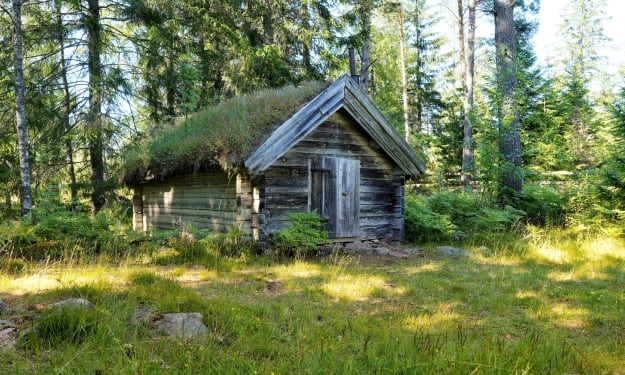
In reading the old journal that was on the shelf you start to look around. The journal is quite descriptive, and the first page describes the big rocks in the front yard. They are the tombstones of the couple that lived here. They were not young, but not old either. Who were they?
By Mark Grahamabout a year ago in Fiction
A Little Cabin
What a cute little house. I wonder who lives there. Let's knock on the door. The door creaks open as I knock. All it is, is one room with an old table and some shelves. There's a book on the shelf. I pick it up and begin to read. It's a journal of sorts.
By Mark Grahamabout a year ago in Fiction