Short Story
The Play That Killed the King
The first draft was stained with ink and wine. Matteo Bellini, the finest playwright in Venice—some whispered in all of Italy—leaned back in his carved walnut chair as the last candle on his desk flickered low. The lagoon winds whispered against the arched windows of his studio, high above the Piazza San Marco.
By Muhammad Sabeelabout a year ago in Fiction
The Widow’s Watch – Chapter Two
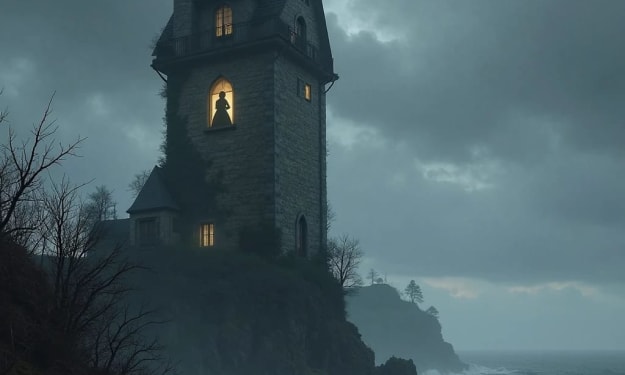
The following evening, Jonah found himself once again standing at the base of Greystone Manor. The ivy-clad tower loomed above, its silhouette bleeding into the graying sky. He didn’t know what drew him back—curiosity, guilt, or something unspoken whispering through the wind.
By Muhammad Sabeelabout a year ago in Fiction
The Poisonous Secret of French Wives
In the shadowy corners of medieval France, hidden behind the charm of cobblestone streets and flickering candlelight, lay a secret so chilling it would make even the bravest souls shudder. This is the untold story of a French city where love was not just a bond—it was a carefully crafted prison, enforced by poison.
By Hamayun Khanabout a year ago in Fiction
The Whisper Beneath the Banyan Tree
In the sleepy village of Sonarpur, time moved slowly. The days were measured by the rising sun and the evening call to prayer, and news traveled not through phones or papers, but through mouths—mouths that whispered, gossiped, and sometimes, invented.
By Ahmed Rayhanabout a year ago in Fiction
The Beggar and the Crown
In a quiet valley nestled between green hills and flowing rivers lay a village called Amarkot. Though small in size, Amarkot was ruled by a man who bore the title of king—a self-styled monarch named Rajan, who lived in a grand house overlooking the huts and farmlands of his people. King Rajan was not a cruel man, but he was blind to suffering. Born into wealth and surrounded by luxury, he believed that hard work alone determined one's fate. So when a poor beggar named Nandu arrived in the village, Rajan barely took notice. Nandu had wandered for days, dusty and exhausted, carrying little more than a cloth bag and a wooden walking stick. His eyes, however, still held a strange sparkle—one of hope, wisdom, or perhaps a quiet challenge. Villagers offered him scraps, but some looked away. To them, he was just another burden. One morning, as Rajan strolled through the village inspecting farms and shops, he spotted Nandu sitting under a banyan tree, carving birds out of dry wood. The craftsmanship was striking. “You beg for food, yet waste time making toys?” Rajan asked. Nandu looked up and smiled. “They are not toys, my king. They are stories carved in silence.” Rajan frowned. “What use are stories to an empty stomach?” “Sometimes,” Nandu said, “stories feed more than rice can.” Intrigued by the beggar’s words, Rajan invited him to the palace. That evening, Nandu was given food, a bath, and a clean bed—perhaps the first comfort he'd known in years. Still, he remained humble and quiet, spending his time carving, observing, and listening. The days passed, and the king began to seek Nandu’s company. His riddles and tales, his quiet understanding of people, his odd questions about life—all made Rajan feel strangely awake. One evening, as the sun dipped behind the hills, Nandu told him a story. “There was once a king,” he said, “who believed power made him wise. He built high walls and filled them with gold, but outside those walls, his people starved. One day, a poor man knocked on his gate, asking for a crumb. The king laughed and sent him away. That night, he dreamed the gods came and took away all his wealth, leaving only the poor man’s bowl behind. He woke up—alone and forgotten.” Rajan stared at Nandu, unsettled. “Are you warning me?” “I’m telling a story,” Nandu replied. “But only those who see themselves in it are changed by it.” Later that week, Rajan disguised himself and walked the village without guards. For the first time, he noticed the thinness of the farmers, the tears in children’s clothes, the weary eyes of mothers. He felt ashamed. “Why did no one tell me?” he asked Nandu. “You were not listening,” the beggar replied. “But now, perhaps, you are.” Rajan began to change. He opened the granaries to feed the poor. He reduced taxes. He encouraged trade and education. People spoke of a new age, and at the heart of it was the beggar who asked for nothing yet gave everything. But not everyone was pleased. Rajan's advisors grew wary. They whispered that Nandu was casting spells, poisoning the king’s mind. One day, they demanded he be banished. “You trust a vagabond more than men who served your father?” they protested. Rajan was torn. He asked Nandu what he should do. Nandu smiled sadly. “A crown is heavy. Every head that wears it must bear the weight of truth. If your court cannot bear honesty, then their loyalty is hollow.” Rajan chose to stand by Nandu, and in doing so, lost half his council. But the village stood with him. For the first time, they felt seen. One morning, Nandu told the king he must leave. “Why?” Rajan asked, heart heavy. “My journey is not over,” he replied. “There are other kings, other hearts still locked in silence.” Rajan tried to offer him gold, land, a home—but Nandu refused. He took only a small wooden bird he had carved, saying, “Keep this. When pride returns, let it remind you that greatness begins with humility.” Nandu left the village as quietly as he had arrived. Some said he was a saint. Others believed he was a god in disguise. But Rajan believed only this: Nandu was a man who owned nothing, yet gave him everything. Years passed. Under Rajan’s rule, Amarkot flourished. And in the grand palace, beside the throne, sat a small wooden bird—worn smooth by time, untouched by dust. And when children asked who carved it, the king would smile and say, “A poor man with nothing to his name—but everything in his soul.”
By Zeeshan Khanabout a year ago in Fiction
The Silent Choir
They called him the Mute Miracle. No one remembered his name—only his presence. A calm figure who walked through broken villages with a satchel of herbs and a soul full of song. But no one had ever heard his voice. Only a low hum, like a lullaby echoing from another world. When he placed his hands on wounds, the pain lessened. When he closed his eyes, the restless slept.
By F. M. Rayaanabout a year ago in Fiction
"Weirdos" . Top Story - May 2025.
My heart pounded against my rib cage as my mind went completely blank. But then Pallas caught my eye from the other side of the hallway. One hand hovered over her chest and rose and fell slightly with the rhythm of her breathing. Her deep green gaze seemed to glow in the distance, allowing a better understanding of her message:
By Taylor Rigsbyabout a year ago in Fiction
Ashes of the Burned
When Aelia's village was reduced to ash by the Unitist Seekers, all that remained was silence—and her. The fire that consumed her home did not touch her skin, but it scarred her soul. Justice was preached as flames devoured her past. The Seekers called it divine cleansing. She called it annihilation.
By F. M. Rayaanabout a year ago in Fiction
Sleep Tech
The lady is very, very old, and her hands shake. Her hair has grown long and white, and her eye-bags droop so much, she looks like a Bassett Hound. The teacup rattles in its saucer. I take it from her before she scolds herself, and set it on the little side-table, which is as bland as the rest of the room.
By L.C. Schäferabout a year ago in Fiction
Ananke Bridge . Content Warning.
Claud peers at his blue-tinged hand wrapped around the railing. He wishes he could blame the color on the temperature. He flicks open a Zippo with his other hand then snaps it back shut with a click. Wind whistles past his ears as he stares at the river below, a couple of hundred feet between the water and him – all open air.
By caitodoesstuffabout a year ago in Fiction
The Moon’s Chosen
The first time Kiran sleepwalked into the forest, he awoke beneath a silver-lit sky with no memory of how he got there. Before him stood an ancient shrine, half-sunken in earth, its marble kissed by moonlight and vine. He should have been afraid. But he wasn’t.
By F. M. Rayaanabout a year ago in Fiction