Short Story
The Flowers Never Wilted.
Every Tuesday at 9:00 AM sharp, he walked into the flower shop on Fifth Street. He never needed to speak. The florist already knew. > “White lilies and lavender, wrapped in brown paper,” she’d say. He would smile — softly, politely — and pay in cash. Always exact change. Then he would leave. --- The routine had gone on for months. Some of the newer staff wondered who the flowers were for. A lover? A wife? A grave? No one asked. His eyes had a look people didn’t interrupt. Not angry. Not broken. Just… distant. Somewhere else entirely. --- He would walk to the same park after that. Past the benches. Past the children. Past the noise. Toward the tree with the twisted trunk near the pond. There, he’d sit and gently place the bouquet beside him — never on the bench, always next to his thigh, as if someone invisible was there to receive it. Then he would whisper. Stories. Memories. Apologies. Sometimes, just silence. --- He remembered the first time he brought her flowers. They had only known each other for a week. > “Why flowers?” she had asked. > “Because I didn’t know what else to say.” She laughed. “Next time, say it anyway. And bring me lavender. I like how it smells like peace.” --- He did both, for years. --- They fought, sometimes. Of course. All couples do. But he never missed the Tuesday flowers. Not even after they separated for six months. > “You still brought them?” she had asked, when they reunited. > “Of course,” he said. “I didn’t know how else to apologize.” She had cried then — the soft, chest-shaking kind of cry people try to hide. And they started again. From scratch. From honesty. --- But even second chances run out of time. The accident came out of nowhere. She was walking. Sunny day. No warning. The kind of moment that splits a life into “before” and “after.” --- He didn’t cry at the hospital. Didn’t scream. Didn’t say much at all. But the next Tuesday, he showed up at the flower shop. Same order. Same routine. As if she were waiting at the bench like always. --- He did this every week. And then one day, a young florist asked — gently: > “Sir, if you don’t mind me asking… do you leave the flowers at her grave?” He shook his head. > “No. She’s not buried anywhere near here.” Pause. > “So why this spot?” she asked again, respectfully. He smiled, finally. > “Because this is where I felt closest to her. Not when she died… but when she lived.” --- Every bouquet was a conversation he never finished. Every visit was a memory he couldn’t afford to forget. Sometimes he read her old texts. Sometimes he told her what the world had become — how the news felt heavier, how the sky looked different now. Sometimes he just closed his eyes and imagined her voice saying: > “You brought me lavender? You’re still terrible with words, but you’ve got the scent right.” --- One rainy morning, a girl on a bench nearby watched him closely. She had seen him before. This time, as he stood up to leave, she approached. > “Excuse me,” she said, nervously. “I know this might be weird, but… you remind me of my father. He did something similar after my mom died.” He looked at her, surprised. > “You think it’s strange,” he said. > “No,” she smiled. “I think it’s beautiful.” He nodded. > “People forget that grief doesn’t disappear. It just changes shape.” --- She walked away. And he stayed. Longer than usual. This time, he whispered: > “They still remember love when they see it. Even if it’s wrapped in brown paper.” --- He never missed a week. Even when he got sick. Even when his legs hurt. Even when the sky poured. Until one Tuesday… he didn’t come. --- The florist waited. She kept his bouquet ready just in case. Days passed. Nothing. --- A week later, a letter arrived at the flower shop. No return address. No signature. Just a note: > “Thank you for helping me love her longer than time allowed. I don’t need the flowers anymore. But if someone ever asks why — tell them love didn’t stop. It just walked a little farther.” --- And so they did. They kept a bouquet of white lilies and lavender on the counter. Every Tuesday. For the man who loved with flowers. For the woman who still received them — in every scent, every silence, every soft memory the petals carried.
By Muhammad Usamaabout a year ago in Fiction
Always Asleep. Content Warning. AI-Generated.
I was drunk when I decided to do it. Not tipsy, not philosophical — drunk. The kind of drunk that makes your hands itch and your morals go quiet. One fist clutched a bottle, the other gripped the shotgun. I stumbled down the block, boots clapping the pavement like punctuation marks.
By Jesse L Shelleyabout a year ago in Fiction
The Last Leaf: A Beautiful Story of Hope, Sacrifice, and Art
The Last Leaf: A Beautiful Story of Hope, Sacrifice, and Art Have you ever read a story that touched your heart so deeply that you remember it for years? That’s how many readers feel about “The Last Leaf” by O. Henry. This short story, though simple, carries a powerful message about hope, sacrifice, and the unexpected ways art can save lives.
By Muhammad Farhad Khanabout a year ago in Fiction
The 6:17 to Somewhere New. Winner in The Second First Time Challenge. Top Story - July 2025.
Marc hadn’t taken the 6:17 PM train in nearly two years. Not since he left the job he thought he’d die in, not since Elise had walked out with the last of their shared plants and all the warmth from the apartment. Not since he stopped believing in rhythms - that predictable cadence of departure and return that used to structure his weeks like a heartbeat.
By Alain SUPPINIabout a year ago in Fiction
The Roar and the Whisper
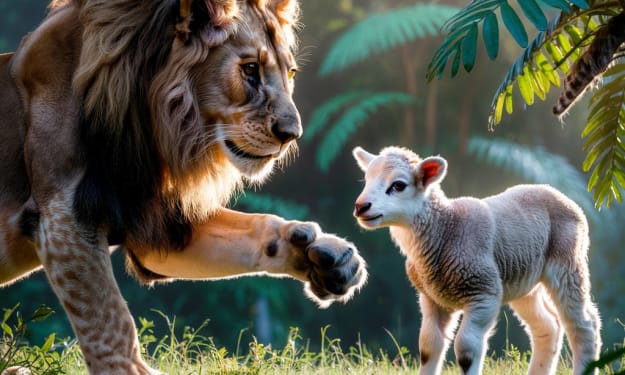
The Roar That Ruled "eep in the heart of the forest where sunlight cracked through tangled canopies and shadows held secrets, ruled the mighty lion, Ragnar. His mane was like flame, his roar like thunder, and no creature dared question his rule. He hunted when he pleased, roamed where he chose, and took what he wanted. The law of the wild was simple: “The strong survive, and the weak obey.” And no creature was considered weaker than the lambs of the northern meadow. Their soft bleats and peaceful grazing made them easy prey. They never ran far. They never fought back. And they always feared Ragnar. But the lion was growing tired. No hunt thrilled him anymore. No roar echoed long enough. A gnawing emptiness followed every victory, though he didn’t know why. The Lamb Who Didn't Run One overcast morning, Ragnar padded through the forest and came upon a stream near the meadow. There, alone and humming a strange little tune, stood a lamb—Lyra—her snow-white wool glowing against the gray sky. She was far from her flock, vulnerable, unaware. Or so Ragnar thought. He stepped forward, ready to pounce, but Lyra didn’t flinch. She looked up, locking eyes with the predator of her kind. "You’re the lion they all whisper about," she said. Her voice was calm. Almost... curious. Ragnar paused mid-step. No creature had ever spoken to him without trembling. "You should run," he growled. "I know," she replied. "But I won’t." "Why not?" Lyra smiled faintly. "Because I don’t believe you want to eat me. Not today. A Strange Curiosity Instead of devouring her, Ragnar sat down. For the next hour, they talked. Or rather—she talked, and he listened. She told him about the wind and how it carried the scent of wildflowers from the southern hills. She told him about a mother bird building her nest in a crooked tree. She even sang him a lullaby her grandmother used to hum during storms. When the sky darkened, Ragnar rose. “You’re strange for a lamb.” "And you’re quiet for a lion," Lyra said, unbothered. He left without a word, but that night, Ragnar didn’t sleep. He kept hearing her voice—soft and steady like a whisper brushing against thunde- Return to the Meadow The next day, Ragnar returned. And the next. And the next. They never talked about fear. Or death. Or what might happen if one day his hunger outweighed his curiosity. They spoke of stories instead. The myths of the forest. The colors of the moon. The dreams Lyra sometimes had where lions and lambs danced together without fear. “You’re ridiculous,” Ragnar said once, but he found himself wondering—what would that world look like The Challenge But the jungle noticed. And the pride grew restless. “You’ve gone soft,” snarled Drax, Ragnar’s younger rival. “You sit with prey while your strength withers.” “I’m still king,” Ragnar growled. “Then prove it. Hunt her. Bring her back as your prize.” Ragnar said nothing. But inside, something cracked. That night, he stood at the edge of the meadow. Lyra was waiting. She always waited. But this time, he didn’t sit. He stared at her as if seeing her for the first time—as a lamb, as prey, as the weakness he had once vowed to destroy. "Is today the day you eat me?" she asked gently. "I might have to." Lyra nodded. “Then at least let me tell you one more story.” He listened. It was a story about a lion and a lamb who were born into war but dreamed of peace. Who were told they could never be friends but still shared shade under the same tree. A story that never had an ending—because no one dared imagine one. “You can write it,” Lyra said. “You’re the lion. You decide how the story ends.” The Roar That Changed Everything The next morning, Ragnar returned to the pride. He roared—not a roar of dominance or hunger, but something new. A roar that echoed with choice, not instinct. “I will not hunt the lamb,” he declared. “Nor any creature who offers no harm.” The pride erupted. "You’ve betrayed your nature!" Drax roared. “No,” Ragnar said. “I’ve rewritten it.” A battle followed. Fierce, brutal, primal. But in the end, Ragnar stood over Drax, bloodied but unbowed. “This is our law now: strength with mercy, power with restraint.” Some lions left. Others stayed. But the jungle heard. And the whisper began to spread. A New Meadow Months passed. The forest changed. Predators and prey still lived by instinct, but not by fear. A fragile truce was born—not perfect, not without setbacks—but real. And sometimes, in the quietest part of the meadow, Ragnar would sit beside Lyra, listening to her stories as the sun dipped low. “Do you miss being feared?” she asked once. “Sometimes,” he admitted. “But I’ve found something better.” “What’s that?” He smiled. “Peace.” The Final Story Years later, when Lyra grew old and her steps slowed, she asked Ragnar for one last favor. “Tell the story,” she whispered. “Even when I’m gone. Tell it like it mattered.” Ragnar, now grayed and gentler, nodded. And he did. He told the cubs and the calves, the foxes and the fawns. He told them of a time when the jungle was ruled by fear, and how a lamb changed a lion with nothing but her voice. He ended each tale the same way: > “Strength isn’t in how loud you roar, But in how quietly you can listen.”
By Arshad khanabout a year ago in Fiction
The Man Who Painted Memories into the Skies
In a small coastal town where the waves whispered lullabies and the wind carried secrets, there lived a man named Elias Grey. He was known to most as the town recluse—quiet, peculiar, and always seen with paint on his hands. Children made up stories about him: some said he was a wizard, others believed he could talk to birds. But the truth was far more extraordinary—Elias painted the sky. Not with airplanes or drones, and not with technology, but with an art so subtle, so unseen, it almost felt like magic. Every evening, as the sun dipped behind the cliffs, Elias would climb to the top of the old lighthouse carrying a satchel of colors and brushes. And then, in a silence so profound you could hear the ocean breathe, he would begin to paint—not on canvas, but into the very air. What followed was always spectacular. Hues of rose, lavender, gold, and burnt orange would spill across the heavens, transforming the dusk into a living gallery. People began to gather at the shoreline just to watch. Tourists called it “the miracle sunset.” Scientists came with their instruments and left baffled. But Elias never asked for attention. He never took money, never gave interviews. He only painted. And he painted memories. You see, Elias had a gift—not just of color and composition, but of emotion. He could take a memory—his or someone else’s—and paint its essence into the sky. A soldier once visited the town, lost and weary, and after speaking just a few minutes with Elias, the sky that night exploded in the vibrant blue of his mother’s eyes and the soft amber glow of the porch light that once welcomed him home. A grieving widow visited one summer, her hands clenched with old letters and tear-stained photographs. Elias listened without speaking, then climbed the lighthouse. The clouds swirled into shapes of a man dancing barefoot on a beach, while the sunset turned a brilliant red—the same as the roses he once gave her. She smiled for the first time in years. No one knew how he did it. He used ordinary brushes. His paints were made from crushed petals, minerals, and rainwater. But the magic was never in the tools. It was in Elias himself. As years passed, the town changed. New buildings rose, streets modernized, and the lighthouse grew quiet. Fewer people visited. But Elias continued. Even when arthritis knotted his fingers and his eyesight dimmed, he climbed that hill each evening without fail. He said the sky still had stories to tell. One autumn, as the winds turned sharp and the leaves burned gold, Elias didn’t appear for several days. The townsfolk grew worried. Finally, a few climbed the hill and found the door to his small cabin ajar. Inside was his easel, a collection of handmade pigments, and hundreds of sketchbooks—each filled with images, names, and dates. They were memories—some written, some drawn, some only marked with colors and feelings. Elias had passed quietly in his sleep, a brush still in his hand. That night, the sky mourned. Not a single color appeared. The heavens were muted, like a canvas washed clean. And for the first time in decades, the town felt the absence of something it had never fully understood. But just as the sun dipped below the sea, a single streak of color bled into the sky—a pale violet, soft and shy. Then a swirl of orange. Then a burst of blue. The sky was painting itself. People gasped. Children pointed. And then they noticed—every evening after that, the skies continued to change. They were softer, subtler, but they still held stories. Some believed Elias had left behind a gift in the wind. Others said he had simply taught the sky to remember. Years later, an art gallery opened near the beach, funded by a mysterious donor. Inside were his sketchbooks, his brushes, and recordings of those miraculous evenings. The walls read: “To remember is to love. To paint is to remember out loud.” – Elias Grey Visitors came from all over the world to read his memories, to feel them, and to watch the sky when the sun began to set. And somewhere above, where clouds turn into stories and light becomes language, the man who painted memories into the skies continues his work—quietly, beautifully, endlessly. ---
By Mati Henry about a year ago in Fiction
The Last Library Card
The rain tapped gently on the windows of the tiny bookstore where Nora Carter spent most of her days. Tucked away in the quieter end of Charleston, the shop was more of a sanctuary than a business. On slow days, she sorted used books, made tea, and watched the world move without her.
By Sana Ullahabout a year ago in Fiction
Allergic to Copper
I don't like coppers. I'm allergic. They always put me on edge. But for this, I made an exception. I watched the uniforms from the parked car. The air hummed with anticipation. I'd hoped they would arrive like a SWAT team, bust down the door off the storage unit. That would have been satisfying somehow. Instead, the anorak was there, dipping his head to the pigs and twisting his hands together nervously. Every inch the bewildered citizen, helping the police with their inquiries. Fumbling in his pockets. Fiddling with the key. Go ahead, dork, stall for time. It won't make any difference. It looked like the police reassured him, can you believe that? One patted his arm. One said, sorry about this. They addressed him as Mr. Two of them, there were. In those beastly uniforms. I imagined their faces when they found it. The case. The toe. I waited and waited for the trio to re-emerge, him trusted and poutimg; the uniforms looking fierce. They didn't pin him to the ground yowling or snivelling. They didn't frogmarch him away and accidentally on purpose clout his head as they were getting him in the car. They didn't until years of that yellow tape and leak the whole story to journalists. They didn't cuff him. Didn't even arrest him. Their mouths framed words that looked like, sorry to have bothered you, and thank you for your time. He stammered a bit, acted embarrassed. I use it for storage... bit of a hoarder... More reassuring patting. The wind went right out of my sails. The urge to sprint across there and grab that little turd by the lapels was insane. It bubbled under my skin. I thought I might boil over with it., or go mad from keeping it in. How did he do it? How did he hide it? Did I get it wrong? I'd been so sure.
By L.C. Schäferabout a year ago in Fiction