Short Story
The Root That Wouldn’t Die
They dug the hole as if they were burying a villain. Shovels bit into damp earth, mud clung to boots, and the air smelled of rain-soaked leaves. Three neighbors stood over the stubborn stump in my grandmother’s yard, muttering curses under their breath.
By Hamayun Khanabout a year ago in Fiction
The Light at Miller's Dock
The trail down to Miller’s Dock had narrowed over the years, overtaken in places by roots and brush. What once was a foot-worn path now felt more like a memory than a route. Calvin moved carefully, stepping over slick stones and ducking under branches. The lake wind stirred the treetops, but everything below held its breath, as if waiting.
By Rick Allenabout a year ago in Fiction
Doppelgänger
Bryan is bulleting down the road in the pitch dark when the man steps out in front of his car. Only one of his headlights is working, and by the time the figure, crossing from the opposite side, is lit up in its dull beam it is far too late. One moment he registers a face- wide eyes, gaping mouth, hair plastered to a sweat-slick forehead- and then there is the sickening, meaty thud as his mother's '99 Corolla slams directly into the body attached to that face and, still moving, rolls over something- an arm, a leg, Bryan isn't exactly sure- before it finally grinds to a stop under the insistent pressure of his foot on the brake. He shuts the car off, and all the light leaves the world around him. He hears nothing on the deserted, rural road, nothing but the slow ticking of the engine powering down.
By Raistlin Allenabout a year ago in Fiction
The Headless Horseman
Sometime ago, up the mountain between Toas and Mora, there lived a family of sheepherders. They were a typical family of the time, three generations and a dozen children all living on the ranch, taking turns at the various chores from tending sheep to tilling the field and felling trees.
By Judah LoVatoabout a year ago in Fiction
Her Voice on the Wind
The wind was already rising when Eloise turned the key in the door for the first time in years. It stuck halfway, swollen from salt and neglect, but with a hard twist she forced it open. The house gave a small groan as if surprised by her return. Inside, the air smelled of lavender, old cedar, and something sharper—salt maybe, or time. She stepped over the threshold, her boots echoing on bare wood, and paused in the entry. Nothing had moved. And yet, everything had changed.
By Rick Allenabout a year ago in Fiction
Man in Charge
Daniel was a man of few words. Even at age fifty-five, his body remained chiseled and in top shape. Years of military training and special operations service to his country had formed him into a disciplined, loyal, and forthright man and husband, sound in body and mind.
By Shirley Belkabout a year ago in Fiction
Postcards from the End of the World
The news had been counting down for weeks. Forty-two days until the asteroid made landfall, the scientists said, give or take a few hours. People coped in their own ways—some fled inland, some held rooftop parties, some barricaded themselves in basements stocked with years of canned beans. I chose to do what I’d always done when life made no sense: pour myself a coffee, sit by the window, and watch the mailman shuffle down the street. It was on one of those mornings, with thirty-nine days left, that the first postcard arrived. The handwriting was hers.
By Musawir Shahabout a year ago in Fiction
Weight of Names
The first time I noticed it, I thought I was imagining things. “Eli,” my teacher called, and something like a warm stone settled on my chest. It was small—just enough to make me pause, to make me wonder if I’d taken a deep breath without realizing it. By lunch, three more people had said my name. Each time, the weight grew heavier. I told myself it was nothing—fatigue, nerves, the start of a cold. But by the end of the day, my legs ached as if I’d run a marathon. How the Weight Grew It didn’t happen every time someone thought about me, only when they spoke my name aloud. “Eli, can you grab that for me?” “Eli, you forgot your notebook.” “Eli, you’re quiet today.” Each syllable was like another brick added to an invisible backpack strapped to my body. The weight wasn’t metaphorical—it was real. My shoulders hunched, my steps slowed, and my breathing grew shallow. At first, I could shake it off. Sleep helped; I’d wake up lighter, as if the day’s weight had evaporated overnight. But the more people said my name, the longer it took to recover. The Popularity Problem Before this started, I was a pretty average guy. Not invisible, but not the center of attention either. That changed fast. The more sluggish and withdrawn I became, the more people seemed to notice. Teachers called on me more, friends checked in, strangers at the bus stop asked if I was okay. Every question began with my name. Every question made me heavier. Soon, I couldn’t run during gym class. My feet dragged. My back ached. I started avoiding people, skipping lunch, hiding in the library where no one knew me well enough to call out to me. The Day I Couldn’t Stand It happened on a Tuesday. “Eli!” “Eli, wait up!” “Hey, Eli, over here!” By the time I reached the school gates, my knees were trembling. My backpack felt like it was filled with stones, but I knew it was my own body that had become impossibly heavy. When I got home, I collapsed on the floor of my room. I couldn’t even lift my head. My phone buzzed on the carpet beside me—messages from friends, my mom, even my little sister. I didn’t have to open them to know they all began the same way: Eli… The weight pressed me into the carpet until I could barely breathe. My vision darkened. The Stranger Who Knew I woke up in a small, dimly lit room. A woman sat across from me, her hands folded on her lap. She looked old—older than my grandmother—but her eyes were bright. “You’ve inherited it,” she said. “Inherited what?” I croaked. My voice sounded strange, like it had to fight its way past something thick in my throat. “The burden of names.” She smiled sadly. “Some of us carry the weight of recognition. Every time we’re named, the world reminds us we exist. That reminder… adds up.” She told me her name was Mara, but I didn’t feel anything when she said it. “Why doesn’t your name weigh you down?” I asked. “Because no one knows it anymore,” she replied. “I’ve erased it from the world. No friends, no family, no records. Even I avoid speaking it.” I shivered. “You mean you’re… alone?” “Yes,” she said simply. “It’s the only way to stay light enough to move.” The Choice Mara offered me a way out. She could teach me how to fade—how to stop people from saying my name. It would mean starting over somewhere new, never keeping friends for long, and never letting anyone get close enough to say it aloud with affection. “You’ll live,” she said. “But you won’t be known.” The alternative was to keep living as I was, until one day someone said my name for the last time and I wouldn’t be able to get up again. I thought about my little sister, who shouted “Eli!” every time I came home. I thought about my best friend, who said my name in the middle of a laugh. I thought about the way hearing my name in someone’s voice made me feel seen, even as it pulled me down. The Weight We Carry Willingly I didn’t take her offer. Instead, I learned to ration my days, to disappear for a while when the weight grew too much. I told people to use nicknames—E, L, even “hey you”—but I never erased my name entirely. Yes, it still grows heavy. Sometimes it pins me to my bed for hours. But some names aren’t meant to vanish, and some weights are worth bearing. Because the truth is, the heaviest thing isn’t my name. It’s the thought of no one ever saying it again.
By LUNA EDITHabout a year ago in Fiction
"When Beauty Broke His Heart". AI-Generated.
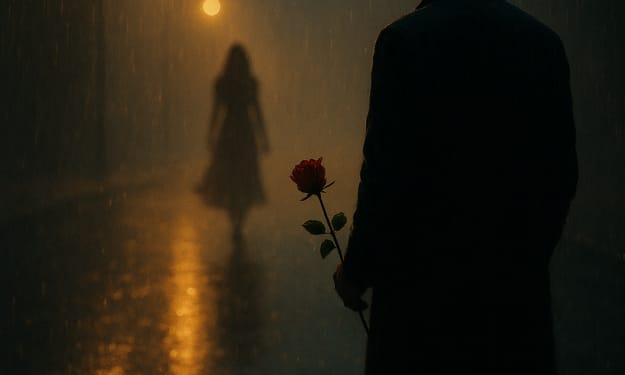
The night was quiet, except for the faint hum of streetlights and the soft patter of rain against the cobblestones. Daniel stood there, his coat damp, clutching a single red rose that had already begun to lose its petals. He didn’t know why he had come back to this place. Maybe it was habit. Maybe it was hope. Or maybe it was the cruel need to stand where it had all begun—and ended. He had met her on a summer afternoon that seemed painted by the hands of a poet. The air was warm, the sun stretched lazily across the sky, and the world felt as if it had slowed down just for them. Her name was Elena. She wore a white dress that moved like whispers in the wind, and her hair shimmered like golden threads in the sunlight. Daniel wasn’t looking for love that day. He wasn’t looking for anything at all. But Elena was the kind of person you didn’t find—you stumbled into her, and she changed the way you saw everything. They first spoke over something trivial. She had dropped a book in the park, and Daniel, without thinking, picked it up and handed it to her. “You read poetry?” he had asked. She smiled, that warm, disarming smile that seemed to undo the knots in his chest. “Only when I need to remember how beautiful the world can be.” From that moment, their lives began to thread together. Days became weeks, weeks became months. They talked about dreams, fears, and the strange little details that make a person unforgettable—like how Elena always smelled faintly of jasmine, or how she laughed with her head tilted back, as if she was sharing the moment with the stars themselves. Daniel loved her quietly at first, afraid of scaring away something so rare. But love has a way of growing louder until it demands to be heard. One autumn evening, under the glow of lanterns strung between old oak trees, he told her. She didn’t say anything right away—just held his hand and leaned against his shoulder. That night, she kissed him for the first time. It should have been the beginning of forever. But life rarely follows the script we write in our hearts. Elena began to drift away in small, almost unnoticeable ways. She answered calls less often. Her laughter didn’t come as easily. She seemed to be somewhere else, even when she was sitting beside him. Daniel told himself it was stress, that she’d come back to him if he just waited. But deep down, he felt the cold wind of loss creeping in. One rainy evening—much like the one he stood in now—she told him the truth. “Daniel,” she whispered, not meeting his eyes, “I can’t stay. I thought I could, but I can’t.” There was no betrayal, no cruelty in her voice. Just a quiet honesty that cut deeper than any sharp word could. She said she loved him, but not in the way that lasts a lifetime. And then she was gone, walking into the rain until she became a blur. Daniel tried to move on. He buried himself in work, in friends, in anything that could fill the hollow space she left behind. But some loves don’t fade; they live like ghosts, haunting the edges of every day. Years later, he would still think of her whenever he passed the park where they met, or when the scent of jasmine drifted by in the wind. He didn’t chase her, didn’t try to pull her back into his life. Love, he realized, wasn’t about holding on—it was about letting go when someone needs to leave. Tonight, standing in the rain with the rose in his hand, he closed his eyes and imagined her one last time—laughing, her hair catching the sunlight. He pictured the way she looked at him that first day, as if she’d known all along that he would carry her memory for the rest of his life. He placed the rose on the park bench where she had once sat, reading poetry. Then he turned away, not in anger, but in quiet acceptance. Some stories are not meant to be endless. Some are beautiful precisely because they end. As he walked away, the rain began to fall harder, washing away the last loose petals of the rose. But in Daniel’s heart, Elena would remain—timeless, untouchable, and forever the beautiful woman who had taught him both the joy and the ache of love.
By Salman Binabout a year ago in Fiction
The Snowman Hunter
You’ve heard the songs by now, the ones about snowmen. How they have a jolly happy soul, a corn-cob pipe and a button nose, two eyes made out of coal. Well, the song was right about one thing, they have eyes made out of coal. Charred, shouldering embers from hell. Or stones, plucked from mucky gutters by naïve children with no idea what they’re in the process of creating. Those beady little eyes – ceaselessly peering at passerby through the falling snow – haunt me in my sleep. Their murderous gaze is sharp enough to pierce even the darkness of my dreams. Even during the sparkling hours of daylight, the sight of an eye-shaped pebble is enough to send shivers down my spine.
By Alyssa Cheriseabout a year ago in Fiction