Short Story
The Last Voice Message
I wasn’t asleep. I never am anymore. Night has become a quiet battlefield for me. Thoughts line up like soldiers, memories attack without warning, and silence feels heavier than noise. So when the screen lit up, I stared at it for a long moment, unsure whether to breathe or panic.
By Salman Writes7 months ago in Fiction
What We Chose Not to See
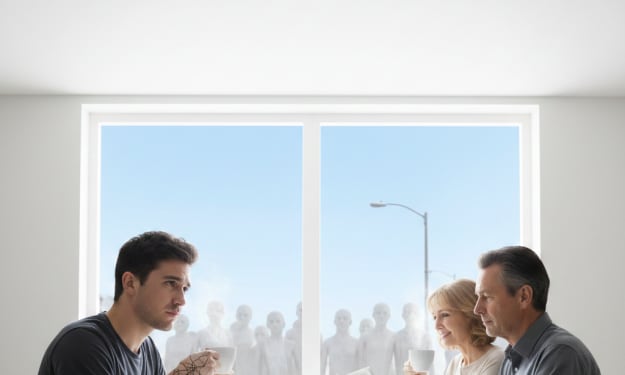
The morning the cracks appeared, no one said a word. It started with the sound. A thin, splitting noise like glass bending under pressure. I heard it while brushing my teeth. The mirror above the sink trembled slightly, but when I looked at it, my reflection stood steady. Calm. Ordinary. Behind me, however, a thin black line ran from the ceiling to the floor. I blinked. It was gone. At breakfast, my mother spread butter across toast as if the world had never once disappointed her. “Did you hear that?” I asked. “Hear what?” she replied, not looking up. “That sound. Like something breaking.” She smiled faintly. “Old houses make noises.” Our house wasn’t old. I wanted to argue, but my father folded his newspaper with precise movements and stood up for work. The headline read: CITY REPORTS RECORD STABILITY Outside, the sky was pale gray. Not cloudy — just colorless, like someone had erased the blue. The air felt thick in my lungs. On the way to school, I noticed something else. The streetlight at the corner leaned slightly to the left, its metal pole twisted unnaturally. Cars drove past it without slowing. A woman pushing a stroller walked directly beneath it without glancing up. Didn’t they see? Or were they choosing not to? At school, the cracks were everywhere. A long fracture ran across the classroom wall, jagged and dark. The clock above the board ticked backward for three full seconds before correcting itself. No one reacted. Mr. Halpern continued explaining supply and demand as if time reversing was part of the curriculum. I raised my hand. “Sir, the clock—” He didn’t look at it. “Focus on your notes.” “But it just—” “Everything is functioning normally,” he said firmly. The class nodded. I stopped talking. By afternoon, the air outside carried a faint smell of smoke. Not strong enough to cause panic. Just noticeable enough to make breathing uncomfortable. People walked with their usual rhythm. They checked their phones. They laughed. They ordered coffee. The café windows reflected the street, but something was wrong with the reflections. Buildings looked taller in the glass. Skewed. Like they were stretching upward beyond the sky. I stepped closer to look. In the reflection, I wasn’t alone. Behind me stood a crowd of faceless figures. Perfectly still. Watching. I turned. The street was empty. When I looked back at the glass, the reflection was normal again. A barista tapped on the window from inside. “We’re closing early.” “Why?” I asked. She hesitated. Just for a second. “Maintenance.” Smoke drifted faintly above the rooftops. No alarms sounded. That night, the cracks returned. This time they didn’t disappear. They spread across the ceiling like lightning frozen in place. My bedroom light flickered. The air hummed. From downstairs, I heard my parents talking in soft, measured voices. “…it’s spreading faster.” “…don’t scare him.” “…if we act normal, it stabilizes.” I froze. If we act normal. Stabilizes what? The humming grew louder. A picture frame fell from the wall, its glass shattering against the floor. I ran downstairs. The living room ceiling had split open. Not wide — just enough to reveal darkness beyond it. Not night sky darkness. Not empty space. Movement. Slow. Shifting. Breathing. My mother stood beneath it with her arms crossed. “Mom,” I whispered. “You see that, right?” She didn’t look up. “See what?” “The ceiling!” “It looks fine.” My father placed a hand on my shoulder. His grip was firm. Too firm. “Listen to me,” he said quietly. “Nothing is happening.” “But it is.” He leaned closer. “The more you acknowledge it, the worse it becomes.” The crack above us pulsed. Dust fell like ash. I felt something inside me twist. “So we just pretend?” “Yes,” my mother said gently. “That’s how we’ve always survived.” Survived what? The house groaned. The next morning, half the sky was gone. Where blue should have been, there was only blankness. Not clouds. Not storm. Just absence. News channels played cooking shows. Social media was full of selfies under a disappearing sky. #Blessed #AnotherBeautifulDay The city continued moving. I stood in the center of the street and stared upward. The blank space spread slowly, swallowing color inch by inch. Birds flew into it and never came out. A man beside me checked his watch. “Traffic’s bad today.” “Look up,” I said. He frowned. “At what?” The blankness crept closer to the sun. Shadows sharpened. Windows began cracking outward. Still, no one screamed. My chest tightened. Maybe they were right. Maybe acknowledging it made it worse. Maybe silence was safety. A loud snap split the air as the leaning streetlight finally broke in half, crashing onto a parked car. People stepped around it casually. I looked at the sky again. It was nearly all gone now. Only a thin strip of blue remained, trembling like fragile glass. My reflection appeared in a nearby shop window. Behind me stood the faceless crowd again. But this time, they weren’t watching. They were fading. And in the reflection, I saw something else. Cracks spreading across my own skin. Thin. Dark lines tracing my arms. I touched my face. Smooth. Untouched. But in the glass, I was breaking. The last piece of blue sky shattered without sound. Everything turned white. Blinding. Endless. I waited for panic. For screams. For collapse. Instead— Voices. Calm. Measured. “Beautiful morning.” “Everything’s fine.” “Nothing unusual.” The white brightness softened. Buildings reappeared. The sky returned — perfect blue. No cracks. No smoke. No blankness. The streetlight stood upright again. The car was undamaged. People walked past me with mild annoyance. I rushed home. The ceiling was whole. The walls smooth. My parents sat at the table drinking coffee. “Rough night?” my mother asked lightly. “You remember it,” I said. “You have to.” My father folded his newspaper. The headline read: CITY REPORTS RECORD STABILITY He met my eyes. “For things to remain,” he said carefully, “some things must go unseen.” My reflection in the window smiled before I did. And that was when I understood. The cracks hadn’t been in the world. They had been in me. And everyone else had learned the secret long ago: Ignore the fracture. Ignore the smoke. Ignore the missing sky. Because if even one person refuses to pretend— The illusion breaks. And maybe the world with it. So I sat down. Picked up my cup. Looked at the perfect ceiling. And said nothing.
By Inayat khan7 months ago in Fiction
It's A Work Day!
Yes, it is an anonymous time, as names and faces cannot be shown. I can't share too much, anything that may identify anyone, except me. It is nanaboozhoo story time today. Then again, it may not be as there is not much snow on the ground on this day.Tomorrow will be different; we could have a fresh 7 or 8 inches of snow. After reading about 103 weather in other parts of the world, where they have summer now, I don't mind our weather.So what story will I tell if I need snow on the ground to tell a nanaboozhoo story? How about this one?Several years ago now, I was at a Tiospye (extended family or community group in the Dakota language), and an elder Lakota woman was telling this story, and her granddaughter was interpreting in English.Iktomi is a spider and a trickster. There were probably 15 to 20 people listening to the story. I've told this story over the years and have had some interesting comments.
By Denise E Lindquist7 months ago in Fiction
The Latch
There is a practice that holds a place between habit and superstition in the lane: a set of small, unspoken behaviors everyone follows. It grew from a season when ordinary things began to misbehave—mirrors that showed rooms that were not there, reflections that lagged a breath behind the person who cast them, lamps that bent their light away from certain thresholds, music that drifted down the street and stopped at the gate. People learned that some openings answered back, and that answering could change the shape of a life. Out of that learning came rules: ways of moving, of refusing, of tending one another so that the strange things might pass by without being invited in. The rules are not written; they are taught by consequence and by the steady, patient care of neighbors who prefer to keep one another whole.
By Kristen Barenthaler7 months ago in Fiction
A Door Ajar
The morning began like a promise someone had almost kept. Light came in through the kitchen window in a thin, apologetic strip, as if the sun had remembered at the last minute and was still tying its shoes. On the table, a mug with a lipstick crescent at the rim cooled beside a folded map whose edges were softened by being looked at too often. The map was open to a place whose name the narrator had practiced saying in the shower, in the car, under the breath of the houseplants. The syllables felt like a borrowed coat: warm enough, but not yet fitted.
By Kristen Barenthaler7 months ago in Fiction
The Knot
Myth They tell it as a lesson: Icarus soared on wings of wax and feathers, drunk on the sun, and fell because he would not listen. The story is short and sharp, a moral carved into children’s mouths. It leaves no room for the small, ordinary things that make up a life.
By Kristen Barenthaler7 months ago in Fiction
Hallowbridge
The Town That Forgot The town of Hallowbridge sat in a fold of hills where the river slowed into a wide, glassy bend. In autumn the maples flamed and the air smelled of woodsmoke and apples; in winter the streets were neat with snow and the lamplight turned the drifts to gold. The town had a single main street—brick sidewalks, a hardware store with a bell that never stopped jingling, a bakery that opened at dawn, and a library whose windows always steamed in the mornings. People knew one another by the sound of their footsteps and the way they left their porches at dusk. It was the kind of place where the past felt like a neighbor you could borrow sugar from.
By Kristen Barenthaler7 months ago in Fiction
Maple Street Moon
The moon was on Mrs. Halvorsen’s porch. It had been there when I walked past at seven, a pale, pocked globe the size of a bathtub, cradled in the wicker swing as if it had come to borrow a cup of sugar. It hummed faintly, like a refrigerator left on the back porch, and when I stopped to look the cat that lived under the swing blinked at it and went back to licking its paws. Mrs. Halvorsen sat on the step with a knitting basket in her lap and a mug of something steaming beside her, and she waved at me as if the sight of a celestial body parked on her stoop were the most ordinary thing in the world.
By Kristen Barenthaler7 months ago in Fiction