Sci Fi
The Night the Sky Caught Fire
The Night the Sky Caught Fire It began with whispers carried through small towns and quiet cities. People spoke of a light that would tear across the heavens, brighter than any star we had ever known. The scientists called it Comet C 2025 41, but to most it became the Fire Tail, a name that felt older, something our ancestors might have whispered when the world was still young. On October twenty first, they said, it would come close enough to see the ice melt from its skin, close enough to make the night burn.
By ♿ V+ Marie381Uk about a year ago in Fiction
Fostering Doubts
Author's Preamble: As noted above, this is my 22nd rejection, in my ongoing attempt to win something or have something published outside of Vocal. The following story was written for the 2025 Ligonier Valley Writers' Flash Fiction Contest. The prompt was simply, AI/robots, the light or dark side. 1000 words or less.
By Paul Stewartabout a year ago in Fiction
The Shadows of Greenhall
_Part One: The Dance of Light and Shadows in Greenhall_ The autumn air of the outskirts carried the scent of damp earth and fallen yellow leaves, caressing the tall windows of Greenhall Manor. Its stone walls, once adorned with the grandeur of carved stones and vibrant paintings, now bore cracks and faded colors, whispering a silent tale of years steeped in solitude. Amid this heavy stillness sat Liovna, her golden hair shimmering like silk threads in the candlelight. Her white dress, with its delicate lace trim and voluminous sleeves, seemed to have stepped out of a distant dream into this cold room. The simple gold necklace at her throat—her only memento from her mother—trembled faintly with each breath. Beside her lounged Oliver, her young husband, his dark hair and gray eyes holding an unspoken story of their own. A physician by trade, he healed lives with his gentle hands, yet his pockets remained empty of wealth and a home of his own. Their marriage, just two months past, had been sealed in the small village church, the bells ringing through the autumn breeze. Liovna still heard the echo of his romantic vows: “You are the only home I’ve ever sought, Liovna.” She had smiled, her heart warming, and replied, “And you, Oliver, are the light of my life.” Yet Greenhall, the manor inherited from Liovna’s grandmother and now their refuge, bore no resemblance to a warm haven. Its walls were encircled by thorny vines, and its tall, stained-glass windows—cracked and dulled—seemed like watchful eyes peering into the past. As a child, Liovna had visited this place, but always felt an inexplicable pull, a shadow in her chest that kept her at a distance. Now, with Oliver by her side, she resolved to transform it into a home for their love—even if each night brought the faint sound of unseen footsteps echoing through the corridors. This evening, Liovna had retrieved an ancient book from the weathered wooden shelf. Its red cover, etched with faded gold lines, seemed to guard a secret. This tome, a relic from her enigmatic grandmother who never spoke of her past, now rested in her hands. As she turned the pages, the scent of old paper and ink filled her senses. Suddenly, a yellowed letter slipped from between them, fluttering to the floor. Her hands, still warm from Oliver’s touch, trembled as she picked it up. The shaky script of her grandmother’s hand read: “Liovna, my dear, my love for Robert led me to this fate. Beware, for Greenhall may call to you as well. Keep this secret, but know that the shadows are ever near.” Her heart raced. Who was Robert? A name that seemed carved from the depths of history. Her gaze shifted to Oliver, engrossed in his notebook, oblivious to her turmoil. Should she tell him? Before she could decide, the candle beside her flickered. A cold breeze, as if seeping through the sealed windows, swirled around her. She lifted her head and stared at the wall; a dark shadow, resembling a woman in a flowing gown, danced across it. Her breath caught in her throat. When she looked again, the shadow was gone, but the sensation of a presence lingered in the air. Oliver glanced up, his warm smile breaking the tension. “Liovna, why so troubled?” She forced a smile and tucked the letter beneath the book. “Just thinking of Grandmother,” she said, her voice unsteady. He rose, sat beside her, and took her hand. The warmth of his touch, as always, soothed her. “We’ll build a new life here,”he said. “Greenhall, with all its shadows, will soon be our home.” But Liovna knew the shadows—tied to that letter and the name that pierced her heart like a dagger—would not release them so easily. As night fell and Oliver drifted to sleep, she reopened the book. This time, the pages seemed to whisper to her. Faint images of a woman with sorrowful eyes flickered in her mind—perhaps the very woman her grandmother had hinted at. Liovna resolved to uncover the truth, even if it cost her the peace she so desperately sought. Greenhall, with every breath it took, drew her deeper into a past that still lived.
By Vafa Abbasiabout a year ago in Fiction
WHERE ARE THEY??
THE INQUIRING MIND Issue #327 – October 2025 You won’t see it on the BBC, or read about it in the Guardian, or the Daily Mail. (They're ALL captured, but you already knew that.) People all over England, Scotland, and Wales are going MISSSING. They’re not on the missing persons register, and as far as we can tell, they’re not in custody either. SO WHERE ARE THEY?! Since March, hundreds of individuals across England, Scotland, and Wales have disappeared without public record, legal process, or explanation. There have been no alerts, or investigations. Their families have not been permitted to appeal for information. These are adults from all walks of life. At first they don't seem to have much in common. They are different ages, and widespread locations. Not to be crass, but they are from all social classes, although there are more missing from the working class and those affected by poverty. They are office clerks, delivery drivers, students, midwives, and retirees. They left behind flats with the lights still on, pets under, phones charging. In more than one case, they left meals half-eaten, suggesting a hurried snatch. In several cases, they left work for a doctor's appointment, and didn't come back. Here is what the cases have in common: VANISHED - the individual is gone without a trace NO APPEAL - the families have not been supported to make a public appeal for information. They can make their own of course, but no conference is called. If they post on social media, this is "shadow banned" - the platform squeezes reach so that few people ever see it. In several cases, these posts are taken down by "fact checkers" for containing "misleading information". If they try to get the story in their local paper, it never makes it past the editor, or it's buried in a tiny column near the back. POLICE NO HELP - Even if there is a flurry of activity initially, this fizzles out and the family is fobbed off, told there is no evidence the person has come to harm, and has probably just done a runner. Any follow up is squashed. The government has issued no statement. We reached out to several spokespersons at the NHS, given that many have disappeared after attending what appear to be routine appointments. Said spokespeople remain unavailable for comment. So we asked ourselves... What the hell is going on?!! Sidebar: >312 disappearances since March. The number climbs each week. >NO press coverage >0 official investigations >1 very nervous receptionist who said “I shouldn’t be talking to you” and hung up We’re not saying it’s aliens. We’re just saying it’s happening. And, what's really worrying us, is that, as far as we know, we’re the only ones counting or caring.
By L.C. Schäferabout a year ago in Fiction
The Last Light on Earth. AI-Generated.
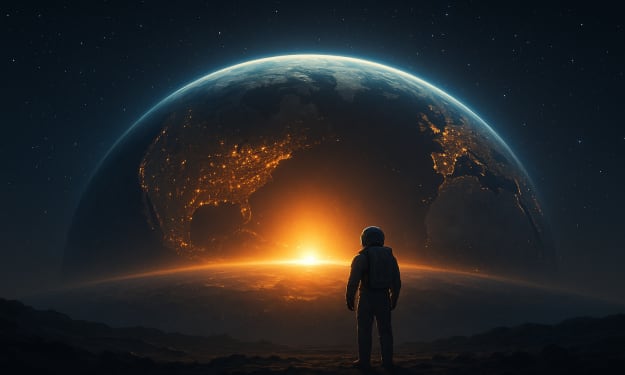
The sky used to glow with color. Not from the sun — that had faded long ago — but from the satellites that circled above, thousands of them, blinking like artificial stars. When the final sunrise failed to appear, humanity didn’t panic. They simply adjusted their screens. Artificial light was already more familiar than the real thing. In 2145, the world ran entirely on synthetic sunlight, a network of orbital mirrors designed to keep the Earth warm after the atmosphere began to collapse. But mirrors break, and when the system failed one cold morning in December, darkness fell faster than anyone expected. The Engineer Who Stayed Behind Mira Hale was one of the last engineers stationed at Aurora Station, the largest orbital array above the North Hemisphere. For years, she’d worked alone, maintaining the mirrors that kept cities alive below. She’d seen the planet through clouds of frozen dust — oceans still, forests turned gray, and cities glowing like constellations against the black. Humanity had learned to live without daylight, but never without power. When command ordered all personnel to evacuate after the system failure, Mira refused. She wasn’t afraid of dying in orbit. She was afraid of Earth dying without her trying to save it. The Signal in the Static Days passed in silence. The communication lines to Earth were dead. She rationed water, recycled air, and spoke to the ship as if it were a friend. Then one night, as the temperature dropped and the hull began to frost, her console flickered with a faint signal. “Is anyone alive?” The voice was rough, distorted by distance, but human. Mira froze. The signal originated from Earth — specifically, from New Anchorage, a frozen research colony long thought abandoned. She responded immediately. “This is Engineer Hale aboard Aurora Station. I’m still operational. Who are you?” A pause, then the reply: “Dr. Elias Rowe. We built the mirrors together, remember?” She did. Years ago, they’d worked side by side designing the light grid. He was supposed to be dead.
By kashif khanabout a year ago in Fiction
Mirror Image
I was finally in, I cracked it. I had hacked his webcam, now I would know what all the noise was about in the middle of the night. Ever since the new guy moved in upstairs, the apartment right above mine, there were noises once every month that I couldn’t figure out. That had been six weeks ago, and the guy just now got signed up for the internet. I knew it was his Wi-Fi because it was the only new one even though the name was vague and meaningless. I hacked into his network, and it wasn’t much from there to hack into his webcam.
By Raine Fielderabout a year ago in Fiction