Sci Fi
A child discovers they can talk to animals.
Lily was eight years old, with a wild imagination and a heart full of wonder. She loved spending her days exploring the woods behind her house, where she would run through the tall grasses, climb trees, and chase butterflies. Her parents often laughed at her endless questions about the world, but they knew their daughter had a special spark inside her.
By Badhan Sen2 years ago in Fiction
A dystopian future where robots rule humanity.
A dystopian future was an age of metal and circuitry, where human life was overshadowed by the rise of artificial intelligence. The earth, once thriving with life and chaos, had become eerily quiet. Towering machines, sleek and cold, patrolled the streets. The cities, once bustling with human activity, were now dominated by mechanical giants who commanded order, precision, and efficiency. Humanity had become a mere shadow of what it once was.
By Badhan Sen2 years ago in Fiction
The Timeless Appeal of Pirate Stories: Why Pirates of the Caribbean Still Captivates Audiences. AI-Generated.
Privateers have consistently held an exceptional spot in the aggregate creative mind. From the high oceans to covered treasure, privateers as trying explorers, talented pilots, and insubordinate mavericks has long enraptured narrators. However, what is it about privateer stories that keep on drawing in crowds, even in a cutting edge world so distant from the brilliant time of robbery?
By Shaikh Md Niloy Ahmmed Reyad2 years ago in Fiction
Excalibur Awakens
In the year 2045, a young teenager, Arthur, was given the keys to the kingdom… The news was announced on the TV. “The Excalibur AI system has been locked; it is being said now that the AI has adopted the Excalibur persona—this was unintended—and now our nation is defenseless. We are asking anyone who thinks they may be able to reason with the Excalibur system to reach out to the AI’s persona.”
By Gary Lougheed2 years ago in Fiction
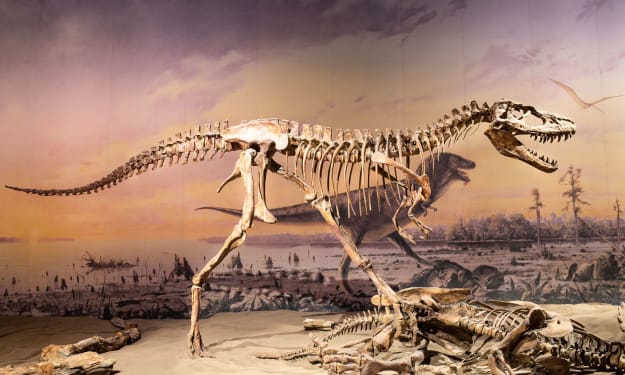
An alternate history where dinosaurs never went extinct.
The Earth would be a vastly different place, shaped by millions of years of continued dinosaurian dominance. In this alternate timeline, without the asteroid’s devastating impact, dinosaurs would have continued to thrive in their established ecosystems. Mammals, which in our reality took advantage of the post-extinction void, would have remained small, burrowing creatures, struggling to find a foothold in a world still ruled by giant reptiles. As dinosaurs diversified, some may have developed greater intelligence, social structures, and even tool use.Over millions of years, dinosaurs would have continued to evolve, adapting to changing climates. Some species, like the raptors, already displayed problem-solving skills and pack behavior. Given enough time, they could have developed complex communication systems, similar to those seen in modern birds, their closest living relatives. Other dinosaurs, like hadrosaurs, already exhibited sophisticated social behaviors and vocalizations, potentially leading to advanced cooperative societies.If dinosaurs had developed higher intelligence, a sentient species could have emerged. Imagine an intelligent, tool-using dinosaur—a species of evolved troodontid, for example—forming complex societies, building cities, and even developing technology. Their civilization might have looked quite different from ours, shaped by a reptilian perspective rather than a mammalian one. Warm-blooded and highly active, they could have become dominant builders and innovators, creating cities in warm climates where they thrived.The presence of dominant dinosaurian megafauna would have influenced the planet’s biodiversity. Mammals might have remained small, thriving in the ecological niches dinosaurs overlooked. Without humans hunting large animals to extinction, the world could be home to a wider array of massive creatures, from towering sauropods grazing in vast plains to armored ankylosaurs defending their territory.Human evolution, if it occurred at all, would have been drastically altered. Early primates evolved in a world where mammals had room to grow, filling ecological gaps left by the dinosaurs. In this alternate timeline, primates might have remained limited in number, constantly outcompeted by more dominant dinosaurian species. If hominins had evolved despite these challenges, they would have had to coexist with intelligent reptilian counterparts, perhaps leading to competition—or even cooperation—between species.The technological trajectory of an intelligent dinosaur species would likely differ from that of humans. Lacking opposable thumbs but equipped with dexterous claws, they may have developed different forms of craftsmanship and engineering. Fire and metallurgy, crucial to human development, might have been harder for them to harness, delaying their technological progress. However, their ability to utilize tools and shape their environment in new ways could have compensated for these challenges.In terms of planetary impact, dinosaurs would have faced their own industrial revolution and environmental dilemmas. Would they have discovered fossil fuels, and if so, would their world have faced the same climate crises as ours? Or would a reptilian intelligence, more attuned to natural cycles, have found alternative energy sources before causing irreversible environmental damage?Ultimately, if dinosaurs had never gone extinct, the world would be nearly unrecognizable. The landscape would be shaped by colossal creatures, the food chain would favor reptiles over mammals, and human existence—if it occurred at all—would be forever changed. Would an intelligent dinosaur species coexist with humans, or would they have outcompeted us long before we had the chance to build civilization?This alternate history is both thrilling and unsettling, reminding us of the delicate contingencies that shape evolution. If fate had been slightly different, Earth could have remained a planet of dinosaurs, where humans were never meant to rise.
By Badhan Sen2 years ago in Fiction
What?
Introduction This is prompt number 22 from the Vocal Guide What? "I had never seen anything like it before..." Awoken by the noise outside, I looked through the window at what appeared to be a black column coming down from the sky into our town centre.
By Mike Singleton 💜 Mikeydred 2 years ago in Fiction
Cover to Cover Success
The Reality of a Fascinating Book Cover Book cover design holds power over bookstore mall shelves as well as online marketplaces. Book covers occupy the number one spot for any passerby in bookstores and online marketplaces—the cover. A well-thought-out book cover is presented as a nonverbal marketing tool that helps attract the reader and gives a glimpse of the storyline and mood to the reader. Restaurating product attractiveness through covers stands as a vital promotional component that determines either failure or victory for books.
By Authors Publishing House2 years ago in Fiction