Sci Fi
The Last Train to Love
A Cold Platform It was 8:30 pm on a grey November night in London. The crowd at St. Pancras Station moved like waves — purposeful, busy, and unaware of the quiet hearts that passed among them. Anna Morgan stood on Platform 6, her breath visible in the cold, clutching a cup of lukewarm coffee and a worn leather satchel. Her train — the 8:47 pm Eurostar to Paris — was the last one that night.
By Aman Ullahabout a year ago in Fiction
Twenty Minutes to Midnight
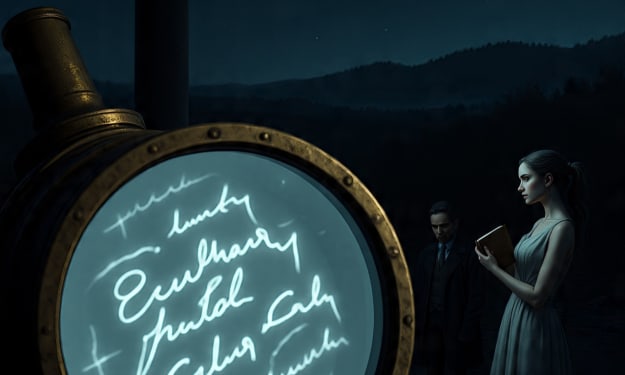
It was twenty minutes to midnight when Elara finally realized she’d been followed. The night had wrapped itself around the city, cloaking narrow streets in velvet shadows, and somewhere in those shadows, footsteps echoed hers. She quickened her pace, clutching the small, worn leather journal closer to her chest. The journal smelled faintly of cedar and old ink — it had been her father’s, and now it was the only thing that might save her. Elara ducked into an alley, heart pounding. The footsteps grew louder, then stopped. Silence spread across the cobblestones like spilled oil. Holding her breath, she listened — and waited. She could feel time slipping through her fingers. In exactly twenty minutes, the bell of St. Vesper’s would strike midnight. And if she didn’t reach the old observatory by then, everything her father had hidden would remain buried forever. She peered around the corner. Empty street. Only the restless flicker of a dying gas lamp. Elara ran. Her boots slapped against the stones, each step pushing her closer to the edge of panic. Fifteen minutes to midnight. The journal’s last page held a message, scrawled in her father’s shaky hand: “At midnight, the truth will appear in the glass.” She hadn’t known what it meant until the letter arrived that morning — an unsigned note, written in the same ink: “Find the truth before they do.” And now they were coming. Whoever they were. Elara reached the bridge that led to the observatory, its ancient arches covered in ivy. Her lungs burned; sweat trickled down her neck despite the cool night air. She hesitated for a moment, staring at the crumbling stone building silhouetted against the starless sky. Thirteen minutes to midnight. As she crossed the bridge, the footsteps returned, louder this time. She dared a glance over her shoulder — and saw him. A man in a dark coat, face hidden by the brim of his hat, moving steadily after her. Fear twisted in her stomach, but she forced herself forward, pushing open the heavy iron gate that groaned in protest. The observatory loomed before her, windows shattered and door half off its hinges. Inside, the air smelled of damp and dust. Moonlight streamed through broken glass, tracing silver patterns across the floor. The great telescope, though rusted, still pointed skyward — as if it, too, was waiting. Ten minutes to midnight. Elara opened the journal, flipping through brittle pages. Notes about stars, planetary alignments, coded diagrams she never understood. And on the last page, those words again: “At midnight, the truth will appear in the glass.” She turned to the telescope, her father’s words echoing in her mind. The glass. The telescope’s lens. That had to be it. But as she stepped closer, the man in the dark coat entered the observatory, his footsteps soft on the dusty floor. “Don’t move,” he ordered. His voice was calm, almost gentle, but something in it made her skin prickle. “What do you want?” she demanded, backing toward the telescope. “The same thing you do,” he said, taking another step forward. “The truth your father hid. Hand me the journal.” Elara tightened her grip on it. “No.” Seven minutes to midnight. The man sighed. “You don’t know what’s at stake, do you? Your father was part of something much larger than you imagine.” “What do you mean?” she whispered. “Your father discovered something. Proof of what really happened twenty years ago — the accident at the Vesper Collider. They said it was an explosion, but it was something else. Something… dangerous.” Elara felt her heart stutter. Her father had never spoken of that day, except to say he’d made mistakes he could never undo. Five minutes to midnight. “He left the proof somewhere,” the man continued, eyes locked on hers. “In this observatory, perhaps. Give me the journal, and no one has to get hurt.” Elara shook her head. “No. My father died trying to keep this secret from people like you.” Three minutes to midnight. The man moved suddenly, grabbing her wrist. They struggled, the journal slipping from her grasp and falling to the ground. The sound echoed through the empty chamber like a gunshot. Elara broke free, stumbling toward the telescope. She pressed her eye to the lens, heart pounding in her throat. At first, she saw nothing. Only the cracked lens and the black sky beyond. One minute to midnight. Then, the bell of St. Vesper’s began to toll. With each resonant strike, faint letters shimmered into view on the glass — words written in her father’s hand, only visible under the right alignment of moonlight and midnight: “The truth is in the collider archives. Room 12B. Trust no one.” The man saw the change in her face and lunged, but Elara stepped back, clutching the words in her memory. The bell tolled its twelfth chime. Midnight. In the silence that followed, Elara turned to face her pursuer, determination hardening her fear. “It’s too late,” she said softly. “I know where to go now.” And before he could react, she ran — out of the observatory, across the bridge, into the night. She didn’t know what she’d find in Room 12B. But her father had given her a path, and the truth — whatever it cost — was now hers to chase. The city clock ticked on, but for Elara, it had just begun.
By Mati Henry about a year ago in Fiction
The Last Notification
The Last Notification It was 11:11 PM when Ethan’s phone buzzed. Normally, he wouldn’t have even looked—he got hundreds of notifications a day. Likes, comments, updates, news flashes, random pings from apps he never remembered downloading.
By Habibullahabout a year ago in Fiction
The Last Firefly Summer
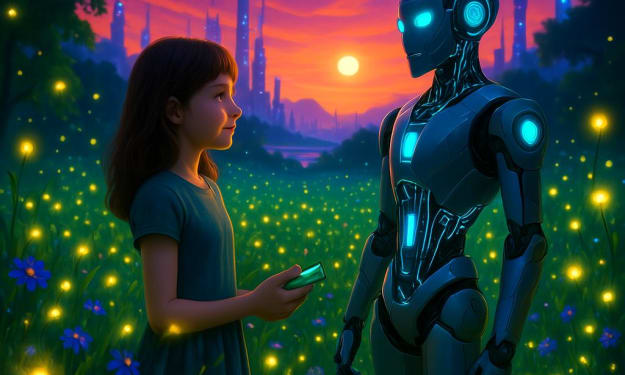
The summer of 2075 was supposed to be my last in Willow Hollow. The town was dying, just like the rest of the world. The air was thick with dust, the rivers were dry, and the trees were more brown than green. They said the planet was giving up, that we’d burned it out with our machines and greed. I was sixteen, and all I knew was that I didn’t want to leave. Not yet. My name’s Lila. I lived in a crumbling house with my dad, who spent his days fixing broken tech for the few families still hanging on. The city folks had already left for the domes—giant glass bubbles where the air was clean and the food was fake. But Willow Hollow had something the domes didn’t: fireflies. Every summer, they’d light up the meadow behind our house, tiny stars dancing in the dark. Dad said they were a miracle, a sign the world wasn’t done fighting. I believed him. That summer, everything changed. It started with Rusty, the robot Dad built from spare parts. Rusty wasn’t like the shiny bots in the city. He was clunky, with mismatched arms and a screen for a face that flickered when he talked. Dad made him to help with chores, but I thought of him as my friend. He’d follow me to the meadow, his joints creaking, and ask questions like, “Why do humans like glowing bugs?” I’d laugh and say, “Because they’re hope, Rusty.” One night, the fireflies didn’t come. The meadow was dark, silent except for the hum of Rusty’s circuits. I sat on the grass, my stomach twisting. “They’re gone,” I whispered. Rusty tilted his head, his screen glowing faintly. “Data suggests environmental collapse. Fireflies require clean water, stable temperatures.” His voice was flat, but it felt like a punch. I didn’t want data. I wanted my fireflies. The next day, I heard the news. Willow Hollow was being evacuated. The last transport to the domes was coming in a week. Dad started packing, his hands shaking as he boxed up tools. “It’s safer there, Lila,” he said. But the domes felt like giving up. I wanted to fight, like the fireflies did. I snuck out to the meadow every night, hoping for a glow. Rusty came with me, scanning the grass with his sensors. “No biological activity,” he’d say, and I’d glare at him. “Stop being so smart,” I’d snap. But one night, he didn’t scan. He just sat beside me, his metal hand brushing the dirt. “Lila, why do you stay?” he asked. I didn’t have an answer, not really. “Because this is home,” I said finally. “Because I believe they’ll come back.” On the last night before the transport, I was desperate. I ran to the meadow, my sneakers kicking up dust. Rusty followed, his screen flickering. “Lila, probability of firefly return is 0.03%,” he said. I ignored him and dropped to my knees, digging through the dirt like I could find hope buried there. That’s when Rusty did something weird. He knelt beside me and pressed his hand to the ground. A soft hum came from his chest, and his circuits glowed brighter, pulsing like a heartbeat. Then I saw it—a tiny green spark in the grass. A firefly. Then another, and another, until the meadow was alive with light. Emerald, sapphire, amber—they danced around us, brighter than I’d ever seen. I laughed, tears stinging my eyes. “You did this?” I asked Rusty. His screen flickered, almost like a smile. “I accessed dormant nanobots in the soil. Programmed them to mimic firefly bioluminescence. For you.” I stared at him, this clunky robot who’d given me a miracle. “Why?” I whispered. He tilted his head. “Because you believe in hope. I calculated it is worth preserving.” For the first time, I hugged him, his metal cold against my cheek. The next morning, we boarded the transport. I carried a jar with a single firefly—not a real one, but one of Rusty’s nanobots, glowing softly. Dad didn’t ask questions. He just squeezed my hand. As the dome gates closed behind us, I looked back at Willow Hollow, a dusty speck under a purple sky. The fireflies were gone again, but I wasn’t afraid. I had Rusty, and I had hope. In the dome, I started telling stories. Not just about fireflies, but about the world we could rebuild. Kids listened, their eyes wide, and even the adults leaned in. Rusty sat with me, his screen glowing. “You are changing probability,” he said one day. I grinned. “Good.” That summer, I learned something. The world might break, but hope doesn’t. It’s in the stories we tell, the friends we keep, even the ones made of metal. It’s in the fireflies, real or not, that light up the dark. What’s your firefly? What keeps your hope alive? Tell me below.
By Muhammad Abuzar Badshah about a year ago in Fiction
When the Last Beam Fell
I can still see the fire when I close my eyes. The unbridled, wanton destruction of an angel’s gift. That particular memory burned into my brain as hot and fast as the flames that razed this house to the ground, leaving it but the pile of rubble we stand before now. This is a homecoming, in a way, and then you show up with threats of condemning the property if I don’t sell.
By Cypher Robinsonabout a year ago in Fiction
Unbanished
It's the heat that hits me first. Like a memory, like a wall, it makes each breath pull harder and the heart pound. The air shimmers with it, moisture rising off the stony ground and sweat breaking out on my skin. It feels soupier than it did before and I quickly put on my mask and adjust the oxygen levels. The last time I was here I was saying goodbye. I never meant to come back, never thought I'd come back. But, I guess they don't make exile like they used to.
By Freyja Serenabout a year ago in Fiction
The Tiller
With fingers on the keyboard, I am ready to describe the journeys that have maintained the same thrill as the first time, many times since. I recall the same feelings, that still arise today, as they did that first time that I let Golinda and Gallopatrot direct me, as a loadstone, down a road less travelled.
By Katherine D. Grahamabout a year ago in Fiction
I Married a Ghost. Last Night, He Served Me Divorce Papers. AI-Generated.
The divorce papers appeared at 3:07 AM. One moment: empty pillow. Next moment: parchment thick as graveyard soil, smelling of bergamot and decay. Ink the color of dried blood spelled out *Silas Alistair Thorne v. Elara June Finch*. A wax seal pulsed with cold blue light. I didn’t scream. After ten years married to a Victorian-era industrialist’s ghost, you learn panic is pointless. Especially when your undead husband’s idea of foreplay is reciting Edgar Allan Poe during your showers. *How Do You Meet a Ghost? Badly. It started with a Ouija board at a frat party—cliché, I know. We’d aimed for "spooky fun." We summoned Silas Thorne, dead since 1889 (typhoid fever, complicated by poor stock investments). He haunted my apartment for months: freezing my wine, rearranging my books into cryptic symbols, whispering investment tips that *actually* worked. He was charming. For a corpse. He’d materialize as a flicker of top-hatted shadow, quoting Keats while I burned toast. When my fiancé left me ("You’re emotionally cheating… *with a ghost?*"), Silas manifested fully for the first time—a translucent gentleman in waistcoat and cravat, offering a spectral handkerchief. "Modern men lack fortitude," he’d sniffed. "Shall I haunt his Tesla?" *The Chapel of Lingering Vows* We married at a paranormal chapel in New Orleans. Our vows: *"Beyond breath, beyond bone, ‘Til entropy claims the last stone."* Our prenup was… unusual: **§3.2* *Corporeal Spouse (Elara) retains all tangible assets (real estate, chocolate, living pets).* **§5.7: *Ectoplasmic Spouse (Silas) reserves right to manifest during showers/baths for "aural companionship."* **Addendum B:** *Infidelity defined as "consorting with rival spirits (e.g., Gertrude the flapper ghost, who sings show tunes off-key in the parlor on Wednesdays)."* *The Trouble with Immortal Husbands* Immortality makes ghosts *particular*. Silas despised: - Smartphones ("Soulless pocket-spies!") - Scented candles ("Cloying bourgeois propaganda!") - My historian boyfriend, Liam ("That beard has the audacity to touch my wife!") Liam tried. He left 1873 port wine by the fireplace. Read Dickens aloud. Silas retaliated by making Liam’s coffee taste like grave dirt. **The Last Straw: The Tesla Coil Incident** Liam installed an "ambiance enhancer" in the study—a singing Tesla coil. Silas saw it as an act of spectral war. For weeks, our brownstone became a paranormal battleground: - Lights flickering in Morse code insults (*"L-I-A-M I-S A P-E-A-S-A-N-T"*) - Antique portraits weeping black oil - My bathwater turning inexplicably… *chunky* When I unplugged the coil, Silas froze every bottle of Chardonnay in the house. "Prioritizing that *bearded transistor* over our matrimonial resonance?" His voice vibrated from the gramophone horn. "This union is a crypt, Elara." *The Phantom Plaintiff’s Grievances* His legal filing was absurd, even for the dead:
By Wondermindabout a year ago in Fiction
The Midnight Bargain: When My Brother's Voice Cracked a Decade of Silence. AI-Generated.
3:17 AM The phone’s vibration drilled into the silence like a bone saw. I fumbled blindly, squinting at the screen. The name flashing there—*Jake*—felt like a ghost punching me in the throat. Ten years. Three thousand six hundred fifty days of radio silence. And now this. 3 AM. The hour of emergencies and drunks. I almost silenced it. *Almost.* That old bitterness—thick as scar tissue—rose in my chest. The last time I’d heard his voice, he’d called me a "self-righteous parasite" before slamming the door so hard our dead mother’s photo rattled on the wall. Grief over her loss had twisted us into strangers, then enemies. We’d built walls with the bricks of her absence. But something in the *way* it rang… frantic. Relentless. A sound that bypassed my anger and hooked straight into my lizard brain. *Danger.* I swiped answer. Held my breath. *The Static and the Gasp* "E-Ellie?" His voice was shredded glass and static. Not drunk. *Terrified.* "Jake? What—" "They’re… inside the walls." A wet, ragged cough. "The bugs. Can you… *hear* them?" My blood froze. This wasn’t an apology. Wasn’t a reunion. This was a Code Red from a collapsing mind. The Unspoken War Our estrangement wasn’t simple. After Mom’s cancer won, Jake dove headfirst into conspiracy forums and cheap whiskey. I buried myself in spreadsheets and sterile relationships. We became caricatures: *The Crazy Brother. The Ice Sister.* The last fight was nuclear—him screaming about government trackers in his fillings, me hissing that he’d dishonored her memory. Truth? We were both drowning. Just in different oceans. Now, listening to him wheeze about "bioluminescent mites" chewing through his drywall, I faced the gut-punch truth: *He wasn’t calling for forgiveness.* **He was calling because I was still his emergency contact.** *Driving into the Storm* I broke every speed limit driving to his rust-belt apartment. Key still fit the lock (why did I keep it?). The smell hit first—sour milk, stale smoke, and something acrid. Ammonia? He was crouched behind a toppled bookshelf, face gaunt in the blue light of a dead laptop screen. A makeshift "weapon"—a fireplace poker wrapped in duct tape—clattered from his hand when he saw me. "Ellie?" He blinked, childlike. "The… the ventilation shafts. They’re laying eggs in—" "Shut up, Jake." My voice surprised me. Cold. Steady. *Nurse-mode activated.* "Where are your meds?" *The Diagnosis in the Debris* His lithium bottles were empty. Anti-psychotics, untouched since November. Piles of printed forum rants about "nano-parasites" covered the moldy carpet. This wasn’t just addiction. This was schizophrenia’s cruel masterpiece, painted over a decade of neglect. As I forced water into him, wiped grime from his forehead, the old rage flickered. *Why me? Why now?* Then I saw it. Taped to the fridge beneath a takeout menu: A faded Polaroid. Mom, laughing, arms around us at Coney Island. Age 12 and 14. Before the wars. *"My Keepers,"* she’d scribbled on the border. *The Bargain* Getting him committed wasn’t gentle. He fought, sobbing about "extraction teams." I signed papers with hands that didn’t feel like mine. In the sterile hospital hallway, a social worker asked, "Relationship to patient?" I opened my mouth. Closed it. The word *sister* felt foreign. Heavy. "Emergency contact," I finally said. *The Silence After the Storm
By Wondermindabout a year ago in Fiction
The Night My World Turned Upside Down
I was curled up in my favorite armchair, half‑asleep with a mug of lukewarm coffee in hand, when my phone buzzed at 2:47 a.m. The screen lit up with a name I hadn’t thought about in months, and my heart skipped. Four simple words stared back at me: “We need to talk.”
By Hamayoun Tareen about a year ago in Fiction
Artificial Intelligence
In the fast-paced digital age, artificial intelligence (AI) is reshaping how we live, work, and communicate. From chatbots like ChatGPT to powerful image generators and deepfake tools, AI is rapidly expanding its reach. However, behind the seamless digital interactions lies a hidden environmental cost — a rising threat to the world’s most precious resource: water.
By Ahmad shahabout a year ago in Fiction