Psychological
The Clockmaker's Garden
There was a village at the edge of the world where time stood still—not metaphorically, but truly. The sun always hovered in the same place. The shadows never grew longer. The leaves on the trees were forever green, and not a single wrinkle ever touched the faces of the people who lived there. Some called it a paradise. But not Mira. Mira had lived her entire life in this frozen place, where no one aged and nothing ever changed. The village was clean and calm, the people kind and quiet, but it all felt... trapped. Like living inside a snow globe where someone forgot to shake the magic. You see, the village had once been ruled by time like anywhere else. Until the day the Clockmaker came. No one remembered where he came from, or how he had arrived. But he built a tower at the village center—a tall, spiraling thing made of stone and bronze, topped with a golden clock that ticked louder than the wind. Then, one day, he stopped the clock. And when the clock stopped, so did time. People were amazed. No one got older. No one died. Food never spoiled. Days were always sunny. And for a while, it truly was a paradise. But after years, something changed—not outside, but inside the people. They stopped dreaming of new things. They stopped planting new trees. They stopped falling in love. They stopped asking, "What if?" Mira was different. Even as a child, she asked questions no one liked answering. “Why don’t we celebrate birthdays?” “What happens if the clock breaks?” “What’s beyond the hills?” The villagers would smile politely and say, “Don’t worry, dear. Everything is exactly as it should be.” But Mira wasn’t convinced. Especially not after the day she found the seed. It was buried beneath the soil behind her grandmother’s cottage, wrapped in cloth and tied with red thread. The cloth was old—older than the village’s stillness. On it, written in fading ink, were five words: "Plant me when time aches." Mira didn’t know what it meant, but she kept the seed. Years passed—or they should have—and Mira grew older in her heart, even if her body never changed. She read every book the village had. She asked questions the elders refused to answer. She even climbed the clocktower once, but found the door bolted shut with a glowing blue lock she couldn’t break. Until one night, something happened that had never happened before. She saw a petal fall. A single pink petal, drifting down from a tree in the village square. It didn’t make sense. Nothing changed here. Nothing moved unless someone moved it. But that petal had fallen on its own. As if the tree had breathed. That night, she went to her grandmother’s garden with a lantern and trembling hands. She dug a small hole in the earth and placed the old seed in it. As soon as the dirt touched the seed, the ground shivered—just a little. Not enough for anyone else to notice. But Mira did. She watered it with tears. Not because she was sad, but because she suddenly felt something for the first time in a long, long while: hope. The next morning, a small green shoot had emerged. And the day after that, a bud. And a few days later, a flower bloomed—vibrant and golden, with petals that shimmered like sunlight. People began to whisper. Nothing had grown in the village since time stopped. No new flower had bloomed in decades. But there it was, glowing softly like a candle in the fog. When the elders saw it, they panicked. They tore it from the ground. They warned Mira not to interfere again. They told her she was risking everything. That peace must be protected. That the Clockmaker would not approve. But Mira didn’t stop. She remembered what the cloth had said. “Plant me when time aches.” And time was aching. The people were stuck. Their laughter was thin. Their eyes were dull. Peace without change had become a prison with invisible walls. So Mira planted more seeds—some from old apples, some from forgotten flower pots, some even stolen from the locked archives beneath the school. And each time, something bloomed. Small things at first: daisies, dandelions, bluebells. Then vines. Then fruit. Then trees with golden bark that hummed when the wind passed through. And slowly… people changed. Some cried without knowing why. Some remembered dreams they’d buried. Some started writing poems again. Children drew things they’d never seen—skies full of color, mountains beyond the village, oceans they only imagined. And then the unthinkable happened. The clock in the tower ticked. Just once. But loud enough that everyone heard it. That night, Mira returned to the tower. The door that had once been sealed was cracked open. Inside, the gears groaned, stiff from stillness. Dust floated in the beams of moonlight. At the top of the stairs stood the Clockmaker. But he wasn’t what she expected. He looked like an old man made of wood and brass, with eyes like candle flames. His hands were tools. His spine was a coil. And on his chest was a key, long since wound down. “You have brought time back,” he said, his voice the sound of creaking floorboards. “Why did you stop it?” Mira asked. “Because the world was full of pain,” he replied. “And I thought stillness would bring peace. But peace without change… is silence.” She stepped forward. “And silence without growth... is death.” The Clockmaker nodded. “Then finish what you’ve started.” He handed her the key from his chest. She placed it in the clock. And turned it. The clock roared to life. The gears spun. The bell rang. Time surged through the village like a warm wind. The sun moved for the first time in a hundred years. Shadows danced. Trees swayed. Children grew. Laughter returned—not the polite kind, but the wild, uncontrollable kind. People wept and hugged and aged. And in the middle of the village stood Mira, now older, a little grayer, but glowing with life. She never became queen. She didn’t want to. Instead, she planted more gardens. One for every lost year. One for every forgotten dream. And people joined her. Because now… time moved. But so did hope. The End.
By Lucien Hollow about a year ago in Fiction
Forgive Us Our Trespasses
--A day before Thanksgiving-- St. Raphael is a quiet church. In its quiet, at the front of the antechamber, a marble relief of Mary stands with a face bowed and lovingly expressionless. Before her, an exchange priest draped in a white chasuble kneels with his hands clasped. whispering prayer. His name is Elijah, and his patron saint is Michael the Archangel. He is recently ordained and soon to be headed home from his time preaching in the States.
By Anna Whinneryabout a year ago in Fiction
king of thieves
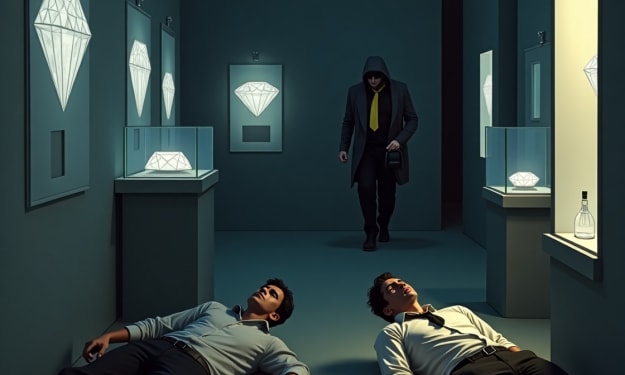
The hall was filled with people. Today, a grand exhibition of diamonds was being held in this hall. Many precious diamonds were on display. Most of the people were outside, busy admiring the diamonds. I too had come to the exhibition when suddenly, a man approached me. He grabbed my hand and led me aside. In his other hand, he held a glass of cold drink, which he placed on the windowsill.
By Bilal Ahmadabout a year ago in Fiction
The Lantern of Whispering Trees
by Yahya Asim In a remote village nestled between the emerald folds of two great hills, there stood a forest known as the Whispering Trees. Locals spoke of it with reverence and caution. They said the trees could talk—not with mouths, but with murmurs carried in the wind. Only those who truly listened could understand their secrets.
By Yahya Asimabout a year ago in Fiction
Somewhere, You Still Exist
You left in August. I remember because the sun looked tired, like it had been burning too long for too many people. That day, even the wind felt final. We didn’t say goodbye properly. Not because we didn’t want to, but because we didn’t know how. Some moments don’t come with instructions. Some endings don't sound like goodbyes — they sound like silence. I still set the table for two sometimes. Out of habit. Or hope. I can’t decide which one is more dangerous. Your laughter used to echo through this apartment. Now, the only sound is the hum of the fridge and the occasional creak of wood—like the place itself is mourning you. I kept your sweater. The blue one. It still smells like that cologne you wore — the one that smelled like forests and something I could never name. Some nights, I press it to my face and breathe in like I’m drowning. I don’t cry as much anymore. But I do stare at walls. I think that’s just a quieter way to fall apart. You told me once that if love was real, it wouldn’t need reminders. But I see you everywhere — in strangers' faces, in the steam of my coffee, in the lines of my palms. If love doesn’t need reminders, why does everything remind me of you? There are things I never told you. Like how I memorized the way you took your tea. Or how I used to fake sleep just to hear you whisper things you were too afraid to say when I was awake. You said you needed space. I tried to be generous with it. I gave you galaxies. But I didn’t know I was handing you the distance to disappear. I walk the long way home now. Past the bookstore we loved. Past the bakery that spelled your name wrong on your birthday cake. These places still exist. But they feel like shadows. I exist in them, but never with you. Time moves, but I don’t. Not really. My body wakes up, eats, breathes — but my heart is curled up somewhere in the past, wrapped in the moment you looked at me like I was enough. I’ve started writing letters I’ll never send. They sit in a shoebox beneath my bed, collecting dust and courage. I call it our archive. Someday, maybe, I’ll burn them all. Or maybe I won’t. My mother asks if I’m okay. I nod. I say yes with my lips while my soul screams no. There’s no language for this kind of ache. I don’t hate you. I hate how I love you — even now. Especially now. Sometimes I dream of you. You’re always happy in those dreams. And I’m always just close enough to hear you laugh but too far to touch. Someone new tried to love me recently. But their hands didn’t know the rhythm of my skin the way yours did. I pulled away before they could find the beat. I don’t compare them to you. That wouldn’t be fair. You’re not a person anymore — you’re a feeling. A season. A storm I walk into willingly. If I saw you again, I don’t know what I’d say. Maybe nothing. Maybe everything. Maybe I’d just smile and hope it translated to “I miss you.” You once told me that people leave, but love doesn’t. You were right. You left. But love stayed. It set up camp in my chest and refused to move. Some nights, I imagine a version of us in another world. One where timing is kind. One where we’re brave. One where you stay. I hope you’re well. Truly. I hope you laugh hard, sleep deeply, and wake up loved. And if ever the wind carries this to you — know that somewhere, quietly and without expectation, I’m still holding space for you. Somewhere, you still exist.
By fazilat bibiabout a year ago in Fiction
The Stranger Who Paid for My Silence
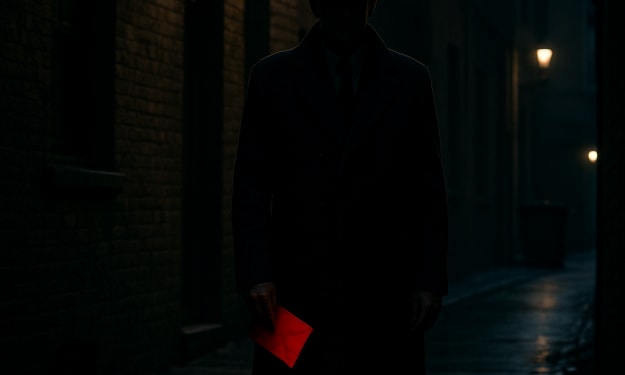
It began with a knock. Not the polite kind. Not the impatient kind either. This one was deliberate. Soft. Three slow taps that echoed louder than they should’ve in the stillness of 2:17 a.m. I sat up in bed, heart thudding louder than the knock itself. I live alone in a small flat above a closed electronics shop. Nobody visits me. Not at this hour. Not ever, really. I peered out the window and saw nothing. The narrow alley was swallowed in shadows, lit only by a flickering streetlamp that gave off more buzz than brightness. Another knock. I hesitated, then opened the door. A man in a black overcoat stood still as stone. No emotion. No urgency. Just... stillness. He held out a thick envelope and said, “Forget what you saw.” I stared at him. “I didn’t see anything.” His eyes narrowed. “Not yet.” Before I could say another word, he dropped the envelope into my hands and walked away, swallowed by the shadows as quickly as he had appeared. --- Inside the envelope were five crisp one-hundred-pound notes. No message. No instructions. I waited until morning before I told anyone — which is to say, I didn’t. Instead, I walked the alley where he had vanished. Nothing unusual. No blood, no signs of a struggle, no footprints. Just a quiet street pretending nothing had happened. I told myself to ignore it. Maybe it was a prank. Maybe it was a mistake. But the next night, I saw it. --- I had stepped outside for air, trying to convince myself the whole thing had been a dream. That’s when I noticed the blinking red light — a small security camera I never installed, positioned just above the alley exit. It wasn’t there before. I followed its line of sight. And saw the stain. Blood, dark and dried, partially hidden behind a dumpster. I moved closer, and that’s when I saw the shoe — just one. Women’s. Red, with a broken strap. There was no body. Just silence and the growing certainty that I had stepped into something far beyond coincidence. --- The next day, I received a letter in my mailbox. No name. No return address. “Keep quiet. Or we’ll come for what we paid for.” --- I told myself it wasn’t worth the risk. I didn’t know anything for certain. I wasn’t involved. Maybe someone else already called the police. Maybe the shoe meant nothing. But I couldn’t sleep. I started checking the alley every night, waiting for something to return. Or disappear. One night, I noticed the shoe was gone. The blood, too. And the camera? Disconnected. Like it had never been there. I stopped receiving letters. No more money. No more knocks. Just a deep, slow unraveling of my peace. --- Weeks passed. I went back to work, pretending I wasn’t watching every stranger’s face on the street, wondering if one of them knew. Or was watching me. Then the dreams began. A woman, face hidden, standing at the foot of my bed. Silent. Pointing to the door. Sometimes she cried. Other times, she held an envelope in her hand. A red shoe dangling from her fingers. One night, I followed her. In the dream, the door opened to the alley. I stepped outside. The man in the black coat waited for me. But this time, his hands were empty. “You kept the money,” he whispered. “Now pay the price.” I woke up screaming. --- I started carrying the envelope with me everywhere. As if holding it gave me control. As if I could reverse what I hadn’t done. And then one evening, while walking past a charity shop, I froze. In the window display was a familiar red shoe. Not a pair. Just one. Broken strap. Faded sole. I rushed inside. “Where did this come from?” I asked the old woman behind the counter. “Oh, people drop things off all the time,” she replied. “That one came in a black bag last week. Anonymous donation.” I bought it for 50p. And placed it next to the envelope on my nightstand. --- I never did go to the police. Not because I was afraid of being accused — but because I knew, deep down, they’d find nothing. No camera. No man in black. No record of anyone disappearing. Just me. And my silence. --- It’s been six months now. Sometimes, I hear footsteps outside my door, but when I check, there’s no one. Other nights, I wake up to see the red shoe has moved an inch closer to the edge of the nightstand. I push it back. But every time I do, I feel like I’m pushing her further away. --- You might ask why I never spent the money. Maybe I’m waiting for him to come back. Maybe I’m hoping someone else will knock on my door, this time asking me to speak — not to stay silent. Or maybe, deep down, I know the truth: Some payments don’t settle the debt. They only buy the quiet. And silence, I've learned, has a sound all its own. ---
By Muhammad Riazabout a year ago in Fiction