Psychological
The Last Train to Miray. AI-Generated.
The train station of Miray hadn’t seen a real crowd in years. The walls were cracked, the benches splintered, and the ticket window covered in dust. Once, this place had been the heart of a small but thriving mining town. Now, it was only the heart of one old man who refused to let it die.
By shakir hamidabout a year ago in Fiction
The Angel’s Masquerade. AI-Generated.
The ballroom shimmered with golden lights, chandeliers swaying gently as violins played a haunting tune. Everyone wore masks — some glittered with diamonds, others shimmered with feathers and gold. It was the city’s grandest night — The Masquerade of Grace, where the wealthy and powerful danced their way through lies, secrets, and charm. Among them stood Elena, a girl from the quiet side of the city. She wasn’t rich or famous. She didn’t belong to this world of champagne smiles and whispered betrayals. But tonight, she had a reason to be there — a secret she carried like a shadow. Her mask was simple, made of white silk, but her eyes — they carried fire. A Dance with the Stranger When the orchestra began a slow waltz, a tall man in a black mask approached her. His voice was calm but strangely familiar. “May I have this dance?” he asked. Elena hesitated. Something about him felt dangerous yet magnetic. She placed her hand in his, and they began to move across the marble floor. “You don’t belong here,” he whispered near her ear. “Neither do you,” she replied. He smiled beneath the mask. “Maybe that’s what makes us the same.” For a moment, she forgot why she had come. His presence pulled her in like a spell — until his silver ring caught the light. Her heart stopped. She had seen that ring before — on the hand of the man responsible for destroying her family’s life. Truth Behind the Mask Suddenly, the music faded into the background. Elena’s memory played a cruel symphony. Her father had worked for the city’s biggest corporation, one that ruined hundreds of families — and the man behind it all was the company’s cold-hearted heir. The same man who now danced with her. Her hand trembled, but she didn’t pull away. Instead, she smiled — not out of kindness, but control. “So, what brings a devil to a masquerade of angels?” she asked. He laughed softly. “Maybe even devils want to look like angels sometimes.” That line stung. Because she, too, wasn’t there for pure reasons. Beneath her mask, she wasn’t an angel either. She had come to find him — not to dance, but to destroy. A Game of Shadows They left the ballroom and walked to the balcony, where the night air carried the scent of rain. Below, the city lights glowed like a thousand secrets. “I know who you are,” Elena said finally. His smirk didn’t fade. “Do you now?” “You ruined my father. You took everything from us.” He sighed, taking off his mask. His eyes were sharp, sad even. “I didn’t ruin your father, Elena. The system did. I was just born into it.” “You could have stopped it.” “Maybe,” he said quietly. “But tell me — what are you doing here then? Revenge?” Her silence was the answer. He stepped closer. “Then you’re no angel either.” For a moment, their masks lay forgotten, their truths exposed. Two broken souls standing at the edge of the same darkness, pretending to be different. The Choice Elena’s heart raced as she pulled out a small envelope from her purse — filled with confidential files, stolen from his company’s archives. Evidence that could ruin him forever. She could end everything tonight. But as she looked at him, she saw not a villain — but a man carrying his own burden of guilt. His words echoed in her mind: “Maybe even devils want to look like angels sometimes.” Was revenge really justice? Or just another mask people wore to hide their pain? Unmasking the Heart He turned away, unaware of the papers she held. “You remind me of someone,” he said. “Someone who believed the world could still be kind.” “Maybe it still can,” she whispered, surprising herself. The rain began to fall, washing the glitter from the night. People inside still danced, still laughed, still wore their masks — but outside, Elena dropped hers. It landed softly in the puddle, the silk darkened by rain. She walked away from him, from revenge, from the lies she almost became. Weeks Later A letter arrived at her doorstep, unsigned. Inside it were two things — a check large enough to rebuild her family’s life, and a note that read: > “Not all devils stay devils forever. — Someone you once danced with.” Elena smiled faintly, tucking the note away. She realized that sometimes, the masks we wear are not to deceive others, but to survive the world. Moral of the Story: ✨ Every person carries two faces — one for the world and one for their truth. What matters is not what mask you wear, but what you choose when the mask falls.
By Sajjad Aliabout a year ago in Fiction
His Freckle Too, Stayed Until Morning
I did not notice it before. That small freckle just beneath his left eye, the one the light always seems to find before I do. How many times have I seen his face and never really seen it? The mark itself is nothing special, really, a speck, a shadow of pigment the sun decided to keep for itself, yet tonight it feels like a secret I have finally been allowed to see.
By Peter Thwing - Host of the FST Podcastabout a year ago in Fiction
To The Dead We Owe the Truth. Content Warning.
“We should be considerate to the living; to the dead we owe only the truth. " - Voltaire. I loved my Gran. I loved visiting her and wouldn't stop. But since her dementia had taken its vice-like grip. Since that evil disease had squeezed out everything that made her spectacular, it was harder.
By Paul Stewartabout a year ago in Fiction
The Lighthouse Keeper’s Letter. AI-Generated.
The wind howled along the cliffs of Cape Town, tearing at the edges of the lighthouse like it wanted to knock it into the ocean. Inside, an old man sat hunched over a wooden desk, pen in hand, paper worn and yellowed.
By shakir hamidabout a year ago in Fiction
The Moving Experience
Gold speckles lined the blue carpet. The house in Wilmington, Delaware showed a bed, a basin, and a chair and desk set with a place for a candle in the room. The bed featured a wooden frame and a single mattress with colorful blankets of blue and gold draped on it; the basin had a crack in the outer rim but looked like ivory; the desk showed scratches and lines that covered its surface. A single flame burned and cast a glow over the whole place. In over a hundred and sixty years, the room had not been touched. The door creaked. The musty smell of old paper struck at the nose of Taylor David. He wore jeans and a uniform that spelled out his reason for being there. “We Move Rooms” emblazoned on his gray shirt in crimson. That remained his task. He received a paycheck to collect the items of rooms and relocate them to storage facilities, homes, and incinerators. Now, he ensured the items wound up in a museum.
By Skyler Saundersabout a year ago in Fiction
The Memory Broker
The Memory Broker By Hasnain Shah The first thing I remember selling was my mother’s laugh. It was soft, golden, like sunlight on rippling water. A collector offered me 800 credits for it — a fortune at the time. I told myself I didn’t need it anymore; I still had the memory of her hands, the way she stirred coffee, the way she hummed “Fly Me to the Moon.” I figured one memory wouldn’t hurt.
By Hasnain Shahabout a year ago in Fiction
The Girl in the Red Umbrella
The Girl in the Red Umbrella The rain had been falling for seven straight mornings, soft and unrelenting, like the world was trying to wash itself clean. The city streets shimmered with reflections — puddles catching headlights and broken clouds. Daniel stood under the crooked metal awning of the bus stop, coffee in one hand, his tie damp at the edges. He wasn’t a man who liked change. Every morning, he took the same route, boarded the same bus, and sat in the same seat. But seven days ago, something — or rather, someone — interrupted his quiet routine. She appeared just as the rain began to fall: a woman in a long beige coat, holding a bright red umbrella. The color stood out against the gray world, a stubborn, cheerful defiance against the storm. She never looked up from her book, not once, but the corners of her lips lifted slightly, as if she knew the world around her was watching her glow. That first morning, Daniel only noticed her because she was humming. A faint tune, something half-forgotten — maybe an old love song. He didn’t say anything. Neither did she. But the next morning, she was there again. Same coat. Same red umbrella. Same faint smile. --- On the third day, Daniel found himself leaving home five minutes earlier, just in case she arrived before him. He didn’t know her name. Didn’t even know her destination. But her presence felt like something steady — a quiet comfort between two strangers who never spoke. He started paying attention to details. The way her fingers brushed over the edge of the pages when she turned them. The way she leaned slightly to her right foot, as if the left leg tired easily. And that she always paused reading for a few seconds when the bus pulled up, as though deciding whether to board or wait for another. He tried to catch her eyes once. She didn’t notice. Or maybe she pretended not to. --- By the fifth day, it became a ritual — the rain, the bus stop, the unspoken companionship. He brought an extra coffee that morning. Just in case. He even practiced a line in his head: “Rain’s always better with company, isn’t it?” But when he got there, she was already standing beneath her red umbrella, smiling faintly as she looked out toward the wet street. He hesitated. Words caught in his throat. He never gave her the coffee. That night, he couldn’t stop thinking about her — the woman who read while the world rushed around her. He wondered what kind of stories she liked. Romance? Mystery? Maybe poetry? Did she believe in fate? --- The sixth morning came, and the rain felt heavier, angrier. The sky was the color of steel. Daniel’s umbrella flipped twice in the wind before he made it to the bus stop. She was there, as always, her red umbrella trembling slightly under the gusts. This time, when their eyes finally met, she smiled — small, polite, but real. He smiled back, and something in him shifted. A connection, fragile and wordless, but it was enough. When the bus came, she stepped forward, hesitated, then turned slightly toward him. “You should take this one,” she said softly. Her voice was exactly as he’d imagined — warm, like sunlight through clouds. He blinked, surprised she had spoken first. “What about you?” “I’ll catch the next,” she said. And just like that, he was on the bus, looking out the window as her red umbrella faded into the blur of rain. --- The next morning, Daniel woke before his alarm. The world was quieter. No thunder. No heavy rain — just a gentle drizzle. He smiled to himself, grabbed his umbrella, and hurried out the door. But when he reached the bus stop, she wasn’t there. He checked his watch. Early, maybe? He waited. One bus came, then another. Still no red umbrella. He told himself she was probably running late. Maybe the rain had stopped her. Maybe she’d caught a different route. But the longer he stood there, the more the gray pressed down on him. The city felt dull again. Lifeless. The next day — no sign of her. The third day — nothing. By the fourth day, he wasn’t even pretending anymore. He stood at the bus stop in silence, holding his coffee like a fool, staring at the spot where her umbrella used to glimmer red against the gray. --- Two weeks passed before he saw it again — that flash of red, glinting across the street. His heart stumbled. He turned quickly. But it wasn’t her. Just another woman, another umbrella. Still, the sight tugged at something deep inside him — that ache of something unfinished. He started walking instead of taking the bus. Every now and then, he’d glance down side streets, searching for that familiar color. He never found her. --- One morning, he arrived at the bus stop out of habit. The sky was pale, the air still. And there, taped to the bus stop’s glass wall, was a small, damp note. The handwriting was elegant but faded, written in blue ink: > “To the man with the quiet eyes — thank you for sharing the rain with me. I’m moving away. But those mornings made me believe the world can still be kind. — The girl in the red umbrella.” Daniel stood there for a long moment, the note trembling in his hands. He smiled, though his chest ached. He folded the paper carefully and slipped it into his wallet. Then, for the first time in months, he boarded the bus without waiting. --- That evening, the rain returned — soft and slow. And as the city blurred outside the window, Daniel found himself smiling again. He looked at the empty seat beside him and whispered, “Safe travels, red umbrella.” And maybe it was just a trick of the light, or maybe not — but in the reflection of the window, he swore he saw a faint glimmer of red.
By Abdul Muhammad about a year ago in Fiction
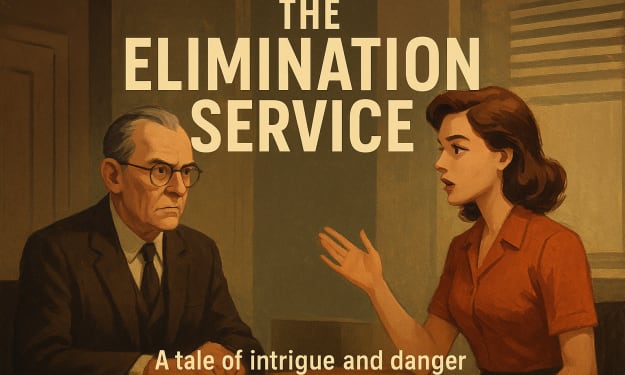
The Elimination Service
The visitor should never have been allowed past the reception desk. Mr. Ferguson only received guests by prior appointment, except for those with matters of extreme importance. Ferguson was a man who valued time as gold. But his secretary, Miss Dale, was young and impressionable. The visitor — an elderly, dignified man dressed in an expensive suit and leaning on a cane — looked every bit the part of someone important. Assuming he must be, Miss Dale ushered him straight into Ferguson’s office.
By Izabella Johnsonabout a year ago in Fiction