Mystery
THE LAST LIGHT IN WILLOW CREEK
When I returned to Willow Creek after twelve years away, the town looked almost exactly as I’d left it—small, neat, peaceful—like someone had pressed “pause” on time. The wooden houses stood in rows like storybook cottages, the old bakery still filled the street with the smell of cinnamon buns, and the creek ran lazily beside the main road, singing its familiar whispering song.
By Alisher Jumayev11 months ago in Fiction
Amber Heartbeat
The first time the wall pulsed beneath Aria’s palm, she thought it was a trick of the late-evening light—one of those soft illusions old houses like to play on tired minds. The hallway was already quiet in that peculiar, listening way, its faded wallpaper breathing dust and age. A thin beam of dusk filtered through the cracked window above the staircase, striking the vine-patterned wallpaper like a spotlight trained on forgotten history. Aria had only returned to the house because her mother insisted. “Just look around,” she’d said over the phone, her voice thin with exhaustion. “Your grandfather kept things… he wasn’t always ready to talk about. Maybe you’ll feel something.” Aria didn’t expect to feel anything. Not in a place abandoned for years, left to creak and sigh with its own memories. But then the wall warmed under her fingers. Not just warmth—a pulse. A slow, deliberate thrum, like a heartbeat reaching up from the wooden bones of the home. It matched her own, syncing with the familiar rhythm in her chest. For a moment she wondered if she was imagining it, projecting her loneliness into the plaster. But the glow was real. A soft amber shimmer spread beneath her hand, faint but alive, like a firefly trapped under thin ice. Aria’s breath caught. “Hello?” she whispered, as if the house might answer. Instead, it remembered. The moment her palm flattened against the glowing patch, the hallway dissolved—not vanished, not replaced, but opened. A rush of warmth swept through her, rolling through her veins in waves. Suddenly she was everywhere at once: in her childhood, running through this corridor with socks sliding over polished wood; at her father’s funeral, where grief pressed into her ribs like a stone; and at age six, where she sat cross-legged near the staircase as her grandfather carved something small from amber, humming a tune she’d forgotten until now. But the visions didn’t stop with her. She saw her grandfather as a young man, barefoot on these very boards, carrying boxes during a moonlit move-in. She saw her great-grandmother at the kitchen table writing a letter she never sent. She saw laughter echoing from a New Year’s Eve long before she was born, and tears shed in corners never touched by daylight. The house held all of it—every grief, every secret, every hope pressed into wood and wallpaper. And then she saw it: Her father, still a teenager, standing in the very hallway where she stood now. He pressed his hand to the wall, the same glowing heartbeat pulsing beneath his touch. His eyes widened with awe, then softened with recognition. He whispered something Aria couldn’t hear. But whoever—or whatever—heard him answered. A final memory rose from the depths of the house, and this one was not gentle. Aria’s chest tightened as she watched her father kneel and press something small into a gap between floorboards. A necklace. A pendant shaped like a teardrop—amber, warm and honey-bright. Then he covered it again, hiding it with the practiced care of someone burying something precious. The glow from the wall flickered. Aria stumbled back, breath shaking. The hallway returned to stillness. Her heartbeat raced unevenly, no longer paired with the pulse. But she knew, with an instinct deeper than thought, where she had to look. She knelt on the floor, fingers trembling as she pried at the gap she’d seen in the memory. Dust puffed out. Wood shifted with a reluctant groan. And then—there it was. A pendant. Amber. Smooth as river-worn stone, warm as held sunlight. Her chest tightened. She remembered leaning against her father at age five, playing with a pendant just like this while he told her a story about “hearts that stay behind to guide the ones they love.” This was his. A folded slip of paper lay beneath it, the edges browned with age. Aria opened it carefully, afraid it might crumble. The handwriting was unmistakable—thin, looping, thoughtful. For Aria. If you find this, it means the house remembered you too. Some memories hurt to speak aloud. But I never wanted mine to become ghosts. This home holds our family because it holds our hearts. When it pulses for you, it means you’re part of its memory now. Trust it. And don’t be afraid to listen. —Dad Aria pressed the paper to her chest. The hall blurred as tears filled her eyes, warm and aching. She had spent years thinking her father kept his distance because he didn’t know how to be close—never realizing he was trying to protect her from the weight of his own past. The amber pendant pulsed once—softly, gently. Like a heartbeat. Like a welcome. Aria rose to her feet, pendant in hand. The glow beneath the wallpaper dimmed, settling back into silence. But she felt it now—the steady, quiet presence beneath the plaster. The house was no longer just a house. It was a keeper of souls, a guardian of stories, a witness that wanted to share instead of hide. She placed her palm once more on the wall. It warmed beneath her touch. This time, the heartbeat aligned not with hers, but through hers—as if the house itself had taken a steady, calming breath. “I’m here,” Aria whispered. “And I’m listening.” The wall pulsed again. And the house remembered.
By Jhon smith11 months ago in Fiction
THE QUIET WOMAN ACROSS THE HALL
I first noticed her on a wet Tuesday morning, the kind of morning when the city felt permanently exhausted. She stood in the narrow hallway of our apartment building, staring at the wall as if deciphering invisible handwriting. A pale woman, tall and thin, with dark circles under her eyes that suggested she hadn’t slept in days.
By Alisher Jumayev11 months ago in Fiction
Dust Map
There are houses that keep their secrets in the walls, and then there are houses that whisper them directly into your bones. My grandmother’s house was the second kind. I returned to it on a wind-heavy evening in late autumn, when the air tasted like rain that hadn’t decided whether to fall. The hallway greeted me with its familiar hush. The faded wallpaper—vines, tiny birds—looked softer than I remembered, as if age had gentled it instead of erasing it. But it was the dust that caught my eye. It hovered in the beam of my flashlight, not drifting randomly like it should have, but swaying as if listening to something I couldn’t hear. The floor creaked beneath my boots, and the particles shivered, settling in soft waves, then ripples, then lines. A shape began to form. I crouched down. The dust gathered with a strange, delicate patience, sketching curves and corners across the floorboards. My heart climbed into my throat. When the pattern completed itself, I realized I was staring at a map—crude, shimmering, impossibly precise. At the bottom edge, the dust thickened into a symbol I knew by heart: the silhouette of the old oak tree outside. The one my grandmother used to call the sentinel. The one that guarded our summers with its wide arms and shadow-cool afternoons. But beneath the sketched symbol, the dust dipped into a deeper groove—a small indentation in the floor I’d never noticed. I touched it with the tip of my finger. Something beneath the house hummed, like a memory waking up. I stood abruptly and backed away. The dust pattern stayed still, as if waiting. Grandma used to tell me that houses remember the things we forget. I always thought she meant the way a house creaks differently after someone moves away, or how a closed room keeps a faint trace of perfume long after its owner is gone. But standing there, staring at a map made from light and dust, I wondered if she had meant something more precise. Something more literal. I slipped on my coat and stepped outside. The night was crisp. Leaves skittered across the lawn like restless thoughts. The oak tree rose ahead of me, quiet and solemn, its branches swaying as if acknowledging my arrival. A childhood image flashed in my mind—Grandma standing under it, her apron pockets full of stories she never told. I walked closer. The ground beneath the tree felt oddly loose, softer than the rest of the yard. I knelt, digging with my hands first, then with the rusty gardening trowel I found half-buried nearby. The earth gave way easily, as if it, too, had been waiting. Minutes passed. Maybe an hour. Then the metal thunked. My breath caught. I swept dirt aside and uncovered a small wooden chest, edges worn, hinges rusted, the wood darkened by decades of silence. It looked like it had been hidden not just by soil but by intention. My hands trembled as I lifted it out of the ground. A part of me expected it to hum, or glow, or shift like magic. Instead, it simply existed—quiet, heavy, patient. I carried it back inside, dust map still glistening faintly on the floor. I sat in the glow of the hallway light, the house breathing softly around me, and opened the chest. Inside were letters. Dozens of them. All addressed to my grandmother. Each sealed with the same symbol etched into the dust: the oak tree, the sentinel. I opened the first letter. The handwriting was unmistakable—my grandfather’s. The man who vanished when my mother was a child. The man whose name sat in family history like a half-erased sentence. His words spilled out in looping ink: “If anyone ever finds these, it means the house remembered. It means the truth was patient enough to wait.” He wrote about leaving during a winter storm, following a rumor of buried family land and a promise he didn’t fully understand. He described clues hidden in the house, in the beams, in the rafters. He wrote about being followed, not by a person but by a feeling—like the past itself was on his heels. And then the final line: “I couldn’t return. Not safely. But the truth is here, in these letters. And the tree will guard them until the house decides you’re ready.” I sat there for a long time, reading until the hallway light flickered with a familiar, tender pulse. It felt almost like approval. The dust map on the floor slowly loosened, drifting back into the air like a sigh of relief. The pattern dissolved, but its memory stayed etched into me. I understood then: the house wasn’t haunted. It was loyal. It had spent years trying to speak. The oak tree outside rustled, its branches swaying to a rhythm older than my family name. And somewhere in that sound was a message—one my grandmother must have heard all her life, one she trusted the house to keep until I grew old enough to listen. I closed the chest gently and held it to my chest. Some secrets are buried. Others are planted. This one had finally grown.
By Jhon smith11 months ago in Fiction
The Last Ember of Aravelle
Aravelle had always been a kingdom of fire. Not destructive fire—but living flame. The ancient Emberstone at the heart of the capital city, Solinaris, glowed with an eternal light that warmed crops, filled the sky with a soft golden haze, and kept the darkness of the Netherdeep at bay. Children were taught that as long as the Ember burned, Aravelle would endure.
By Alisher Jumayev11 months ago in Fiction
I Opened a Door in My House That Should Not Exist
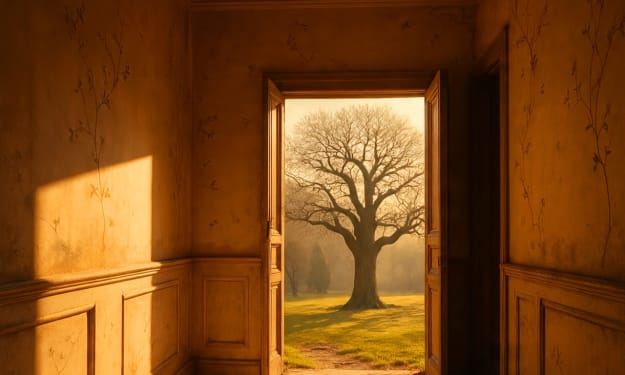
I’ve lived in my house for more than a decade. In all those years, I believed I knew this place better than anyone—every creaking floorboard, every shifting shadow, every cold draft that slipped through the old wooden frames. But yesterday, I discovered something that should not exist in any home. It started like a normal Sunday. I was cleaning the attic—a cramped, dusty room I rarely entered. The air smelled of old books, mothballs, and forgotten years. My flashlight flickered as I swept it across the cluttered space. That’s when I saw it. A door. Not the crooked little cupboard door I already knew about. This one was different. New. Sleek. Pitch‑black. It swallowed the dim attic light like a void. There was no knob, no keyhole—nothing that suggested it belonged to the house. Yet it fit seamlessly into the wall, as if it had always been waiting for me to notice it. Curiosity tugged at me. I touched the door. It was cold—so cold it felt unnatural. A shiver ran through me, urging me to walk away. But then a whisper, faint but insistent, echoed inside my mind: Open it. I found a hidden latch along the edge and pulled. The door swung inward without resistance. Beyond it was complete darkness—thick, endless, almost alive. My flashlight beam disappeared into it as though the dark was swallowing the light itself. I should have stopped. But my feet moved on their own. The moment I stepped through, everything changed. The attic vanished. I found myself standing on a cobblestone street wrapped in dense fog. Golden lampposts flickered in the distance. The air smelled of damp earth and burning wood—like a forgotten century. People walked past me wearing long coats, bonnets, and top hats. Victorian clothing. But none of them saw me. I wasn’t part of their world. I felt like a phantom drifting through someone else’s memory. As I walked deeper, the fog thickened. Buildings tilted inward as if watching me with their dark windows. The ground rippled beneath my feet like shifting water. I tried to speak, but my voice was gone—replaced by a humming sound that felt ancient, intelligent, and aware of me. Then I noticed the clock tower. Its cracked face spun backward, time twisting in reverse. And at its base stood a woman. Tall, draped in black silk, her face hidden by a veil. She lifted a gloved hand and beckoned. “You shouldn’t be here,” she said. Her voice echoed everywhere at once. “This place chooses its visitors. Not every door is meant to open.” My heart thudded. “Where am I?” “This is the Between,” she whispered. “A liminal space stitched between moments. A place where time folds and forgotten memories drift. Your world touches ours only briefly. Leave now—before it notices you.” I realized then: the fog wasn’t fog. It was the residue of old memories—lost, fractured, waiting for someone to step inside. I felt eyes on me, countless unseen eyes, studying me like I was an intruder in a sacred place. Panic surged. “How do I leave?” “Through the door you came,” she said. “But hurry. The door closes once. Hesitate, and it disappears. Hesitate, and you become part of this place.” I ran. The cobblestones liquefied under my feet. The fog grew so thick I could barely see my hands. But then— I was back. Back in my attic. Back in the dust and dim light. The black door was gone. Completely vanished. Except for a faint outline pressed into the plaster, like the ghost of a doorway that refused to be forgotten. I told myself it was stress, lack of sleep, imagination. But every night since then, I hear something. A soft, patient scratching. Like a knock. From the other side. One thing is certain: My house is hiding a secret. And if that door appears again… I don’t know if I’d have the strength to open it—or the wisdom to walk away.
By Muhammad Reyaz11 months ago in Fiction
PART II — THE SKY THAT REMEMBERS
The instant Kael and Elara stepped through the star-lit arch, the ground vanished beneath their feet. Wind roared around them. Colors bled like liquid starlight, swirling in impossible shapes—spirals of violet flame, rivers of gold flowing upward, fragments of constellations drifting like snow.
By Alisher Jumayev11 months ago in Fiction