Mystery
Above From Below Part 5
Rick was dressed and ready to go, after a much needed rest at a local hotel. It was one of those cash by the hour joints, or by the week, as the case was. It served Rick well enough since it had a shower, a toilet, and a sink with running water. There was an ice machine at the end of the structure, and across the street was a greasy diner. Overall, he'd been forced to spend time in worse placed than this.
By Jason Morton7 months ago in Fiction
Never Go Through This Door
Never Go Through This Door The warning was carved deep into the wood, not written, not painted, but cut in hard as if someone had pressed a blade into it again and again just to make sure it stayed. The letters were uneven, rough at the edges, and darkened with age. You could tell it had been there a long time. Never go through this door. I stood there longer than I should have, not because I believed it, but because of how it had been done. No one carves something like that for no reason. It takes time, effort, and a state of mind that does not come lightly.
By ♿ V+ Marie381Uk 7 months ago in Fiction
The Last Customer at Closing Time. AI-Generated.
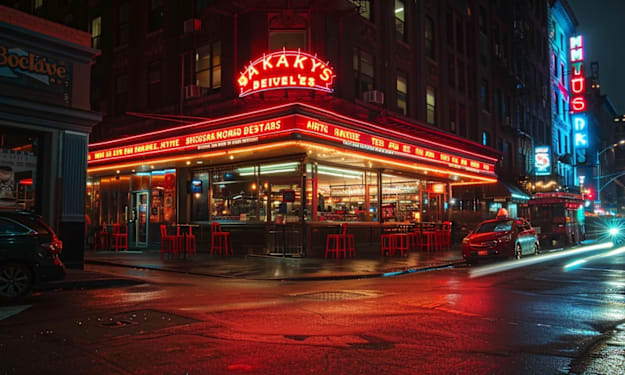
The fluorescent sign above the diner buzzed its final warning: Closed. Grace wiped down the counter for the third time that night, her rag moving in slow, tired circles. It was 11:47 p.m. on a Tuesday in late October, and the rain outside fell like it had nowhere better to go. She had worked the graveyard shift at Benny’s Diner for six years — long enough to know that after midnight, only the lonely, the lost, and the strange wandered in.
By Waleed khan7 months ago in Fiction
When the Streetlights Come On
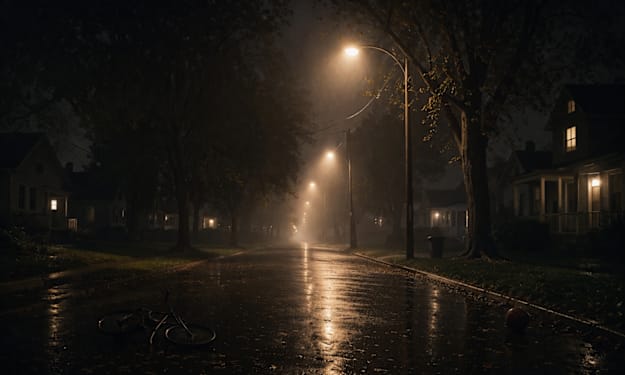
Nobody had to tell us to be home before the streetlights came on. We just were. Not because we were good. Not because we listened. Kids don’t work like that. We rode our bikes too far. Let the basketball roll into the street. Climbed fences we weren’t supposed to touch. Skinned our knees. Lied about where we’d been. Came home sweaty, filthy, and half wild. But when the streetlights flickered, the whole neighborhood changed shape. You could feel it before you saw it. A tightening. Like the evening itself had drawn in a breath and decided not to let it go. The glass over the bulbs would buzz once, then tremble into light, pale and sickly at first, and all at once the street would break open. Bikes dropped mid-spin. A ball left bouncing into somebody’s yard. Kids running full tilt for porches and screen doors and the square yellow safety of kitchen windows. Mothers in doorways with dish towels in their hands. Fathers on the porch with that sharp-edged patience adults get when they’ve already asked twice. And from outside—always from outside—you’d hear your parent call your name. That was enough. You ran faster. No one stood there wondering why the voice sounded farther away than it should. No one stopped to ask why their mother sounded like she was calling from the dark instead of the porch. No one tested it. You heard your parent. You ran. You didn’t stop to think about it. Until Leo. We were twelve when he disappeared, and old enough to think that made us harder to kill. Leo was my identical twin, which meant people said dumb things about us all the time. That they couldn’t tell us apart. That it was like seeing double. That if one of us smiled, the other one looked guilty. We hated most of it, but there was one part that was true: I knew his voice better than anything else in this world. Better than my own, maybe. That night, the streetlights flickered while we were still in the woods. We had cut through because it was faster. Because we were late. Because the long way home felt like admitting we’d misjudged the time, and boys would rather gamble with the dark than lose to a clock. The trees were already going black around the edges. The path was barely a path, just dirt packed hard by years of bad decisions. Roots rose through it like knuckles. The air smelled wet and green and old. Then, from somewhere behind us, our mother called: “Leo. Nico. Get home. Now.” Clear as church bells. We ran. I can still feel the first blind burst of it in my chest. Shoes tearing through leaves. Branches lashing at my arms. That ugly panic that comes when your body decides before your mind does. Leo was right behind me. Until he wasn’t. I heard him hit the ground. A hard sound. Flesh, dirt, roots. All the breath in him leaving at once. I slowed. Not enough. Just enough to know I had. Then his voice split through the trees. “Wait.” Not our mother. Leo. I turned my head just enough to see him in pieces through the dark—one hand in the dirt, one knee bent wrong, face turned toward me— And then something yanked him backward. Not dragged. Not pulled. Yanked. Like the dark itself had gotten tired of waiting. I ran. I ran out of the woods and across the ditch and up the porch steps so fast I nearly broke my face on the front door. My mother grabbed my shoulders. I remember that. Her hands, hot and solid. The porch light. The smell of fried onions coming from the kitchen like the world had the nerve to still be normal. “Where’s Leo?” “He fell,” I said. That was what I gave her. He fell. Like that covered it. Like the woods had simply misplaced him. We went back with flashlights. My father crashed through brush like noise alone could scare the dark into giving his son back. My mother called until her voice shredded. I stood there shaking and watched our lights move across tree trunks and briars and the uneven ground where the path dipped. All we found was his baseball cap. And the marks. The dirt looked torn up. Not like footprints. Not like an animal, either. More like someone had tried to hold on with both hands and failed. Furrows cut into the ground. Lines dragged through leaves. The shape of fear left behind after the body was gone. The forest here was too quiet. The kind of silence that feels heavy, like it’s holding its breath. There was no blood. Just those deep, desperate gouges in the loam. They ended at the base of a tree, bark stripped raw where something had met it hard enough to leave a mark. Whatever had taken him hadn’t lifted him up; it had simply made him cease to be part of the ground. No one said much after that. They didn’t have to. Something in the whole town bent. Parents got meaner when the sun went down. Kids got quicker. By late afternoon, yards started emptying on their own. Nobody played near the woods anymore. Nobody cut through them. Nobody looked toward them if they could help it. And when the streetlights flickered, every porch became a mouth and every house swallowed its children whole. We moved before winter. My mother called it needing a fresh start. My father called it practical. I called it nothing. I stopped calling it anything at all. Years passed. The kind that make people think what happened to them has settled into the past, when really it has just found a quieter room to wait in. Then we came back. The town had shrunk. You could see it in the empty houses with grass grown up around the steps, in the playground with more rust than paint, in the school windows gone dark wing by wing. But our street was still our street. Same poles. Same tired wires overhead. Same road split by old cracks like healed bones. Same woods at the end of the block, dense and silent and pretending to be just trees. I avoided them at first. Then I avoided thinking about them. Then one evening I lost track of time. That’s how it happens. Not with intention. Not with drama. Just a day that runs longer than you meant it to. A sky going from gold to gray while you tell yourself you’ve still got a minute. A block becoming two. Then the whole neighborhood pulling tight around you like a fist. The streetlight above me flickered. My stomach dropped so fast it felt like missing a step in the dark. I ran. The long way home would take too long. I knew that before I had fully turned. My body chose the shortcut before my guilt could object. The woods. Same path. Same mistake. I hit the tree line at a sprint. Branches clawed at my shirt. Dirt kicked loose under my shoes. The smell hit me first—that same wet rot, same green-dark stink of earth and leaves and things left too long alone. I knew this path. I knew every bend of it. I knew where it narrowed, where the roots broke through, where the ditch ran shallow after rain. I knew it right up until the second I didn’t. My foot caught. I went down hard enough to skin both palms and bite my tongue. For one long second everything emptied out. No wind. No insects. No sound but blood hammering in my ears. Then— “Wait up.” I froze. Every part of me went cold at once. Because I knew that voice. Not the way you know a familiar song. Not the way you recognize somebody after years apart. Closer than that. It sounded like me. Not because it was mine. Because it was his. Leo. I shoved myself off the ground and ran. Branches snapped across my face. My breath came ragged and wet. My heart was beating so hard it felt less like panic and more like impact, like something trying to get out. Behind me: “Wait…” Closer. Then, with a crack in it—small, human, almost ashamed— “Please.” My legs kept moving. That was the worst part. Not that I wanted to stop. That I almost did. The trees thinned ahead. Through them I could see the road and the scattered burn of porch lights—warm squares in windows, yellow bulbs over doors, the thin ordinary glow of people washing dishes and arguing and living. Home was there. The world was still there. I only had to reach it. Then the voice came again. Quieter now. Not chasing. Not angry. Almost tired. “Don’t leave me again.” That slid under my ribs and opened something rotten. Because I had heard that plea before. The night I left him. “Don’t leave me.” I didn’t stop. Memory doesn’t need truth. It feeds on what you felt. And this— this felt the same. Leo on the ground. Leo reaching for me. Leo’s voice breaking behind me while I ran— and kept running. I still dream about it with my teeth clenched. My stride faltered. The road was right there. The ditch. The curb. My porch light burning like a tiny private heaven. Behind me: “Wait.” Then softer— “Please.” I slowed. Just enough to feel it. The pull. Not a hand. Not breath on my neck. Nothing I could name and survive naming. Just that awful, intimate certainty that if I turned around, something would be there waiting in the shape of what I loved most. My head started to move. Barely. The beginning of a turn. The first betrayal. Then porch light hit my face through the trees, sudden and gold, and I lunged toward it like a man surfacing from deep water. I broke out of the woods at a stumble, hit the road wrong, nearly fell again, caught myself on the porch rail, and shoved through the front door hard enough to rattle the frame. I barely made it inside. The house smelled like detergent and old wood and whatever my mother had cooked hours ago and forgotten to put away. The clock over the stove ticked too loudly. The kitchen light made everything look flatter than it should have, like the room had been copied from memory and pasted back wrong. My mother stood at the sink. She turned when she heard the door slam. For one second neither of us said anything. I must have looked wrecked. Mud on my jeans. Blood on my palms. Face white as paper. She took a step toward me. I flinched. That stopped her. The silence that followed felt crowded. Like the house was no longer empty around us. Like I had dragged something in with me without meaning to. Then, from the living room— Static. Thin at first. Then louder. A dry electrical hiss, like a voice trying to be born through sand. Neither of us moved. The television was on. Or had been. The screen washed the wall in cold blue pulse. A newscaster’s voice pushed through the static in broken pieces. “…local officials are urging families to keep children indoors after dark…” “…another disappearance reported late last night…” “…residents describe hearing voices—” The signal cut. More static. “…school districts are considering closures due to declining enrollment…” “…authorities continue to advise—” The screen flickered. Then another voice came through. Not the newscaster. Quieter. Closer. “…don’t leave me out here.” My mother crossed the room in three steps, snatched up the remote, and turned the TV off. The black screen held us both. Nobody said a word. Outside, down the block, a porch light stayed on too long.
By Tifani Power 7 months ago in Fiction
The Architecture of the Void
In the city of Oakhaven, the most important things are the ones we agree not to see. Julian was a master of the peripheral glance. It was a skill honed over forty years, a fine-tuning of the soul that allowed him to navigate the world without ever truly looking at it.
By Edward Smith7 months ago in Fiction
The Lesson
I had just deplaned in Austin after a torturous flight from Sacramento. The weather had been bad when we lifted off and didn’t seem to get much better throughout the flight, with an unexpected delay in Vegas that lasted more than three hours. I was already wound up tight for this trip, a work gig that was going to involve either me or someone else losing their job, so the tension of the delays didn’t help me much. Turbulence makes me nervous, and I could definitely feel my shoulders and my gut paying the price. Needless to say, when the plane finally landed, I was more than ready to disembark.
By David Muñoz7 months ago in Fiction
The Fourth Door. Honorable Mention in The Rule Everyone Knows Challenge.
A young man moves into a quiet house with one unspoken rule: never answer the wrong door. But when something begins knocking each night, he learns that survival depends on understanding what no one will explain.
By Ajan Lori A. 7 months ago in Fiction
THE CORNER HOUSE
The mail carrier never walked up the path. She'd pause at the edge of the sidewalk, toes aligned with the crack where concrete met grass, and slip the envelopes through the slot with a practiced flick of her wrist. Sometimes they caught. Sometimes they fluttered to the welcome mat, which had faded from red to something closer to rust. She never went to retrieve them.
By Edward Smith7 months ago in Fiction
The Weight of a Feather
The sun hadn't yet cleared the jagged teeth of the basalt cliffs when Elias began his morning ritual. He stood before the mirror, checking the leather harness that crisscrossed his chest. It was worn supple by decades of salt and sweat. He adjusted the buckles, ensuring the iron-grey stone fastened to his small of his back was centered. It was the size of a prize-winning pumpkin and weighed exactly eighty-four pounds.
By Edward Smith7 months ago in Fiction