Mystery
Endless Tracks: The Train That Never Stops
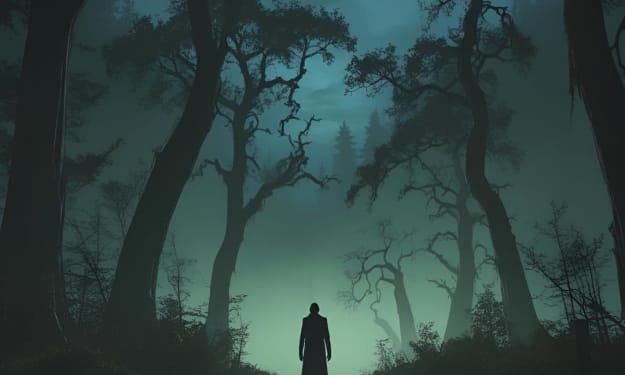
It was a rainy evening when I first heard the whispers about the train that never stops. Everyone in the small town spoke about it in hushed tones—an old steam engine that passed through once in a blue moon, never halting, no matter how much someone waved or begged for it to stop. Some said it was a ghost train, others believed it carried lost souls searching for their final destination.
By Mian Suhaib Aminabout a year ago in Fiction
The Weight of Forgotten Things
The house on Sycamore Lane wasn’t the kind of place you’d notice unless you were looking for it. Tucked behind a curtain of overgrown willow trees, its peeling paint and sagging porch made it seem like it was trying to disappear. Clara hadn’t meant to find it. She’d been wandering, as she often did when the world felt too heavy, her boots crunching through the autumn leaves that blanketed the outskirts of her small town. But something about the house—its silence, maybe, or the way the windows seemed to watch her—drew her closer.
By Fahad Contentabout a year ago in Fiction
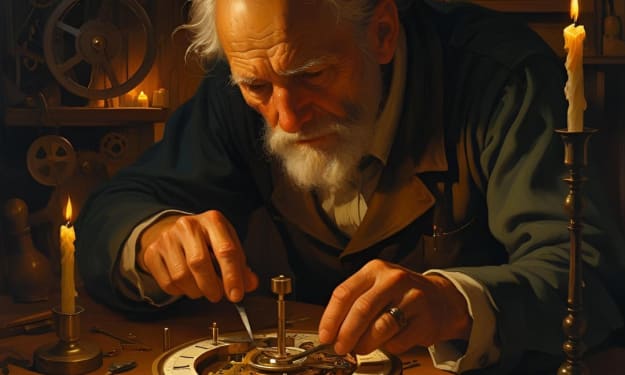
The Clockmaker's Secret. AI-Generated.
The village of Liermont was small, wrapped in hills and fog like an old secret. Time itself seemed to slow there, moving gently through cobbled streets and mossy rooftops, where stories outlived the people who told them. At the heart of it sat a crooked little shop with a weathered wooden sign that read:
By Awais Qarni about a year ago in Fiction
The Keeper’s Call
Clara thought she’d closed the book for good. Her novel, The Keeper of the Crescent, had become a quiet phenomenon, passed from reader to reader like a secret. Book clubs in Chicago, coffee shops in Seattle, and libraries in Atlanta buzzed with its words, each person claiming the story felt written for them. Clara, now 33, had settled into a rhythm—writing by day, reading fan letters by night, the locket still warm against her chest. But the dreams hadn’t stopped.
By Shohel Ranaabout a year ago in Fiction
The Next Chapter
Clara hadn’t touched the book in months. It sat on her shelf, its plain gray cover blending into the shadows of her apartment, now just a silent relic of that strange autumn. The locket, though, she wore every day, its crescent moon engraving catching the light as a quiet reminder of the impossible. Life had moved forward—Clara had started writing again, short stories at first, then a novel, her words spilling out with a courage she hadn’t known she possessed. The bookstore’s disappearance still haunted her, but she’d convinced herself it was a chapter closed.
By Shohel Ranaabout a year ago in Fiction
When the moon stopped rising
When the Moon Stopped Rising No one noticed it the first night. The sky was clouded, and most people were tucked into their glowing rectangles of distraction—phones, tablets, televisions. But the astronomers noticed. They watched the lunar feed glitch, then go black. The moon had vanished. By the second night, headlines screamed “Where Is the Moon?” Panic settled in like a low fog. Tides swelled unpredictably, swallowing shorelines and vomiting up forgotten shipwrecks. Animals grew restless—wolves howled in disoriented confusion, and migratory birds flew in circles. Children stopped sleeping. Grown men forgot how to cry and simply stared at blank skies with red, twitching eyes. Governments issued statements. "An optical illusion," some said. "An atmospheric anomaly." But no satellites could find it. It wasn’t hiding. It was gone. And slowly, the world began to break. --- Dreamwalker. That’s what they called her. Her real name was Mera, and she had never been like everyone else. Since childhood, her dreams weren’t just dreams—they were places. Sometimes beautiful, sometimes terrifying, but always real. She could walk in others' dreams too, though most locked her out with walls of noise and trauma. But now, in this moonless world, people began to dream of the same thing. The same place. Mera saw it first: a scorched desert of gray, dust-filled air, a sky of endless black, and above her—a massive, chained orb screaming in silence. The moon wasn’t gone. It was trapped. --- News of Mera spread fast. Her drawings of the chained moon matched what hundreds began to see in their dreams. Governments scoffed. Scientists dismissed it. But ordinary people… they started to believe. A quiet movement formed—those who followed Mera called themselves The Nightbound. They believed the moon was crying for help, and only dreamwalkers like Mera could reach it. Each night, Mera returned. The dream was always the same. A ruined temple of bone and dust stood beneath the suspended moon. Blackened chains anchored it to invisible corners of the dreamworld. And always, a figure waited at the temple’s steps: a child made of stars. “You remember us,” the child said one night. “Who are you?” Mera asked. “We are the parts of the mind left behind when the world stopped dreaming,” the child said. “The moon is not just a rock. It is memory. It is balance. The world needed rest, needed darkness. Now… now it is unraveling.” Mera began to understand. The moon was more than light. It was a boundary, a rhythm, a mother of dreams. Its absence was turning people mad not just from lack of sleep, but from the collapse of something far deeper: the unconscious connection between the earth and the mind. --- Outside the dream, chaos brewed. Sleep-deprived drivers turned highways into death strips. Oceans surged with a madness of their own. A second sun appeared in the sky for one terrible hour—then blinked out. People stopped dreaming altogether. And those who could still sleep? They screamed in their sleep. Mera knew time was short. She gathered the Nightbound and taught them to enter the shared dream. It required focus, stillness, and a willingness to let go. On the seventh night of no moon, Mera walked into the dream temple with twelve others. The star-child greeted them, face flickering with old light. “Why is it chained?” Mera asked. “Because you forgot what it means to be still. To rest. To feel the cold and know you are alive. The moon begged to be remembered, but you lit your cities and drowned its song.” “So how do we free it?” someone whispered. The child extended his hand, and twelve dreamers stepped forward. One by one, they disappeared into the dust—offering a piece of their waking selves. Each chain groaned, cracked, and broke. Mera was the last. --- Back in the waking world, her body never moved again. But that night, the clouds parted. And the moon rose. Not as it once was, but larger—deep silver and etched with dark scars that hadn’t been there before. It glowed with a kind of sorrow. The tides settled. Sleep returned to people like rain to parched soil. But Mera never woke. Some say you can still see her—if you stare too long at the moon. A shimmer. A figure. Walking slowly across its surface, barefoot in dust. They call her the Keeper now. And every month, when the moon waxes full, dreamers gather in silence. Not to pray. But to remember. That even the sky can go mad… When the world forgets how to sleep.
By Hammad younasabout a year ago in Fiction
I Rented a Room That Didn’t Exist
I. The Motel in the Middle of Nowhere It was close to midnight when my car’s engine gave up. I was stranded on a mountain road in northern Pakistan, deep in Kaghan Valley. No signal. No lights. Only mist crawling along the road like it had a destination.
By Muhammad Kaleemullahabout a year ago in Fiction
The Coffee Pot Never Lies”
Every morning in Maple Hollow, the coffee pot starts brewing at exactly 5:30 AM. It’s the kind of town where people still wave from their porches, gossip over pie at the diner, and know your dog’s name — even if they don’t remember yours. Eleanor Reeves, 63, has been the first to open the corner café for nearly four decades. Her hands are calloused, her memory sharp, and her coffee stronger than regret. In this town of 3,000 people, Eleanor's Café is more than just a pit stop — it's where lives quietly unfold. Across the cracked linoleum floor, you’ll find Army vets reading the paper, high schoolers whispering into their phones, and new parents looking like they’ve seen war. Eleanor knows them all. She doesn’t need Facebook to know who got divorced, who’s running for town council, or who just came back from rehab. Every day at 6:15, Thomas Young walks in. Always wearing the same faded flannel and trucker hat, always orders black coffee and a cinnamon roll. Retired mechanic. Lost his wife last spring. He doesn’t talk much, but Eleanor knows grief when she sees it. Then there’s Maya, 28, who moved back in with her parents after trying to “make it” in Austin. She now teaches second grade and spends her evenings working on a podcast that maybe five people listen to. But Eleanor listens. That matters. One Thursday morning, Maya asks Eleanor, “How do you stay in one place your whole life?” Eleanor pours her a fresh cup and replies, “You don’t have to go far to live a big life. You just have to pay attention.” That line sticks with Maya. It ends up in her next podcast, which somehow goes semi-viral. An agent emails. A publisher calls. She’s baffled. All she did was quote Eleanor. Weeks go by, and one day Eleanor finds her own face — lines and all — on a magazine cover Maya sends her. “The Wisdom of Small-Town America.” Maya’s voice on the phone shakes with gratitude. “You changed my life,” she says. But Eleanor just chuckles. “I didn’t change anything, honey. You just started listening.” That year, Maya moves to New York. Thomas starts sitting a little longer at the café, sometimes smiling at a woman who comes in after yoga. And Eleanor? She keeps opening up at 5:30 AM. Because even if everything changes, the coffee pot never lies. Eleanor never considered herself a storyteller, yet every cup of coffee she poured carried one. The café had become a patchwork of lives — stitched together not by grand gestures, but by morning routines, quiet nods, and the occasional unsolicited advice. It was a living, breathing diary of Maple Hollow, and Eleanor was its keeper. On the surface, not much changed in the town. The same wooden sign swung above the café door, and the same bell jingled when it opened. But underneath, people grew, stumbled, and healed — all within those worn-out walls. Eleanor didn’t need to say much; she had the rare gift of listening deeply. Her silence gave others room to speak their truth, even when they didn’t know they needed to. That’s what Maya had picked up on. The podcast wasn’t just about a café — it was about presence, about noticing the things that most people rush past. Maya had tried to find meaning in cities filled with noise, but it was in Eleanor’s stillness that she finally heard it. The town changed slowly, one honest moment at a time. And while Maya’s voice reached thousands, Eleanor’s never left the café. She didn’t have to — her truth was already steeped into every pot she brewed. Theme: This story highlights the essence of American life — a slower pace, deep roots, generational wisdom, and the way ordinary people quietly impact each other. It blends modern realities (burnout, return-to-hometown, digital lives) with timeless Americana.
By Dr Gabriel about a year ago in Fiction