Mystery
The Clockmaker’s Promise
Part 1: The Inheritance of Gears Elara’s grandfather died on a Tuesday. By Friday, she stood in his clock shop, "Chronos & Heart," breathing air thick with oil and loneliness. Hundreds of timepieces covered the walls—grandfather clocks sighing like tired giants, pocket watches humming in drawers, cuckoo clocks silent behind sealed doors.
By Habibullahabout a year ago in Fiction
The Summer Below
The summer was supposed to be perfect. Jayla had made a list: get her lifeguard recertification, work mornings at the pool, spend nights at the lake with Theo, and maybe—finally—tell him she liked him as more than a friend. They’d joked about it during senior week. He’d touched her hand and hadn’t let go.
By Shai Andersonabout a year ago in Fiction
The Silent Mountain
The Silent Mountain Written by Noor Khan Part I: The Whisper of the Carpathians In the autumn of 1947, just two years after the end of World War II, Europe was still licking its wounds. Towns were rebuilding, families were reuniting, and the continent's scars ran deeper than any map could show. But in a quiet café on the outskirts of Brașov, Romania, a different story was about to unfold. The café was filled with cigarette smoke and murmurs when a man named Elias Kovács stepped inside. A Hungarian linguist and former codebreaker during the war, Elias wasn’t there for coffee. He carried a leather satchel filled with maps, letters, and a single photograph: a grainy black-and-white image of a snow-covered mountain with strange markings near its peak. “I need a team,” Elias said quietly to the woman sitting at the corner table. Her name was Ana Petrova, a Bulgarian geologist who had studied fault lines all through the Balkans. She took a sip of tea, then nodded slowly. “I’ve heard of this mountain. Locals call it Tăcerea, the Silent One. No birds fly near it. No one who climbs it ever speaks of what they saw.” By the end of that week, five had joined the expedition: Elias, the linguist and seeker of hidden codes. Ana, the scientist chasing seismic anomalies. Luca, an Italian war photographer haunted by the past. Elena, a Polish nurse turned herbalist, fascinated by ancient cures. And Henrik, a stoic Austrian mountaineer with lungs like bellows and eyes that missed nothing. They set off from Brașov with mules, canvas tents, and little fanfare. Their destination: a forgotten path through the southern Carpathians, rumored to lead to a site that predated Roman rule—a mountain lost in silence and time. --- Part II: The Mountain That Watched The climb began gently. Green meadows gave way to dense fir forests. Villagers in nearby hamlets whispered warnings in half-lost dialects: “Don’t stay on the mountain after sundown.” Others simply crossed themselves and closed their doors. On the third night, as the group camped near a frozen stream, Henrik said he’d seen figures among the trees—silent, unmoving, and gone when he looked back. “Elk, maybe?” Luca offered. Henrik shook his head. “Elk don’t watch. These did.” On the fifth day, they reached the base of Tăcerea. The snow was thin but icy. Strange spirals were carved into the rocks—patterns that Elias matched with symbols found in a pre-Christian manuscript from Transylvania. “These weren’t just markings,” he said. “They’re warnings. Directions, maybe. Or barriers.” Elena found herbs growing where no light reached. “This plant shouldn’t exist here. It’s used in rituals... old ones.” And Ana, placing a seismograph into the ground, discovered constant vibration—not from the earth below, but from within the mountain itself. That night, the wind howled in bursts like whispers. The fire wouldn't stay lit. Luca’s camera snapped twice—no one had touched it. --- Part III: The Descent into Silence On the seventh morning, Henrik didn’t wake up. He was alive, but stiff as stone, eyes wide open, lips murmuring nonsense in an unknown tongue. When Elias leaned closer, he gasped. “He’s repeating the same five words… over and over. But it’s not a language I know.” They tried to carry Henrik down the mountain, but as they descended, the mountain began to change. The trail they had marked was gone. The rock underfoot seemed to breathe. Luca tried to photograph the spirals again, but every picture came out black—except one, which showed six shadows instead of five. Panic set in. Elena, normally calm, broke down crying. “We were warned. We shouldn’t have come here. This isn’t science or history—it’s something older. Something angry.” On the ninth day, with food low and sanity fading, the group split. Elias and Ana tried to trace their steps back. Luca insisted on finding the spiral chamber again. Elena stayed to care for Henrik, who now spoke clearly—but in a dead language no one understood. Only Ana returned. --- Part IV: What She Told the World Ana was found two weeks later by a shepherd. She was pale, bruised, and holding a cloth bag containing only Henrik’s compass and Luca’s broken camera. She never spoke publicly about what happened. In a letter to her sister, smuggled out of a hospital in Vienna, Ana wrote: > “The mountain doesn’t want to be known. It was never meant to be touched. Whatever was buried there… watches still. We weren’t the first. We won’t be the last. But I pray the next ones don’t come so soon.” The film from Luca’s last shot was eventually developed. It showed a cavern lined with glowing moss and a dark figure standing just beyond the group—tall, faceless, arms stretched wide. That photograph, now locked in an archive in Warsaw, has never been released.
By Moonlit Lettersabout a year ago in Fiction
When the Sirens Stopped
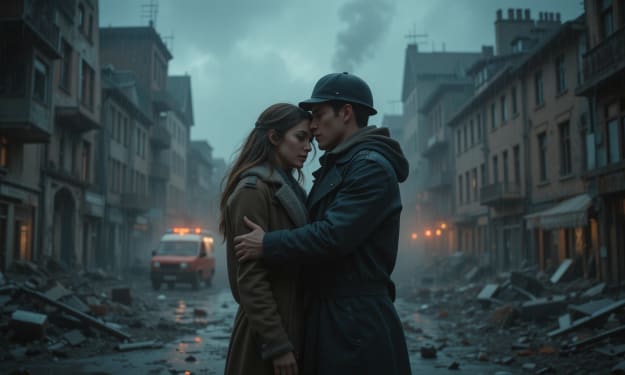
When the Sirens Stopped Written by Noor Khan The air smelled like smoke, and the sky never turned blue anymore. In a shattered corner of Eastern Ukraine, just miles from the frontlines, 22-year-old Lena clutched her backpack tighter and glanced over at Amir. Dust clung to his eyelashes, and his hands trembled as he checked the half-broken radio for updates. The sirens had stopped two days ago, but no one knew whether that meant safety — or silence before the storm. Lena had grown up in Luhansk. She was a university student when the war escalated again, studying literature and dreaming of teaching. Amir was a foreign volunteer medic, half-Ukrainian, half-Turkish, who had arrived to help civilians. Their paths crossed during an airstrike at the local hospital. Amid chaos, their eyes met. She was bleeding from her arm; he wrapped it with a torn shirt and whispered, “You’ll be okay.” She wasn’t. Nothing was. But she followed him anyway. They had been hiding together for eleven days in a collapsed train station basement with no heating, little food, and one flickering flashlight. The city above them was rubble — bones of what once was home. But in that underground darkness, something quietly bloomed. “Do you still think we’ll make it out?” Lena asked one night, her voice barely a whisper. Amir looked at her and smiled faintly. “I don’t think. I believe.” That was Amir. A man of belief. Belief in survival, belief in hope, belief in her. Every few hours, they took turns peeking through a shattered concrete crack above the stairs. Drones still buzzed in the sky. Gunfire echoed like thunder. They scribbled poetry on the back of ration wrappers just to feel human. Then came the twelfth night. They heard footsteps. Loud. Unhurried. Foreign. Amir held his breath and slowly turned off the flashlight. Lena pressed her back to the cold wall, her heartbeat louder than any bomb. The footsteps passed. Then returned. “Russian patrol?” Amir whispered. She nodded silently. They had no weapons. No way to run. Just each other. Suddenly, the footsteps stopped. A voice called out in broken Ukrainian, “We know someone is here. Come out.” Amir grabbed Lena’s hand. “No,” she whispered. “They’ll shoot.” “We can’t stay. We’re out of food. If they find us here, it’s worse.” “But…” “If anything happens—remember your name. And that I love you.” She wanted to scream. Instead, she kissed his forehead, and they stood up together. But fate is strange. As they reached the top of the stairs, a sudden blast rocked the building. Dust rained from the ceiling. The patrol scattered. A nearby apartment tower had been hit — not them. Using the confusion, Amir pulled Lena through a broken side tunnel he had spotted days ago but never dared to use. They ran. Through collapsed corridors. Through narrow alleys lined with burnt-out cars. Through snow dusted with ash. That night, they reached an abandoned Red Cross outpost. It had no doors, no staff, and no medicine. But it had maps. And a working radio. Amir managed to call an NGO in Poland using an old frequency. “Two survivors. One injured. Near checkpoint Bravo 9. Need extraction.” They waited 48 hours in the broken building, feeding on crackers and hope. Finally, a drone hovered above, dropping a flare. Minutes later, a black van appeared from the west — silent, fast, foreign-plated. They were rescued. 💬 Why This Story Matters Lena and Amir now live in Warsaw. She teaches Ukrainian refugee children; he volunteers at a trauma clinic. They still write poems on the backs of receipts. They say war took everything — except what mattered most. Love in a dangerous place is not romance. It's survival. It's staying when everything says to run. It's sharing silence in a room full of fear. It’s believing in life when death is outside your door. Their story never made headlines. But somewhere, in a city still broken, a wall stands with faded graffiti: “The sirens stopped — but we didn’t.”
By Moonlit Lettersabout a year ago in Fiction
The one I couldn't forget. AI-Generated.
I met Ayaan when I was seventeen. He was sitting alone on the school bench during lunch, reading a book no one cared about. He wore a black hoodie, headphones around his neck, and had a calm, quiet smile that never left his face. Nobody really talked to him. He was that kind of boy — always distant, always somewhere else. But I was curious. One day, I sat beside him and asked, “What are you reading?” He looked at me, a little surprised, and replied, “It’s a story about a boy who travels the world to find what he already has.” I laughed. “That sounds confusing.” He smiled. “Sometimes, life is confusing too.” That was the start of something beautiful. We became friends. Slowly, but surely. Ayaan wasn’t like the other boys. He never made fun of people. He didn’t talk loudly or show off. He listened. Really listened. And when he spoke, his words felt like they came from a deeper place. I started sharing things with him I never told anyone. About my dreams, my fears, and the songs I loved. He told me about the stars, his favorite writers, and how he believed people meet for a reason. He always said, “Everything happens when it’s meant to.” A year passed. Then another. By the time we finished school, we were inseparable. Everyone said we looked good together, but we never said anything about love. It was there, unspoken, floating between our words and smiles. Then came college. We went to different cities. I cried the night before he left. He held my hand and said, “We’ll meet again. This isn’t the end. Just a pause.” We texted every day at first. Then once a week. Then… silence. I don’t know what happened. Life happened, maybe. New people, new places, new dreams. I sent him a message once: “Do you still remember me?” He never replied. I waited. One month. Two months. A year. Still, nothing. It broke me in ways I didn’t understand. How could someone who knew me so well forget me so easily? But life moves on. And so did I. Five years passed. I graduated. Got a job. Made new friends. Smiled in photos. Laughed at jokes. But at night, when everything was quiet, I thought of him. Every bridge I crossed. Every song I heard. Every time it rained. He was there. Like a ghost I never wanted to forget. Then one day, out of nowhere, I got a letter. A real letter, not a message. Just an envelope with my name on it. I opened it with shaking hands. It was from Ayaan. > Dear Zara, I don’t know if this will reach you. I don’t even know if you still live at this address. But I had to try. I’m sorry. For the silence. For disappearing. For making you feel forgotten. You were never forgotten. Life got hard. I lost someone in my family. I couldn’t talk about it, not even to you. I didn’t know how. So I shut the world out. Including you. That was my biggest mistake. I came back to our old school last week. Sat on the same bench. I remembered your laughter. Your questions. Your dreams. You’re the one person I still carry in my heart. I don’t expect anything. I just hope… maybe we could meet again. Even just for a walk. Like old times. If you ever feel the same, I’ll be at the bridge — the one near the lake — this Sunday at 5 PM. If you don’t come, I’ll understand. But I’ll still wait. Yours, always, — Ayaan I read the letter a hundred times. My heart felt heavy and light at the same time. Sunday came. I stood in front of my mirror for an hour. Should I go? Would he really be there? Or was it just another goodbye? I took a deep breath and left. The sun was setting when I reached the bridge. The same colors painted the sky — orange, pink, gold. I walked slowly, my hands shaking. And there he was. Leaning against the railing. Looking at the water. Just like before. He turned. His eyes met mine. And suddenly, nothing had changed. We didn’t speak at first. Just stood there, the silence saying more than words ever could. Then he whispered, “I didn’t think you’d come.” I smiled, my eyes full. “I didn’t think you’d wait.” He pulled something from his pocket — an old photo of us sitting on that school bench. “I carry this everywhere.” Tears ran down my cheeks. “I never forgot you,” I said. “I never stopped loving you,” he replied. We talked for hours. About everything. About nothing. We laughed. We cried. We remembered. That night, as the stars appeared one by one, I realized something: Some people come into your life for a moment. Some stay for a season. But a few — just a few — are meant to stay forever. Even if they leave, even if time passes, their place in your heart never fades. They are the ones you can never forget.
By Asad Ullah khan about a year ago in Fiction
The Last Message Before Dawn
It was 3:27 AM when Aiden’s phone buzzed. He groaned, half-asleep, pulling the screen toward his face. One message from Ella. > "If anything happens, I need you to remember what I said at the bridge." He blinked. The bridge? By 3:28 AM, she had gone offline. --- Ella and Aiden had been best friends for eight years. More than friends, some would say. But nothing was ever official between them. They had this unspoken connection, a fragile string stretched tight between distance, fear, and what-ifs. That night, Ella wasn’t supposed to be out. She’d texted Aiden earlier: > "Going home early. Mom’s being weird again." Weird how? He didn’t ask. He should have. --- By morning, Ella was missing. Police found her phone in a drain by Seventh Avenue. No signs of struggle. No trace of her on cameras after 3:30 AM. But Aiden remembered the message: "What I said at the bridge." He hadn’t thought about that night in two years. It was the summer of 2023. They were both seventeen. Sitting on the old railway bridge near Black Hollow Creek, legs dangling off the edge, hearts beating louder than the crickets. She had looked at him, serious. > "If I ever disappear... promise you won’t believe what they say." > "What do you mean?" he’d asked. > "I mean it. One day, something will go wrong. Everyone will tell you it’s my fault. That I ran away, or went crazy. But it won’t be true." At the time, he thought she was being dramatic. Just Ella being Ella. Her mom did have some strange rules. Her dad was absent. Still, nothing prepared him for this. --- Days passed. News reports claimed Ella had a history of depression. That maybe she’d run away. Her mother cried on TV. But something didn’t add up. Aiden went back to the bridge. He stood at the same spot they once sat. Same rusted bolts, same graffiti. His fingers grazed the metal as if it would somehow hold her fingerprint. Then he saw it. Carved beneath the railing, hidden unless you knew where to look: “AIDEN – I’LL FIGHT.” She had written it. Recently. The scratch marks were fresh. So she hadn’t given up. --- He started digging. Ella had once told him her mom used to take her to a therapist she didn’t trust. That the sessions felt more like interrogations. Aiden tracked down the clinic — no record of any sessions. No record of Ella. But a nurse remembered her. “She came with her mother once,” the nurse said quietly. “Didn’t speak. Just stared. Her mother did all the talking.” “What did she say?” Aiden asked. “That Ella wasn’t... behaving. That she needed correction. The words scared me.” --- Then came the second message. From an unknown number. One sentence: > “They’ll come after you too. Stop looking.” Aiden’s blood ran cold. Was this connected? Or someone playing a sick joke? He couldn’t stop. He went to Ella’s house. Her mother refused to open the door. “She’s gone,” she said through the screen. “Let it go. You boys always live in fantasy.” Aiden’s hands shook. “Ella didn’t run,” he whispered. “You know that.” The door slammed. --- That night, Aiden received a package. No sender. No return address. Inside: a flash drive. One video file. He clicked play. It was Ella. In a dimly lit room, hair messy, voice trembling. > “If you’re watching this... it means I didn’t make it. Or they’ve taken me somewhere I can’t leave.” > “My mom isn’t who she pretends to be. There’s a place. A facility. They call it Reform Haven. It’s hidden. Not government, not legal. They take girls like me—rebellious, emotional—and ‘fix’ them.” She looked straight into the camera. > “I never wanted to run. I wanted to live. But they think silence is safety.” > “Tell my story, Aiden.” --- He uploaded the video to every platform he knew. Twitter. Instagram. Reddit. It went viral in 2 days. By day 4, the police raided a farmhouse outside of town. Hidden underground was a private “behavior correction center.” Ella’s mother was arrested. And Ella? They found her. Alive. Broken, but breathing. She had never left. She had been locked away for 19 days. --- A month later, Aiden met her again at the bridge. She looked different. Lighter. Like she could finally breathe. “I knew you’d remember,” she whispered. He didn’t speak. He just sat beside her. Same spot. Same graffiti. But now, carved next to her words, he added: “WE FOUGHT.”
By Ahmad Khanabout a year ago in Fiction
Constellation on Her Skin
Mara had always known there was something different about her. Not in the obvious ways — she looked, spoke, and laughed like anyone else. But late at night, when the world slipped into quiet darkness, she would stand before her mirror and trace the pattern on her skin. A scattered trail of pale, silvery scars meandered over her shoulders and down her back. Most people might have dismissed them as childhood accidents, but Mara knew better. They weren’t random. They had an order, a symmetry that whispered of ancient secrets and forgotten truths. It had started on a winter evening when she was twelve. Mara had fallen on the ice behind her grandmother’s old farmhouse. She remembered the sharp pain of skin tearing, the sting of cold air rushing into the wound, and then — nothing. When she awoke in bed, her grandmother sat beside her, gently dabbing away the blood. “Don’t be afraid,” her grandmother murmured. “Some of us are born marked.” As she grew, the scars multiplied, always appearing after moments she couldn’t remember. A slip on a stairway, a tumble in the forest, a cut from a shattered dish — yet the marks they left were too precise, too deliberate. One night, Mara counted them under the soft glow of her bedside lamp, sketching them onto paper. When she connected the points, they formed a pattern startlingly like a constellation. Years passed, and life moved forward. Mara left home, studied art in the city, and learned to keep her secrets hidden. By day, she painted in studios filled with sunlight. By night, she traced her scars, feeling the pull of something she couldn’t name. Then came the dream. She stood in a vast field under a sky crowded with stars, brighter than she’d ever seen. A voice — soft, ancient, and sorrowful — whispered: “Find us.” When she woke, her skin burned faintly, and a new scar had appeared along her ribcage, completing the constellation. Compelled by something she didn’t fully understand, Mara returned to her grandmother’s farmhouse. The air smelled of earth and memory. Dust floated through shafts of light, and the floorboards creaked beneath her feet. In the attic, tucked away in an old cedar chest, Mara found a bundle of letters bound in faded ribbon. They were addressed to her grandmother, written in careful, looping script. Each letter spoke of the Marked: people born with scars in the shape of constellations, destined to carry messages between worlds. The letters hinted at a gathering place, deep in the forest where the trees grew ancient and silent. At dusk, Mara set out, guided by a pull that felt as familiar as her heartbeat. The forest welcomed her — shadows curling around her like protective arms. She walked until moonlight spilled through the branches, illuminating a clearing she’d never seen before. There, waiting under the silver glow, stood others. Each bore their own constellation: some across their arms, others along their necks or faces. They turned to her, recognition in their eyes — strangers who somehow felt like family. An elder woman stepped forward. Her constellation wound around her wrist like a bracelet of stars. “You’ve heard them too,” she said gently. Mara nodded. “The voice belongs to those who came before us,” the woman explained. “We are the bridge, the storytellers of the sky. Each mark carries a fragment of a story lost to time. Together, we remember.” Mara felt her scars pulse lightly, as if in response. The group formed a circle, and under the watchful stars above, they shared their stories. Tales of forgotten lands, of love and loss, of kingdoms swallowed by sea and cities built in the sky. Each story stitched into the tapestry of the cosmos, their scars a living map. When it was Mara’s turn, words she didn’t know she remembered poured from her lips — of a queen who fell in love with a star, of a promise broken, of a child born carrying the star’s light on her skin. As she spoke, her constellation seemed to shimmer faintly, the scars glowing like pale moonstone. In that moment, Mara understood: her scars were not accidents. They were memory and destiny entwined. Each mark a gift, connecting her to something greater — a lineage of souls tasked to keep forgotten stories alive. As dawn painted the sky with pink and gold, Mara and the others stood together, quiet and whole. The path ahead remained uncertain, but for the first time, she did not feel afraid. The constellation on her skin had always been there, waiting for her to see beyond the scars, beyond the pain. Waiting for her to remember that even the deepest wounds can become the brightest stars. In the end, she realized, we are all marked by our stories. And sometimes, it’s the stories hidden in our scars that shine the brightest. ---
By Mati Henry about a year ago in Fiction
The Summer That Never Ended. Runner-Up in The Summer That Wasn’t Challenge.
Dear Reader, let me tell you a story that changed my fate— and with it, the life of my whole family. A story that I haven't told to anyone in nearly 60 years. A story I stopped telling because nobody believed me.
By Imola Tóthabout a year ago in Fiction
Born of Grit
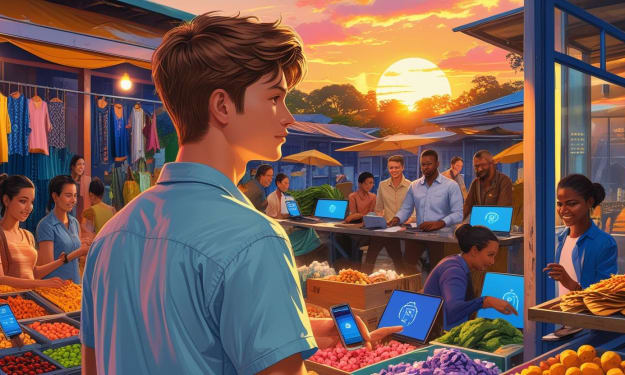
Born of Grit A Tale of Tenacity and Triumph In a sun-baked alley of a sprawling shantytown, where hope was as scarce as shade, lived a boy named Sameer. At nine, he roamed the streets, collecting plastic bottles to trade for a handful of coins. His father, a rickshaw puller, toiled until his lungs gave out; his mother sold wilted vegetables at the market’s edge. Their one-room shack sagged under the weight of poverty, but Sameer’s spirit refused to buckle. In his pocket, he carried a tiny, broken calculator, its cracked screen a mystery he longed to unravel.
By Shohel Ranaabout a year ago in Fiction