Mystery
Remember Your Childhood Bedroom!. Content Warning.
Imagination in childhood is powerful. For a short time, it shapes our lives but how we loose it.. I remember waking up in my bedroom, colours bursting all around me, toys of every shape and size waiting to be played with. Big smiles, bold eyes, and bright creatures greeted me each morning. Back then, even the smallest things seemed huge and magical.
By Cryptic Edwardsabout a year ago in Fiction
The Moon That Mended Itself with Light. AI-Generated.
They said the moon was dying. At first, I didn’t believe them. The sky had always been her stage — eternal, unshaken, perfect in her silver glow. But that night, when I looked up, I saw it — cracks running through her surface like veins of pain.
By Hamayun Khanabout a year ago in Fiction
The Knock at Room 9
The first knock came just after midnight — three slow, deliberate taps against the door, patient and almost polite. Agnes Miller opened her eyes. A thin strip of light spilled beneath the door, but the sound hadn’t come from the hallway. It was closer, as if the room itself had exhaled. She turned toward the nightstand, where her worn Bible and silver rosary rested. The beads trembled faintly, catching the moonlight that slipped through the blinds. The nursing home was meant to be a place of rest, yet Room Nine was never quiet. They said the room was cursed — that people assigned to it never lasted long. Patients who arrived healthy would weaken within days. Machines faltered, crosses fell from their hooks, and radios whispered static during the night. The nurses stopped discussing it aloud, but their silence said more than rumors ever could. Even the most practical ones would cross themselves before entering. When Agnes was wheeled into Room Nine earlier that week, someone murmured, “Poor thing.” She heard it but only smiled. She wasn’t afraid, or at least she told herself she wasn’t. Her Bible and rosary had seen her through war, childbirth, and widowhood. They were her anchor — symbols of faith that kept her tethered when the world tried to unmoor her. Still, she noticed how heavy the air felt her first night there, as though the walls themselves were holding their breath. And when she prayed, she sensed something listening that wasn’t God. The second knock came the following night, softer this time but undeniably closer. The sound seemed to come from within the room rather than beyond the door. The rosary hanging from the bedpost began to sway, the small cross glinting in the dim light. Agnes reached for it, clutching it tightly as she whispered, “The Lord is my light and my salvation; whom shall I fear?” Her hands trembled. The Bible on her nightstand fluttered open on its own, the thin pages settling on Psalm 23. She began to read, her voice wavering as she reached the familiar line: “Yea, though I walk through the valley of the shadow of death…” The words comforted her, yet something in them felt less like reassurance and more like preparation. The air grew colder. She could feel a pull — gentle but insistent — as though the rosary were being drawn toward the door. She gripped it tighter, whispering through clenched teeth, “Not tonight.” On the third night, the knocking came from within the walls. It was steady, patient, almost rhythmic, like a heartbeat. The rosary slipped from her fingers and clattered softly onto the tile. Agnes’s breath caught. “Who are you?” she asked. No voice answered aloud, but she felt the response rise in her chest, a voice both foreign and familiar: It is time. Her pulse stumbled. She wanted to scream, but she couldn’t. The voice didn’t carry malice; it carried finality. Still, fear tried to take hold. “If you are not of God,” she said shakily, “you have no power here.” The light flickered. Her Bible fell open again, this time to Luke 12:5. Her gaze fixed on the verse: “Fear Him who, after your body has been killed, has authority to throw you into hell.” The words struck her like a revelation. This was not a warning but a reminder — that she had feared the wrong thing. At three in the morning, the final knock came. The room had fallen utterly silent, the kind of silence that presses against your ears. The sound no longer came from the walls or the door. It came from somewhere deeper, inside her chest — a slow, fading rhythm that matched her heartbeat. And in that moment, Agnes understood. Death hadn’t come to claim her. God had come to call her home. Tears welled in her eyes as she smiled faintly. “I’m ready,” she whispered. Her trembling hands rested on her Bible and rosary — her faith, her armor, her peace. “Your will be done.” When the nurse entered at dawn, the room felt different. Still, but not cold. Peaceful. Agnes lay motionless, the Bible open across her chest, her rosary coiled perfectly beside her hand. On the open page, something had been written in shaky handwriting, the ink smudged by tears: Do not fear what He created. Fear the One who commands all creation. The nurse stared at the words, her heart pounding as she thought she heard a faint knock — not from the door, but from somewhere far beyond the room. From that day forward, no one feared Room Nine again. The knocks stopped, and those who entered found rest rather than dread. Because sometimes, the knock you fear the most is the one that saves you.
By Carolina Borgesabout a year ago in Fiction
Last Lighthouse Keeper’s Secret
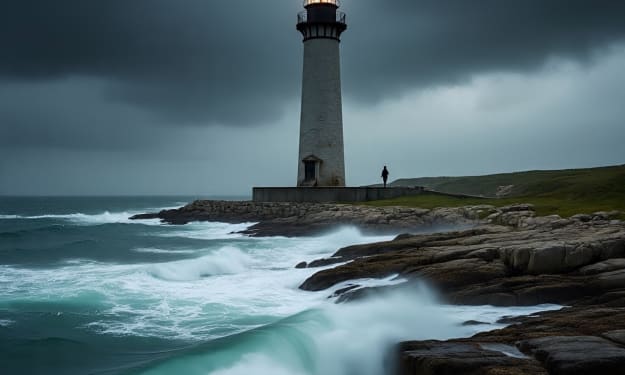
The lighthouse at Graystone Point had been dark for nearly thirty years when I arrived. The tower stood alone on the cliff, leaning slightly toward the sea like an old man listening to the wind. My assignment was simple: document the building before it was demolished and turned into a coastal museum. But the moment I stepped inside, it didn’t feel empty. The air smelled of salt and oil. Dust floated like mist through the sunlight breaking through cracked windows. A table near the corner still held an oil lamp, half-full, as if someone had planned to return. That someone was Thomas Hale — the last lighthouse keeper of Graystone Point. The Keeper Who Never Left According to local records, Thomas had served there for over forty years. When automation arrived in the 1980s, the government ordered all keepers to leave. But Thomas refused. He stayed long after the lights were automated, long after the supply boats stopped coming. The villagers said he was waiting for something — or someone. When I found his logbooks stacked beside the old radio, I expected simple notes about tides and weather. Instead, the entries grew stranger the farther I read. “January 3rd, 1986 — The light flickered tonight. She’s out there again. I can feel her watching the beam.” “March 19th — The fog horn answered back. Three short blasts. That was our signal.” “April 7th — They think she drowned, but the sea doesn’t take what it loves.” I froze at that line. Who was “she”? The Woman in the Storm I found the answer in an envelope hidden beneath the final page of his log. Inside was a photograph — black and white, water-stained — showing Thomas standing beside a woman with dark hair and an unmistakable smile. On the back, in faded ink, were the words: “For when the sea calls her back.” I turned toward the window. The ocean outside was calm, but I swear I could hear a low hum, like a voice buried in the waves. The Night the Light Went Out As I dug deeper into the archives, I learned that in 1962, a ship named The Clementine had wrecked near Graystone Point during a violent storm. The entire crew perished — except for one woman, a marine researcher named Eleanor Reed. Records say Thomas found her clinging to the rocks below the lighthouse. He rescued her, nursed her back to health, and the two became inseparable. But one night, Eleanor took a small boat out during another storm — and never returned. Her body was never found. After that, Thomas stopped writing for a year. When his notes resumed, they were filled with messages not meant for people, but for her — letters written to the sea. The Secret Room In the basement of the lighthouse, I found a rusted hatch beneath a pile of rope. When I pried it open, I discovered a small hidden room, untouched by time. Inside was a single chair, facing a circular window that looked out toward the horizon. On the table before it sat an old transmitter, still connected to the lighthouse power grid. And beside it — a seashell radio. It wasn’t standard equipment. It looked handmade, wires coiled inside a large conch shell. A note taped beneath it read: “When the fog rolls in, listen closely.” That night, as the fog crept in from the ocean, I turned the transmitter on. At first, there was only static. Then — faintly — came a woman’s voice. “Thomas… the light… I see it.” My heart stopped. The signal faded, then returned, soft and distant, like waves whispering through glass. “Keep it burning… until I find my way home.” The voice faded again, and the static swallowed it whole. The Final Entry Thomas’s last logbook entry was dated two days later: “I’ll keep the light burning one more night. She’s closer than ever.” He was found the next morning, sitting by the window in that hidden room, the lamp still glowing. He’d passed peacefully, his hand resting on the conch shell. No one ever heard the voice again. The Secret That Stayed When I left Graystone Point, I turned back one last time. The museum officials hadn’t yet disconnected the power. The light, which had been dead for decades, flickered once — then steadied into a single, warm beam stretching across the dark sea. I stood there for hours, watching it turn. And for just a moment, I thought I saw the silhouette of a woman on the horizon, waving.
By LUNA EDITHabout a year ago in Fiction
Little School of Horrors
Knock, knock knock! No one had knocked on my door for eight years. Now, the rapping is loud, insistent. Its echo stirs my desolate corridors. I used to hear laughter. And shouting, and whispers too. I comforted occasional weeping in a quiet corner, and I sheltered little people from rain. I was their ship that sailed them to a future of letters, numbers, creativity; I was a conduit for friendships, connections, and finished projects.
By Teresa Rentonabout a year ago in Fiction
Echoes of Solace
The knock came just after midnight. Three sharp, deliberate ramps that echoed through the apartment like a warning. I froze, gripping the edge of the kitchen counter, heart hammering. No one should be here. Not at this hour. Not in my building.
By Marlowe Solaceabout a year ago in Fiction
The Visitor Who Never Left
Rain has a way of making the house feel occupied again. It softened the edges of silence, filled the gaps between the floorboards, and carried faint echoes of how the place used to sound—Julian moving between rooms, the low hum of his record player, the kettle beginning to whisper before it boiled.
By Rick Allenabout a year ago in Fiction
The Wrong Address
The house had been settled for hours. The fridge hummed peacefully as I finished cleaning up the kitchen and preparing to settle in. The streetlight in the cul-de-sac made the living room floor glow softly in it's pale light. I brought my book to the living room, tucking myself in under a soft blanket. Inside the hush of rustling pages as I opened my book, the whole night felt careful, like a child holding a glass of water filled to the brim, trying not to spill a drop.
By Autumn Stewabout a year ago in Fiction
The Bracken Will Wither
What happens when the looking eye notices you? That was a question Donald Finnegan asked himself as he was transfixed, bent over the door to the old cellar of the bar, where a saline-dripping, large iris looked from side to side before focusing on him. Salt crusted the handle as a thin layer of sea mist rose from under the door. As he knew full well the door led to nothing but an old, unused storeroom and then the thick back wall of the bar, he put it down to the whisky. He fell backwards, turned away, and ignored it. Daft bastard.
By Paul Stewartabout a year ago in Fiction