Mystery
Katie's Shocking Discovery. Content Warning.
As the sun started to set, Katie jumped from her swing and began her walk home. The swing set was her favorite part of the small playground in the woods near her house. She went there almost every day, and now that it was summer break, she could spend as much time there as she wanted during the day.
By Leah Flesherabout a year ago in Fiction
Behind the Masquerade
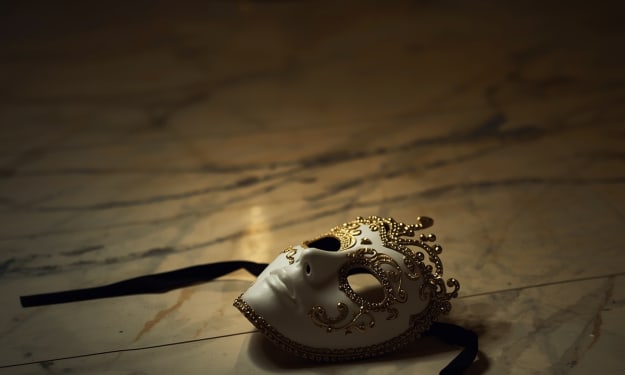
Behind the Masquerade The ballroom glimmered like a dream dipped in gold. Dozens of masked faces floated beneath the chandeliers — laughing, drinking, whispering — each voice carefully measured, each movement rehearsed. It was called The Masquerade of Truth, though no one knew why. The invitation had been printed on black paper, written in silver ink: > “Come dressed as who you are — or who you wish to be.” No one questioned it. In this city, anonymity was elegance. Eleanor stepped inside, her gown flowing like midnight silk. Her mask was simple — a half-face made of white porcelain, smooth and perfect. It hid everything that trembled beneath it: the sleepless nights, the quiet doubts, the secrets she buried beneath perfume and poise. Music fluttered through the air — violins, soft and slow. Couples twirled across the floor, pretending to be whole. A man in a raven mask approached her. His voice was low, like velvet dipped in smoke. “Do you ever wonder,” he asked, “what would happen if we took them off?” Eleanor smiled faintly. “The music would stop.” He tilted his head. “Maybe it should.” There was something about his tone — curious, dangerous, almost too honest. She wanted to ask who he was, but she didn’t. That was the rule here: Don’t ask. Don’t tell. Don’t break the illusion. They danced instead. His hand was steady against her back, but his eyes — dark through the mask — seemed to see her far too clearly. “Tell me your story,” he whispered. She laughed, soft but brittle. “Which one?” “The real one.” “There’s no such thing.” “Then tell me the lie you like best.” She paused. “That I’m happy.” For a second, silence replaced the music — a breath that stretched too long. Then the violins started again, as if nothing had happened. Hours passed, or maybe it was minutes. The Masquerade had a strange way of bending time. Behind every laugh, Eleanor sensed a kind of hunger — everyone trying to hold together the person they wished they were. She saw a woman in a fox mask watching her reflection too closely, as if trying to recognize herself. She saw a man in gold pretending not to cry behind his glass of champagne. She saw herself, reflected in the marble floor, smiling when she didn’t mean it. And she realized: the masks weren’t the disguises. The faces underneath were. Midnight struck. The chandeliers dimmed. A hush rolled through the crowd. The host — an elegant figure dressed entirely in white — stood at the top of the staircase. “Ladies and gentlemen,” they announced, “the hour of truth has arrived. Remove your masks — and see who remains.” Gasps fluttered like wings. No one moved. Then, one by one, the masks began to fall. Porcelain clinked against marble. Feathers brushed the floor. The air felt colder. Eleanor hesitated, her fingers trembling near the edge of her mask. What if the face underneath wasn’t enough? What if it was too much? The man in the raven mask looked at her. “You first,” he said softly. She took a breath — and lifted it away. The room shifted. People she’d known for years looked suddenly different. Without their masks, they seemed smaller, fragile — faces that no longer knew how to smile without help. Some covered themselves with their hands; others turned away in shame. Eleanor’s skin prickled. The air felt sharp, almost too real. The man removed his raven mask next. His face was ordinary — kind eyes, a tired mouth. Nothing magical, nothing strange. And yet, something about his bare honesty felt like the first true thing she’d seen all night. He met her gaze. “Feels lighter, doesn’t it?” “Yes,” she whispered. “And heavier.” All around them, people began to leave, embarrassed by their own humanity. The music faded completely. Only the faint echo of the violins remained, ghostlike. The host in white descended the stairs. Without their mask, they looked just as uncertain as the rest — but their smile was gentle. “You see,” they said quietly, “the masquerade was never about hiding. It was about daring to be seen.” Eleanor stood there, mask in hand, heart pounding. Outside, dawn waited behind the curtains — pale light seeping into the cracks of night. She didn’t know the man’s name. She didn’t know if she would ever see him again. But for the first time in years, she didn’t feel like pretending. They walked out together into the morning air, leaving the masks behind. The city was waking — unmasked, unpolished, real. Eleanor turned to the man beside her and smiled. “Maybe,” she said, “the real masquerade begins when the masks come off.” And somewhere, behind them, the ballroom lights flickered out — one by one — until only the dawn remained.
By Straylightabout a year ago in Fiction
ICU. Content Warning.
The video bell rang and I answered it. It was dark and rainy out, and there was thunder as well, but I was not expecting anyone, so I was a bit wary of it. I hadn't ordered anything from Amazon or Just Eat, so I wondered who it was.
By Mike Singleton 💜 Mikeydred about a year ago in Fiction
The Lost Colony of Roanoke: America’s Oldest Unsolved Mystery
“When they returned, the colony was gone. No bodies. No survivors. Only one word carved into a wooden post: CROATOAN.” In the summer of 1587, a group of 117 English men, women, and children set sail across the Atlantic, dreaming of a new life in the New World. Led by John White, they arrived on Roanoke Island, off the coast of present-day North Carolina. It was England’s first attempt at establishing a permanent settlement in America—a bold step toward expanding its empire across the ocean. But what began as a hopeful venture would soon become one of the greatest mysteries in history.
By Shohel Ranaabout a year ago in Fiction
The River That Remembered Names. AI-Generated.
They said the river could remember. Of course, I didn’t believe it. Grown-ups never do. But in our town, the stories had roots deeper than reason — and if you listened closely enough, the water sometimes sounded like it was whispering.
By James Taylorabout a year ago in Fiction
The Clockmaker’s Daughters. AI-Generated.
When I was a child, my father told me never to listen to the clocks after midnight. He said they whispered. He was the town’s only clockmaker — a patient man with silver eyes and trembling hands that never seemed to miss a gear. Our house sat at the end of a cobbled lane where the wind always smelled like metal dust and oil. Inside, time lived in every corner: walls lined with pendulums, shelves of pocket watches ticking in uneven rhythm, and a great tower clock above our heads that never struck the same hour twice.
By MUHAMMAD SAIFabout a year ago in Fiction
The Lantern at Hollow’s End. AI-Generated.
There’s a road outside the village that no one takes after dusk. It winds through the trees like a sleeping serpent — silent, cold, and shimmering faintly under the moon. The locals call it Hollow’s End, though no one remembers exactly why. Some say a house once stood there, some say a temple, and others whisper it was something far older.
By MUHAMMAD SAIFabout a year ago in Fiction