Microfiction
You Are Darkness
You move gracefully as you saunter through the night. The moon is full above you while the stars are black. It should be unsettling but the absence of the stars doesn’t affect you like it has the others. While they moan, almost in pain, crouching over to clutch their stomachs, you pull your shoulders back, chest out, and walk swiftly with your head held high.
By B. M. Valdezabout a year ago in Fiction
The Secrets My Mother Kept
The Morning Light August 19, 2005 The beach stretched endlessly in both directions, a ribbon of silver sand unmarked by footprints or debris. It was that liminal hour just before dawn when the world held its breath, suspended between night and day. The lighthouse at the far end of the bay had already stopped its rotation, leaving only the faintest echo of its beam painting ghosts across the water.
By Parsley Rose about a year ago in Fiction
The Train That Never Stops
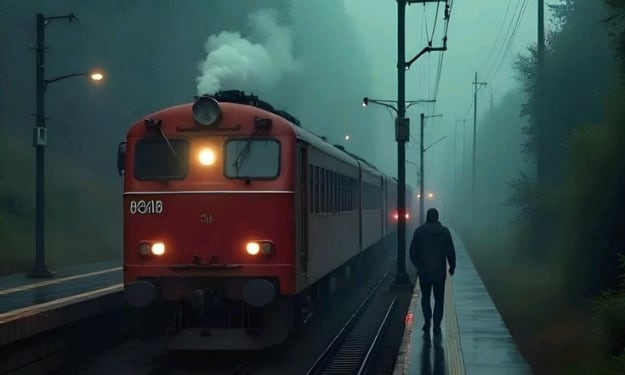
M Mehran Every night at exactly 2:13 a.m., Sam heard the train. It was impossible. The town’s railway station had been closed for nearly twenty years, the tracks long abandoned, weeds curling around the rusted rails. Yet, like clockwork, the whistle echoed through the valley, low and mournful, followed by the distant rattle of wheels. Sam never told anyone. They’d laugh, say it was the wind or his imagination. But he knew what he heard. And deep down, he knew it was calling him. On the anniversary of his father’s death, sleepless and restless, Sam finally gave in. He pulled on his jacket and followed the sound. The moon was high, silvering the broken tracks as he walked. When the whistle blew again, he froze. Up ahead, where the station had crumbled into nothing but brick skeletons, a train stood. Its cars gleamed midnight black, polished as if fresh from the factory. Golden lamps burned in the windows, and steam hissed softly into the night air. The sign above the station—long fallen years ago—glowed faintly with words he could barely read: The Midnight Line. The doors opened with a sigh. Sam’s heart pounded. He should have run, but grief and curiosity overpowered fear. He stepped inside. --- The train was alive with light. Velvet seats lined the compartments, chandeliers swayed gently above, and an old-fashioned bar sparkled with crystal glasses. Yet no passengers filled the seats. Only shadows lingered, faint outlines that dissolved when he looked too closely. At the far end, a conductor in a crisp uniform waited. His face was obscured beneath the brim of his cap, but his voice was smooth as polished wood. “Welcome aboard, Samuel.” Sam stiffened. “How do you know my name?” The conductor smiled faintly. “I know every traveler who boards. The Midnight Line runs only for those who need it.” Sam swallowed hard. “Need it for what?” The conductor tilted his head. “To visit what they’ve lost.” Sam’s breath caught. His father’s face surged in his mind—his laughter, his rough hands, the way he used to ruffle Sam’s hair before bed. “Is he here?” Sam whispered. The conductor stepped aside, gesturing toward the corridor. “Your destination awaits.” --- Sam moved from car to car. In the first, he saw a child clutching a tattered teddy bear. She looked up with wide, tearful eyes. For a heartbeat, he thought she was real—but she faded into mist, leaving only the bear behind. In the next car, an old woman hummed a lullaby. Her voice broke into silence before she too dissolved. Each car held echoes of people long gone, fragments of memory caught in the train’s current. Sam’s chest ached as he passed them, the air thick with longing. Finally, he reached the last car. There, seated at a table by the window, was his father. Solid. Whole. Just as he remembered—broad-shouldered, tired eyes, a gentle smile when he saw Sam. For a moment, Sam couldn’t breathe. His knees buckled, and he sank into the seat across from him. “Dad?” “Hey, kiddo.” His father’s voice was exactly the same—warm, steady. “Took you long enough.” Tears blurred Sam’s vision. “I thought I’d never see you again.” “You weren’t supposed to,” his father said softly. “But the Line… it bends rules, now and then. Gives people a chance to say what they left unsaid.” Sam gripped the table. “Then listen. I’m sorry. For not being there that night. For ignoring your calls. For—” His father raised a hand. “None of that matters now. I don’t blame you. I never did.” Sam’s throat burned. “Then what does matter?” “That you live. Really live. Not just for me. For yourself.” His father leaned forward, eyes shining. “Promise me, Sam. No more letting days slip by like sand. No more waiting for tomorrow to start over.” Sam nodded, tears streaming. “I promise.” The whistle blew again, louder this time. The train began to shudder. His father stood. “Time’s almost up.” Sam panicked. “Wait—can’t I stay? Just a little longer?” His father placed a hand on his shoulder. “If you stay, you’ll never leave. And your story isn’t done yet.” The car dissolved around them. His father’s outline blurred, light spilling through. “Goodbye, son. Keep your promise.” “Dad!” Sam cried, reaching— But his hand closed on empty air. --- Sam woke sprawled on the cold platform of the ruined station. The sun was rising, gold over the hills. The tracks lay rusted, silent. Yet in his hand, he clutched a small object: a brass train whistle, gleaming as though new. He stared at it, heart pounding. For the first time in years, the weight in his chest had lifted. His father was gone, yes. But he’d been given something rarer than a second chance—permission to move forward. Sam stood, pocketed the whistle, and walked back toward town. The day stretched before him, bright and unfinished. He had promised. And this time, he intended to keep it.
By Muhammad Mehranabout a year ago in Fiction
Something Doesn't Add Up
"I don't like it, Sarge. Look, she says he attacked her, but he was already here, at this station, asking for help. Then he went to the hotel. What, did he go home again and stick her in the eye, and then come back here? Or did she wait around for a day before she tootled off to the hospital? With trauma to her eye? She was worried she'd lose sight in it, she said so. She must have gone as soon as it happened..."
By L.C. Schäferabout a year ago in Fiction
A Dreamer's Journey
The neural crown fitted snugly around Pudding's head, its crystalline sensors pulsing with ethereal light as they delved deep into her unconscious mind. She had been asleep for nine months now, her frail body suspended in the gossamer threads of the Dream Weaver—a chair that seemed more grown than built, its organic curves shifting subtly with each of her breaths. Above her, translucent screens bloomed like jellyfish in the sterile air, displaying the vast archipelagos of her sleeping thoughts.
By Parsley Rose about a year ago in Fiction
What Would Wonder Woman Do?
Lilly opens her bedroom door. Hallway light slants across the grey carpet, illuminating the corner of her Barbie blanket against the bedpost. Beside it is a narrow strip of darkness, where the monster has been watching for the past three nights. Waiting to feed.
By Kenny Pennabout a year ago in Fiction
The Library of Forgotten Names
M Mehran It wasn’t on any map, nor marked by any sign. But if you ever lost something precious—so precious that the ache of it followed you like a shadow—you might find yourself wandering a narrow street one evening and stopping before a tall, ivy-covered building you had never noticed before. Its wooden doors were always unlocked. Inside, the air smelled of old parchment and candle wax. The shelves stretched higher than seemed possible, vanishing into shadows overhead. The spines of the books were unmarked, except for a single word embossed in gold letters: a name. Maya stumbled into the library on a rain-soaked Tuesday. She had just returned from a funeral—the third in as many years. Her grandmother, who had once told her bedtime stories about gods and monsters, was gone. Maya walked without direction until she found herself at the library’s door. She stepped inside, dripping water on the floor, and froze when she saw a man seated at a desk. He wore a black coat, his gray hair pulled back neatly, and his eyes were sharper than the edge of a blade. “Welcome,” he said. His voice echoed strangely, as if the shelves themselves were listening. “What name have you lost?” Maya frowned. “I don’t understand.” The man rose and gestured for her to follow. He led her past rows of books until he stopped and ran a finger along a spine. “Here,” he said, pulling one free. The cover was plain, save for the name: Elena Marquez. Maya’s grandmother. Her breath caught. She opened the book, and there it was—the sound of Elena’s laughter written in looping script, the smell of her perfume pressed into the page. Each line was a memory, captured as vividly as if it had just happened. “How is this possible?” Maya whispered. The man gave her a small, knowing smile. “Every person leaves behind echoes. We collect them here. But you must understand—borrowing comes at a price.” Maya didn’t ask what price. She simply read. Hours slipped away as she turned the pages, reliving moments she thought she had forgotten: her grandmother teaching her how to roll tortillas, scolding her for staying up past midnight, kissing her forehead on nights when storms shook the windows. She cried, she laughed, she lingered. When she closed the book at last, the man was waiting. “You may take it with you,” he said. Her hands tightened around the cover. “What’s the price?” The man’s eyes softened. “For every memory you keep, you must surrender another. The shelves remain balanced.” Maya hesitated. “Surrender? As in… lose it?” “Yes. A name for a name.” She thought of her grandmother’s face, how sharply grief had cut into her heart. The temptation was unbearable. “I’ll do it,” she said. The man nodded. “Then speak the name you wish to give up.” She searched her mind. Who could she afford to forget? At last, she whispered a name—an old school friend she hadn’t spoken to in years. The man wrote it carefully on a blank spine, slid the book into place, and nodded. Maya left the library with her grandmother’s book pressed tightly to her chest. The days that followed felt magical. She opened the book each night, reading her grandmother’s words until she fell asleep. But soon she noticed a strange emptiness. When an old classmate waved at her in the street, Maya only stared blankly. Their name was gone, as if erased from her mind. Still, she told herself it was worth it. Weeks passed before she returned to the library. This time, she asked for another book—her mother’s. Her mother was alive, but distant, her love worn thin by years of silence between them. Maya wanted what she no longer had: closeness. Again, the man offered her the book. Again, she surrendered another name. One became two. Two became five. Soon, Maya had a growing stack of books at her bedside. Every night, she devoured memories, filling the void her heart could never quite satisfy. But with each trade, her own life thinned. Friends grew frustrated when she didn’t recognize them. Colleagues avoided her. Even her reflection felt like a stranger. Until one day, she realized she no longer remembered her own father’s name. Panic drove her back to the library. She burst through the doors, clutching the stack of books. “Take them back!” she cried. “I don’t want them anymore.” The man looked at her sadly. “Once a name is surrendered, it cannot return. Memory flows one way.” Maya fell to her knees. “Then what happens to me?” He gestured to the shelves. “You’ll become like them. A book among books. A name waiting to be read.” She stared at the endless rows of spines, each a person reduced to words on a page. And for the first time, Maya felt the true weight of her choices. No one knows how long she stayed there. But years later, when another wanderer stumbled into the library on a rainy evening, they found a new book resting on the desk. Its cover was plain, embossed with gold letters: Maya Rivera. The wanderer opened it and found laughter, sorrow, love, and regret—an entire life bound in paper. They read, they wept, they wondered. And when they closed the book, the man behind the desk smiled politely. “What name have you lost?” he asked.
By Muhammad Mehranabout a year ago in Fiction
The Dead Are Too Loud
I mean, he wasn't exactly a person. So what I did wasn't that bad. This is what I'm thinking this as the sun beats down on my unaccustomed limbs, and I signal the waiter to bring me another drink. It's good and cold, with plenty of ice. My sunglasses shield me from the worst of the glare. Keeping my book open and my eyes trained on the pages means that most people will leave me alone to my thoughts. It's silly, then, with this moment of respite, to travel mentally back across the ocean. To the problems left behind. Prodding at it, like you might niggle at a loose tooth. He used to be a person, okay, but now something has gone wrong and he's just a human-shaped robot. Malfunctioning, too. So what I did was actually a good thing. When you think about it. Look at it this way, it would have been worse to leave him it wandering around unchecked. Who knew what he it might do? I didn't kill him. He might not be a person, not properly, in fact I'm almost definitely sure about that, but he still looks basically like one. You'd have to be a real psycho to hurt a person-shaped person, even if they weren't actually a person. Even if I was the pyscho sort, the killing kind, I wouldn't bump him off. Bodies are too much hassle to get rid of. Unless you're experienced and skilled, I suspect the living are quieter, and easier to hide. No I just sewed his mouth closed so that he couldn't keep screaming, which he does a lot, and locked, him in the spare room. I couldn't leave the implant in it, so I took that out. Besides, my Jac is still on there. I can't bear to leave him. Once he was unconscious, I made the smallest incision I possibly could. Wielding a small pair of boiled pink tweezers and lot of confidence, I got the chip out through the tiniest hole. I closed my fingers around the little prize, soft and gentle as you like. The only thing stopping me from kissing it tenderly was the blood dripping from it.
By L.C. Schäferabout a year ago in Fiction