Love
Espresso of the Heart(in coffee shop)
The first time I saw her, it was raining. Not the kind of rain that rushes you indoors, but a soft drizzle—gentle and reflective, like the start of something delicate. I ducked into the corner coffee shop on 6th and Main, wiping droplets off my glasses. The smell of roasted beans wrapped around me like a memory, and there she was—behind the counter, steaming milk with the focus of an artist and the grace of a dancer. “Medium Americano?” she asked before I could even order. I blinked. “How’d you know?” She smiled without looking up. “You’ve come in every Friday for the past month. You always sit at the window with a notebook you never write in.” I laughed, awkwardly. She noticed me. From that day on, the coffee shop was no longer just a shelter from the world—it became the heartbeat of my week. Her name was Lila. She wore old band tees and always had ink smudges on her fingers. I learned she was a poet, scribbling verses on receipt paper during slow shifts. She said coffee was her backup plan, just until her words found a home. We talked more with each visit. One day, I brought in my notebook and finally wrote something. She noticed that, too. “You're writing,” she said, leaning on the counter. “What changed?” “I think I just needed a better muse.” Her cheeks flushed, and for the first time, she didn’t have a clever comeback. Weeks passed. I learned the way she took her coffee—black, no sugar—and the way she twirled her hair when deep in thought. She learned about my failed short stories, my fear of being ordinary, and my love for rainy days. One Sunday, the shop was empty except for us. She pulled me behind the counter, breaking every rule. We danced between espresso machines and syrup bottles, laughing like children in a playground of steam and sugar. That night, I kissed her. It tasted like cinnamon and courage. Seasons shifted. Autumn brought more than falling leaves; it brought comfort. We weren’t just customers and baristas anymore. We were storytellers sharing a single plot line. But love, like coffee, can go cold if left unattended. As winter crept in, so did the silence. She stopped writing on receipts. I stopped bringing my notebook. She would stare out the window while steaming milk, and I would sip my Americano with too many questions. One evening, as snow dusted the windows, she handed me a cup with a note taped to the sleeve. “I got a poetry residency in New York. Three months. I leave next week.” I stared at her, at the eyes that once lit up at the sound of my voice. “When were you going to tell me?” “I didn’t know how.” I wanted to ask her to stay, to tell her that our story wasn't finished. But love isn’t a cage, and hearts can’t be brewed under pressure. So I simply said, “Go.” The coffee shop felt quieter after she left. Her absence echoed in every corner, in every unfinished poem tucked into the cash register. Three months later, she returned. Not with a grand gesture, but with a paper cup. “Medium Americano?” she asked, sliding it toward me. “Still remember?” She smiled, pulling out a folded receipt. A new poem, about love that doesn't beg, only waits. “You were never the background,” she whispered. “You were the story.” And just like that, the coffee was warm again. In the quiet hum of a coffee shop, we found more than warmth—we found each other. And while the world rushed past outside, inside we learned that some of the greatest love stories aren’t written with fireworks, but with ink on receipts, whispered dreams, and two hearts choosing to stay—over and over again. Because sometimes, all it takes is the right person, a little courage, and a medium Americano to change your life forever.
By Dr Gabriel about a year ago in Fiction
I came from Earth
A shard of a world drifted in the cosmic void. An island of dirt and stone suspended in stars. Earth-like trees twisted through cracks in concrete, their roots drinking from long-dead gutters. Rusted skeletons of machines lay half-buried in moss and silence. The sky above was a tapestry of forgotten constellations, unrecognizable even to those who once named them.
By Vito V. Valeabout a year ago in Fiction
A Goodbye letter from Austin
I stood at the edge of Lady Bird Lake, the fading sun casting a golden hue over the water, as if the city itself were trying to hold onto me just a little longer. Austin had always been more than a place on a map to me — it had been my compass, my chaos, my comfort. And now, I was saying goodbye. I came here six years ago with a suitcase and a restless heart. Austin was supposed to be a temporary stop, a “see how it goes” kind of move. But like most people who fall into this city’s rhythm, I got caught in its charm. The music on every corner, the tacos at 2 a.m., the strange warmth of strangers who quickly become family — it all seeped into my soul. I remember the first time I drove down South Congress. I didn’t know where I was going, but the neon signs and the scent of coffee and barbecue in the air felt like a welcome. I stumbled into my first open mic night at a dusty little bar on East 6th and sang my heart out to five people and a bartender who clapped like I was famous. That night, I believed I could become anything. Austin gave me that kind of magic. I found my best friends here — misfits and dreamers, artists and engineers — who taught me that family isn't always blood. We’d spend summer nights floating the river, laughing at nothing and everything. We’d cry over broken hearts on patios, drink cheap beer under fairy lights, and dance barefoot in living rooms until the sun came up. I fell in love here too, with someone who saw through the masks I didn’t even know I wore. We built a life out of vinyl records, Sunday mornings, and slow-cooked dinners. And even though that love eventually unraveled, Austin softened the heartbreak. The city held me gently through my grief, as if whispering, “You're not alone.” Every corner of this town has a memory etched into it — the bookstore on Guadalupe where I spent hours pretending to read just to sit beside them; the trail at Zilker where I ran out my anxiety and ran into new ideas; the porch of our first apartment where we planned a future we’d never have. And now, each of these places feels like a goodbye waiting to be said. It’s hard to explain why I have to leave. Some stories just reach a natural end. Maybe it’s the job offer in a city that doesn’t know my name yet, or maybe it’s the quiet knowing that I’ve grown as far as I can in this soil. I don’t leave because I stopped loving Austin — I leave because it loved me enough to help me become someone who’s ready for the next chapter. Still, it hurts. Tonight, as I watch the sun melt behind the skyline, I let myself cry. I let myself remember everything — the messy, beautiful, imperfect everything. Because Austin deserves that. It deserves to be mourned and celebrated, to be held close even as I let go. To the people I met here, thank you. For the kindness, the laughter, the shared silences. For reminding me that even when life feels like it’s falling apart, it can be rebuilt — better, truer. To the city itself, thank you for being patient with me, for pushing me, for giving me space to fail and start over. You were never just a backdrop. You were a character in my story, and perhaps the most important one. I’ll carry your songs in my heart, your sunsets in my eyes, your wild spirit in my bones. This isn’t the end. It’s just goodbye, for now. With love, Always, Austin
By Dr Gabriel about a year ago in Fiction
Tragic Love
I’ll start out by saying that it was not the perfect romance. We were not the perfect couple, and we didn’t have the fairytale relationship that some people would make you think we had. We were that “on the outside” couple because on the outside we were ideal. On the outside, we were everything that two people together wished they had. We looked like we were happy . . . on the outside. Well, I suppose not necessarily just from other people’s perspectives. Wade thought the same as everyone else too-that we were perfectly happy together. I guess I was the only one who disagreed.
By pelchen dorjiabout a year ago in Fiction
Static in the Signal
It started with a flicker. A blinking cursor. A screen that wouldn’t load. Jamie slammed his laptop shut like it had betrayed him — again. Third time this week. He leaned back in his chair, rubbing his face, feeling the texture of another sleepless night creeping into his skin.
By Ahmed Rayhanabout a year ago in Fiction
Whispers Beneath the Surface
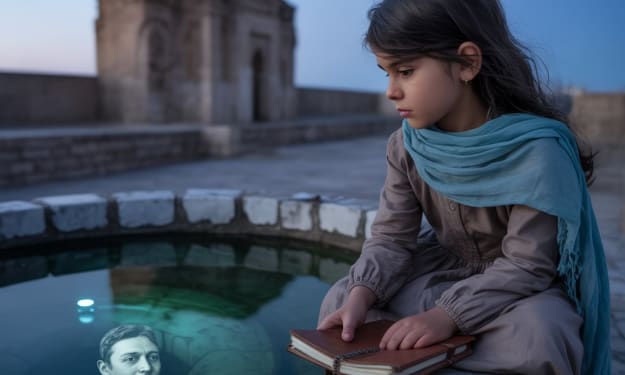
A Desert of Dust and Silence In a quiet desert village where the wind often carried more dust than sound, Lina lived with her grandmother in a small clay house. Life here was dry in more ways than one — the air, the soil, and often, the spirit. The days passed with chores, silence, and stories whispered under flickering lanterns. But nestled at the edge of the village stood an ancient, half-forgotten mosque, and beside it, a cracked stone well that hadn’t been used for years. The villagers said its water had vanished. Lina discovered otherwise.
By Hanifullah Hanifabout a year ago in Fiction
When Love Meets Time’s Cruel Joke
It was a rainy Tuesday when I met her. Not the kind of rain that ruins plans, but the kind that makes the world feel softer, slower. I was sitting in a half-empty café near campus, hiding from the drizzle and nursing a black coffee I didn’t really want. She walked in wearing a yellow coat—bright, like a sunflower lost in a storm—and for a moment, the gray around me faded. Her name was Lila. She ordered chamomile tea, smiled at the barista, and turned—eyes meeting mine like it was scripted. She asked if she could sit. I nodded. That was the start. We talked like old friends rediscovering each other. Music, books, how we both hated olives. She laughed at my sarcasm; I loved the way her voice caught between joy and hesitation. There was something raw about her—like she had loved and lost more than she let on. In a matter of weeks, she became my favorite part of everything. We’d walk around the city for hours, sometimes not saying much, just existing together. I memorized the freckles on her cheekbones, the curve of her smile when she spoke about her dreams. She wanted to travel, to teach, to write poetry no one would ever read. But behind her laughter, there was always a shadow. A clock ticking I couldn't see. One night, we sat on the roof of her building, city lights blinking like distant stars. She looked at me—really looked—and whispered, “I wish I’d met you another time.” I asked her what she meant. She hesitated, then said, “I’m leaving. In a month. For good. Grad school abroad. I applied before we met. I got the scholarship last week.” I tried to smile. I told her we’d figure it out. But I could feel the ache growing in my chest, slow and heavy. The next few weeks were a blur of almosts and what-ifs. Every kiss felt like goodbye. Every silence echoed with the things we were too scared to say. We didn’t fight. That was the worst part. There was no anger, no betrayal—just love, pure and untimely. The night before her flight, we stood in the same café where we met. Rain tapped gently on the windows, as if mourning with us. She held my hand, eyes glistening. “I don’t want to leave you,” she said. “Then stay,” I whispered. “I can’t.” I nodded. Because I knew. Because sometimes, love isn’t enough to bend time or rewrite choices. She kissed me one last time—soft, slow, memorized. Then she left. I stood there long after she was gone, watching the rain blur the world outside. It’s been a year now. She sends postcards sometimes—photographs of foreign streets and poems scribbled in the margins. I keep them all in a box under my bed. I’ve dated others. Smiled. Moved on, at least on the surface. But sometimes, when it rains, I sit by that café window, and I remember the girl in the yellow coat who made the world brighter for a little while. And I wonder what would’ve happened if the right time had found us, instead of just the right love. Some people are meant to cross your path, not stay in your life. And sometimes, the right person teaches you the most heartbreaking lesson: that love isn’t always enough when time is your enemy. Love, no matter how real, sometimes collides with time in the cruelest ways. Lila wasn’t just a chapter in my life—she was a reminder that not every great love story ends in forever. Some are meant to pass through, leaving behind echoes and lessons we carry in silence. I don’t regret meeting her. If anything, I’m grateful. Because in that fleeting season, I felt something rare—pure, unforced, unforgettable. And maybe, just maybe, that’s enough. Not all love stays, but some love still saves a part of you.
By Dr Gabriel about a year ago in Fiction