Love
Love Without Saying
The small village of Gangauli sat cradled between two sleepy hills, where the river sang its old songs and the earth smelt of wet loam and whispered prayers. In this village lived a humble man named Hari, whose life was unremarkable by worldly standards. He was a potter, known for his steady hands and gentle heart, and he lived in a thatched-roof hut at the edge of the village with his aging mother and a cow named Leela.
By Julia Christaabout a year ago in Fiction
Sixteenth Summer
I really have no idea what the hell happened. That summer was supposed to be the summer. For the first time ever, I had made friends. Our penny-pinching school had finally sprung for a class-wide trip, the first ever I had been on. Two whole weeks in Disneyworld: nothing but sun, fun, and the hottest girls in my class strutting their stuff in bikinis around the hotel swimming pool. What more could a sixteen-year-old guy ask for?
By Natalie Grayabout a year ago in Fiction
Harmony in Time
The old theater in Savannah smelled of polished wood and history, its velvet curtains heavy with stories of performances long past. At twenty-seven, Lily Harper stood on its stage, her alto voice curling through the empty seats as she rehearsed for the annual Lowcountry Choral Festival. She was a music teacher by day, shaping young voices at a local high school, but by night, she was a soloist with the Savannah Songweavers, a community choir that felt like family.
By Shohel Ranaabout a year ago in Fiction
Melody of Us
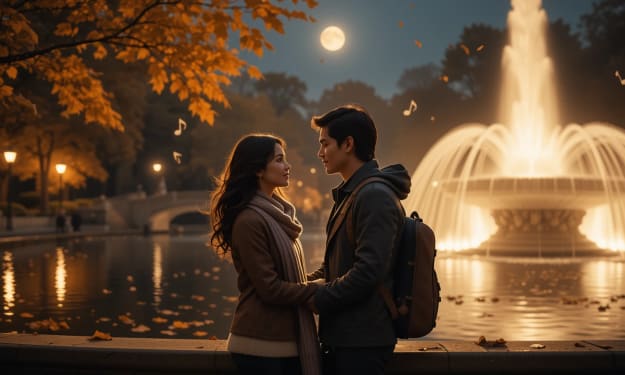
The autumn leaves crunched under Claire’s boots as she walked through Central Park, her scarf fluttering in the crisp New York breeze. At twenty-eight, she was a vocal coach at a small music academy in Manhattan, her days filled with scales, arpeggios, and the dreams of her students. Her own dreams, though, had been tucked away like sheet music in a forgotten drawer. Once, she’d imagined herself on a Broadway stage, her voice soaring over an enraptured audience. But life had a way of rewriting the score, and now she poured her heart into teaching others to sing.
By Shohel Ranaabout a year ago in Fiction
Living with My Husband: A Comedy of Errors and Love
Marriage, they say, is a journey—a beautiful, sometimes bumpy journey filled with love, learning, and a lot of unexpected surprises. But what they don’t always tell you is how much of that journey looks like a slapstick comedy. And let me tell you, living with my husband is nothing short of a daily sitcom.
By Mahayud Dinabout a year ago in Fiction
The Letters She Never Read
Chapter 1: The Girl With the Red Umbrella It was raining — not just from the clouds above, but from somewhere inside me. I stood silently in front of the university gate, drenched in my own thoughts, when I saw her for the first time. She was holding a red umbrella, her beige kurti slightly damp from the drizzle, and her eyes… they looked like poetry waiting to be written.
By FH STORYLINE about a year ago in Fiction
Beneath the Quiet Sky
The village of Arendale was a quiet place, tucked between low green hills and wandering rivers, where time moved gently, like the clouds that drifted overhead. In this village lived two people who never expected to find love—but love, it seemed, found them. Anna Hartley was a schoolteacher, 32 years old, known for her patience and the way she smiled with her eyes. She had lived in Arendale all her life. Most of her days were filled with chalk dust, lesson plans, and children’s questions—“Miss Hartley, how big is the sun?” or “Do birds dream?” Her nights were quiet, a cup of tea by the window, sometimes a book, sometimes a letter to her sister who lived far away. She wasn’t lonely, but she had learned to keep her heart guarded. James Renner was new to Arendale. He moved into the little blue cottage near the orchard, just down the lane from the school. He was 35, a carpenter by trade, with hands that bore the quiet strength of someone who had learned to build, repair, and endure. James didn’t talk much about his past, but it was clear to those who met him that he had walked through something painful, and come out gentler for it. They met in the simplest way. A late summer storm had knocked down the schoolyard fence, and Anna, determined to fix it before the children returned from their weekend, stood in the rain with a toolbox and far too much resolve. James, walking past with his dog, watched her hammer a nail sideways and asked, politely, if she’d like a hand. She hesitated. Then nodded. “I think the fence might appreciate it,” she said. That was the beginning. No grand declarations, no instant sparks—just two people rebuilding a fence in the drizzle, exchanging stories about rain, wood grain, and the way children always find the one puddle you don’t want them to. In the weeks that followed, they became something steady. He would drop by the school to help fix broken chairs or shelves, never staying long, but always leaving behind the scent of sawdust and something calming. She would bring him warm biscuits on Sunday mornings, left on his doorstep with a note: Hope you’re hungry. Their relationship grew not in dramatic turns, but in small consistencies. He walked her home when the streets were icy. She taught him how to plant tomatoes. They sat on her porch some evenings, watching the wind move through the tall grass, not needing to speak much. Their silences were never heavy. It was autumn when Anna realized she loved him. They were walking home from the harvest festival, and James had quietly taken her hand—not out of obligation or show, but as if it were the most natural thing in the world. His hand was rough, calloused, but his grip was gentle. She looked at him then—noticed the way his eyes softened when he looked at her, the way he listened as if every word mattered. Her heart, normally so cautious, settled in a quiet certainty. But love is not without its shadows. One chilly November evening, James stood at her door, his face drawn. “I need to tell you something,” he said. They sat by the fireplace, a mug of tea growing cold in her hands. “I wasn’t always... like this,” he said. “Years ago, I was engaged. We were young, and I thought it was forever. But there was a car accident. I made it. She didn’t.” Anna didn’t speak. She reached across the space between them and held his hand. “It took me years to even feel normal again,” he continued. “Then I came here, thinking I’d just live quietly, maybe alone. And then you—” He stopped, his voice catching. Anna spoke softly, “You don’t have to explain. I see you now. And that’s enough.” Love, real love, makes space for grief. It doesn’t erase the past, but walks beside it. Anna never tried to compete with a memory. And James never used his sorrow as a wall. Instead, they made room for both joy and remembrance. Winter came, with its white hush and early evenings. They spent the holidays together, not in fanfare, but in comfort—reading by the fire, taking walks through the snow-lined paths, sharing memories and dreams in equal measure. For her birthday in February, he carved her a wooden box with painted wildflowers on the lid. Inside was a note: For everything we’ve shared, and everything we will. Spring bloomed in Arendale, and with it came a sense of newness that felt well-earned. The trees wore soft pink blossoms, the children returned to school with muddy boots, and the world seemed to breathe a little easier. One Saturday morning, James asked Anna if she wanted to see something. He led her to the edge of the orchard, where he had been building a bench under a willow tree. “For sitting,” he said, “and growing old.” It wasn’t a proposal in words, but in something better—intention. They sat there that afternoon, listening to the breeze, birds, and the unspoken promise of a future. No rings yet, no announcements. Just a beginning made not of grand gestures, but quiet presence. Love, they had learned, wasn’t a flame that blazed and burned out. It was more like the sky above their village—calm, vast, and always there, even on the cloudy days. Would you like to share your thoughts or feedback on the story? I’d love to know how it made you feel, or if there’s anything you’d like to see explored further in a future piece.
By Julia Christaabout a year ago in Fiction