Love
The Silence Between Chapters
"The Silence Between Chapters" The first time she noticed him, he was sitting in the corner of the university library, hunched over a thick book, his glasses slipping down his nose. A soft beam of sunlight fell across his cheek, dust floating around him like a constellation. His lips moved ever so slightly as he read, completely unaware of the world. She tilted her head, curious. Who still reads like that? Her stilettos clicked softly against the marble floor. She was wearing a pink blazer over a black crop top, her nails freshly done, her notebook tucked into a Prada bag. She wasn’t supposed to be here—fashion design students rarely wandered into the silent world of books—but something had pulled her in that day. Something, or someone. His name was Arman, and he rarely looked up unless it was to find another book. A final-year literature student, he found solace in words—old ones, melancholic ones. Fyodor Dostoevsky was his god, Khalil Gibran his prophet. He loved the smell of old pages and the way stories held sorrow so gently. He first noticed her when she dropped her pen beside his desk. “Uh—sorry,” she said, crouching to pick it up, her perfume a soft citrus. “Didn’t mean to disturb your universe.” Arman looked up, blinking. “You didn’t,” he said, his voice low and polite. “It’s just a book.” She smiled. “You talk like the pages are your friends.” “They are,” he replied simply. She didn’t laugh. Instead, she sat across from him. And just like that, the first chapter began. She was Nayra—vibrant, confident, full of questions. She knew how to walk into a room and own it. Fashion wasn’t just an interest; it was how she spoke when she didn’t want to use words. But with Arman, she didn’t mind words. She wanted to listen to them. “Why do you like reading so much?” she asked one day. “Because books don’t leave,” he said, eyes still on the paragraph. “And if they do, they always come back when you reopen them.” Something tightened in her chest. He didn’t know it, but she had spent most of her life wishing someone would say that about her. Slowly, she began to need him. Not in the romantic, cliché way—at least not at first. She needed his presence, his quiet faith in the world, his stubborn devotion to becoming something better than the circumstances he came from. He was discipline in human form. When she struggled with her theory classes, Arman would help. “Colors speak in emotion,” she said once, showing him her sketchpad. “But why do they expect me to write essays about them?” He chuckled. “Because words are also colors. You just need the right brush.” She stared at him like he was magic. Months passed. They shared silent coffees, laughed softly in the corners of the library, and traded stories in whispers like secrets. Nayra began noticing the little things—how he folded page corners only on books he adored, how he hummed under his breath when he was deep in thought, how his eyes darkened when he talked about home. She never asked, but she knew his past was stitched with sacrifice. One rainy evening, she left a book beside his backpack: White Nights by Dostoevsky. Inside it, a note: “To the boy who reads to breathe. Maybe we both dream in silence.” — N. He never said thank you. But he read it twice. By the final semester, they were inseparable. “Do you believe in forever?” she asked him under the banyan tree near the auditorium. He looked at her with eyes like dusk. “No,” he said. “But I believe in moments that last longer than time.” “You’re such a romantic,” she teased. “I’m not. I’m just afraid,” he admitted. “Of what?” “Of promising something I can’t keep.” She wanted more. She wanted him in all the hours she hadn’t lived yet. She didn’t care that he came from a small town, or that his father worked three jobs, or that he often went without things she took for granted. To her, Arman was wealth—real, grounded, golden-hearted. But when she said, “Stay,” he hesitated. He looked down, then away. “I can’t be what you deserve. I can’t give you the life you’re meant to live. My story isn’t written for a girl like you.” “You’re wrong,” she whispered. “You are the story I want to live.” Tears welled in her eyes, but he didn’t hold her. He didn’t kiss her. He only looked at her like she was the most beautiful sentence he had ever read—one he could never say aloud. Graduation came like winter—cold, inevitable. They hugged in front of the library, the place it all began. She gifted him The Broken Wings by Khalil Gibran. Inside, another note: “If ever your silence turns into longing, find me in our pages.” — N. He didn’t reply. Not then. Years later, Nayra opened a boutique named “Chapter One.” In a frame behind her desk sat a photo of the university library—and two worn books on the shelf: White Nights and The Broken Wings. As for Arman, he published a novel. The dedication read: To the girl who saw colors in my shadows. Some stories don’t end. They echo. Some loves aren’t written to be complete. But they are no less beautiful. They live on—in the silence between chapters.
By Khalid Khanabout a year ago in Fiction
When the Night Speaks
The city was asleep, cloaked in the gentle hush that only the night could bring. Street lamps flickered softly, casting pools of golden light on the empty sidewalks. Amidst this calm, Ayaan walked slowly, his mind tangled in thoughts he could not escape. The weight of the day still lingered, but it was the night that felt alive with possibilities.
By Mian Suhaib Aminabout a year ago in Fiction
I Married a Man I Met at a Stranger’s Funeral
Prologue I shouldn’t have been there. The church was too quiet, filled with too much grief I hadn’t earned. I sat in the back row, legs crossed, sunglasses on, pretending my heart was shattered by the death of a woman I never knew. My dress was black silk. My lipstick was crimson sin. I looked like grief in high heels, and no one questioned me.
By Adrian-Razvan Ispasabout a year ago in Fiction
"What Happens After We Block Someone? A Digital Ghost Story Told by Algorithms"
I used to think that blocking someone was the end. A digital wall. A simple act of control in a chaotic, hyperconnected world. But what if I told you that’s not true? That when we block someone — or get blocked — it doesn’t delete the bond. It just buries it.
By Hamad Haiderabout a year ago in Fiction
The Brave Cub Who Walked Into the Storm
art of the African savanna, where golden grass whispers stories of survival and legacy, a lion cub named Leo was born. But unlike his siblings, who roared with instinct and leapt with promise, Leo was different. He was smaller. Quieter. Often overlooked. While the others played fiercely beneath the tall acacia trees, Leo watched from a distance—his eyes not on the games, but on the horizon. His paws were too small to race, his roar too soft to intimidate, and his legs trembled in the company of boldness. Yet there was something else inside him. A spark that didn’t show on the surface. A curiosity. A question. “Why don’t you join them?” his mother would ask gently, her golden eyes filled with worry. Leo would lift his head, ever so slightly. “Because I want to learn,” he would whisper. “I want to see the world before I try to conquer it.” Others in the jungle didn’t understand. They dismissed him. “Too small to matter,” scoffed the zebras. “Too quiet to be brave,” mocked the monkeys from their high, swinging homes. But Leo didn’t argue. He didn’t need to. Somewhere deep inside him, a voice far older than his own murmured: “Your time will come. And when it does, the world will know.” he Storm That Changed Everything It came without warning. The sky, once a blue canvas, darkened into a violent grey. Thunder cracked through the heavens, and the jungle trembled. The rain poured like arrows from the clouds, and the wind howled like forgotten spirits. Leo’s family, like many others, found refuge in a rocky cave near the cliffs. They huddled close, seeking warmth and safety as the world outside unravelled. Then came the sound that pierced the storm. A cry. Fragile and distant. Milo. The baby elephant from the neighboring herd. Lost. Alone. The lion king, Leo’s father, growled with authority. “No one moves. The storm is not kind to wanderers.” But Leo couldn’t sit still. His ears twitched at the sound. His heart raced—not with fear, but with purpose. “He’s out there,” Leo said, more to himself than anyone else. “He’s afraid.” “You’re just a cub,” his father barked. “Don’t be foolish.” But Leo had already stepped forward. His mother tried to stop him. But courage moves faster than doubt. And sometimes, a lion’s heart knows exactly when to roar—even if no one else can hear it.
By Arshad khanabout a year ago in Fiction
When She Locked the Door. AI-Generated.
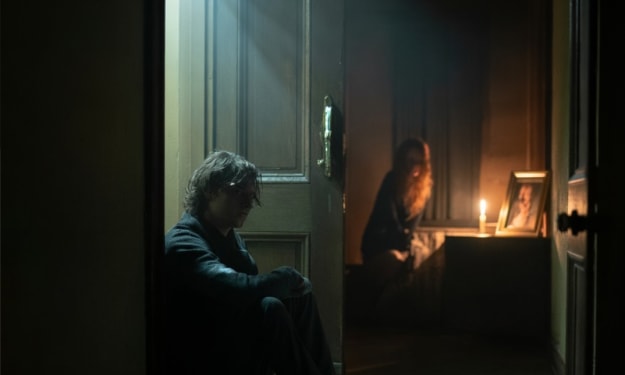
The clock struck midnight when Ahmed returned home. The street outside their apartment in Lahore was unusually silent, the distant buzz of traffic dulled by the warm, sticky air. He stood at the door, fishing out his keys, but as soon as he twisted the lock—he realized it had been bolted from the inside. He knocked. Once. Twice. No answer. He sighed, frustrated. “Sana, open the door. It’s late.” Silence. After a long pause, he heard her voice. Calm. Steady. Unrecognizable. “No.” He blinked, unsure if he had heard right. “What?” “I said no, Ahmed.” His heart pounded. Not out of anger. Out of fear. He had never heard her sound like that before—like she had nothing left to lose. --- Sana had been sitting by the door for hours. She’d lit a candle and placed their wedding photo beside it. In the picture, she was smiling so wide her eyes crinkled. Ahmed looked nervous but happy, like a man standing on the edge of something good. But that was five years ago. Since then, their apartment had turned into a battlefield—where silence screamed louder than words. She remembered the night he forgot their anniversary. The time he mocked her for wanting to restart her studies. The days he came home, reeking of stress and anger, throwing his phone on the table like she was the problem. He wasn’t cruel—not in the way people warned you about. But he was careless. Distant. Tired of her. And she? She had become invisible. --- Inside, Ahmed’s frustration melted into confusion. “Sana, are you okay? What’s going on?” She replied softly, “I wanted to talk to you. But talking never worked. So tonight, I decided to do something different.” He leaned his forehead against the door. “This is crazy. I’m not standing out here like a fool.” “Then leave,” she said. “You’ve been leaving me every day anyway.” Her words hit him like a slap. “I come home every night.” “Your body does,” she said. “Not your mind. Not your heart.” He stared at the dark hallway, suddenly aware of the weight of his briefcase in his hand, the sweat on his back, the silence in his soul. He sat down outside the door. “Sana, I know I haven’t been present. But this—locking me out—it isn’t the way.” “And ignoring me wasn’t the way either,” she replied. “But you did it for years.” --- In that still night, something broke. But it wasn’t the marriage—it was the silence. Sana started talking. She told him about the loneliness, about the nights she cried herself to sleep. About how she missed the boy who used to write poetry for her. How even the fights would’ve been welcome—at least that would mean he cared enough to argue. Ahmed listened. For the first time in years, he really listened. He didn’t interrupt. He didn’t defend himself. He let her words wash over him like a flood he had no strength to stop. And then he spoke. He told her about the pressure at work, about how he felt like a failure every time he looked at her because she deserved better. How he stopped sharing things with her because he didn’t want her to see how broken he felt inside. How ashamed he was that the man she married no longer existed. They sat on either side of that wooden door, pouring out five years of silence like two strangers rediscovering a shared language. --- The candle inside flickered. Sana touched the wedding photo and whispered, “Do you still love me?” His voice cracked. “Every day. But I forgot how to show it.” She stood slowly and unlocked the door. Ahmed stood too, unsure. The door creaked open a few inches. Her face appeared—tired, tear-stained, but softer. “Come inside,” she said. “Let’s try again. Not for the world. Just for us.” He dropped his briefcase and stepped in. No grand gestures. No dramatic music. Just a man and a woman, who had almost lost each other in the noise of life—choosing to begin again, in the quiet.
By Muhammad Usamaabout a year ago in Fiction
The Dove's Flight
In the heart of a war-torn village nestled between two rugged mountain ranges, a soft coo echoed through the rubble. The sun peeked out from behind grey clouds, casting a faint glow over the shattered walls and broken streets. Amid the ruins, a single pigeon fluttered its wings, resting atop what remained of an old bell tower. No one noticed it at first—after all, it was just a bird. But soon, this unassuming pigeon would become the village’s most powerful symbol of hope and peace.
By Intresting Storiesabout a year ago in Fiction
The Forgotten Room: A Haunting Tale of Hidden Emotions and Unspoken Truths
The Forgotten Room: A Haunting Tale of Hidden Emotions and Unspoken Truths By: Hamza Yaqoob Introduction What if you had a room inside your mind, one that held every memory you refused to face? What if you could walk through it—and uncover the secret you’ve been hiding from even yourself?
By Dr Hamza Yaqoob about a year ago in Fiction
A Cup of Tea and Goodbye
Every Sunday at exactly 4:00 p.m., the little bronze bell above the café door rang the same soft, hollow chime. It was never too loud, never rushed. Just enough to announce a presence — like a whisper in a quiet room. The staff had come to expect it, the way one expects the sunset or the smell of chai in the rain.
By Sana Ullahabout a year ago in Fiction