Love
Cute Spouses: A Love Story That Grows with Time
A Love Story That Grows with Time Discover the heartwarming story of cute spouses Emma and Jake, whose love story proves that the simplest moments can make the biggest memories. A must-read for romantic souls.
By its_ishfaq_ahmadabout a year ago in Fiction
The Last Letter I Didn’t Send
I never meant to keep that letter. It was just an impulse—written in the restless hours of a sleepless night during college, hidden in the pocket of a coat I haven’t worn since graduation. Three years later, I found it—and realized how much I’d been carrying without knowing. It all began when I was eighteen and staying in a tiny dorm room in a university town far from home. I was studying literature, reading Kafka and Woolf, but what really consumed me was Mia—my roommate’s older sister, who visited us every weekend. She had bright eyes that seemed to read right through my insecurities. We talked over take‑out in her sister’s room, about poetry and music and why the city felt so huge, so isolating. I told her things I told no one else. She told me about her own dreams and disappointments. It felt electric. One night, after she left, I sat at my desk under the buzzing lamp and scribbled a letter: Mia, You make me feel alive in ways I didn’t think possible. I admire your courage to chase a life bigger than expectations. I wish I could tell you— —Sam I never finished it. I wrapped the half‑thoughts in a folded notebook and stuffed it into the pocket of an old coat. Weeks turned into months. I left university, took a job far away, and every now and then, I’d think: Did she ever know? Would I regret not sending it? Fast forward three years. I’m back in that town, packing up the last of my things from my old student house, preparing to move again. I pull out the coat and find the letter. The summer light streams through the window as I unfold the paper. My handwriting looks young. Vulnerable. Hopeful. And somewhere in me, a pang: I owed her something more than silence. I looked her up online and discovered she moved to a different country to work with community theater. She’s photos, smiling in group shots, holding scripts and coffee cups. She seems happy. I wonder if she ever wondered what could have been. I decide: I’ll send the letter now. I re‑type it on my phone, adding a few years of reflection: Mia— I found something I wrote for you back in 2021. I never sent it, but I held onto it—because what I’d started writing was gratitude, awe, and I realized how deeply you inspired me. You made me brave enough to pursue what mattered: moving across continents, starting over, writing again. I don’t expect anything from you now. I hope you’re well. I hope you’re still dreaming big. —Sam My heart thumps as I hit send. I wait, for minutes that stretch like days. Minutes later, a reply: “Sam, I remember that night—I thought you were just shy—but this… this means so much. You were kind when I felt unseen. You reminded me I wasn’t just a visitor in someone’s world but the center of my own. I’m so glad you wrote.” In that moment, I understood something I’ll carry forever: courage isn’t always in loud declarations—it lives in small truths shared when nobody’s watching. It lives in finding someone who saw you, and daring to see them back. That response made everything worth it. But something else happened too: it freed me. Freed me from the “what if” and the “maybe later.” I realized that letters unsent gather dust in corners of our hearts, whispering of unlived chances. But a letter sent—even late—is brave. It becomes an honest echo of who we were and who we’ve grown to be. After that, I wrote more—long emails, small messages, entire scenes in a novel I’d almost given up on. I started submitting essays and stories, sharing the messy, hopeful parts of life. And each time I publish a piece, I remember: someone once gave me permission just by listening.
By Jibran Khanabout a year ago in Fiction
The Echo Inside the Map
It was tucked away in a box of old travel books at my grandfather’s attic—worn leather maps, rolled scrolls, and forgotten pages smelling like dust and time. I wasn’t looking for anything, just killing time on a rainy afternoon. But then I found it.
By Hanif Ullah about a year ago in Fiction
Salt and Vinegar Summers
The gravel crunched beneath her tires as the car rolled to a stop beneath the familiar canopy of pine. The air smelled of sap and sun-warmed wood, with just a trace of last night's rain lingering in the ferns. Sylvie sat for a moment with the engine off, her fingers curled loosely around the wheel. The silence settled around her like a held breath.
By Oula M.J. Michaelsabout a year ago in Fiction
Colorado Couple Missing Since 2011 Found Dead in Abandoned Mine Eight Years Later
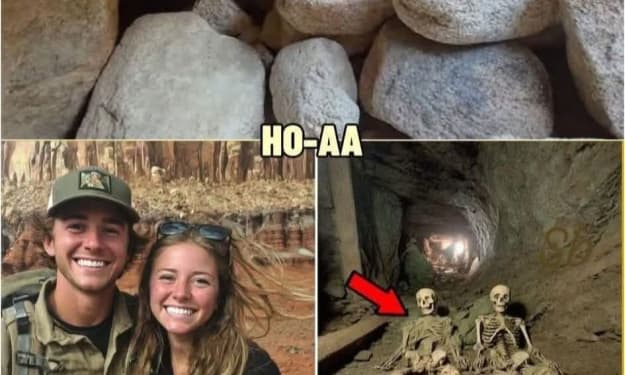
Colorado Couple Missing Since 2011 Found Dead in Abandoned Mine Eight Years Later A haunting mystery that tormented two families and baffled authorities for nearly a decade was finally laid to rest in 2019. The remains of Sarah Bennett, 26, and Andrew Miller, 28—two Colorado residents who vanished without a trace in 2011—were discovered deep inside a long-sealed uranium mine in Utah’s unforgiving San Rafael Swell. The revelation brought closure, but also raised chilling new questions about how and why they ended up there. In May 2011, Sarah and Andrew set off on what was supposed to be a peaceful three-day camping trip. Both avid nature lovers and amateur photographers, they were drawn to Utah’s remote desert landscapes. The San Rafael Swell—a stark, breathtaking expanse of red rock cliffs, abandoned mining sites, and winding slot canyons—was the perfect escape from the demands of city life. “They weren’t thrill-seekers,” recalled Sarah’s younger sister, Emily Bennett, in a 2020 interview with The Denver Post. “They weren’t looking for danger. They were just looking for silence. Some time away from the noise of work and life.” The couple was last seen alive at a gas station in Green River, Utah. Surveillance footage showed them smiling, laughing, refueling their Subaru Outback, and buying a paper map of Emery County. They appeared relaxed and excited. After that brief stop, they vanished. The disappearance sparked an immediate and intensive search. Local authorities, park rangers, volunteers, and even federal agencies scoured the area by foot, ATV, helicopter, and drone. Search dogs combed the desert, and tips from the public poured in. But despite the massive effort, no clues were found. The Subaru, their camping gear, their phones—everything had simply disappeared. As months turned to years, theories ran wild. Some speculated the couple had been murdered, perhaps stumbling upon something they weren’t meant to see in the remote desert. Others believed they’d become victims of drug traffickers. Conspiracy theorists floated ideas of government cover-ups, even alien abduction. The lack of evidence only deepened the mystery. Then, in August 2019, the long-cold case was suddenly reignited. A group of geology students from the University of Utah, conducting field research near Temple Mountain, ventured into a little-known uranium mine that had long been sealed and marked as unstable. About 300 feet into the shaft, they stumbled upon something unimaginable: two fully clothed skeletons sitting side by side on rusted folding chairs, as if frozen in time. Scattered nearby were personal belongings—an old thermos, a broken lantern, and a dusty Nikon camera still intact despite the passage of time. A partially collapsed section of the mine had sealed the area off, creating a hidden chamber that had preserved the eerie scene almost perfectly. Dental records quickly confirmed the identities. After eight long years, Sarah and Andrew had finally been found. The Emery County Sheriff’s Office reopened the investigation, led by Detective Laura Martinez, a veteran officer who had reviewed the case more than once in the past. The official cause of death was listed as “undetermined.” There were no signs of trauma or foul play, but experts suggested that the couple may have become trapped after entering the mine and experiencing a collapse. Toxic gas buildup—common in abandoned uranium mines—was also considered a likely factor. But it was what was found on the camera that disturbed investigators most. Inside were several undeveloped photos, miraculously preserved. They depicted scenes from within the mine: old mining carts, graffiti, rusted tools—and then, a self-timer photo of Sarah and Andrew sitting on the very chairs where their remains were found. The timestamp? Just over an hour after they were seen at the Green River gas station. “They went in willingly,” Detective Martinez said in a 2019 press briefing. “There was no sign they were being chased or coerced. They weren’t running from anything. It looks like they went in, explored, sat down... and just waited.” Why they remained inside remains a mystery. Some believe they became disoriented in the maze-like tunnels and chose to stay put rather than risk wandering deeper. Others wonder if something more psychological or symbolic was at play—perhaps they intended to disappear, though loved ones dismiss that theory. A modest memorial now marks the mine’s entrance: a stone slab engraved with their names, flanked by wild desert flowers and offerings from strangers who followed the story over the years. “Sarah and Andrew went looking for peace,” said Emily Bennett during a memorial service held at the site in 2021, marking ten years since their disappearance. Her voice trembled as she added, “I hope they found it—wherever they are.” Though the case is technically closed, its emotional and psychological impact lingers. To many, Sarah and Andrew’s story is a haunting reminder of nature’s beauty and danger, and of how, even in our modern world, people can still vanish—quietly, completely, and without warning. And sometimes, even when they're found, the answers don’t come easily.
By Israr khanabout a year ago in Fiction
From Hate to Love
Ayan Khan was the pride of his college — a cricket star known for his sharp mind and leadership skills. He had always been the center of attention, admired by many, envied by some, and respected by all. People saw him as confident and untouchable, but behind that confident exterior was a young man driven by ambition and the pressure to always be the best.
By Aman Ullahabout a year ago in Fiction
“From Rivalry to Romance”
Ayan Khan had always been the pride of his college’s cricket team — confident, sharp, and a born leader. His name echoed in corridors not just for his sportsmanship, but also for his razor-sharp wit and charm. Professors liked him, juniors admired him, and most of the campus secretly wished to be in his circle. But everything changed when Meher Saeed joined the university. She was different. Fierce. Brilliant. And unapologetically bold. Unlike others, she didn’t seem to care about Ayan’s so-called reputation. If anything, she seemed to enjoy knocking him off his pedestal. From the very first debate competition — where she publicly dismantled his argument with poise and a smirk — to the interdepartmental cricket match, where she stunned everyone by hitting the final six against his team, Meher made her presence impossible to ignore. It was war from day one. Their friends joked it was “the cold war of campus.” Whenever Ayan passed Meher in the hallway, it was with a half-scoff, half-smirk. Sometimes, he’d drop a sarcastic one-liner. Meher, never one to back down, would return fire — her words precise, her smile smug. But fate, as always, had its own wicked sense of humor. In their final semester, the university announced a mega cultural festival. A drama skit, dance performance, and storytelling competition — all rolled into one. Each department had to nominate a boy and a girl as lead performers. Ayan was obvious. The faculty trusted him. The students idolized him. But when Meher’s name was called alongside his — gasps filled the room. Ayan's jaw tightened. “I’d rather fail than work with her,” he muttered under his breath. “You can fail,” Meher replied, not even looking at him, “but I don’t lose.” Their first week of rehearsals was chaos. Every creative decision turned into a full-blown debate. Ayan accused Meher of being bossy. Meher called Ayan a control freak. The script was rewritten twice. One time, Ayan walked out. Another time, Meher refused to show up. But amidst all that friction… something strange started to happen. One evening, they stayed late to rehearse a particularly emotional scene. The campus was quiet. Most students had left. Under the glow of soft yellow lights, Meher stumbled over a line and let out a sudden laugh — not mocking, but genuine. It echoed softly through the empty hall. Ayan looked up, stunned. It was the first time he’d seen her not in battle mode. “You look… different when you laugh,” he said, almost to himself. Meher looked at him, raising an eyebrow. “And you don’t look half bad when you’re not trying to win.” Their eyes met. And for the first time, there was no sarcasm. No smirk. Just silence. Charged and confusing. After that, rehearsals shifted. There were still arguments — but now they ended in laughter. They shared meals, stayed late working on scenes, even opened up about their lives. Ayan learned Meher had moved around a lot as a kid — always the new girl. Meher learned that Ayan’s confidence was partly a mask for the pressure he felt to always be perfect. One night, rain poured as they sat on the auditorium steps, script papers soaked and forgotten. Ayan shrugged off his jacket and placed it over her shoulders. She looked at him — no words, just a long glance. “Why did you hate me so much?” he asked quietly. “I didn’t,” she replied, her voice soft. “I just thought you were too full of yourself. But now... I think you were just afraid to be seen.” Ayan leaned in slightly. “And maybe I never hated you either. Maybe I was just waiting for someone who could challenge me.” The night hung between them like a secret. The day of the competition arrived. Their performance was electric. The storyline — two enemies forced to work together, eventually falling for each other — felt eerily personal. The audience cheered, but Ayan and Meher only had eyes for one another as the curtain fell. Later that evening, under the old oak tree near the main ground, Ayan found her standing alone. He walked up, nervous for the first time in years. “I think I’ve been falling for you,” he whispered, “since the day you hit that cricket shot.” Meher turned, smiling. “Took you long enough.” She reached for his hand — not for a script, not for show — but for real. And in that moment, enemies became something much more.
By Aman Ullahabout a year ago in Fiction
Redemption, A Broken Souls Chronicle - Part 2. Content Warning.
The sound of crushing metal echoed through Hal's mind. He backed his truck away from her smashed vehicle and sped down the highway, ignoring the damage to his vehicle.. His work was done here, and he was certain the crash killed Lili. Elation washed over him as he picked up speed, knowing she’d never mess up his plans again.
By KA Stefana about a year ago in Fiction
Ronaldo and Kids. AI-Generated.
In a small village nestled between green hills and dusty roads, lived a ten-year-old boy named Hamid. He was tall for his age, with curious eyes and a constant smile that lit up the classroom. Like every other kid in his school, Hamid had one big dream — to meet Cristiano Ronaldo, the football legend he watched on his uncle’s old television.
By Bilal Mohammadiabout a year ago in Fiction