Humor
Thursdays Are for Ghosts
The first time I noticed her was the week after the funeral. A Thursday, to be exact. I was in the kitchen, stirring a cup of tea I hadn’t meant to make, in a house too quiet for comfort. The sugar clinked gently against the mug like footsteps on tile. I wasn’t thinking of her, not directly, not consciously. But there she was. A shape in the hallway mirror—quick, soft, and impossibly familiar.
By Jawad Khanabout a year ago in Fiction
The Clockmaker's Garden
There was a village at the edge of the world where time stood still—not metaphorically, but truly. The sun always hovered in the same place. The shadows never grew longer. The leaves on the trees were forever green, and not a single wrinkle ever touched the faces of the people who lived there. Some called it a paradise. But not Mira. Mira had lived her entire life in this frozen place, where no one aged and nothing ever changed. The village was clean and calm, the people kind and quiet, but it all felt... trapped. Like living inside a snow globe where someone forgot to shake the magic. You see, the village had once been ruled by time like anywhere else. Until the day the Clockmaker came. No one remembered where he came from, or how he had arrived. But he built a tower at the village center—a tall, spiraling thing made of stone and bronze, topped with a golden clock that ticked louder than the wind. Then, one day, he stopped the clock. And when the clock stopped, so did time. People were amazed. No one got older. No one died. Food never spoiled. Days were always sunny. And for a while, it truly was a paradise. But after years, something changed—not outside, but inside the people. They stopped dreaming of new things. They stopped planting new trees. They stopped falling in love. They stopped asking, "What if?" Mira was different. Even as a child, she asked questions no one liked answering. “Why don’t we celebrate birthdays?” “What happens if the clock breaks?” “What’s beyond the hills?” The villagers would smile politely and say, “Don’t worry, dear. Everything is exactly as it should be.” But Mira wasn’t convinced. Especially not after the day she found the seed. It was buried beneath the soil behind her grandmother’s cottage, wrapped in cloth and tied with red thread. The cloth was old—older than the village’s stillness. On it, written in fading ink, were five words: "Plant me when time aches." Mira didn’t know what it meant, but she kept the seed. Years passed—or they should have—and Mira grew older in her heart, even if her body never changed. She read every book the village had. She asked questions the elders refused to answer. She even climbed the clocktower once, but found the door bolted shut with a glowing blue lock she couldn’t break. Until one night, something happened that had never happened before. She saw a petal fall. A single pink petal, drifting down from a tree in the village square. It didn’t make sense. Nothing changed here. Nothing moved unless someone moved it. But that petal had fallen on its own. As if the tree had breathed. That night, she went to her grandmother’s garden with a lantern and trembling hands. She dug a small hole in the earth and placed the old seed in it. As soon as the dirt touched the seed, the ground shivered—just a little. Not enough for anyone else to notice. But Mira did. She watered it with tears. Not because she was sad, but because she suddenly felt something for the first time in a long, long while: hope. The next morning, a small green shoot had emerged. And the day after that, a bud. And a few days later, a flower bloomed—vibrant and golden, with petals that shimmered like sunlight. People began to whisper. Nothing had grown in the village since time stopped. No new flower had bloomed in decades. But there it was, glowing softly like a candle in the fog. When the elders saw it, they panicked. They tore it from the ground. They warned Mira not to interfere again. They told her she was risking everything. That peace must be protected. That the Clockmaker would not approve. But Mira didn’t stop. She remembered what the cloth had said. “Plant me when time aches.” And time was aching. The people were stuck. Their laughter was thin. Their eyes were dull. Peace without change had become a prison with invisible walls. So Mira planted more seeds—some from old apples, some from forgotten flower pots, some even stolen from the locked archives beneath the school. And each time, something bloomed. Small things at first: daisies, dandelions, bluebells. Then vines. Then fruit. Then trees with golden bark that hummed when the wind passed through. And slowly… people changed. Some cried without knowing why. Some remembered dreams they’d buried. Some started writing poems again. Children drew things they’d never seen—skies full of color, mountains beyond the village, oceans they only imagined. And then the unthinkable happened. The clock in the tower ticked. Just once. But loud enough that everyone heard it. That night, Mira returned to the tower. The door that had once been sealed was cracked open. Inside, the gears groaned, stiff from stillness. Dust floated in the beams of moonlight. At the top of the stairs stood the Clockmaker. But he wasn’t what she expected. He looked like an old man made of wood and brass, with eyes like candle flames. His hands were tools. His spine was a coil. And on his chest was a key, long since wound down. “You have brought time back,” he said, his voice the sound of creaking floorboards. “Why did you stop it?” Mira asked. “Because the world was full of pain,” he replied. “And I thought stillness would bring peace. But peace without change… is silence.” She stepped forward. “And silence without growth... is death.” The Clockmaker nodded. “Then finish what you’ve started.” He handed her the key from his chest. She placed it in the clock. And turned it. The clock roared to life. The gears spun. The bell rang. Time surged through the village like a warm wind. The sun moved for the first time in a hundred years. Shadows danced. Trees swayed. Children grew. Laughter returned—not the polite kind, but the wild, uncontrollable kind. People wept and hugged and aged. And in the middle of the village stood Mira, now older, a little grayer, but glowing with life. She never became queen. She didn’t want to. Instead, she planted more gardens. One for every lost year. One for every forgotten dream. And people joined her. Because now… time moved. But so did hope. The End.
By Lucien Hollow about a year ago in Fiction
The Lantern of Whispering Trees
by Yahya Asim In a remote village nestled between the emerald folds of two great hills, there stood a forest known as the Whispering Trees. Locals spoke of it with reverence and caution. They said the trees could talk—not with mouths, but with murmurs carried in the wind. Only those who truly listened could understand their secrets.
By Yahya Asimabout a year ago in Fiction
Animal Farm — Chapter 3 (George Orwell)
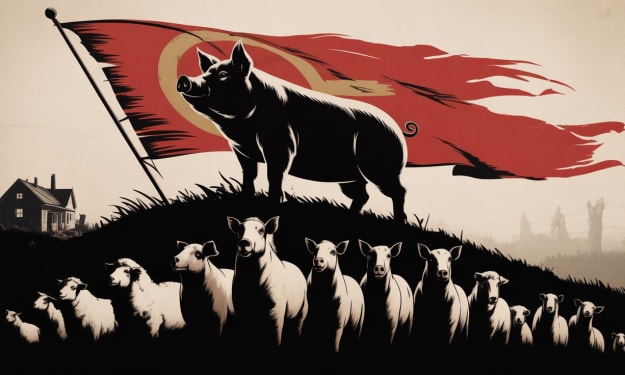
With Manor Farm now transformed into Animal Farm, the animals waste no time in putting their new society into practice. They begin working enthusiastically in the fields, more motivated than ever under Mr. Jones. The pigs, thanks to their superior intelligence, take on leadership and planning roles, while the other animals throw themselves into physical labor. Boxer, a huge cart horse, becomes the farm's workhorse in both name and spirit. His personal motto - "I will work harder" - inspires everyone around him. Even the ducks and chickens do their best, picking up stray kernels of corn to ensure that nothing goes to waste. Although harvesting is difficult without human tools and skills, they manage better than expected, with greater success than ever before. There is a sense of pride and ownership in every mouthful of food they produce, which drives them to work harder and cooperate more willingly. The animals, for the first time, feel that their labor is truly for their own benefit, not for some master who steals the fruits of their labor.
By Echoes of Lifeabout a year ago in Fiction
Perfect Apple Pie
Baking a pie with you is a lot different than doing one alone. I’ve always baked my birthday pie without anyone with me. It isn’t because I’m a snob or a perfectionist. But I’ve just preferred to do it alone. Or that’s what I kept telling myself. As I started greasing the pie tin, I smiled as I listened to you hum. Before this I just listened to whatever podcast that I could find on my phone.
By Raphael Fontenelleabout a year ago in Fiction
The Punchline Podcast. AI-Generated.
The Great Zoom Fiasco: A Punchline Podcast Special It all started on a Monday morning, the kind of Monday where even your coffee needs coffee. Jamie, host of the wildly popular Punchline Podcast, had a brilliant idea: a live Zoom episode with guest comedians from around the country. The perfect way to connect with fans during this “work from anywhere” era. What could possibly go wrong?
By shah afridiabout a year ago in Fiction
The Last Letter from Elderidge Lane
Elderidge Lane was the kind of road you’d miss if you blinked while driving past. Tucked between thick woods and forgotten by modern maps, it led to a crumbling village swallowed by time and silence. But for Nora Whitman, it wasn’t just a road—it was a lifeline to a mystery that had haunted her family for decades. Her grandmother, Elsie Whitman, had vanished from Elderidge in 1952, never to be seen again. The police blamed the wilderness. The town gossips spoke of elopement or madness. But Nora’s mother had always insisted something darker had taken her. Now, seventy-three years later, Nora held the key—quite literally. It arrived in a plain manila envelope postmarked from England with no return address. Inside was an old brass skeleton key wrapped in a letter written in delicate cursive: > If you are reading this, I am gone. But Elderidge is not done with us. Come to the house on Elderidge Lane. Bring no one. Find the truth that was buried. The door will open for blood. No signature. But Nora recognized the handwriting. She’d seen it in her grandmother’s old recipe books. Against every logical instinct, she drove to Elderidge. She didn't tell her husband, didn’t notify anyone. It felt like a summons. The air grew heavier the closer she got, as if time resisted her arrival. The house was still there—just as the letter described—a two-story wooden structure clinging to its foundations, shutters hanging like broken limbs, the porch cracked and moss-covered. But the lock on the front door looked strangely polished. With trembling fingers, she inserted the key. It turned smoothly. Inside, the house was... untouched. Dusty, yes, but not decayed. A faint scent of lavender hung in the air. An old grandfather clock ticked steadily in the corner, its hands frozen at 3:17. The fireplace crackled faintly, though no fire burned. On the table, another envelope. > You're early, Nora. Or maybe I’m late. Time doesn’t work right here. She dropped the letter. Her heart thudded. “This isn’t real,” she whispered. But her voice echoed unnaturally. The house groaned. A shadow moved across the hallway though no one was there. She wandered the house, each room whispering of the past—photographs of people who resembled her, furniture frozen in mid-use, teacups with dried leaves. In the attic, she found a girl’s bedroom—pink curtains, a music box, and a name carved into the wall: Elsie. That’s when the whispering started. Faint at first, like wind through trees. But it grew louder. > “Nora… Nora… open the mirror…” There was an ornate mirror on the wall. She stepped closer—and gasped. It didn't reflect her. It reflected her grandmother. Young. Alive. Terrified. The reflection mouthed words: "Behind. The. Books." Nora yanked the mirror from the wall. Behind it was a loose plank. Inside, a hollow cavity with a faded journal and a third letter. > I never left. They wouldn’t let me. The house, the woods—they feed on memories, on people. I tried to escape. I failed. But maybe you can finish what I couldn’t. Bury the locket. Burn the mirror. Break the cycle. The journal was filled with drawings of strange symbols, pages detailing rituals, cries for help, and a recurring name: The Timekeeper. Nora ran outside into the overgrown garden. The locket was easy to find—buried beneath a sundial that pointed not to north, but to 3:17. She dug with her hands until she pulled it out—cold, silver, pulsing like a heartbeat. When she returned inside, the house had changed. The clock now ticked. Slowly. The walls bled shadow. The air was thick with whispers and cries. Holding the mirror in one hand and the locket in the other, Nora set both in the fireplace. She hesitated—but then struck the match. The locket shrieked. Not mechanically—it screamed. The mirror cracked. Then shattered. The clock chimed once. Twice. At the third chime—everything stopped. Silence. Total. And then—light. The air cleared. The walls brightened. The whispers fell silent. The house—aged. Quickly. Decayed before her eyes, collapsing into the abandoned ruin it should have been all along. Nora crawled outside, coughing. Behind her, the house crumbled into ash and smoke. A figure stood among the wreckage. A young woman. Elsie. Not a ghost—but real. Tangible. Tears streamed down both of their faces. “You broke the loop,” Elsie whispered. “You freed us.” And then she was gone. Vanished into the morning light. --- The authorities found Nora by the road, confused and shaking, clutching an old brass key and a burned locket. The house, they said, hadn’t stood in that spot for over fifty years. She told them her story. No one believed her. But sometimes, late at night, when the wind is just right, she hears the chimes of a grandfather clock striking 3:17. And she smiles. Because Elderidge Lane is no longer haunted. And her grandmother is finally at peace.
By Kausar Hayat about a year ago in Fiction