Holiday
Beneath the Tree That Watched Us
The Tree on the Hill On the edge of a quiet village named Kalwara, stood a tall, old peepal tree, alone on a small hill. Its branches were wide, its bark dark and cracked like an ancient face, and its leaves sang with the wind. The villagers called it “The Watching Tree”, because no matter where you stood on the hill, it felt like the tree was looking right at you.
By Muhammad Hayatabout a year ago in Fiction
Footprints in the Wrong Direction
A Trail That Shouldn’t Exist In the cold, mountain village of Ravenshade, 15-year-old Noah Elwin had always followed the rules. He never wandered into the forest, never stayed out after dark, and never questioned why the old northern path was forbidden.
By Muhammad Hayatabout a year ago in Fiction
The Day My Refrigerator Tried to Kill Me
Let me start by saying I did not expect to be attacked by my own fridge on a Tuesday. Tuesdays are supposed to be boring. Middle-of-the-road, halfway-to-the-weekend, emotionally beige. But that was before I downloaded a “smart kitchen” app called FridgeFriend+.
By Ashikur Rahman Bipulabout a year ago in Fiction
The Clockmaker’s Secret
In the heart of a forgotten town nestled between the mountains and the sea stood a small clock shop with dusty windows and a crooked wooden sign that read: Elias Grimm, Clockmaker. Most of the townsfolk passed by without a second glance. After all, in the digital age, who needed ticking clocks?
By MD BILLAL HOSSAINabout a year ago in Fiction
"The Clock That Whispered Wishes"
The Story Begins... In a quiet village where nothing unusual ever happened, there stood an old clock shop at the end of Moon shadow Lane. No one remembered when it opened, or who owned it, but everyone knew one rule: Never ask the clock for a wish unless your heart truly means it.
By Ayesha Maryamabout a year ago in Fiction
The Star of Winter Hollow
In the snow-blanketed village of Winter Hollow, nestled deep within a forest of evergreen trees, Christmas had always been more than a holiday—it was a season of magic. Each year, a great glowing star would appear in the sky on Christmas Eve, said to be the spirit of the season watching over the town.
By Mir Ahmad Khanabout a year ago in Fiction
A scary ghost story P [1]
To get to my house, I have to cross this alley now. I can hear the sound of insects chirping. It's a creepy feeling. I've never been afraid of ghosts. Many times, I've come through this alley at around 2/3 in the morning and bought cigarettes from the street corner shop. That day, no such fear crossed my mind. I'm walking down the alley. A lit cigarette in my hand. I'm looking at the road from time to time in the light of my mobile phone and humming the song Just then, in the middle of the alley, I suddenly heard someone say, "Excuse me, brother." I turned the light of my mobile phone around. I looked around but there was no one there. I thought that someone might have said it in one of the houses on either side of the alley. I started walking again. After taking two steps, the call "Excuse me, brother" again, and a small voice rang out from my ear. This time I stood up. I felt a slight fear, but it was not of the ghost, but of the kidnapper. I thought again that if I ran from here now and it was someone I knew, they would tell everyone about the run and puncture my prestige. Didn't talk through the throat. Nevertheless, I brought artificial courage in Gambhir's voice "Who?". The answer came to the wreath of the scandal. I have woken up. The drawer of the drawer. This time I jiggled with some resentment in the voice, or are you talking like a ghost? Answer the scandal. What is the ghost of the scalp? I didn't understand what to say. Where are you thinking of giving me a shouting, while he is just thinking of giving me a scream, he again said that he would pull the sigh of walking in the wandering walk and burst into it. You can find the ghost of the jerk. You don't get to draw. He used to swallow the slope of the tip of the shore. Fear the hair is swept away? I have heard so long that the hair becomes erect. He said that the loot of the people of the painters was like a lid. The ghost of the ghosts of the ghosts of the tumor is swept away in the creek. I did not drop the cigarette and gave him a pull. The ghost said like a bit of akuti and said, "Do not dive it on the foot of the painter." Tima is drawing a shaft.
By Arfan Raihenabout a year ago in Fiction
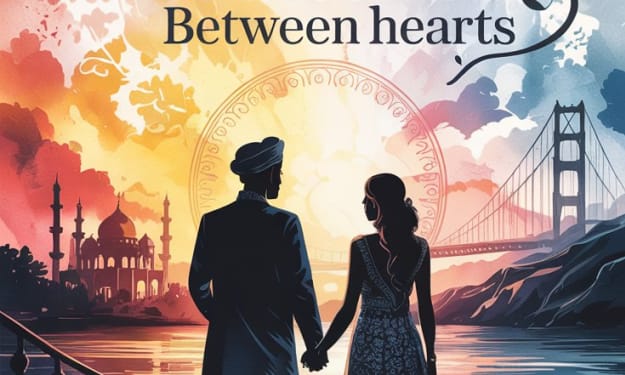
Across Cultures, Between Hearts
"Across Cultures, Between Hearts" A Love Story of Boundaries Broken and Hearts United In the heart of San Francisco, where fog rolled in like whispered secrets and streetcars rattled through time, Mr. Shah Khan lived a life of quiet purpose. Originally from Lahore, Pakistan, Shah was a literature professor at a small liberal arts college, known for his passion for Rumi, Baldwin, and his afternoon chai, which he made himself in a copper pot passed down from his grandmother. He wasn’t looking for love—not actively, anyway. He had long accepted that his life would be centered on teaching, books, and quiet evenings. But life, in all its unpredictability, had other plans. Vegernia Adams was an art curator at a local gallery known for showcasing multicultural artists. A Georgia native, she was a bold blend of Southern charm and urban elegance. Her days were filled with canvases, colors, and conversations, and her heart was a soft space for stories, especially the ones that could not be painted—only lived. Vegernia was content with her life, but somewhere deep inside, she felt as though something was missing. She hadn’t yet figured out what that was. Their paths crossed on a rainy Thursday afternoon at a community lecture on “Poetry Across Borders,” where Shah was the guest speaker. Vegernia sat in the front row, her eyes alight with curiosity. When Shah read out a verse by Faiz Ahmed Faiz—“You are that star of love, burning far above all borders”—she felt something stir within her. It was as though the words reached into the deepest part of her soul and pulled her into the moment. After the lecture, she approached him, a smile playing on her lips. “You read that like you’ve lived it,” she said, tucking a curl behind her ear. Shah paused for a moment before replying, his eyes meeting hers with a certain softness. “Poetry only works when it’s real.” That was the start. Their first conversation lasted hours, and by the time the rain had subsided, they had exchanged phone numbers and agreed to meet again. Over the next few weeks, they shared coffees, dinners, and long walks through Golden Gate Park. What started as casual talks about art, literature, and music soon shifted into deeper revelations. Shah told her about growing up in a house filled with laughter, jasmine vines, and evening prayers. He spoke of the love he had for his family, for his country, and for the stories that shaped his life. Vegernia, in turn, told him about her childhood in Georgia, about her mother's humming as she baked pies, and the sense of belonging that came with the traditions of her Southern upbringing. Despite their cultural differences, they found common ground in their shared love of storytelling. There was an ease in their conversations, as though they had always known each other. Yet, underneath it all, there was the subtle awareness that the worlds they inhabited were not always aligned. Shah had never imagined himself in a relationship outside his culture. Vegernia had never thought her future would include someone who prayed five times a day or celebrated Eid with such reverence. But love, they discovered, was about seeing each other fully, not about erasing what made them unique. One evening, they found themselves on the Golden Gate Bridge, walking slowly beneath the dusky sky. The lights of the city twinkled below, but it was the quiet between them that felt most significant. “Do you think this could work?” Vegernia asked, her voice soft, her gaze distant. Shah looked out over the bay before turning his gaze back to her. “I think love is worth finding a way.” It wasn’t easy. There were awkward conversations with family. Her friends, though well-meaning, sometimes asked ignorant questions. His relatives back home warned him about losing his traditions. Yet, they chose each other, again and again, each time realizing that their bond was far stronger than any societal boundary. Shah taught Vegernia how to cook biryani, laughing as she overused the cumin. They shared a thousand little moments of joy, from cleaning up spilled masala to picking out fresh herbs from the farmer’s market. She, in turn, introduced him to the beauty of Southern soul music, taking him to concerts where he marveled at the soulful melodies. He took her to vibrant Eid celebrations, where families gathered under tents filled with rich food and laughter. She brought him to her family’s Thanksgiving in Atlanta, where he helped her grandmother set the table and charmed everyone with his quiet warmth and gentle humor. Though their cultures sometimes clashed—Shah’s quietness in the face of her Southern assertiveness, or the challenges of fitting her artistic nature into his more traditional upbringing—they found ways to understand each other. In the spaces where they didn’t understand, they built bridges, learning to adapt and embrace each other’s world with open hearts. One spring afternoon, while visiting a book fair in Oakland, Shah handed her a small, leather-bound journal. Her heart skipped a beat as she saw the words inscribed on the first page in his neat handwriting: “No border can bind the heart that sees, No language needed when love agrees. You and I, like verse and rhyme, Belong together, across all time.” Vegernia looked up, her eyes misty. “Is this…?” He nodded, his voice soft. “Will you write the rest of our story with me?” They married the next summer in a beautiful garden ceremony. It was a fusion of their two worlds—Quranic verses were recited under a flower arch, while gospel music played in the background. Vegernia wore a white lace dress, and Shah donned a cream sherwani with a pink rose pinned to his chest. The ceremony was not just a marriage of two people but the joining of two distinct worlds, cultures, and traditions. Their first dance wasn’t choreographed. It didn’t need to be. It was a dance of understanding, of love that didn’t need words to be spoken. Years later, when they looked back on their journey, they often told their children about the way their love had crossed oceans and defied expectations. How it hadn’t been perfect but had been real. How it had taught them that love does not ask you to erase your roots; it asks you to grow together, to create something that’s more than the sum of its parts. And every time the fog rolled into San Francisco, Shah would look at Vegernia with the same wonder he had when he first read that poem aloud. The world was still full of noise and division, but they had found something that would always remain: their rhythm, their love.
By Shah saab IT2 years ago in Fiction
Beneath the Jasmine Sky
In the quiet town of Gulshanpur, where the air smelled of jasmine and evening tea, lived Mr. Shahdal — a young teacher with gentle eyes, a poetic soul, and a smile that carried the warmth of a summer afternoon. After years of studying literature abroad, he had returned to his hometown not just with knowledge, but with a heart full of dreams and memories that hadn’t faded.
By Shah saab IT2 years ago in Fiction
2016 CAVALIERS. Top Story - April 2025.
He remembered when she gave him that box, wrapped with a little gold bow. He may not have had the best grades, that was always her, always, but it didn’t take a genius to see how excited she was. Looking back, it was crazy how young they both were, yet seemed like yesterday.
By Matthew J. Fromm2 years ago in Fiction