Holiday
The Last Bus to Terminal 9
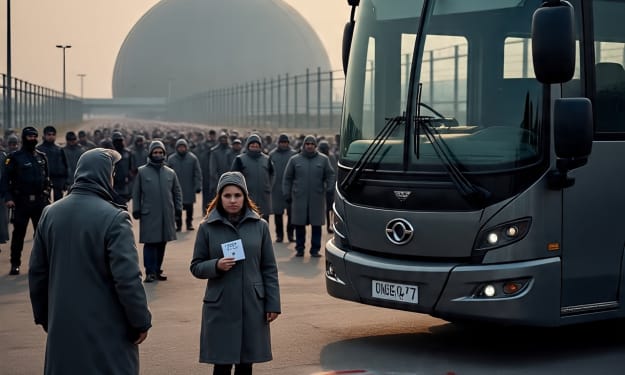
The sky was never blue anymore. It hung low over the crumbling city like a rusted lid, filtering every ray of sunlight into a dull, sickly hue. People walked the streets with bowed heads and regulation-gray masks, their eyes hollow with routine. Screens blinked from the walls, reminding everyone: "Compliance Ensures Survival." Terminal 9 was the only airport left functional in the Republic. But flights were not for leisure or business — they were for escape. If you had the right documents, the right reason, and the right connections, you could board a plane and leave Sector Delta for the rumored “Free Zones.” If not, you stayed. Forever. And so, the bus to the airport had become more than transportation — it was a symbol of possibility. But no one smiled on it. Mira clutched her gray travel permit tightly in her coat pocket, her heart racing with a mix of dread and defiance. She had forged the document with the help of an underground printer known only as “The Carver.” If caught, she would vanish — like her brother did two years ago. Her number was called that morning. A voice on the public announcement system had echoed across her block: "Passenger 45B, report to Bus Line Omega-7. Destination: Terminal 9." That was her. Mira Reynolds. 45B. The Omega-7 bus growled to a halt on the cracked pavement. Painted in government black with no windows, it looked more like a transport for prisoners than passengers. The door hissed open. Inside, dim lights flickered. Silent figures sat in pairs, some clutching bags, some holding nothing at all. No one spoke. The only sound was the whirring surveillance drone that hovered quietly near the driver’s booth, watching. Mira sat beside an elderly man with clouded eyes and trembling hands. He looked up at her and whispered, “Do you think they’ll really let us go?” She hesitated. “I don’t know,” she said, “but I have to believe it.” The bus jolted forward, and the cityscape slid past — towering walls, surveillance towers, long lines of gray-uniformed workers entering factories. A child stared at the bus from behind a wire fence, eyes wide with something like hope… or fear. Every ten minutes, the bus stopped. Officers in obsidian armor would board and scan IDs. Mira’s palms were sweaty. Each time the scanner beeped green and the officer moved on, she felt a wave of cautious relief. But on the fourth stop, something went wrong. An officer’s scanner beeped red. The passenger — a young man — was dragged from his seat without a word. No one screamed. No one moved. That was how it worked in Sector Delta. The man’s backpack remained behind. Mira stared at it. She didn’t know his name, but his absence pressed on her like a stone. She glanced around. No one else dared to look up. As the bus moved again, her neighbor leaned in. “You’re not from the Registry, are you?” he asked softly. Mira froze. “What do you mean?” “I used to be a teacher,” he whispered. “I taught kids how to spot truth in fiction… until fiction became illegal.” His eyes, though old, burned with awareness. “I can see it in your eyes. You don’t believe in this world either.” She didn’t respond, but her silence was enough. He smiled faintly. “There are more of us, you know. Rebels, thinkers. We hide in plain sight.” The bus neared Terminal 9 — a massive concrete dome surrounded by fences and automated turrets. The closer they got, the heavier the silence became. At the final checkpoint, passengers were ordered to disembark. Drones hovered lower. Armed guards lined the path. Each traveler was funneled into an inspection tunnel. Mira’s forged pass trembled in her hands. The old man stepped ahead of her, moving slowly. As he entered the tunnel, he turned back and said, “You have something worth more than a permit, child. You have the truth. Protect it.” He vanished into the scanner’s light. Mira stepped forward. A mechanical voice spoke: “ID scan commencing. Please remain still.” She held her breath. The scanner beeped. Green. Relief flooded her. But just as she moved to take her next step, a hand grabbed her shoulder. “Secondary inspection,” a guard said, expressionless. Her heart thundered. She was led to a side room. The air was colder here. A single screen flickered to life. “We detected anomaly in your record,” the screen said. “State your purpose for travel.” She swallowed. “Reunification. My brother is in Free Zone 3.” “Name?” “Caleb Reynolds.” The system paused. Then: “Subject deceased.” Her stomach dropped. “No… that can’t be.” “Records confirm termination. Application invalid.” Tears welled in her eyes, but then she remembered the old man’s words. You have the truth. She looked into the scanner and spoke clearly: “Your system is built on lies. But we remember the truth. And we will rebuild what you destroyed.” There was silence. Then, the screen blinked. “CLEARANCE GRANTED.” Mira gasped. She was escorted to the terminal gates. Around her, a few others looked just as surprised, just as scarred. They were the ones who dared to question. The plane stood ready — white, sleek, glowing in the haze. Mira stepped onto the last bus that would take her to the boarding stairs. As the door closed, she looked back at the wall behind her, where a phrase had been spray-painted in red: “Truth flies. Lies rot.” She held her breath, and the bus rolled forward — into the unknown. --- Moral of the Story: In a world where truth is punished and obedience is rewarded, even a single voice that dares to speak can break the silence — and begin a journey toward freedom.
By Muhammad Bilalabout a year ago in Fiction
I Paid a Witch to Erase My Memories But They’re Coming Back
I Paid a Witch to Erase My Memories But They’re Coming Back You don’t find witches in neon-lit cities or suburban cul-de-sacs. You find them in the cracks of reality between the forgotten and the forbidden. I didn’t seek her out because I believed in magic. I sought her because I was desperate to forget.
By Farooq Hashmiabout a year ago in Fiction
The Letter I Was Never Meant to Read
By Nadeem Shah I found the letter by accident. Tucked inside the back of my mother’s worn-out recipe book, behind a page smudged with gravy stains and faint ink scribbles about nutmeg, was an envelope that didn’t belong. It was brittle, yellowed with age, and sealed with a faded wax stamp I didn’t recognize.
By Nadeem Shah about a year ago in Fiction
The Bookstore That Only Opens at Midnight
he Bookstore That Only Opens at Midnight I stumbled upon it by accident or maybe, as I now believe, it found me. It was just past midnight on a rainy Thursday when I saw a faint light flicker in the corner of an old alley I had walked past a hundred times before. Between two abandoned buildings stood a narrow, ivy-covered doorway with a crooked wooden sign swinging in the wind. It simply read: “Open”.
By Farooq Hashmiabout a year ago in Fiction
The Fox Who Filed Complaints
The Fox Who Filed Complaints In the sleepy village of Willowbrook, life moved as slowly as the stream that hummed its gentle lullabies through the pines. The cobblestone streets were soft with moss, the bakery smelled perpetually of cinnamon and warm bread, and the loudest drama anyone could expect was the occasional chicken escaping from Old Man Carter’s yard.
By Malik BILALabout a year ago in Fiction
Kindness Tastes Like Lemon Tea. AI-Generated.
I never liked tea. Not the bitter green kind, not the herbal kind my mom kept insisting would help me “balance out,” and definitely not the flowery ones that tasted like wilted garden petals. But I drank it anyway—every day at 4:15—for nearly four months, sitting at a round table by a window in Mrs. Calloway’s faded yellow kitchen.
By waseem khanabout a year ago in Fiction
The Weight of the Empty Chair
The smell of rosemary and pie filled the house, warm and too familiar. Rachel hovered in the doorway between the kitchen and the dining room, a damp dish towel still clutched in her hand. Her mother stood at the head of the table, folding a napkin with slow precision.
By Oula M.J. Michaelsabout a year ago in Fiction