Fantasy
Her Shoes Were Still at the Door After She Was Gone
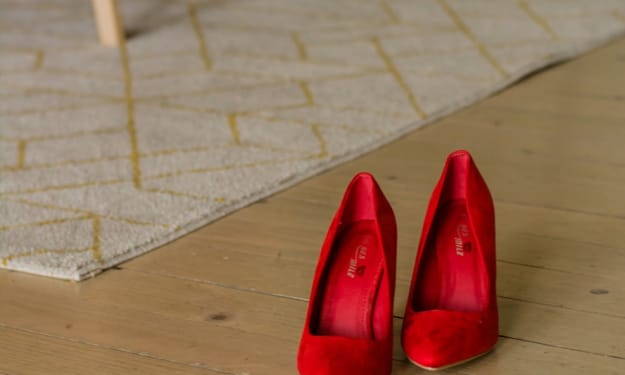
The day she left, I didn’t realize it was goodbye. We had argued over something small—something about laundry, or maybe the thermostat—and she left in a flurry, grabbing her keys but forgetting her coat. I remember the sound of the door closing behind her. Not a slam. Just... final. I figured she’d go for a walk, cool off, maybe get coffee like she always did when she needed space. That’s what we always did. Fight, fume, forgive. But this time, she didn’t come back. At first, I thought maybe she was staying at her sister’s. Or that she’d driven to the lake to clear her head. But as the sun dipped behind the skyline and the house filled with silence, something heavier began to set in. I called. No answer. Texted. Left voicemails. Tried not to panic. Then her sister called me—she hadn’t seen her either. That night felt endless. Every creak of the floor, every car passing on the street outside made my heart race. I barely slept, hoping she'd walk in any minute. She didn’t. Days turned into weeks. Police reports. Searches. Pleas on social media. I handed out flyers with her picture and clung to hope like it was the last thread of sanity I had left. But through it all, one thing remained constant: Her shoes—those scuffed, maroon canvas ones she loved—sat at the door. They were the first thing she kicked off when she got home. She wore them to the market, on our lazy Sunday strolls, and even once to a wedding just to make a point. They were part of her, like the way she twirled her hair when she read or hummed Fleetwood Mac while cooking. I couldn’t move them. Friends came and went. They brought casseroles, awkward hugs, and well-meaning advice. “She wouldn’t want you to suffer like this.” “You need to accept it and move on.” “You should get rid of her things—it’ll help.” But I couldn’t touch those shoes. They stood like silent witnesses to a life interrupted. To mornings filled with shared laughter and nights tangled in whispered dreams. They reminded me of who she was—vibrant, stubborn, alive. Every morning, I’d sit on the couch, staring at them. Waiting. Hoping. Months passed. Seasons changed. I kept telling myself maybe she was just lost. Maybe she was figuring things out. Maybe she was trying to protect me from something. But deep down, I knew. One rainy afternoon, I came home to find a small package at the door. No return address. Just my name in her handwriting. Inside was a note. > “I’m sorry. I couldn’t carry it anymore. You gave me more love than I believed I deserved. Please remember me in the light. —Em.” I collapsed to the floor, holding that note like it was her. Grief isn't loud. It's quiet and cruel and settles into the corners of your life. Into the empty spaces beside you in bed. Into the half-full cup of coffee on the counter. Into the shoes still waiting by the door. I still haven’t moved them. I don’t know if I ever will. Some days, I talk to them—tell them how work was, or how our dog still scratches at the bathroom door expecting her voice. I water the plants she loved, replay her favorite records, and let her memory live in the spaces she left behind. Grief has no expiration date. It just... becomes part of you. And those shoes—those damn shoes—remind me that once, she was here. She was real. She was mine. And maybe, in some way, she still is. Sometimes, I imagine her walking through that door again—smiling, apologizing, slipping back into those shoes like nothing ever happened. It’s a fantasy I can’t let go of. And maybe I don’t have to. Because love like that doesn’t vanish. It lingers... in the silence, in the shadows, in the shoes. #EmotionalStory #LostLove #GriefAndLove #LoveAndLoss #VocalMedia #TrueFeelings #HeartbreakingMoments
By Dr Gabriel about a year ago in Fiction
Dodge Tanner’s Highly Unrecommended Travelogue - #17: Thunder Deer
Dodge Tanner’s Highly Unrecommended Travelogue Entry #17: A Shocking Encounter I would like to formally renounce all claims that the open plains are safe. In fact, I’d like to propose legislation against calling anywhere without walls "safe."
By Canyon Cappola (TheNomad)about a year ago in Fiction
A Portrait of Silent Love
Deep within the heart of a dense forest, far from the reach of wandering eyes and sunlit paths, bloomed a wildflower. She wasn’t a flower of renown—no dazzling colors, no intoxicating fragrance. And yet, she was a symbol of silent beauty, a creation of nature that only solitude could nurture.
By Sadia Afrinabout a year ago in Fiction
The Reinitializer. AI-Generated.
The rain ticked steadily against the lab window—almost like the system’s habitual pre-boot diagnostics. Eliot opened his eyes to a too-quiet world. He stared at the ceiling for several seconds before the crystalline interface at his side flickered on, pulsing with a message he could quote in his sleep:
By NeuralDriftabout a year ago in Fiction
The Sun at the Center: A Modern Fable
In a universe not far from our own, nestled in a sky of perpetual twilight, lived a small planet called Orbis. Unlike Earth, Orbis believed in an ancient tradition passed down for generations: that everything—stars, moons, truths, and even destinies—revolved around them. The people of Orbis were proud, certain that their place in the cosmos was central, immovable, and unquestioned. This belief shaped everything. Maps were drawn with Orbis at the heart of all creation. Songs praised the land as the axis of the universe. The skywatchers, Orbis’s most honored thinkers, created elaborate systems that explained how everything circled them. Anyone who questioned it was politely ignored—or politely removed. Among the people of Orbis lived a quiet young thinker named Solen. He wasn’t like the others. While others studied charts to affirm what they already believed, Solen gazed at the sky with curiosity, not certainty. He noticed odd things: stars that didn’t follow expected paths, seasons that changed with patterns too precise to be accidental, and shadows that moved with a logic beyond local understanding. One day, Solen built a small machine. It was simple—a collection of polished orbs, strings, and a turning crank. He called it the Orbitale. Instead of placing Orbis at the center, Solen put a brilliant golden sphere in the middle and let the other spheres rotate around it. “It’s wrong,” said the elders. “You insult tradition.” “It’s dangerous,” whispered the teachers. “Such thinking could unravel everything.” But when Solen turned the crank, the model moved with elegant precision. The seasons aligned. The patterns made sense. The sun at the center explained what generations of ego could not. Solen’s idea did not spread easily. Some laughed. Others warned that to believe in the sun’s centrality was to erase Orbis’s greatness. The council of skywatchers declared the model heretical. They tried to confiscate the Orbitale, but Solen had already shared copies with others curious enough to see. Eventually, young minds gathered around Solen. They weren’t interested in preserving the past but understanding the present. These thinkers, once shunned, began asking questions that couldn’t be ignored. If Orbis was not the center, what else were they wrong about? If the sun was at the center of their system, maybe humility—not pride—was the beginning of wisdom. Over time, the society changed. Not quickly, and not without conflict. Some clung to the old ways, furious that their maps and beliefs no longer matched reality. But others, inspired by Solen’s quiet courage, began to see the beauty in being one part of a vast, magnificent whole. The sun, it turned out, didn’t demand worship. It simply illuminated. --- The Meaning Behind the Fable "The Sun at the Center" isn’t just a tale about astronomy or science—it’s a metaphor for personal, societal, and philosophical transformation. At its heart, it challenges the idea of self-centeredness—whether in individuals, institutions, or ideologies—and promotes the value of truth, humility, and curiosity. Historically, the fable echoes the revolutionary shift brought on by Nicolaus Copernicus, who first proposed the heliocentric model in the 16th century, replacing centuries of geocentric belief. That change wasn’t merely scientific—it disrupted theology, philosophy, and humanity’s sense of place in the universe. Much like the citizens of Orbis, people initially resisted the idea that Earth wasn’t the center of all things. But the truth eventually reshaped our entire understanding of reality. On a personal level, the story invites readers to consider: What assumptions do we center in our lives that might not be true? Do we see ourselves as the central figure in every narrative, or can we recognize that we orbit larger truths? Are we courageous enough to turn the crank and question what we’ve always believed? --- The Modern Context In today’s world, where echo chambers and rigid ideologies often dominate discourse, The Sun at the Center feels especially relevant. Many institutions still cling to outdated models—about power, identity, history, and even truth. Much like the Orbis council, they resist change not because they lack evidence, but because they fear the loss of control. Yet, this modern fable reminds us that progress isn’t about being right—it’s about being open. The sun in Solen’s model represents not just astronomical truth, but the illuminating power of insight, the light of wisdom that can reorder our lives if we let it. There’s also a subtle spiritual layer to the tale. The sun is often used as a metaphor for clarity, divinity, or inner awakening in many traditions. To move from self-centered thinking to a sun-centered worldview could symbolize a shift from ego to essence—from ignorance to awareness. --- Final Reflection The Sun at the Center: A Modern Fable is a tale for anyone standing at the crossroads of doubt and discovery. It honors those who dare to think differently, even when tradition resists. It reminds us that truth, though often uncomfortable, is always liberating. In the end, Solen’s discovery didn’t diminish Orbis—it elevated it. By stepping out of the center, the people finally saw the grandeur of the universe they were part of. And that, perhaps, is the greatest fable of all: that humility doesn’t make us small—it makes us whole.
By Wasif islamabout a year ago in Fiction
The Duality of Twins
It's funny how the same upbringing could so frequently produce such different people. It was never more prominent, to my own belief, than in myself and my sister. Identical twin girls, you would expect us to be the same right down to our breakfast preferences. You wouldn't be alone in this view, either.
By Alexa Forbes-Ritteabout a year ago in Fiction
"The Message I Couldn't Unsend"
The Message I Couldn't Unsend It was 2:03 AM in New York City. The kind of hour where regrets echo louder than traffic, and memories feel heavier than sleep. I sat on the edge of my bed, phone in hand, heart pulling me toward a message I wasn’t sure I should send. My last message to her. We hadn’t spoken in four months. Not since that final argument in the rain outside her apartment in Brooklyn. I remember the way her voice cracked when she said, “You don’t fight for me anymore.” I had turned away instead of replying. I didn’t know then how much silence could say. Since then, I replayed that night like a scratched vinyl — same fight, same ending, same emptiness. She moved on, or at least that’s what Instagram told me. I hadn’t. Not even close. That night, insomnia was louder than usual. The streets outside were asleep, but inside me was chaos. Her laughter, her texts that used too many emojis, the way she’d nudge my arm during movies — everything came flooding back. And so, I opened our old thread. The one I never deleted. It was still there — the last message from her: “Please just say something.” And I hadn’t. I stared at the blinking cursor for twenty minutes before I typed: "I never stopped loving you. I just didn’t know how to show it. And I’m sorry I let you walk away thinking I didn’t care." I hovered over “Send.” My thumb trembled. It was a truth I'd buried beneath pride and fear. But sometimes love doesn’t die — it just waits behind locked doors. And maybe, just maybe, she'd still be on the other side. I hit send. Three little dots appeared. My breath caught. She was typing. Then they vanished. Ten seconds. A minute. Two. Nothing. The screen stayed quiet, like the night around me. And in that moment, I realized the truth: not every apology gets a reply, not every wound is meant to heal with words. But I didn't regret it. That message wasn't just for her. It was for the version of me that never spoke up, that let love slip through his fingers while pretending it didn’t hurt. That message was my release. The next morning, I woke up to no reply. Just the blue ticks — proof she saw it, nothing more. Weeks passed. Spring turned to summer. I started going to therapy, picked up journaling, reconnected with old friends. I didn’t send another message. I didn’t need to. Because the last one said everything. Maybe she found peace in those words, or maybe she deleted them right away. I’ll never know. But that’s okay. Sometimes closure isn’t a reply. It’s the courage to speak your heart, even if the world stays silent. And maybe — just maybe — that silence is the answer we were both looking for her. I used to think closure came from conversations — the kind where both people sit across from each other, unraveling every tangled thread. But now I know, sometimes closure is quiet. It’s a message you send without expecting a reply. It’s waking up the next morning knowing you finally said what needed saying — not for them, but for yourself. And in that silence, I found something I hadn’t felt in months: peace. Not the kind someone else gives you — but the kind you earn by being honest, by being brave. I may never know what that message meant to her. But I know what it meant to me: the beginning of letting go "If you liked the story, please leave a like or comment and share your thoughts with us." Thanks for reading
By Dr Gabriel about a year ago in Fiction
The Watcher of Dusk Rock
Somewhere off the North Atlantic coast, where the sea carves whispers into the stone cliffs, stands Dusk Rock Lighthouse. For nearly seventy years, it’s been abandoned—no keepers, no ships, no records. The locals say the last man who lived there vanished, leaving his light burning for three nights after he was gone.
By Muhammad Sohailabout a year ago in Fiction