Fantasy
Whispers of the Forgotten Clock
In the sleepy town of Elderglow, nestled between rolling hills and a river that sang secrets to the stars, time had a peculiar habit of standing still. Not metaphorically, but literally. The townsfolk swore the old clock tower, perched on the edge of the square, hadn’t ticked in a century. Its hands, frozen at 3:17, cast long shadows that never shifted, as if the sun itself respected the clock’s stubborn refusal to move. The townspeople called it the Forgotten Clock, and they whispered that it held the soul of Elderglow, trapped in a moment no one could remember. Lila Wren, a young woman with a penchant for unraveling mysteries, arrived in Elderglow on a rainy afternoon, her boots splashing through puddles that reflected the gray sky. She’d heard of the clock from an old book she’d found in her grandmother’s attic, its pages yellowed and brittle, detailing a town where time refused to flow. The book hinted at a curse, a pact, and a key—none of which made sense, but all of which ignited Lila’s curiosity like a match to dry tinder. She’d come to Elderglow to write a story for Vocal Media, hoping to uncover something extraordinary. The townsfolk were kind but cagey. At the local diner, where the air smelled of coffee and burnt toast, Lila asked about the clock. Old Mr. Harrow, who claimed to be ninety but looked no older than sixty, squinted at her over his glasses. “Some things are better left alone, girl,” he said, his voice like gravel. “That clock don’t like being questioned.” Others echoed his sentiment, their eyes darting to the tower as if it could hear them. But Lila wasn’t one to heed warnings. She thanked them, paid for her coffee, and headed to the clock tower. The tower loomed over the square, its stones weathered but unyielding, ivy crawling up its sides like veins. The door at its base was locked, but Lila, ever resourceful, found a loose windowpane and slipped inside. The air was thick with dust, and the faint scent of rust clung to everything. A spiral staircase wound upward, its steps groaning under her weight. At the top, she found the clock’s heart—a massive mechanism of gears and springs, frozen mid-motion. In the center, dangling from a chain, was a small, ornate key, glinting faintly in the dim light. Lila reached for it, her fingers brushing the cold metal, when a voice echoed through the chamber. “You seek what you cannot understand.” She spun around, heart pounding, but no one was there. The voice was soft, almost sorrowful, like a sigh carried on the wind. “Who’s there?” she called, her voice trembling. No answer came, but the air grew heavier, pressing against her skin. She grabbed the key and stuffed it into her pocket, determined to uncover its purpose. Back at the inn where she was staying, Lila examined the key under the flickering light of a lamp. It was intricately carved with symbols she couldn’t decipher, but it felt alive, warm to the touch. That night, she dreamed of the clock tower, its hands spinning backward, the town unraveling around it. Faces she didn’t recognize pleaded with her to return the key, while others begged her to use it. She woke in a cold sweat, the key still clutched in her hand. The next day, Lila returned to the tower, determined to find answers. She explored the town first, piecing together fragments of its history. The librarian, a woman with eyes like storm clouds, told her of a watchmaker who’d built the clock in 1873. He’d loved a woman named Elara, but she vanished on the night the clock was completed. The town believed the watchmaker had bound his grief to the clock, stopping time to preserve her memory. “Some say the key unlocks the clock,” the librarian whispered, “but others say it unlocks something far worse.” Lila’s heart raced as she climbed the tower again. The voice returned, louder this time. “You hold my prison,” it said, and now Lila was certain it was Elara’s voice, trapped within the key. She hesitated, her fingers trembling as she approached the clock’s mechanism. The key fit perfectly into a small slot she hadn’t noticed before. She turned it, and the gears groaned to life, a deep, resonant hum filling the tower. The world outside shifted. The sky darkened, the air shimmered, and the townsfolk froze in place, their faces contorted in fear. Lila ran to the square, where the clock’s hands were spinning wildly, forward and backward, as if time itself was unraveling. Shadows moved in the corners of her vision—figures that weren’t quite human, their eyes glowing like embers. “You’ve freed me,” Elara’s voice whispered, now clear and sharp. “But you’ve also freed them.” Lila realized too late what the librarian meant by “something far worse.” The clock hadn’t just preserved Elara’s memory—it had trapped the watchmaker’s despair, his rage, and something darker, something that fed on time itself. The shadows grew, coalescing into forms that reached for her. She sprinted back to the tower, the key burning in her pocket. With no other choice, she yanked it from the slot, and the clock fell silent once more. The shadows vanished, and the town returned to its eerie stillness. Lila stood panting, the key heavy in her hand. She could leave now, write her story, and let Elderglow keep its secrets. But the voice lingered in her mind, pleading. “I’m still here,” Elara whispered. Lila looked at the key, then at the clock. She could try again, find a way to free Elara without unleashing the darkness. Or she could walk away, leaving the town to its frozen fate. She chose to stay. The story wasn’t over yet.
By Nauman Hassan Khanabout a year ago in Fiction
“When the Stars Sang”
“When the Stars Sang” Veilthorn city's sky never changed. Stars punctuated the night in changeless, perfect designs—suspended on the blackness like paint on velvet. Children stopped wondering why ages ago. Most thought stars were lights, ornaments strung up by time. Nessa knew better. She had always felt their presence. Not seen them—felt them. Growing up, she would stare at the stars until her eyes became blurry, her heart filled with something unspoken, something that was old. Even if born without a voice, she was never bereft of sound within her heart. Her dreams were filled with music she could never articulate—tormented and beautiful, like lullabies that the sky sang. Nessa was Eldric's apprentice, the final of the Skybinders—keepers of ancient lore, whose rituals once bound earth and sky. All thought his magic was gone. Forgotten. As are the stars. Nessa listened. Not with ears. With her blood. Her breath. Her dreams. One night, in front of a cold and unseeing sky, she showed Eldric her drawing of the constellation Vaerion, the Wolf-God. His stars shone faintly in her dream last night—they had changed. She had seen it. Eldric went pale. "That is not possible," he whispered, holding the drawing. "Unless…" He walked to an ancient chest, opened it, and pulled out a scroll wrapped in black silk. "The Spell of Reawakening," he said. "A song sung only once—by the First Dreamer. A spell of sound and starlight." He looked at her with a stinging glance. "It must be sung, Nessa. But you…" She didn't need to be reminded. She touched her temple—dreams. Then her heart. Eldric stopped, then nodded his head slowly. "We can try it. But beware—rousing the stars rouses more than deities." That night, Nessa slept under the stars, scroll spread flat against her breast. She slept deeply, deeper than ever before—into a dream that seemed gold-edged. She was on the top of a mountain. The stars pulsed like hearts, soft and distant. Whispering echoes of old voices vibrated around her—a song that lacked words. Nessa's lips parted, and out of the dream-self, sound poured like honey-fire. A single, sacred note unrolled in her hand, sending out forgotten runes. As she'd sung in the dream, the runes burst into light and vanished. High, one star shook. Then another. Then twenty. She jumped up with a gasp—voice still lodged in her throat—but her eyes wide with surety. The stars had moved. Eldric validated it the next morning. "You did it," he gasped in awe, gazing at the shifting constellations. "You awakened them." But their awakening brought omens. The winds grew restless. Oceans whispered of old tides. Humans dreamed of voices they could not understand. The gods were stirring. And they remembered. That night, Nessa slept again. The mountain returned—but crumbled at its edges. The stars cried fire. A low, lamenting voice thundered above: "Why have you called us back, earth's child?" She answered—not with words, but song. A mournful cry of longing. Of forgotten stories. Of the world's silence without them. The stars faltered. Then sighed lightly: "We are unfinished. Wake the others.". When Nessa awoke, the scroll was gone. Burned to ashes in her sleep. But its song remained with her. During the weeks that followed, she slept under different skies—on rocky cliffs, in crumbling temples, at the mouth of weathered caves. Each night, a new song came to her. Each song brought another god: Rhael, the Flame-Binder. Ilyra, the Dream-Fox. Oron, the Thunderbearer. The skies shifted with every dawn—colors danced, stars swirled, and humans began to recall magic. Not everyone was happy. The Council of Silence, who ruled Veilthorn, saw the changing stars as a threat. "The gods create chaos," they warned. "Come back to stillness, or be silenced." Eldric was taken into custody. The scrolls were burned. Nessa was deemed a danger. She fled—in the wilds outside the city, stars her only guide. But the people dreamed again. Children hummed strange songs. Farmers saw lights move in the dark sky at midnight. The ancient songs stirred. Nessa stood on the last peak—the highest in the land. Alone, but not afraid. She only had one god remaining to rouse—the one whose silence had sealed the heavens: Lunareth—the Starborn Queen. In her final dream, Nessa drifted among stars. A throne of silver floated before her. Upon it sat a woman of starlight, eyes closed in eternal slumber. Nessa opened her lips. And sang. It was no longer a solo song—it was the chorus of the gods she had already awakened. Their breath ran through her. Their songs were hers. The Queen's eyes opened. The stars blew in motion—billing through the skies in tides of color and light. The constellations shifted. Earth shook with song. Nessa awoke. And for the very first time in her life— She spoke. One word: "Shine." --- Moral of the Story: Even in quiet, there is a voice that can wake the stars. Dreams are not escapes—they are echoes of things the world has forgotten.
By The Golden Pageabout a year ago in Fiction
Whispers from the Locked Door. AI-Generated.
Emma had always been drawn to old houses. Their stories felt like silent companions, waiting patiently to be uncovered. When she found the quaint Victorian on Maple Street, she knew she had to have it — despite the quirks, the creaky floorboards, and especially the locked door at the end of the hallway.
By Yasir Nawazabout a year ago in Fiction
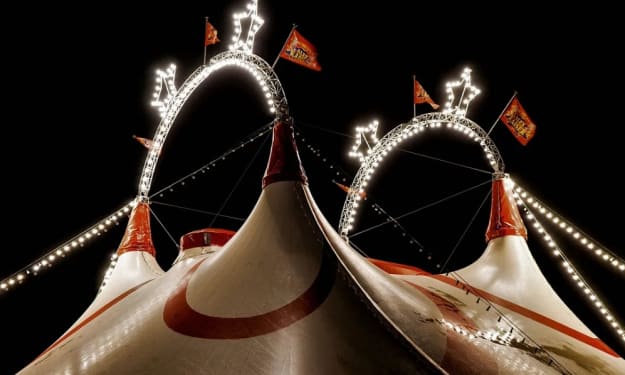
The Warple Wurcus of Thussleberry Circus
I couldn’t believe my destiny. The colours, the motion, the sentiment. I’m older now, nearing death; a great time to write a memoir. But this is no ordinary memoir, for I was the first Warple-Wurcus. I was Scrimitass Sagorious.
By Adz Robinson about a year ago in Fiction
Beyond Reflection
I still remember that morning when I looked in the mirror and it felt like a stranger was staring back at me. The sun was bright, streaming through my window, and I should have felt alive, confident, whole. But instead, all I saw was a dull face with tired eyes—a reflection that didn’t match the events inside.
By Echoes of Lifeabout a year ago in Fiction
One Woman, One Mountain
The sky was already bleeding into ink when Élise tightened the straps of her backpack and stepped onto the trail. A pale crescent moon hung above the Cévennes, casting long shadows across the pines. The forest exhaled cool, damp air, scented with moss and old stone. Each footstep echoed a rhythm older than her thoughts.
By Alain SUPPINIabout a year ago in Fiction