Fantasy
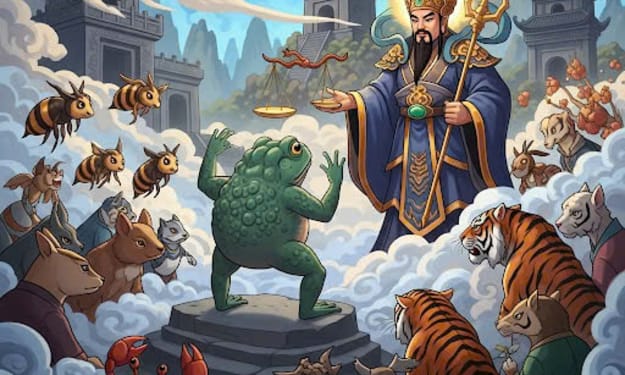
Toad Sues God
Once upon a time, in a year no one could quite remember, the sky brought a terrible drought. The sun scorched the trees month after month, drying up rivers and lakes. All living things were left with no water to drink. The great and powerful animals who had once terrorized the forest now lay helpless, tongues hanging out, waiting for death. None of them could think of a way to save themselves or the world around them. Their strength had only ever been used to bully others, never to confront Heaven.
By Tuấn Trần Việtabout a year ago in Fiction
🐿️ The Squirrel’s Missing Acorn Heist
It all began on a crisp autumn morning when Chester the squirrel awoke to find his prized golden acorn missing. This was no ordinary acorn. It wasn’t gold in color — it was actually gold. A shiny, nut-sized trinket he’d found near a human picnic site last spring. Ever since, Chester had kept it safe in his tree hollow, hidden beneath piles of real acorns. To the forest, it was his treasure. To him, it was a symbol of pride. And now it was gone. His whiskers twitched. His tiny paws trembled. There were no signs of a break-in — no snapped twigs, no disturbed leaves. Just an empty hollow and a sinking feeling in his belly. “This is a heist,” Chester muttered. “And I’m going to crack it wide open.”
By Shoaib Afridiabout a year ago in Fiction
Where the Gravel Whispers Goodbye
It was still summer on the calendar, but in my heart, it felt like the end of something. The heavy heat of August had lifted, and I couldn’t help but feel that the sudden coolness came not from a passing storm, but from the many tears I had cried over the past days. The sky was clear, the sun was shining, but inside me, it felt cloudy. I blinked away the sting in my eyes, not wanting tears to blur my view as I drove through the winding mountain road, tree branches arching overhead like a soft green tunnel. I rolled down the window to breathe in the smell of warm grass, and for a moment, it felt like I had never left.
By ibrahim khanabout a year ago in Fiction
At Eldermore Harbor
The western sunset glimmered like dancing stars of orange and gold across the shimmering surface of the harbor as the wind sailed softly across the surface. It was chilled, bringing with it the tang of salt and sand and seaweed as it tousled sandy locks. He brushed them from his face and inhaled deeply. He loved the sunsets here at Eldermore, when the sea breeze was calm and fair and the clouds were trimmed with golden light; it seemed peaceful: one could almost forget there wasn’t a war going on just mere miles away.
By R.C. McLeodabout a year ago in Fiction
The Curse of Goldleaf
Long ago, in a peaceful valley nestled between green hills and silver rivers, lay a small village called Eldenwood. The people there lived simply. They grew their own food, told stories by candlelight, and trusted one another like family. Among them lived a woodcutter named Arman. He had strong hands, a warm heart, and a quiet smile. Arman didn’t have much, but he had what mattered: a loving wife named Elira, three spirited children, and a home filled with laughter. He rose with the sun each morning and returned with bundles of firewood each evening. His children would run to him, covered in flour or mud, and his wife would greet him with warm bread and tired eyes full of love. Arman believed he was the richest man in the world. But life, as it often does, took a turn. One bitter winter, the harvest failed. Snow came early and stayed long. The rivers froze. The villagers grew thin, their firewood vanished, and their cupboards went bare. Arman worked harder than ever, but the forest near the village had already been stripped bare. His children’s cheeks lost their color. Elira coughed at night, but hid it with a smile. Desperate to feed his family, Arman journeyed deeper into the forest than he had ever dared before. He crossed frozen streams and climbed icy slopes until he found himself standing before a strange grove, untouched by snow. The trees here were different—tall and glowing. Their trunks shimmered with a golden hue, and their leaves glistened like polished coins. Goldleaf Hollow. He had heard whispers of this place in old tales—legends passed down by elders. They said the grove was enchanted, that greedy souls never returned. But Arman wasn’t greedy… was he? Shivering and desperate, he struck the nearest tree with his axe. It bled gold. Coins spilled from the bark like water. Arman gasped, eyes wide. He filled his sack, hands trembling. That night, his children feasted. His wife smiled. He told himself it was a miracle—a gift for the good. But the next morning, he went back. And the next. And the next. Soon, he no longer carried firewood. Only gold. His house grew larger. The roof became tiled with silver. Servants came. He dressed in velvet and sipped wine by a roaring fire while others starved. He no longer chopped wood. He no longer laughed. He no longer tucked his children in at night. But still, he returned to Goldleaf Hollow. And then, the dreams began. Every night, he stood in the grove, surrounded by whispering trees. A voice echoed from the shadows: > “You were given enough. But still, you took. What you take, you must return.” Arman ignored it. Then, one morning, he awoke to find golden leaves scattered across his bed. His hands were stiff. Bark had begun to grow over his skin. He washed, scrubbed, even burned—but the wood remained. Panicked, he ran to the grove. “I’ll give it back!” he cried. “Please, just let me go!” But the trees were silent. The voice returned, colder than before: > “You were warned. You fed your greed and starved your soul.” Desperate, Arman buried his gold beneath an old oak tree, sobbing as he clawed at the earth. He wandered the forest, barefoot and wild, calling out to anyone—anything—that would listen. But he was alone. Days passed. Then weeks. His wife and children waited, but he never returned. And in the heart of Goldleaf Hollow, a new tree grew—taller than the rest. Its bark resembled the lines of a face. Its roots twisted like fingers. Its leaves shone gold, but wept silent tears when the wind passed through. The villagers later found Arman’s manor crumbling, overtaken by weeds. No one could find the gold he once flaunted. His children left Eldenwood, carrying only memories of the father they once adored. To this day, travelers speak of a strange tree in a distant grove. Some say they hear it breathe. Some claim it watches them. And if they listen closely, they hear it whisper: > “I had enough… but I wanted more.” --- Moral of the Story: Greed is never satisfied. It begins with desire… and ends in destruction. True wealth is found not in gold, but in love, kindness, and contentment. For those who forget this, the forest remembers.
By Ishtiaq Ahmadabout a year ago in Fiction
And again and again and again and
The first time it happened, I thought it was a dream. Same with the second. The third felt too real---I thought, he must be a ghost. By the fourth I figured I must be crazy, hallucinating this perfect conjuring of what might have been. But the fifth time proved that others could see him and I felt him under my touch and he must be real. This was real. This is real.
By Raine Nealabout a year ago in Fiction
The Last Monkey of Emberwood
The sun cast golden shafts of light through the tangled canopy of Emberwood, where ancient trees whispered secrets to the wind. Few dared venture deep into the forest, and those who did rarely returned with the same light in their eyes. Emberwood had earned its reputation—not for beasts or bandits, but for something older, something no one could explain. Legends told of a time when the forest teemed with mystical creatures, guardians of balance between man and nature. Chief among them was the red-crowned monkey, said to possess the wisdom of the old world and the power to summon the spirits of the forest. But they vanished centuries ago, or so the world believed. Until now. --- Twelve-year-old Maya stood at the forest’s edge, gripping the leather strap of her satchel. Her father had disappeared into Emberwood six months ago, chasing tales of ancient relics and forgotten creatures. He never returned. The local villagers had warned her, begged her not to follow. But Maya had found his journal—its final pages scribbled with strange symbols, maps, and one repeated phrase: “The Last Monkey watches the heart.” With trembling fingers and fire in her chest, Maya stepped past the last fence post and into the emerald gloom. --- The deeper she went, the quieter the world became. Birds did not sing here. Insects did not buzz. Even her breath seemed to fade into the silence. Strange markings appeared on trees—swirls and glyphs that pulsed faintly when touched. She followed the map, the landmarks lining up one by one: the twin rocks, the river that flowed uphill, the hollow tree humming with energy. After hours of trekking, she reached a wide clearing bathed in sunlight. In the center stood a stone totem, moss-covered and broken. At its base sat something… watching her. It was a monkey—small, with deep brown fur and a brilliant crimson patch on its forehead. Its golden eyes locked onto hers, intelligent and calm. "You…" Maya whispered. "You're real." The monkey tilted its head and dropped from the totem. It didn't run. Instead, it walked toward her on all fours, stopping inches away. Slowly, it reached out and touched her satchel. Inside was her father’s journal. She opened it and showed him the last page. The monkey tapped one symbol—an eye inside a leaf. Maya understood. This was the "Heart of Emberwood," the place her father had written about. But why had he come here? And where was he now? The monkey gestured for her to follow. --- For the next two days, they traveled together. The monkey—whom Maya began calling Ember—led her through forgotten temples and glowing caves, across vines that sang when touched, and to pools that shimmered with stars in daylight. Along the way, Ember showed her carvings, visions locked in the stones: images of a time when humans and forest spirits coexisted. But something had broken the balance. A great fire. And a betrayal. The red-crowned monkeys had tried to stop it, but only one remained. That one now stood beside her. At the mouth of a great cavern, Ember hesitated. The entrance was sealed with a large stone covered in hand-shaped indentations. Maya placed her palm on one. A heartbeat echoed beneath the stone. With a deep groan, the stone door slid open. Inside, vines glowed softly, illuminating what seemed to be a sanctuary—an ancient hall with curved walls and high domes. At its center was a crystal tree, long dead, wrapped in black roots that pulsed with dark energy. Ember shrank back, trembling. Suddenly, from the shadows, a figure stepped forward. Maya gasped. “Dad?” But the man who emerged looked… changed. His eyes were too dark. His skin carried faint markings, like the symbols in the forest. "I found it, Maya,” he said slowly. “The Heart. It speaks. It grants knowledge beyond time.” “You’re scaring me,” she said. He raised his hands. “I did it for us. For mankind. The monkey—he wants to keep this power hidden. He’s afraid.” Maya looked at Ember, who stood firm but sorrowful. “The forest isn’t a weapon,” she said. “It’s alive. You wanted to protect it once. Remember?” Her father hesitated. Then the black roots pulsed. His expression twisted. “The Heart belongs to all,” he growled. The ground trembled. The roots lashed out. Ember leapt forward, placing himself between Maya and the dark energy. His crimson mark glowed bright—brighter than the cavern, than the crystals, than the sun itself. The roots screamed. From Ember’s chest, light exploded—pure, green, and wild. It surged through the room, into the walls, up the dead tree. The blackness hissed and cracked, recoiling like a shadow at dawn. Maya’s father collapsed, unconscious but breathing. The crystal tree bloomed—petals of light unfurling into the air, casting illusions of monkeys past, leaping and dancing across the domes. The sanctuary breathed again. Ember turned to her, tired but smiling. "You saved it," Maya whispered, kneeling beside him. But Ember was fading—his form flickering like the last flame of a candle. The light had taken its toll. “No,” she said, tears spilling down her cheeks. “Don’t go.” He reached up, pressing his small hand to her chest. Then he was gone. --- The villagers gasped when Maya returned—alive, her father weak but safe. They listened in silence as she told them what had happened. Some scoffed. Others wept. But weeks later, the forest began to change. The rivers ran clearer. Birds returned. Trees bloomed out of season. And sometimes, in the corner of an eye, a small monkey with a red crown could be seen watching from the branches. A legend had been reborn. And Emberwood had a guardian once more—not of fur and bone, but of spirit, memory, and hope. ---
By Habibullah. Shoukat Aliabout a year ago in Fiction
The Light of Peace
The Light of Peace Once upon a time, there was a small village named Noorvale, nestled quietly in the arms of tall, ancient mountains. The village was once known for its beauty, kind-hearted people, and joyful gatherings. But for many years, a shadow of fear had fallen over Noorvale. People stayed away from each other, locked inside their homes as soon as the sun disappeared behind the hills. Peace had vanished, and darkness ruled both the night and the hearts of its people. At night, the village streets were empty, and only the sound of wind through the trees could be heard. Children no longer played outside, and elderly women sat by their windows whispering prayers. The men returned from the fields before sunset, fearful of the tales told by their ancestors. Stories of a wandering spirit in the nearby forest haunted their dreams. Noorvale, once alive with music and laughter, was now buried under silence and suspicion. In this village lived a young girl named Amina, who refused to surrender to fear. She believed that the darkness outside could never be darker than the darkness within people’s hearts. Amina had grown up listening to stories of the time when Noorvale was filled with lantern-lit streets and joyful festivals. She dreamed of bringing back the light, not just to the streets, but to the hearts of her people. One evening, while sitting near the old fireplace with her grandmother, Amina asked about the stories of peace that once existed. Her grandmother’s eyes filled with tears as she spoke of the old days. She described how a simple lantern placed in the village square during festivals would light up not just the roads but everyone’s spirits. That single light had once symbolized unity and safety. Inspired by these words, Amina made a bold decision. She would take a lantern to the village square at night, defying the fear that had ruled for too long. Many tried to stop her, warning her of the dangers lurking in the darkness. But Amina’s heart was brave, and her hope was stronger than the shadows. She believed that one small light could start a change. That night, as the wind howled through empty streets, Amina stepped out of her house with a small lantern in her hand. Every door she passed remained tightly shut. Curtains were drawn, and not a soul dared peek outside. But Amina walked on, each step steady, guided by the warmth of the flickering flame. In her heart, she carried the stories of a peaceful Noorvale. When she reached the village square, she placed the lantern in the center, right where the old festival stage once stood. The tiny flame danced against the darkness, its glow soft yet defiant. Amina stood there silently, letting the light speak to the empty night. For the first time in years, the square wasn’t swallowed entirely by shadows. Slowly, a window creaked open. An old man peeked out, then another neighbor. The light, small as it was, had awakened something inside them. Mothers held their children near the windows, pointing at the brave girl standing with her lantern. One by one, doors began to open, and cautious feet stepped onto the cold stone streets. An elderly woman, carrying an old oil lamp, joined Amina in the square. Then a boy brought a candle, and soon, others followed. The square, once empty and forgotten, began to shimmer with scattered lights. Amina smiled, not because the darkness was defeated yet, but because fear was no longer winning. The villagers gathered around Amina, sharing stories of their fears, regrets, and dreams they had long buried. For the first time in years, laughter returned to Noorvale. Though the spirits of the forest still wandered and the nights remained cold, something stronger than fear had returned — hope. Days turned into weeks, and Noorvale slowly transformed. The people repaired their homes, cleaned the old streets, and planted flowers along the paths. Festivals resumed, and children played in the fields without fear of the falling night. The lantern in the square remained lit, tended by different villagers each evening. The wandering spirit, some claimed, still existed. But it no longer held power over the hearts of the people. They had remembered the strength that comes from unity, kindness, and courage. The light Amina placed that night became more than just a flame; it was the symbol of Noorvale’s rebirth. Amina was honored as the heart of Noorvale’s new chapter. Though she humbly refused titles, she remained the one people turned to in difficult times. The village once again became known for its warmth and peace. Stories of a brave girl with a lantern spread to nearby valleys, inspiring other villages trapped in fear. The light of peace wasn’t just in the lantern’s flame but in every kind word, every shared smile, and every act of courage. Noorvale learned that sometimes, it only takes one small spark to drive away years of darkness. The village thrived, not because the danger vanished, but because they faced it together. --- Moral: True peace isn’t the absence of danger, but the presence of courage, hope, and unity. A single brave act can reignite the light in many hearts.
By The Pen of Farooq about a year ago in Fiction