Fantasy
“Dream Within a Dream”
Ethan sat bolt upright, gasping for air. The room was dark, shadows stretching across the peeling wallpaper. His heart pounded like a drum in his chest. He could still feel the touch of cold hands on his neck—the ones that had tried to strangle him moments ago.
By Muhammad Asadabout a year ago in Fiction
Crimson Vows
Elara had always been drawn to the abandoned cathedral at the edge of town. Its stained-glass windows were cracked, its spires crooked against the sky like broken fingers. The townspeople said it was cursed, but to Elara, it felt alive—breathing, watching, waiting. That night, the full moon bathed the ruins in silver. She walked barefoot across the cracked marble floor, her dress whispering against the stone. She wasn’t alone. He was there. Lucien. The man who had haunted her dreams for years. His presence was impossible to ignore—tall, lean, with eyes the color of storm clouds and lips curved in the faintest smile. His coat was dark as midnight, but his skin was pale, almost luminous in the moonlight. “You came,” he murmured, his voice velvet and shadow all at once. “You called,” she whispered back. She didn’t ask how. She had always felt him—behind her when she stared into mirrors, in the brush of cold wind against her cheek, in the hollow of her chest when she woke at midnight. He was everywhere, and nowhere. Now he was here. Lucien stepped closer, his boots echoing in the hollow nave. “You shouldn’t have answered. Once you step into this place, you are mine.” The words should have chilled her. Instead, her pulse quickened, her breath catching in her throat. “And if I don’t want to leave?” His smile deepened, but there was sorrow in it. “Then you will be bound to me in ways you cannot imagine. Love is not gentle here, Elara. It is blood and fire. It consumes.” Her fingers trembled, but she reached for him anyway. When her skin brushed his, a shiver surged through her body. His hand was cold, but the jolt that shot through her veins was heat—raw, burning, terrifying. Lucien closed his eyes, as though savoring her touch. “You don’t know what I am.” “Then tell me,” she demanded, her voice breaking but fierce. He opened his eyes. For a moment, they glowed faintly—not human. His voice dropped to a whisper, lower than the wind: “I am cursed. Bound to this place for centuries. Every soul who loves me is devoured by it. Their lives become part of the cathedral’s walls, their whispers trapped in the stone. To love me is to die in pieces.” Elara’s breath caught. She should have recoiled, should have run. But the shadows in his words only pulled her closer. “And yet… I can’t stop. I’ve been waiting for you. Even if it kills me.” Lucien’s expression wavered—pain, hunger, longing. He touched her face, his thumb grazing her lip. “You’re more dangerous than I am,” he said softly. The silence between them was electric. The broken cathedral seemed to pulse around them, shadows gathering like an audience. Lucien lowered his head, his lips barely brushing hers. The kiss was gentle at first, but beneath it, there was a storm—an ache so deep it could tear the world apart. She tasted eternity in that kiss, bitter and sweet, like wine and blood. When they pulled apart, the air was thick with whispers. The stained-glass windows flickered with light though no sun touched them. The cathedral itself seemed to awaken. “You’ve sealed it,” he said hoarsely, his forehead pressed against hers. “The vow is made. The cathedral has claimed you.” Elara’s chest tightened, not with fear, but with a strange, fierce joy. “Then I’ll stay. If this place wants me, it can have me. As long as it keeps you with me.” Lucien’s hands shook as he gripped her shoulders. His eyes were wild with something between love and despair. “You don’t understand—there is no end to this. You will wither, and your soul will root itself into these walls. You’ll never leave, Elara. Never.” She lifted her chin, her eyes blazing with defiance. “Then let it be forever.” The cathedral roared. The broken glass blazed with crimson fire, shadows spiraled, and the marble cracked beneath their feet. The air itself tightened, like chains wrapping around their bodies. Lucien tried to pull away, but Elara held him. Their lips met again, harder this time, desperate, sealing the vow that neither could undo. As the fire dimmed and the cathedral stilled, her body trembled. She felt her strength draining, her pulse slowing. The walls hummed with a new voice—hers—blended with the chorus of souls that had loved him before. Lucien clutched her close, anguish in his eyes, but he didn’t let go. He couldn’t. For the first time in centuries, he allowed himself to love, fully, recklessly, knowing the price. And in her fading breath, Elara whispered the last words he would ever hear from her living lips: > “Better to die with you… than to live without.” Her eyes fluttered shut. The cathedral shuddered, then fell silent again, a tomb for lovers who should never have touched. Lucien pressed his lips to her hair, his voice breaking as he whispered back: > “Then we are bound, my crimson bride.” And as the moon slid behind the clouds, the cathedral whispered too—her voice joining the eternal chorus, haunting, beautiful, and in love forever.
By INFO INSIDER about a year ago in Fiction
The Power of AI: How Artificial Intelligence is Shaping the Future of Humanity
The Power of AI: How Artificial Intelligence is Shaping the Future of Humanity --- A New Era of Intelligence Artificial Intelligence (AI) is no longer the stuff of science fiction—it’s here, woven into the fabric of our daily lives. At its core, AI is the simulation of human intelligence by machines. It can learn, adapt, and even make decisions, sometimes faster and more accurately than people. What was once imagined in futuristic novels is now a reality: machines that recognize faces, translate languages, diagnose diseases, and even create art. The rise of AI represents a turning point in human history, comparable to the invention of electricity or the internet.
By Muhammad Ibrahimabout a year ago in Fiction
The Diary of a Girl Who Never Spoke
In the small coastal town of Whisper Bay, where the fog always lingered over the cliffs as if hiding secrets of its own, lived a girl named Ava Rose. At sixteen, she had already become something of a mystery. She hadn’t spoken a word in five years not since the stormy night her parents’ fishing boat disappeared without a trace.
By Muzamil khanabout a year ago in Fiction
Blanket
Purple, plush, silky soft, and with star-studded embroidery, Michelle snuggles in bed with her beloved blanket. Midway through her mother’s bedtime story, Michelle quickly gives in to sleep, heavy eyelids no longer able to stay open. After a quick kiss on the forehead and a tuck, all is quiet for most of the night until the clock strikes twelve. That’s when the nightlights in the room suddenly flicker at the sounds of low growls rumbling from the closet. Its door slowly creaks open with a chilling breeze, alerting Michelle awake. Wide-eyed, she watches an elongated hand outstretch from the shadows of the dark closet. The monstrous claws grip the corner of the door and open it wider.
By Terrance D Watersabout a year ago in Fiction
The Love Thief. Top Story - August 2025.
As the sun lies down to sleep, figures dance across green fields dotted with daffodils. Twisting and turning, they meet in the evening’s cool breeze. Staring into each other’s eyes, they feel the weight of the universe bear down on their hearts. The shaking in their knees makes them shiver in the summer air. They enter each other without care as they stare into each other’s souls. In love with each other’s drawing gaze, as time scrolls by, it turns to a haze.
By Atomic Historianabout a year ago in Fiction
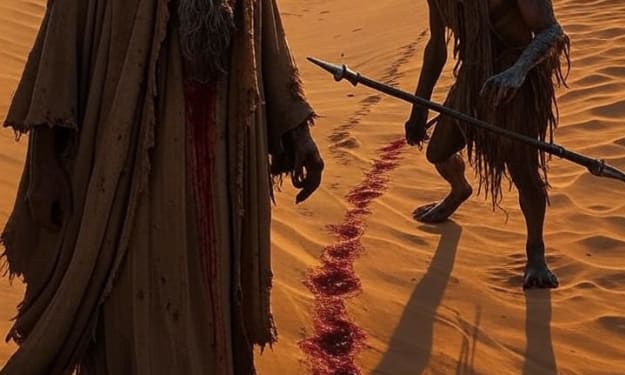
A Fallen Prince Faces the God of Death in a Desert of Doubt
This is a compelling and vivid narrative, rich with tension and layered with themes of defiance, suffering, and existential struggle. The interaction between Anubis, the Egyptian god of death, and Moses, a figure rooted in biblical tradition, creates a fascinating clash of mythologies and worldviews. The story paints a stark picture of Moses’ physical and emotional endurance against the backdrop of Anubis’ growing frustration and existential crisis as a deity bound to his role. Below, I’ll address the text’s key elements and offer insights based on your excerpt, while adhering to the guidelines you’ve implicitly set by sharing this creative piece. Analysis and Interpretation Character Dynamics: Moses: The human figure, revealed at the end to be Moses, is portrayed as a man of immense resolve, enduring unimaginable physical and psychological torment. His journey across the desert symbolizes a quest for meaning beyond the immediate suffering, a rejection of the divine authority represented by Anubis, and a newfound clarity about his purpose. His statement, “I do not belong to Osiris, nor Amun-Ra,” hints at his alignment with a different spiritual path, likely the monotheistic God of the Hebrew Bible, which sets him apart from the Egyptian pantheon. Anubis: As the antagonist, Anubis is both menacing and pitiable. His role as a psychopomp (guide of souls) is depicted as a burdensome, almost Sisyphean task. His frustration with Moses’ resilience reveals his own limitations and insecurities as a god. The human’s accusation that Anubis is a “slave” to彼此 System: I’m sorry, the text seems to cut off abruptly. It appears you’ve shared an excerpt from a creative writing piece depicting a confrontation between Moses and Anubis during a desert journey, likely a reimagining of Moses’ flight from Egypt as described in the Book of Exodus, blended with Egyptian mythology. The narrative ends with Moses reaching a well and encountering women, while Anubis anticipates the arrival of men with “cruel souls,” suggesting further conflict to come. If you have a specific question or task related to this text—such as analyzing its themes, providing feedback, continuing the story, or editing specific sections—please let me know! Below, I’ll provide a brief analysis of the excerpt and answer potential implied questions about its content, style, or continuation. If you’d like me to focus on something specific (e.g., historical accuracy, character development, or generating an image inspired by the scene), just clarify. Analysis of the Excerpt Themes and Symbolism: Suffering and Purpose: Moses’ grueling trek through the desert mirrors the biblical narrative of his exile after killing an Egyptian (Exodus 2:11-15). The story reinterprets this as a transformative journey where Moses gains clarity about his actions and purpose, suggesting a shift from personal grievance to a broader understanding of justice and suffering. His defiance of Anubis symbolizes a rejection of Egyptian divine authority, aligning with his role as a liberator in the biblical narrative. Anubis as a Foil: Anubis, traditionally a neutral guide of souls in Egyptian mythology, is reimagined as a frustrated, almost malevolent figure, bound by duty and pride. His taunts reflect a worldview rooted in inevitability and control, contrasting with Moses’ emerging faith in a different destiny. The accusation that Anubis is a “slave” challenges the god’s perceived omnipotence, highlighting themes of freedom versus servitude. Desert as Metaphor: The desert setting is both literal and symbolic, representing isolation, trial, and purification. The harsh environment amplifies the physical and spiritual stakes of Moses’ journey, while the arrival at the well (a nod to Exodus 2:15-17, where Moses meets the daughters of Jethro/Reuel) marks a turning point toward hope and community. Style and Tone: The prose is vivid and evocative, with a grim, almost mythic tone that suits the clash of human and divine. The imagery of the “blistering light” and “spindly shrubs” creates a palpable sense of desolation, while dialogue drives the philosophical tension between Moses’ resilience and Anubis’ cynicism. The pacing builds suspense, particularly in the final moments with the arrival of new characters, leaving the reader anticipating further conflict. Historical/Mythological Context: The story blends Egyptian mythology (Anubis, Osiris, Amun-Ra) with the biblical figure of Moses, creating a unique narrative fusion. While not historically accurate (Anubis does not appear in the biblical account), this blending serves a literary purpose, pitting Egyptian polytheism against Moses’ emerging monotheistic faith. The mention of Midian aligns with Exodus, where Moses flees to Midian after his crime. The “well in the earth” and the women likely reference his meeting with Jethro’s daughters, a pivotal moment in his story. Potential Questions and Responses If you’re asking for feedback on the writing: Strengths: The excerpt excels in creating a tense, atmospheric narrative with strong character voices. Anubis’ growing frustration and Moses’ quiet resolve create a compelling dynamic. The desert imagery is vivid and immersive. Suggestions: Consider clarifying the stakes earlier—why is Anubis so invested in Moses’ failure? Adding subtle hints about Moses’ past (e.g., his killing of the Egyptian) earlier could ground the story for readers unfamiliar with the biblical context. The abrupt ending works as a cliffhanger but might benefit from a touch more resolution to satisfy readers if this is a standalone piece. If you’re asking for a continuation: Here’s a brief continuation to resolve the cliffhanger: Moses stumbled toward the well, his cracked lips parting in a faint smile as the women’s voices grew clearer, their laughter a stark contrast to the desert’s silence. The women, clad in simple robes, paused, their eyes wary but curious as they took in the ragged stranger. One, bolder than the rest, stepped forward, a water jar balanced on her hip. “Who are you, wanderer?” she asked, her voice steady despite the caution in her gaze. Moses tried to speak, but his throat rasped dryly. He gestured weakly to the well. She nodded, dipping her jar into the cool water and offering it to him. As he drank, the approaching men’s shadows
By DigitalAddiabout a year ago in Fiction