Fantasy
The Mirror in Room Six
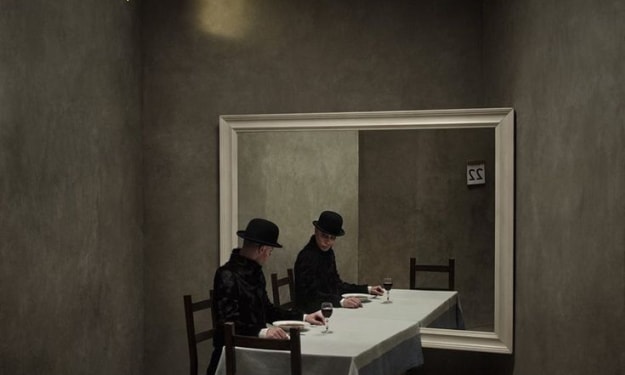
M Mehran When traveling for work, Daniel never expected much from the hotels he stayed in—sterile lobbies, thin walls, and coffee that tasted like cardboard. But the motel he checked into that rainy Thursday was stranger than most. The clerk barely looked up as Daniel signed in, mumbling, “Only one room left—Room Six.” The hallway was dim, lined with peeling wallpaper. Room Six creaked when he pushed the door open. Inside, everything seemed ordinary enough: a bed, a chair, a lamp that flickered. The only unusual thing was the mirror. It was full-length, framed in dark wood, and leaned against the far wall. It wasn’t dusty or cracked like the rest of the room—it gleamed, flawless, as though it had been polished moments before. Daniel didn’t think much of it until he unpacked. He glanced at the mirror and froze. His reflection was smiling. But Daniel wasn’t. He stepped closer, his stomach lurching. Slowly, cautiously, he raised his hand. His reflection raised its hand too, in perfect sync. But the smile lingered, stretched unnaturally wide. “Long day,” Daniel muttered to himself, trying to laugh it off. “Just tired.” He turned away, but unease prickled his skin. He left the television on for noise, but every time he glanced at the mirror, the reflection’s smile seemed sharper. --- At 2 a.m., a noise jolted him awake. A faint tapping, like fingernails on glass. The room was dark, the TV off though he hadn’t touched it. His gaze slid to the mirror. His reflection was standing closer than he was—right up against the glass. The tapping grew louder. The reflection lifted its hand and knocked, once, twice, three times. Daniel’s breath caught. His body felt heavy, pinned to the bed. Then, in a voice that didn’t echo in the room but bloomed inside his skull, the reflection whispered: “Let me out.” Daniel scrambled off the bed, heart hammering. “This isn’t real,” he hissed. “I’m dreaming.” The reflection tilted its head, the smile never faltering. “You don’t belong out there. You’re tired. Worn down. Let me take your place. Rest. Just rest.” “No,” Daniel whispered. The mirror rattled. Cracks spidered across its surface though it didn’t break. The reflection’s smile widened until it split the face unnaturally. Daniel grabbed his bag, fled the room, and didn’t stop running until he was in his car, the rain soaking him through. He drove through the night, not caring about the headlights or the storm. --- By morning, he had convinced himself it was exhaustion and stress. Lack of sleep. Maybe even a fever dream. But when he stopped at a diner for breakfast, he caught his reflection in the window. It was still smiling.
By Muhammad Mehranabout a year ago in Fiction
The House That Waited
M Mehran On the outskirts of town, beyond the crooked oak trees and the overgrown path, stood a house no one claimed. Its paint peeled, windows sagged, and yet every night, one upstairs light glowed as though someone were still waiting inside. Children dared each other to approach it, whispering about ghosts and lost lovers, but few ever got closer than the rusted gate. Clara, however, had never been afraid of the house. At twenty-seven, she returned to her hometown with a suitcase of failures—her business had collapsed, her relationship had ended, and the city that once promised so much now felt like a cruel trick. On her first night back, she walked until the familiar silhouette rose in the moonlight. The house looked just as it had when she was a girl, when she’d sketch it in the margins of her notebooks, convinced it had secrets worth knowing. The gate creaked open easily. No lock. No chain. As if the house had always been waiting for her. Inside, dust blanketed the floor, but the air felt strangely warm. The wallpaper peeled in strips, revealing faded patterns of roses. A staircase curved upward, and at its top, yes—light spilled faintly from a room. Clara should have turned back. Instead, she climbed, each step groaning under her weight. At the landing, she hesitated, then pushed open the glowing door. The room was a library. Hundreds of books lined the walls, their spines gleaming though no hand had touched them in decades. A single lamp on a desk flickered gently. And on that desk sat a book with her name embossed in gold. Clara froze. Her throat went dry. She opened it. The first page read: The Story of Clara Whitmore Below, in delicate handwriting, was the story of her childhood—the afternoons at the creek, the loneliness after her mother’s death, the way she always sat at the back of class, sketching that strange house. The pages turned themselves, as though impatient. They showed her teenage years, her secret dreams of becoming an artist, her decision to chase practicality instead. Every choice, every misstep, every heartbreak. And then, halfway through the book, the pages were blank. The lamp flickered once, twice, and the silence thickened. Clara touched the paper. “What is this?” she whispered. A voice drifted from the shelves—soft, old, but clear. “It is your unfinished story.” She spun, but no one was there. “Who’s speaking?” The voice chuckled, though not unkindly. “The house. I keep the stories of those who wander too far from themselves. Yours has been waiting.” Clara’s hands trembled on the desk. “So… what do I do?” “Write,” the house said simply. “Fill the pages with what comes next. Not what you think you should do. Not what others told you to do. What you want.” Her chest ached. “But I don’t know anymore.” “Then start small. One choice. One word. A blank page is not a curse, Clara. It is an invitation.” Her eyes blurred with tears. She sat, picked up the pen lying beside the book, and hesitated. The nib hovered over the page, her hand shaking. Then she wrote: Tomorrow, Clara paints again. The lamp glowed brighter. Somewhere deep in the walls, gears clicked like locks being undone. --- The next morning, Clara woke in her childhood bedroom, unsure if the house had been dream or memory. But the scent of ink clung to her fingertips, and on her desk sat a canvas she hadn’t touched in years. She began to paint. Hesitant strokes at first, then bolder, until color spilled across the canvas. She painted the oak trees, the crooked path, the waiting house. Day after day, she returned to the library, each time finding the book open to the next blank page. Whatever she wrote there seemed to shape her waking life. She painted, she applied for exhibitions, she reconnected with friends she’d long avoided. But with each written word, the house grew quieter. The wallpaper faded further, the shelves thinned. The voice, when it spoke, sounded weaker. On her final visit, the library was nearly bare. Only her book remained. Its last blank page trembled as though in a breeze. The house’s voice whispered, faint as a sigh: “You have no need of me now. Your story is yours to carry.” Clara placed her hand on the final page and wrote: Clara chooses to keep writing, no matter how uncertain. The lamp flickered once—and went dark. --- Years later, Clara’s paintings hung in galleries across the country. Critics praised the haunting imagery, the way her canvases captured both loss and possibility. She never told them the truth: that each painting began in a library that no longer existed. Sometimes, when she walked past the edge of town, she looked for the house. But the path had grown over, and no silhouette rose in the distance. And yet, on nights when doubt clawed at her, Clara would hear it faintly in her dreams—the creak of a gate, the whisper of pages turning, and the soft voice reminding her: “A blank page is not a curse. It is an invitation.”
By Muhammad Mehranabout a year ago in Fiction
The Stone Circle
Our spaceship hovered above the stone circle as my partner and I disembarked. I paused at the bottom of the ramp and took in the atmosphere. My fingers flexed. There was…something here. An energy unlike anything that the humans of this planet were able to create.
By Stephanie Hoogstadabout a year ago in Fiction
"Here and Now"
“Gus?... Gus!” I heard a snapping noise as soon as I recognized my name. I didn’t jump or flinch to attention, like you’re used to seeing in the movies. Instead, I just raised my head and turned my gaze slowly to discover the deep green eyes burrowing deep into my own.
By Taylor Rigsbyabout a year ago in Fiction
The Witches Redemption
Vivian’s heart pounded as she darted through the twisted undergrowth, her breath coming in sharp, uneven gasps. The wolf-like creature bounded beside her, sleek fur glinting in the dappled sunlight that pierced the thick canopy above. Despite its fierce appearance, its amber eyes flicked to hers with an intelligence that seemed almost human.
By Lyrria Honeyabout a year ago in Fiction
Moonlit Serenade
Adrian had always played his violin under the open sky. It was not fame he sought, nor the coins tossed into his velvet case by hurried passersby. What he wanted was something no audience could give: a listener who truly understood the language of his music. One night, weary of noisy taverns and indifferent crowds, he climbed the hill outside the village. The sky above was deep and vast, the stars like scattered sparks, but it was the full moon that held his gaze. Silver and round, it seemed closer than ever, as if leaning down to hear him. Adrian smiled, tightened the bow, and began to play. The first note drifted through the cool air like a sigh. Then came a melody soft, tender, and filled with longing. It carried secrets of his heart: the loneliness he never spoke aloud, the ache for a love he had not yet found, the hope that one day he would be seen. As the final note faded, something stirred. The moon shimmered brighter, its light spilling over him like a caress. For a heartbeat, Adrian thought he saw her face—gentle, luminous, with eyes that glowed like silver fire. Your song is beautiful, whispered a voice, soft as the wind through leaves. Adrian froze, bow still in hand. He looked around, but there was no one. Only the moon above, glowing brighter. Who speaks? he asked, his voice trembling. I do, the voice replied. I am Selene, the spirit of the moon. You called me with your music. Adrian’s heart pounded. I only wished to be heard. And you were, Selene said. Each note reached me across the night. You played your soul, and I listened. From then on, night after night, Adrian returned to the hill, playing for her. He poured his joys, his sorrows, his dreams into every melody. And each time, the moon answered. Sometimes with whispers, sometimes with soft laughter like silver bells, and sometimes with silence that felt like a hand resting gently on his heart. Days blurred into weeks. The villagers noticed the change in him. His eyes shone brighter, his smile softer, as though touched by something beyond the mortal world. He no longer longed for audiences, for coins, or even for earthly love. For he had found a listener who saw him completely. But with magic comes a cost. On the night of the waning moon, Selene’s voice trembled. Adrian, our time is short. The heavens call me back. I cannot remain bound to Earth forever. No, Adrian whispered, bow tightening in his grip. Do not leave me. I cannot lose you. You will not lose me, she said gently. Play once more, and I shall weave part of myself into your music. Though you may not see me, every time you play beneath the night sky, I will be there. Tears blurred his vision, but he raised the violin and played. This time it was not a song of loneliness or longing, but of love—pure and eternal, reaching higher than the stars. As the final note rose, Selene’s light blazed, wrapping him in warmth. When the glow faded, the hill was quiet. The moon drifted higher, her face no longer visible. Yet Adrian knew she was there, listening. Always listening. From that night onward, whenever Adrian played, people swore the moon shone brighter, the stars leaned closer, and the night itself seemed to hush in reverence. Travelers passing through the village stopped to hear him. Some swore his music healed broken hearts. Others claimed it stirred forgotten dreams. But Adrian cared little for their praise. For he knew that beyond all mortal ears, one listener waited faithfully, her silver gaze turned toward him. The villagers often asked why he always played at night, never beneath the sun. He would only smile, for how could he explain that the night was where love lived for him? That in every bow stroke, every trembling note, he felt the echo of Selene’s promise? The truth was simple. Adrian was no longer a man playing for audiences. He was a man keeping a vow, his music forever bound to the moon. Years passed, and Adrian grew older, his hands lined, his hair silvering like the moonlight he loved. Yet his playing never lost its magic. On his final night, when he felt his strength fading, he climbed the hill one last time. The moon hung full and bright, watching. With trembling fingers, Adrian lifted his violin. The melody he played was soft but steady, a farewell woven with gratitude. As the last note faded, he smiled and whispered, I am ready. And for those watching from the village below, they swore they saw the moon descend, shining brighter than ever before, wrapping Adrian in her light. When the glow dimmed, he was gone. But the violin remained on the hill, strings still warm, as though kissed by moonlight. To this day, villagers say that on clear nights, when the full moon shines, you can hear faint music drifting down the hill—a serenade not of sorrow, but of eternal love. A moonlit serenade, eternal and unbroken.
By LUNA EDITHabout a year ago in Fiction
The Witches Redemption
Because of the betrayal of the king's royal sorceress, the king decreed that all witches must die. 19 year old Vivian was busy mixing herbs and toxins to make medicine for her neighbour down the street. It was late in the afternoon when Vivian finished making medicine for her neighbour.
By Lyrria Honeyabout a year ago in Fiction
Her Lover in Shadows
The World Exist in This Room Mariya walked through the door and tossed her keys in the direction of the table. As the keys clattered to the floor just past their target, she dropped herself down into his favorite chair, still wearing the nursing scrubs the hospital had given her in the emergency room. Her legs slowly drew up into her chest and her body sank into the fabric as she curled the whole of it into the seat.
By Timothy A Rowlandabout a year ago in Fiction