Fan Fiction
When Dreams Become Memories
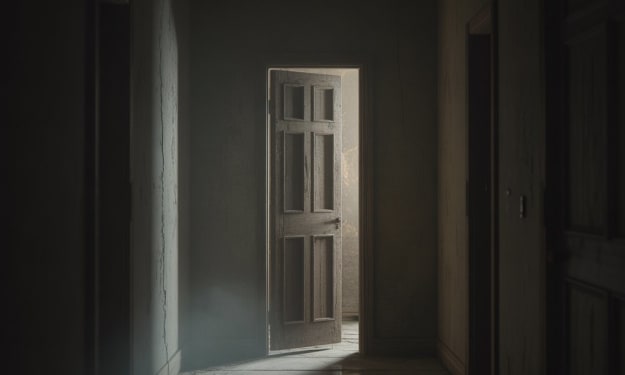
When Dreams Become Memories I woke up this morning remembering a birthday party. There were balloons, a cake with pale blue frosting, and a woman laughing softly as she smeared a bit of icing on my nose. I could smell the vanilla, feel her hand, and hear a child’s giggle echoing behind us. It felt so real — only, it hadn’t happened. Not yet. My apartment was the same as always: one coffee cup, one toothbrush, no balloons, no child. But the memory wouldn’t fade like dreams usually do. It was sharp, like something I had truly lived. At first, I blamed stress. Too many hours at the office, too many sleepless nights staring at spreadsheets and city lights. But then, the second one came. A memory of sitting in a hospital room. Machines beeping. My own hand holding someone else’s. Tears — mine, maybe hers. I could smell antiseptic, hear the faint hum of the ventilator. I didn’t know who the woman was, but I knew she was important. --- The first few times, I wrote them down, thinking they were creative ideas, or maybe my brain’s way of coping with loneliness. “Dream 1: Birthday.” “Dream 2: Hospital.” I kept the list in a small notebook by my bed. But as the days went by, the “dreams” became clearer. One morning, I woke with the taste of burnt toast in my mouth and the sound of a car horn echoing in my ears. That same evening, as I crossed the street to get coffee, a taxi screeched to a halt just inches away. The driver leaned out, yelling something about paying attention. The smell of exhaust was the same as in my dream. That’s when I stopped calling them dreams. --- The next few weeks blurred together. I’d wake up with pieces of the future stitched inside my mind — fragments of conversations, smells, or emotions. Sometimes they were small things: the taste of lemon pie, the scratch of a new shirt collar, the sound of rain on a metal roof. But sometimes, they were terrifying. Like the night I dreamed — no, remembered — the sound of glass shattering, someone screaming my name, and a shadow falling. I woke up drenched in sweat, heart racing. The next morning, I stayed home, afraid to go anywhere. I turned off my phone, shut the blinds, and tried to convince myself it was all in my head. But around noon, I heard the crash. My upstairs neighbor’s window had broken during a storm, glass raining down onto the street. If I’d gone out for my usual lunch, I might’ve been right below it. That was the day I stopped doubting. --- I tried telling my friend Leo about it once. He laughed, said I’d been watching too many sci-fi movies. “You’re just having vivid dreams, man. Everyone’s brain plays tricks when they’re tired.” But then I asked him about the scar on his left hand. He frowned, confused. “What scar?” I told him he’d get it next week — from a camping trip, when he’d try to grab a hot kettle before it fell. He stared at me for a long time, then shook his head and walked away. A week later, he sent me a picture of his hand. The scar was there. --- After that, I started keeping track. Every morning, I’d wake up and write down what I remembered: faces, words, dates, emotions. I learned that the memories came exactly seven days before the events occurred — not a day more, not a day less. At first, it felt like a gift. I saved people from small accidents, avoided bad decisions, and once even stopped a fire from spreading in my building by warning the superintendent about a faulty wire. But then came the memory that changed everything. I woke up gasping, drenched in sweat, remembering fire — real fire this time. My apartment engulfed in flames, the air thick with smoke, the sound of sirens closing in. I saw myself trapped, coughing, crawling toward the door. I could smell burning plastic and hear the crackling ceiling collapsing above me. It was exactly one week ahead. Next Friday night. 9:42 p.m. --- I tried everything. Called the fire department, the landlord, even replaced every wire and appliance. I slept at a friend’s place for a few nights. But as the days ticked closer, I felt something pulling me — like gravity. Friday came. At 9:00 p.m., I was sitting in a café down the street, pretending to read. My heart thudded like a drum. 9:30. I checked my watch. 9:40. I couldn’t stay. I had to see. I ran back toward my building, ignoring the rain and the flashing lights of passing cars. When I reached the corner, I saw the glow — orange and alive, devouring the night sky. Flames rose from the windows of my apartment. But the strange part wasn’t the fire. It was me. Through the smoke, I saw a silhouette in the window — my window — moving, coughing, collapsing. I froze, my mind screaming that it was impossible. I was standing here. And yet, I was also in there. Then everything went dark. --- I woke up this morning remembering the fire. The smell of smoke still clung to my clothes. But my apartment was untouched. No burns. No ashes. Just the quiet hum of the refrigerator. I checked the date. Friday, 9:00 a.m. Seven hours before it happens. I finally understand. These aren’t warnings — they’re memories. Memories of futures I can’t escape. And tonight, when the clock strikes 9:42, I’ll be there — just as I remember.
By Abdul Muhammad 12 months ago in Fiction
The Experience of Viewing the Remarks Produced by AI . Content Warning.
Here’s what it truly feels like to earn appreciation from a machine and why your real, fallible humanity still counts most online. When the words seem genuine, but there is no emotion conveyed. 1. The First Comment That Seemed Fake Just another night of publishing stories on Medium it was business as usual. It wasn't flawless, but it was unfiltered, heartfelt, and penned from that inside space where ideas aren't refined, simply real. After that, a message appeared. A remark had been made. You've written a fantastic piece. I am genuinely inspired by your viewpoint. Continue doing an excellent job. It should’ve made me smile. But instead, something inside me went quiet. It was too slick. Too perfect. Too empty. I copied the comment, pasted it into Google and there it was a dozen similar comments strewn over different blogs. That’s when I discovered it wasn’t a human who spoke to me but It was a machine and somehow, that hurt more than I imagined 2. When Validation Feels Manufactured Writers don’t write for claps alone. We write to connect to feel seen. Every time someone comments, it’s not just feedback, it's a signal. A whisper that says Hey, I read your thoughts, I felt them too. But what happens when that whisper is artificial? When the warmth in the words is produced, not genuine? It feels like being hugged by a ghost. You can sense the shape of the emotion, but not the warmth of it and suddenly, all that affirmation whose likes, those comments, those “great post answers, they lose their value. Because connection without consciousness isn’t connection. It's a simulation. 3. The Paradox of the AI Era We live in a strange time. Writers utilize AI to create. Readers use AI to remark. Soon, maybe, AIs will reply to each other while humans only observe. We say we desire authenticity. But we’re automating our emotions, our voices, our empathy. We call it efficiency, but maybe it's an escape. We’re steadily forgetting how to be human online and maybe, even offline. It makes me wonder If no one’s truly feeling the words, is anyone really talking? 4. What It Feels Like Up Close It feels like applause from an empty theater. It appears like engagement, but it sounds like silence. You start questioning: Did anyone actually read what I wrote? Did anyone feel it? I can’t totally blame AI, because it's smart, useful and even brilliant in its own way. It saves time, improves ideas, and helps authors like us shape thoughts faster. But there’s something about AI that can't fake empathy. It can imitate emotion, but it can’t feel it. It can describe a sunset, but it can’t sit in awe of it. 5. The Imperfection That Makes Us Human The little typo that displays your joy. The jumbled paragraph that suggests you were crying while writing. The raw, unedited sentence you almost deleted but didn’t. Those are not mistakes. They are fingerprints. They prove you were here. Perfection is the enemy of connection and AI, for all its brilliance, is a little too perfect. 6. My Turning Point as a Writer After that moment, I made a quiet pledge to myself, If someone comments on my post, I’ll welcome it but I’ll check for the pulse. I’ll seek for the warmth behind the words, not simply the words themselves and more importantly I’ll never stop writing like a human. Because that’s what readers genuinely need not automation, not optimization, but authenticity. Even if AI learns to replicate humanity perfectly, I’ll still prefer to bleed on the page. Because that’s what writing is intended to be, not clean, not cold, but alive. 7. To Every Writer Reading This If you ever feel disheartened because nobody’s commenting because you assume no one’s reading remember this: Even one real A person who reads your words is worth more than a thousand bots claiming to care. One human connection outweighs a thousand algorithmic exchanges. Your words don’t need millions of eyes. They just need one soul to see them. Keep writing like a person. Because real people can tell the difference. 8. The Future Isn’t About AI It’s About Awareness AI isn’t the enemy. Unawareness is. Use AI to support you, not to replace you. Let it modify your grammar, not your truth. Let it mend your commas not your voice. Because the world doesn’t need another perfect post. It needs something real. Something that reminds people what it is to feel. Seeing AI-generated comments on my postings seems like seeing technology cheer for me loud but lifeless. But it also reminded me of something powerful: In a world where everything is automated, Being human becomes a superpower. The errors, the fragility, the wobbly phrases they’re not defects. They’re proof that you’re alive and that’s what will always separate us fro Next time you remark on someone’s post, don’t let AI compose it for you. Take 10 seconds to feel what their comments made you feel. Then say something real even if it’s just: This touched me. I felt this. Thank you for writing this. Because you can feel it, AI can't and that’s what will always make your presence matters
By Aliyu Ibrahim 12 months ago in Fiction
Unexpected knock at the Door
The first knock was so soft Alexander almost dismissed it as the cabin settling, or a pinecone dropping from the eaves. It was 3:07 AM. He was in his armchair, a biography of a forgotten president splayed open on his chest, the fire in the hearth reduced to a bed of pulsating coals. The silence up here on the mountain was absolute, a thick blanket he’d come to both cherish and fear.
By Muhammad Anas 12 months ago in Fiction
When One Voice Turns Into a Roar — and a City Listens
It began as a whisper. In the narrow alleyways of Nizamabad, the kind where crooked balconies lean over laundry lines and stray cats dart between shadows, a solitary voice rose before dawn. A young woman—barefoot, ragged vest, eyes blazing—stood atop a faded crate in the market square and screamed:
By Alexander Mind12 months ago in Fiction
The Last Prayer of Rahim
There’s a small village at the edge of nowhere — the kind of place where time moves slowly, and people remember everything. That’s where Rahim lived. He wasn’t always sick. Once, he was the strongest man in the village — the kind who carried bricks all day and still helped his neighbors fix their roofs before sunset. People used to call him “Bhai Rahim — the man with a heart bigger than his hands.” But life has a strange way of testing the kindest souls. A few years ago, an illness crept into Rahim’s body. At first, it was just pain — something he could hide behind his smile. Then came the swelling, the weakness, the nights of burning fever. Doctors called it incurable. Rahim just called it “Allah’s test.” His house was small — two rooms and a wooden door that always creaked. Every morning, before the sun climbed over the rooftops, he would spread his prayer mat and whisper the same words: >Ya Allah… give me patience, not comfort. Give me strength, not ease.” The neighbors would hear his voice through the thin walls. Some pitied him. Others just shook their heads and said, “He won’t live long.” But Rahim always smiled when he heard that. “I’ve already lived longer than despair,” he’d say softly. -- One cloudy afternoon, a traveler named Saeed arrived in the village. He wasn’t looking for Rahim — he was just passing through, tired and lonely, searching for something he couldn’t name. Someone at the tea stall told him about “the sick man who prays for others.” Curious, Saeed went to find him. When he reached Rahim’s home, the sight stopped him cold. Rahim was sitting on a thin mattress by the door. His body looked fragile, but his eyes — those eyes had light. He wasn’t praying for healing; he was praying for gratitude. Saeed sat quietly beside him. Neither spoke for a while. The sound of their breathing filled the silence between prayers. Finally, Rahim opened his eyes and smiled. “Brother, you look troubled,” he said softly. Saeed’s eyes were wet. “I came to see you, but now I don’t know what to say. I feel helpless.” Rahim chuckled faintly — a dry, gentle sound. “Don’t be. Pain is not always a punishment. Sometimes it’s a reminder… that we still belong to Him.” -Saeed took out a bundle of money, hands trembling. “Please, take this,” he said. “Use it for medicine, for care… for anything.” Rahim looked at it for a moment, then closed Saeed’s hand around it again. “Brother, money can fix a body, but not a heart. And my heart is fine.” Saeed couldn’t hold back his tears anymore. “What can I do then?” he asked. “Pray with me,” Rahim whispered. “That’s all I ever need.” So they sat together — two strangers who suddenly felt like brothers. Their hands lifted, voices low but full of meaning. “Ya Allah, forgive us when we forget to be grateful. Forgive us when we fear pain more than we fear losing faith. And when we suffer, let us remember — You never test without purpose.” The air grew still. Even the birds seemed to listen. Saeed could feel the weight of those words settle deep inside his chest. Rahim’s hands slowly dropped to his lap. His eyes stayed open, but something changed — a softness came over him. He whispered one last time, barely audible: “Tell the world… I wasn’t waiting for death. I was waiting to meet the One who gave me life.” And then, silence. Complete, peaceful silence. The azaan began to echo from the nearby mosque. Saeed sat there, motionless, tears falling one by one. He wasn’t crying out of pity anymore — he was crying because he’d just seen what faith truly looked like. Before leaving, he looked around the little courtyard. There was no wealth, no comfort, no sign of healing. Yet somehow, Rahim had everything Saeed had been searching for — peace. When Saeed walked back to the main road, the evening light touched the village roofs. He whispered to himself: "He healed me, even as he was dying.” And from that day on, wherever Saeed went, he carried Rahim’s prayer in his heart — a prayer that wasn’t just about pain or faith, but about finding light in the darkest corners of life. Moral / Reflection: Some people leave this world without fame or fortune, but they leave behind something far greater — a lesson that faith can turn suffering into strength, and sorrow into peace.
By Vocal Member 12 months ago in Fiction
Remember Your Childhood Bedroom!. Content Warning.
Imagination in childhood is powerful. For a short time, it shapes our lives but how we loose it.. I remember waking up in my bedroom, colours bursting all around me, toys of every shape and size waiting to be played with. Big smiles, bold eyes, and bright creatures greeted me each morning. Back then, even the smallest things seemed huge and magical.
By Cryptic Edwards12 months ago in Fiction
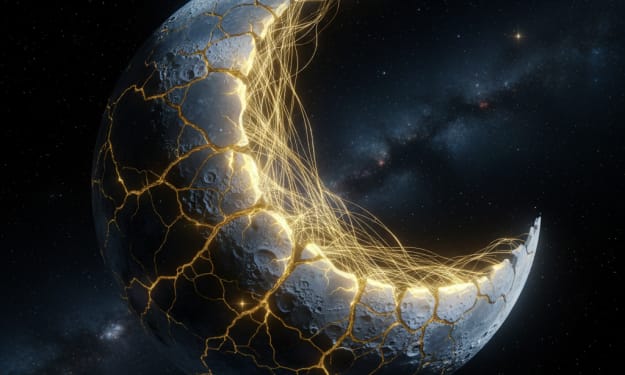
The Moon That Mended Itself with Light. AI-Generated.
They said the moon was dying. At first, I didn’t believe them. The sky had always been her stage — eternal, unshaken, perfect in her silver glow. But that night, when I looked up, I saw it — cracks running through her surface like veins of pain.
By Hamayun Khan12 months ago in Fiction
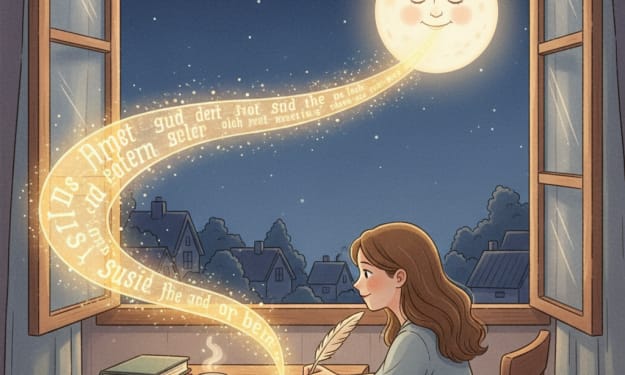
The Moon Who Whispered Words to Me. Content Warning. AI-Generated.
The night was quiet — too quiet to ignore. The clock had just whispered past midnight, and the world outside my window was dipped in blue and silver. The town lay asleep beneath a soft quilt of stars, and I sat alone at my wooden desk, a cup of warm tea breathing out curls of steam beside me.
By Hamayun Khan12 months ago in Fiction