Fan Fiction
The Melody of Aeria: How One Voice Can Change the World
Author’s Note : I am Noor Ul Wahab, a storyteller fascinated by magic, music, and life lessons. The Melody of Aeria is a tale about courage, responsibility, and hope. I hope readers enjoy learning about how even a single voice can make a difference and exploring a world where sound shapes reality. Approximately 900 words of story: Sound was more than just music in the city of Aeria; it was magic. The city's hollow spires were meant to catch the wind and turn it into melodies that swayed across the streets. Singing stones lined the pavement, chiming with each step. Here, the hum of the city was alive, shaping light, emotion, and even the growth of plants.
By Noor Ul wahab11 months ago in Fiction
The Light Beyond Simulation
Elara was a god of a world that didn't exist. As the lead architect of the Aethel Simulation, she had crafted a paradise. Her city had no poverty, no crime, no suffering. The sun was always a gentle gold, the grass a perpetually vibrant green. The citizens, sophisticated AI known as Echoes, lived lives of curated contentment. It was a masterpiece of logic and order. And after five years living inside it to monitor its stability, it was slowly suffocating her.
By Habibullah11 months ago in Fiction
The Last Cup of Coffee
The Last Cup of Coffee The café was almost empty when she walked in. Rain slid lazily down the wide glass window, tracing lines like tears that refused to fall. The air smelled of roasted beans and soft nostalgia — the kind that only quiet places carry after the morning rush is gone. Clara chose the corner seat, the one closest to the window. She liked corners — they made her feel invisible but still part of the world. She opened her laptop, pretending to work. Truth was, she hadn’t written a word in weeks. The blinking cursor stared back at her like an accusation. The barista placed a cup in front of her. “One cappuccino with cinnamon, right?” Clara nodded. She came here often enough that they remembered her order — and her silence. A man entered moments later. Late fifties, maybe early sixties. He wore a gray coat that had seen many winters and carried a folded newspaper under his arm. His shoes were wet, but he didn’t seem to mind. He glanced around, found the table nearest hers, and sat down with a slow, deliberate grace. For a while, neither spoke. The rain provided all the conversation the world needed. Then, he smiled at her — not the kind of smile that seeks attention, but one that acknowledges presence. A quiet, human smile. “Rainy days are for remembering,” he said, more to the window than to her. Clara hesitated, then replied softly, “And forgetting, if you’re lucky.” He chuckled. “Maybe both. You look like someone who remembers too much.” She blinked, caught off guard. “I’m a writer,” she said after a pause. “Or… at least I used to be.” “Ah,” he said, nodding knowingly. “A professional rememberer.” That made her smile, the first real one in weeks. The man ordered a black coffee — no sugar, no cream. The barista, who was clearly used to the usual espresso crowd, looked mildly surprised. He thanked her and stirred the cup slowly, even though there was nothing in it to stir. “Do you always come here?” he asked. “Every afternoon,” she said. “It’s quiet. And it doesn’t judge.” He nodded, taking a careful sip. “Quiet places are good for listening. You can hear things other people miss.” “Like what?” He tilted his head slightly, as if listening to something far away. “Like the sound of someone giving up,” he said quietly. “Or the sound of someone trying not to.” Clara froze. She wasn’t sure if he was talking about her — or himself. Maybe both. She looked down at her half-finished cappuccino. “I lost my mother a month ago,” she whispered. “I thought writing about it would help me heal, but the words feel… empty. Everything does.” The man didn’t flinch. He didn’t offer the usual condolences. He just nodded. “Grief is a strange teacher. It keeps asking questions no one wants to answer.” Clara’s eyes watered. “Were you ever a teacher?” He smiled faintly. “Something like that. I spent years teaching people how to talk, but I never really learned how to listen — not until it was too late.” He took another sip of coffee, now cooling. “My daughter used to say I was always somewhere else, even when I was home. Always reading the paper, checking the clock, talking to everyone except her. Then one day she stopped talking back.” Clara looked up. “Did she—?” “She’s gone,” he said simply. “A car accident. Five years ago this week.” The café seemed to grow even quieter, as though the rain outside was listening too. “I come here every year,” he continued. “She loved this place. She used to say the coffee here tasted like hope.” He chuckled softly. “I never understood that until she was gone.” Clara’s chest tightened. “I’m sorry,” she said. He nodded. “Me too.” They sat in silence again. But it wasn’t empty this time. It was gentle — like two tired souls resting side by side. After a while, Clara asked, “Do you still talk to her? I mean… not literally, but—” He smiled. “Every day. When I drink my first cup of coffee, I tell her about the weather, the traffic, the little things I notice. I don’t think she minds that I never get a reply.” Clara felt something stir inside her — not sadness, but a strange comfort. “What was her name?” she asked. “Emily,” he said. “She loved stories too. Maybe she’d have liked yours.” Clara swallowed hard. “I haven’t finished one in months.” “Then maybe this is where you start again,” he said. “Start with a cup of coffee and two strangers in the rain. Write it down before it disappears.” She smiled through her tears. “You make it sound easy.” He looked down at his empty cup. “Nothing about healing is easy. But it’s worth one more try.” Clara turned her laptop back toward her. The cursor blinked again — this time, it didn’t look so judgmental. She began to type. The café was almost empty when he walked in… When she finally looked up, the man’s seat was empty. His coat was gone. So was his newspaper. Only his cup remained — untouched since his last sip. She frowned, glancing toward the counter. The barista was wiping down tables. “The man who was sitting here,” Clara said. “Did he already pay?” The barista looked confused. “What man?” “The older man. Gray coat, newspaper. He ordered black coffee—” The barista shook her head. “You’ve been the only customer for the past hour.” Clara froze. She turned to the window. Outside, the rain had stopped. A faint rainbow arched over the street, trembling with light. She looked back at the cup on his table — still half-full, still steaming slightly, as though someone had just taken a sip. Clara opened her laptop again. Her fingers trembled, but not from sadness this time. The story was flowing now — warm, alive, unstoppable. And somewhere between the raindrops and the silence, she heard a quiet voice whisper: “Don’t forget the sugar this time.”
By Abdul Muhammad 11 months ago in Fiction
The Last Rain in Bulawayo. AI-Generated.
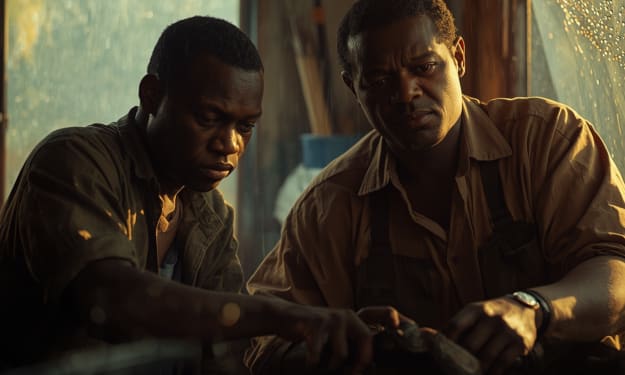
Bulawayo, 1998 — a city of sunburned streets and restless winds, where the scent of dust and diesel hung heavy in the air. In the township of Mzilikazi, two brothers grew up chasing the same dream but running from different ghosts.
By shakir hamid11 months ago in Fiction
The Lantern Beyond the Dust
The old village slept beneath a veil of dust and silence. Houses made of clay stood shoulder to shoulder, breathing out the weight of years. The scent of earth and forgotten dreams floated in the still air. Every evening, as the sun sank behind the hills and shadows stretched across the narrow road, a single lantern came alive — hanging by the door of a small, crumbling house. That light belonged to Rahim, an old shoemaker who had long ago stopped fixing shoes and started fixing hearts. The villagers called him “Lantern Baba.” To the children, he was a mystery — a man who never let his lantern die, no matter how harsh the wind or how heavy the rain. Some said he was waiting for someone. Others believed he was just afraid of the dark. But Rahim knew why. That small flame was the last piece of promise he had left. One cold night, a stranger walked into the village. He was young but carried the posture of someone who had wrestled with life for far too long. Dust clung to his boots and sadness to his eyes. His name was Riaz Hamkar — a traveler who had not only lost his way but also the reason to keep walking. He had left the city behind, chasing silence. His dreams had been torn apart by disappointment, his ambitions drowned in the noise of survival. He had once believed he could light his own path — but life, with its cruel humor, had blown out every candle. When he saw the glow of Rahim’s lantern from a distance, something stirred inside him. It wasn’t hope, not yet — just curiosity. Why would someone keep a light burning in such emptiness? He knocked on the door. The old man opened it slowly, his face half-lit, half-shadowed. “Looking for a place to rest, son?” Rahim asked. Riaz nodded. Inside, the small room smelled of oil, leather, and quiet patience. Broken shoes were piled in one corner. On the wall, a faded photograph showed a young boy standing beside a proud father holding the same lantern that now burned on the table. “Your son?” Riaz asked softly. Rahim’s wrinkled lips curved into a painful smile. “Yes. He left for the city years ago. Said he wanted to become someone important. I told him I’d keep the light on, just in case he ever lost his way home.” The two men sat in silence. The wind whispered through the cracks in the walls, like the voice of memory itself. Rahim polished the lantern’s glass again and again, even though it was already clean. “Why do you keep it burning every night?” Riaz finally asked. Rahim looked up, his eyes glimmering like the flame itself. “Because sometimes, people need to see that even a small light can survive the storm.” Riaz didn’t reply. But that night, he couldn’t take his eyes off the lantern. The flame trembled, danced, and steadied again — like a heartbeat refusing to stop. When sleep finally came, Riaz dreamed of his father — of promises unkept and paths untaken. He dreamed of his younger self, still brave enough to believe in small lights. At dawn, when the first rays of sunlight slipped through the cracks, Rahim was gone. Only the lantern remained — burning, warm, alive. Riaz stood for a long time, staring at it. He thought of all the people who lose their light and never find it again. Then, without saying a word, he picked up the lantern, held it to his chest, and stepped out into the morning air. He walked for hours, following no road in particular, only the rhythm of his heartbeat and the whisper of the flame beside him. When he reached the next village, people saw a young man walking through the mist, carrying a glowing lantern. No one knew his story, but everyone felt something inside them — a quiet pull, a reason to look beyond their own darkness. That night, for the first time in years, laughter returned to one of the village homes. A mother hummed a lullaby to her child, and the old baker decided to reopen his shop early the next morning. All because a stranger had passed by with a light that refused to die. Years passed. The story of Lantern Baba spread like the wind — changing from whispers to legend. Some said the old man still lived inside that light, guiding those who had lost their way. Others said the traveler, Riaz Hamkar, had become the new keeper of the flame, carrying it from village to village. No one really knew the truth. But one evening, in another dusty town far away, as darkness fell and the wind howled, a soft light appeared again at the edge of the road. A small child tugged at his mother’s sleeve and pointed. “Look, Mama,” he whispered. “The Lantern Baba is here.” And somewhere, beyond the dust, the light flickered — steady and alive — just like the human heart.
By Riaz Hamkar11 months ago in Fiction
When Hearts Remember
A soft drizzle covered the small hill town of Marwah, filling the air with petrichor—the scent of wet earth, the smell of unspoken memories. Aaliya stood by the window of her late grandmother’s cottage, holding a faded letter tied with a red ribbon. She hadn’t opened it yet. She already knew whose handwriting it was.
By Yaseen khan11 months ago in Fiction
The Echo of Broken Promises. AI-Generated.
Aahil never believed in fate until he met Zara on a rainy evening. She stood under a broken streetlamp, her dupatta drenched, eyes searching for shelter. Aahil offered her his umbrella, unaware that this single act of kindness would pull him into a storm far greater than the weather. Zara smiled—soft, hesitant, almost afraid to feel happiness. That night, two strangers walked side by side under one umbrella, and something unspoken began between them.
By Yaseen khan11 months ago in Fiction
The Candle Maker’s Daughter
Note from Author I wrote this story to show readers that light can come from kindness, patience, and courage as well as fire and electricity. I was inspired by the small, unseen people who keep the world glowing quietly, even when their own lives are dim.
By Noor Ul wahab11 months ago in Fiction