Fan Fiction
The Wishmakers of Elmwood Academy
At the edge of town, tucked behind thick woods and misty hills, stood Elmwood Academy—a school most people assumed was just another fancy boarding school. But to those who knew the truth, Elmwood was a place for learning magic in all its chaotic, sparkly glory.
By Jordan Imanuel2 years ago in Fiction
The lost city of Atlantis
The Lost City of Atlantis There are many definitions and opinions about the lost city of Atlantis, also known as Atlantica, and it is said to be one of the legendary islands located in the Atlantic Ocean, specifically in the western part of the Strait of Gibraltar. The legend of Atlantis has been spreading for about 2,500 years, and was used to refer to a society characterized by its possession of a set of advanced achievements, whether in the fields of engineering, architecture and buildings, military power, or natural resources. Other definitions of Atlantis include that it is a place the size of a continent, and contains many plants and animals, pure water, rich soil, and other features. The story of the lost city of Atlantis The story of the city of Atlantis and its lost civilization has become part of the human imagination for many years, and no historical or archaeological information or indications have appeared about it. The first appearance of its story dates back to the philosopher Plato's description of it through his composition of a dialogue text entitled Timaeus, in which he describes a dialogue between Socrates and Pythagoras, and a mystic named Critias participates in this dialogue by talking about the city of Atlantis. Description of the lost city of Atlantis The philosopher Plato was keen to provide a description of the city of Atlantis, showing that it is the best place to live for engineers and architects, and he also said that it contains a group of ports, temples, docks and palaces, and that Atlantis was built on a hill surrounded by water in the form of a group of rings connected to each other by tunnels, and this contributed to allowing ships to sail in it, as these rings of water form a very large channel connected to the ocean. The myth of the lost city of Atlantis The philosopher Plato indicates in his writings that the lost city of Atlantis was ruled by the Greek sea god Poseidon, who was keen to use Atlantis to express his appreciation for his wife by building a large house for her on one of the hills in the middle of it. The philosopher Plato also explains that the inhabitants of the city were engineers who possessed advanced and sophisticated technology that surpassed other regions in the world, while the wealthy villagers of Atlantis lived in the mountains. As for the end of the legend of the city of Atlantis, it is with the wrath of the god Zeus, but this ending does not tell us whether Zeus decided to destroy the city of Atlantis or not, but rather it is satisfied with mentioning Zeus’s threat to teach Atlantis a violent lesson. Theories about the lost city of Atlantis Many theories have emerged about the lost city of Atlantis, all of which have been keen to provide reasons for the disappearance of this city, and have contributed to drawing pictures of its shape and nature. The following is information about the most important of these theories: Atlantis was a continent: This is the theory that indicates that the city of Atlantis was a continent that appeared in the middle of the Atlantic Ocean and was suddenly submerged. This theory is linked to the realization that Atlantis is a real place, and not a myth created by Plato. This theory appeared in the late nineteenth century AD through the book by Ignatius Donnelly entitled "Atlantis - The World Before the Flood", and the book contained a discussion of the achievements that appeared in the ancient world, and the writer linked it to the existence of a civilization with an advanced environment. Donnelly provided a description of Atlantis, saying that it was a continent that sank underwater based on the place that Plato specified in the Atlantic Ocean, and referred to it by the rocks found in the Strait of Gibraltar. The disappearance of Atlantis in the Bermuda Triangle: This is a theory that was inspired by the ideas of the writer Donnelly; many authors have been keen to expand the study and creation of theories and predictions about the location of Atlantis, the most important of which is Charles Berlitz, who wrote many books about supernatural phenomena and events. Among the predictions that Berlitz referred to is that Atlantis did exist, and it is one of the continents located opposite the Bahamas, but it disappeared in the Bermuda Triangle. Some supporters of this theory indicate that they have found traces of roads and walls off the coast of Bimini, but scientists have studied these walls and roads and were able to conclude that they are a group of natural forms. Atlantis is Antarctica: This is the theory that indicates that Atlantis is nothing but an advanced image of the present-day Antarctic continent, and this theory goes back to Charles Habbud through his book published in 1958 entitled "The Transforming Crust of the Earth"; Habbud believes that the Earth's crust underwent a transformation about 12 thousand years ago, which led to the emergence of the Antarctic continent.He also says that this continent was the site of one of the advanced civilizations, and the change in its location led to the burial of the Atlantean civilization under the ice. Mythical story: It is the theory that the city of Atlantis is nothing but an imaginary place, while the story of its loss is derived from one of the historical events, related to the flood that affected the Black Sea approximately in the year 5600 BC, and at that time the Black Sea was a lake that was half its current size, and many civilizations spread around it that faced the floods coming from the sea water. The Minoan civilization is Atlantis: It is a theory that says that Atlantis is the Minoan civilization that existed during the period between 1600 and 2500 BC, and it is a civilization that appeared on the islands of Thera and Crete, one of the islands belonging to Greece, and the people of the Minoan civilization belong to the legendary ruler Minos, and it is also indicated that this civilization is the first in the continent of Europe, and it contained many beautiful roads and palaces. Plato's invention of Atlantis: It is the theory that links Plato and his invention of the city of Atlantis; that is, it did not actually exist, but rather appeared as a result of Plato's ideas, and that Plato's accounts of the existence of Atlantis are nothing but imagination.
By Kisama Riyo 2 years ago in Fiction
The Last Whisper
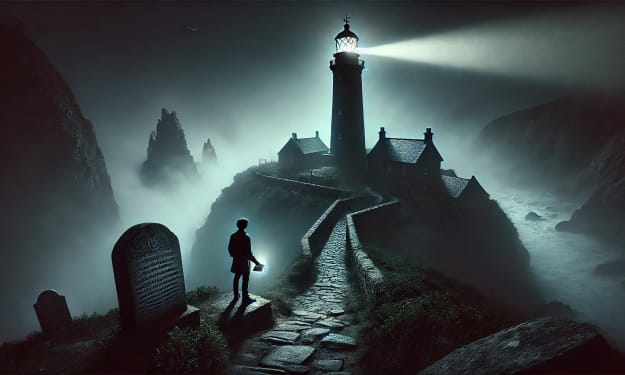
The Wind carried a soft, haunting whisper through the old village, as though a voice long forgotten had returned for its final words. That evening, as the mist thickened around the cliffs, young Marlowe found an envelope wedged between the bricks of his grandfather's cottage—one with his name, but written decades before he was even born. --- Marlowe Hughes had always loved the hidden corners of the seaside village his family called home. Cragmore, with its weathered stone cottages, ghostly mists, and old lighthouse, held a quiet allure, a feeling that something in its ancient streets had never truly left. But after his grandfather passed, Marlowe returned to the village only to settle the estate, packing away fragments of a man who rarely spoke of his past. On his last night, after hours of sorting through dust-covered trinkets, Marlowe stepped outside for air. That’s when he noticed a faint glimmer near the ivy-covered corner of the house—a thin envelope wedged tightly between the stones. When he pried it free, Marlowe froze; it was addressed to him. Yet something was wrong: the handwriting was his grandfather’s, but the ink was faded, and the paper was brittle, as though written decades ago. --- Inside the envelope lay a single note, cryptic yet urgent: "Follow the lighthouse beam when the clock strikes midnight. The truth lies within the shadows it casts." The words sent chills down Marlowe’s spine, stirring memories of his grandfather’s distant gaze each time the lighthouse beam swept over the village at night. No one ever seemed to know what he was looking for—or hiding from. Marlowe glanced at his watch. Just five minutes to midnight. --- He made his way to the cliffside, the lighthouse standing tall against the inky sky. Its light pulsed in rhythm, washing over him, illuminating a jagged path carved into the rock—a path he had never seen before. As he followed it, shadows played tricks with his mind, but he pressed on until he reached the base of the lighthouse. There, in the glow of the beam, he saw an inscription carved into the stone: "Some secrets never die, Marlowe. And some echoes are never silenced." Just then, he heard the softest sound—a whisper, as if from behind him. Marlowe spun around, but the darkness was silent. Yet, when he looked back at the stone, a new line had appeared beneath the inscription. His heart raced as he read the words: "She knows you're here." --- From that night forward, Marlowe would always wonder if he had met the truth—or if it had met him.
By Mohammad Hussaib2 years ago in Fiction
The Curse of Ravenwood Manor
The Curse of Ravenwood Manor Every Halloween, the small, mist-covered town of Ravenwood fell under a chilling spell. Known for its spooky atmosphere and ancient legends, Ravenwood attracted both thrill-seekers and ghost hunters from far and wide. But amidst all the haunted tales, one story remained the most terrifying—the Curse of Ravenwood Manor.
By Nada soliman2 years ago in Fiction