Fan Fiction
"The Perfect Employee"
Chapter 1: The Ideal Hire When Clara Westwood walked into Neon Dynamics, a top-tier service delivery company in the heart of New Haven, she was a hiring manager’s dream. Poised, professional, and exceptionally efficient, she took over the front desk with a kind smile and an uncanny ability to remember every client, every request, and every little detail.
By Mary Emmanuel2 years ago in Fiction
The island of unfinished stories
In a world where stories had the power to shape reality, there existed a place so elusive that only whispers carried its name—the Island of Unfinished Stories. It was said that every narrative abandoned by its creator, every character left in limbo, found its way to this island, awaiting the day it would be brought to life once more. Few had ever glimpsed the island, and even fewer had returned from it. Some spoke of it as a prison for lost creativity, while others believed it was a sanctuary—a place where creators could mend the threads of their unfinished works. One evening, under the light of a strange constellation, three travelers set sail toward the unknown: Lucian, a young writer who had once aspired to write the greatest tale of all, only to abandon it out of fear that it would never measure up. Evander, a poet whose verses had once shimmered with promise, but who now doubted their worth and left his masterpiece incomplete. Everistus, a scholar who had begun a book of wisdom, but halted, convinced that his knowledge was insignificant and unworthy of preservation. The three men, drawn by an invisible pull, followed the stars, leading them to an island hidden beneath a thick veil of mist. As their ship creaked upon the rocky shore, the island stretched before them—a place both haunting and enchanting. Towering trees murmured in the wind, glowing quills floated by like delicate birds, and ancient books lay scattered across the ground, their pages turning without a hand to guide them. Stepping onto the land, they were greeted by a figure emerging from the mist. She was Vespera, the island’s guardian, a woman with silver hair and eyes that seemed to reflect the stars themselves. She looked at them with an understanding that spoke of secrets untold. "You have come in search of answers," she said, her voice a blend of kindness and power. "But know this: you are summoned by the very stories you abandoned." Lucian exchanged a glance with his companions. No words had been spoken of their past failures, yet somehow, this woman knew their deepest regrets. "What is this place?" Evander asked. "This is where the abandoned stories reside," Vespera replied. "The characters you left behind have waited for you. If you do not finish what you began, you may never leave." As they wandered deeper into the island, they encountered characters lost in time—souls once full of potential, now stranded in their incomplete tales: Seraphina, a warrior who had trained her entire life but never fought her final battle, stood frozen in a clearing, her sword raised in perpetual anticipation of a moment that never arrived. Esmeralda, a queen destined to rule, but never crowned, sat upon a cold throne of stone, her kingdom a barren wasteland, her people nothing but shadows. Thalassa, a sailor whose grand voyage had been cut short, her ship stranded, never to embark on the journey it was meant to complete. Lucian felt a pang in his heart. These characters were his creations—his hopes and dreams given life, only to be abandoned halfway. He had failed them. "Can we fix this?" he asked, his voice heavy with guilt. Vespera offered a small, knowing smile. "That is for you to decide." That night, as a fire crackled before them, the three writers sat in silence, blank parchment laid before them. Quills, ink, and ancient tomes appeared as if summoned by the island itself. Lucian hesitated, quill in hand. What if he ruined the story? What if he failed again? Evander stared at the empty page, paralyzed by doubt. What if his words were not enough? Everistus sighed, hands trembling. What if his knowledge held no value? The weight of their fears loomed over them, but then, a voice broke the stillness. It was Seraphina, the warrior. "You are our authors," she said, her voice unwavering. "Do not fear imperfection. A story is not meant to be flawless—it is meant to be finished." Her words cut through the fog of doubt in their minds. Slowly, the quills began to move. As Lucian wrote, Seraphina lifted her sword and charged into battle. Her story, once stagnant, surged forward with every stroke of his quill. Her enemies fell, and her legend grew stronger with each passing moment. As Evander crafted his verses, Esmeralda rose from her lonely throne. A crown of gold appeared upon her head, and her ruined kingdom began to rebuild itself, piece by piece. As Everistus filled his pages with knowledge, Thalassa’s ship set sail, the wind catching its sails. For the first time, she sailed beyond the horizon, her journey no longer lost in time. The island responded—the trees shimmered with life, the air glowed with energy, and the mist began to lift, revealing a sky that seemed to breathe with possibility. For the first time in what seemed like an eternity, the unfinished stories were finding their endings. As dawn broke, the three writers neared the end of their tales. But just as they were about to write the final line, the island trembled. Vespera appeared once more, her expression unreadable. "One final challenge remains," she said. "You must cast aside all fear. If you stop now, everything will be undone." Lucian’s jaw tightened. He had failed before, allowing fear to control him. Not this time. With a deep breath, he wrote the final line. The moment the last word was inked, the island erupted in a burst of light. A warm wind swept through the land, carrying with it the whispers of completed stories. The characters turned to face their authors, smiling with gratitude, before fading into the golden glow of the dawn. The island, bathed in sunlight, seemed to sigh with relief. Vespera approached them again, her eyes filled with satisfaction. "You have done what many could not—you have given your stories the endings they deserved." As the island faded into the horizon, Lucian, Evander, and Everistus felt themselves being pulled back to their world. When they awoke, their manuscripts were in their hands, and their hearts were full of newfound purpose. Their ship was no longer adrift at sea—it was anchored in their homeland. But something had changed within them. Lucian gazed at the pages before him. They were no longer empty. His story was complete. Evander and Everistus exchanged a glance, their once-blank parchment now filled with words they had once been too afraid to write. They had learned an invaluable truth—a truth that would stay with them forever: Every story deserves an ending. And only those who persist through fear will see their dreams take flight. Moral of the Story: Never let fear cause you to abandon your dreams. Every journey deserves a conclusion, and it is only through perseverance that we can create something truly meaningful.
By Danny_lovelyn2 years ago in Fiction
The Taste of Solitude
Solitude had always been a companion for Nora, but not always a welcomed one. For years, she had sought the comfort of her own company, retreating from the world to escape the noise and expectations of others. It wasn’t that she didn’t enjoy people—Nora simply preferred silence. Her life, as a freelance writer, revolved around the peace of her apartment, the hum of the typewriter, and the soothing rustle of pages turning. But everything had changed when her mother passed away. Before the funeral, Nora had lived a routine life—early mornings filled with coffee and the quiet of her cluttered desk, afternoons walking along the city streets, and nights in the company of novels that transported her to different worlds. Yet the passing of her mother left a hole, a space that her usual solitude could not fill. Grief wrapped itself around her heart like an old coat—familiar, heavy, and suffocating. The apartment, which had always been a sanctuary, now felt like a tomb. The silence that once soothed her now echoed with emptiness. She found herself walking through the halls in a daze, unsure of what to do with the space she had once cherished. Nora hadn’t realized how much of her identity had been tied to the presence of her mother—the woman who had been both a source of comfort and a constant reminder of who Nora was, or perhaps who she wasn’t. After the funeral, Nora returned to her apartment, but it no longer felt like home. The walls seemed too close, the air too thick. Each evening, she sat by the window, looking out at the busy streets below, wondering how the world outside could go on so effortlessly when her own was falling apart. Her mother had been everything to her—her confidante, her voice of reason, the person who had made Nora feel less alone in a world full of strangers. But now, in the stillness of her apartment, Nora felt the weight of the void that had been left behind. It wasn’t long before Nora began to notice small, seemingly insignificant things that she had never paid attention to before. The sound of the clock ticking in the hallway, the way the sunlight slanted through the curtains in the afternoon, the lonely chirping of birds outside her window—each one felt like an intrusion, a reminder that life kept moving, even when she couldn’t bring herself to move with it. One day, as Nora sat at her desk, staring at the blank page before her, she realized she had not written a single word since her mother’s death. The words that once flowed easily from her fingers now seemed to be lost, like droplets of water slipping through her hands. She reached for the last piece her mother had written—a letter she had never sent. It was meant to be a birthday message for Nora, filled with memories of her childhood and promises for the future, but her mother had never finished it. It was now all that was left. As Nora ran her fingers over the paper, she felt a rush of emotion—grief, yes, but also a strange comfort. Her mother’s handwriting, her words, still had a presence. In that moment, she realized that solitude wasn’t just about silence. It wasn’t the absence of noise that had made her feel safe, but the presence of something constant and familiar. Her mother had been that constant in her life, and now, with her gone, Nora had to learn how to live with a new kind of solitude—one that didn’t seek to fill the space but simply acknowledged its existence. Days passed, and slowly, Nora started to embrace the stillness in her life. She no longer looked for distractions. She would sit by the window for hours, simply observing the world, noticing the small details—the way the trees swayed in the breeze, the distant hum of a car, the soft rustle of leaves. In the quiet, she found a new kind of peace, one that didn’t try to escape the absence but accepted it as a part of life. She began to write again, but this time it was different. Her words no longer flowed effortlessly, but came with hesitation, like dipping her toe into a cold lake. Yet each word she wrote was a step forward, a way of acknowledging her grief, her loss, and her newfound understanding of solitude. She no longer feared being alone in her thoughts. Instead, she began to appreciate the space that solitude provided to reflect, to heal, and to reconnect with herself. One evening, Nora went to the small cafe at the corner of her street, a place she had once frequented with her mother. She hadn’t been there since the funeral, but tonight she felt a strange pull to return. The warmth of the cafe, the clinking of coffee cups, the soft murmur of conversation—everything seemed louder than usual, but it wasn’t overwhelming. It was just life happening around her. And for the first time in weeks, Nora didn’t feel like an outsider looking in. She was part of it all. She sat down at a table by the window, ordered a coffee, and took out her notebook. The taste of solitude, she realized, wasn’t bitter or sorrowful, as she had once thought. It wasn’t about feeling alone or abandoned. It was about learning to sit with the quiet, to embrace the moments of stillness, and to understand that solitude could be a space for growth, reflection, and healing. In that moment, as she watched the world outside, Nora understood that she would never be truly alone. Her mother’s memory would always be with her, and the quiet, once an enemy, was now her ally—a space where she could begin to find herself again.
By Akshay Kumar2 years ago in Fiction
The Secret Life of Misfits
In a small town, tucked away from the bustle of the world, there existed a group of people known only to a few—The Misfits. They weren't misfits in the conventional sense, though. They weren’t outcasts in the way society might expect. They lived ordinary lives by day, blending in with the rest of the world, their identities hidden behind a mask of normalcy. But by night, they became something else—something more than anyone could have imagined. Maya had always been the quiet one in her group of friends. At school, she was just another face in the crowd—neither popular nor invisible, just there. Her classmates saw her as a shy girl who liked to read books, a perfect fit for the role of a quiet student. What they didn’t know was that Maya had a secret. Every evening, when the last bell rang and the schoolyard emptied, she would slip into an abandoned library, hidden at the edge of town. There, she met with her friends—Dylan, the troubled artist; Sasha, the rebellious former gymnast; and Kai, the genius coder with a knack for hacking. Together, they were part of something that no one else could see. The Misfits weren’t a gang or a group bound by crime. Instead, they were a collective of people who had been deemed "too different" by society—too quiet, too loud, too awkward, too smart, too anything. But in their secret lives, they had a mission: to change the way their town viewed the world and its people. It wasn’t about revenge or anger, but about making people understand that being different didn’t mean you were broken. Their secret life began a few months ago, when Maya stumbled upon an old, dusty book in the library about the "hidden stories" of their town—stories of extraordinary individuals who had lived there but had faded into the background of history. The book was filled with accounts of people who had been overlooked, misunderstood, and cast aside simply because they didn’t conform. Inspired, Maya pitched the idea to her friends: they would uncover these hidden stories, reveal them to the world, and show people that misfits could be heroes too. It started small. Maya would spend her evenings gathering old photographs, letters, and artifacts from the town’s history. Dylan sketched portraits of the forgotten figures, capturing their essence. Sasha, with her background in gymnastics, taught herself parkour and found ways to explore hidden spaces in the town—old homes, forgotten basements, or hidden tunnels long closed off. And Kai, with his hacker skills, unearthed old records and documents, finding forgotten stories buried in town archives. Each night, the Misfits would meet in their secret hideaway, sharing their discoveries and brainstorming new ways to bring these hidden stories to life. The town’s residents never knew what the Misfits were up to. By day, they went about their normal lives—Maya in the library, Dylan at his art classes, Sasha at the gym, and Kai at his computer. No one would have suspected that they were working together to uncover the forgotten heroes of their community. Their actions were subtle—small, seemingly insignificant changes that slowly began to shift the perception of their town. Maya anonymously submitted stories to the local newspaper, stories about the people who had made a difference in the past but had been forgotten. Dylan’s sketches, posted online under a pseudonym, brought attention to the unsung individuals whose contributions were never recognized. Sasha organized flash mobs in the middle of the town square to raise awareness of these forgotten heroes, her flips and tricks a bold, rebellious statement against the conformity of everyday life. Kai created an app that allowed people to explore the hidden history of the town, offering a platform for the stories of misfits to be shared. As the weeks passed, the Misfits began to see the impact of their efforts. People started asking questions. The town's residents began to question why they had never heard of certain individuals or events. Local businesses started supporting the Misfit initiative, offering donations and resources to help preserve the hidden history they were unearthing. The stories of the misfits were being heard, and the town slowly started to change. People began to look at each other differently, more kindly, more openly. They began to realize that everyone had a story to tell, and those stories were worth hearing—no matter how unconventional or unusual they seemed. But just as their project gained momentum, the Misfits faced a challenge. Someone—possibly a friend or foe—began to take notice of their anonymous contributions. One evening, when Maya entered the library, she found a note on the desk. It read, "I know who you are. Keep going. The world needs more misfits like you." The note sent a chill down her spine. Who could it be? Was it a fellow misfit who had discovered their secret? Or was it someone trying to stop them? Despite the uncertainty, the Misfits didn’t hesitate. They pressed on with their mission. The risks, the secrecy, and the mystery only added to the thrill. They realized that they were no longer just uncovering the past—they were shaping the future. They were proving that misfits could change the world. And so, the Misfits continued their secret lives, knowing that they didn’t need to fit into society’s mold to make a difference. In their world, being different wasn’t a curse—it was their greatest strength. The town would never see them the same way again, and neither would the world. The Misfits had found their place, and they were rewriting history—one forgotten story at a time.
By Akshay Kumar2 years ago in Fiction
The Vanishing Hour
The clock struck midnight in the quiet town of Ashford, and the world changed in a way no one could have imagined. Emma Caldwell had always felt like something was missing in her life—an odd, unshakable feeling, like a puzzle piece that didn’t fit. But on the night of her 25th birthday, she discovered that the missing piece wasn’t within her—it was time itself.
By Muhammad Shahbaz Akram2 years ago in Fiction
THAT DAY
That Day The air was thick with the scent of rain, though the storm had long passed. Puddles shimmered under the flickering streetlights, reflecting the skeletal branches of leafless trees. The town was quiet, unnervingly so, as though it had exhaled its last breath and was waiting, just waiting.
By Himansu Kumar Routray2 years ago in Fiction
5 Best Time Travel K-Dramas on Netflix
Korean dramas never fail to deliver compelling stories that keep viewers hooked. Among the many genres, time-travel K-dramas hold a special place for their ability to blend mystery, romance, and suspense into one thrilling package. If you’re a fan of time-traveling adventures and love exploring alternate realities or reliving the past, Netflix offers some exceptional K-dramas that fit the bill. Here's a curated list of the five best time-travel K-dramas on Netflix you should add to your watchlist. --- 1. The King: Eternal Monarch
By INFO INSIDER 2 years ago in Fiction
The Weight of Silence
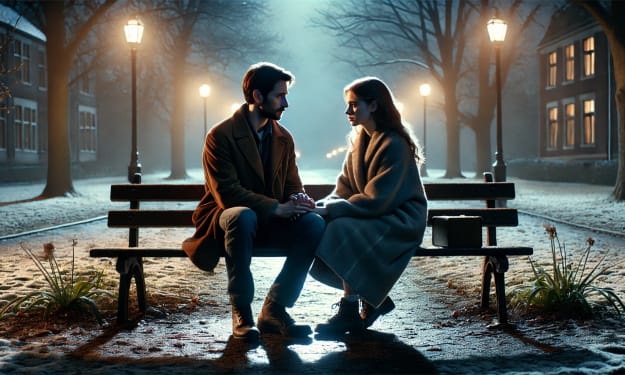
Follow this link for part 2 of this story. The park lights flickered faintly as Aarav sat on the cold bench, his breath visible in the chill of the night. His mind drifted, not to the park around him but to Meera—the unexpected encounter at the café, the words they had shared, and the silence that lingered between them afterward. Why had she come back the second time? Why did she say she was still trapped in her chaos? Aarav found himself grappling with emotions he thought he had buried. He reached into his coat pocket and pulled out his phone. Without allowing himself to hesitate, he scrolled to Meera’s number. Would she answer? The dial tone felt like an eternity, each second weighing on his heart. Finally, she picked up. "Aarav?" Her voice was soft, almost hesitant. "Meera," he breathed, relief washing over him. "I wasn’t sure if you’d answer." "Neither was I," she admitted, a faint hint of a smile in her tone. "What’s wrong?" "Nothing," he said quickly, then corrected himself. "Everything. I don’t know. I just... I couldn’t stop thinking about our conversation." There was a pause, the kind that held more meaning than words could. "I couldn’t either," Meera said finally. "It’s strange, isn’t it? After all these years, we sit across from each other and realize the cracks never really healed." Aarav leaned back, his head resting against the cold wood of the bench. "Maybe we weren’t supposed to heal completely. Maybe we’re supposed to learn how to live with them." "Do you think that’s possible?" Meera asked, her voice tinged with doubt. "I don’t know," he admitted. "But I think we owe it to ourselves to try." Meera sighed on the other end of the line. "You know, Aarav, I’ve spent so much time pretending I was fine. Telling myself I was over it, over you, over everything. But sitting across from you yesterday... I realized how much I’ve been lying to myself." The honesty in her words hit him like a wave. "I’ve been lying to myself too," he confessed. "I told myself I didn’t need anyone. That I was better off alone. But the truth is, I’ve been running from everything—our past, my guilt, even my own emotions. And I’m tired, Meera. I’m so tired." There was another pause, but this one felt different. It was heavy with unspoken understanding, a shared acknowledgment of their pain. "Where are you right now?" Meera asked suddenly. Aarav glanced around. "At the park near my apartment. Why?" "Stay there," she said. "I’m coming." --- It didn’t take long for Meera to arrive. Aarav watched as she approached, her coat wrapped tightly around her against the cold. She stopped a few feet away, studying him for a moment before sitting beside him on the bench. Neither of them spoke at first. The silence wasn’t uncomfortable, but it was charged, as though the air between them carried the weight of everything they’d been through. "Why here?" Meera asked, breaking the quiet. "I don’t know," Aarav said with a shrug. "This place feels... honest. It’s quiet, but not suffocating. Like I can hear my thoughts without being overwhelmed by them." She nodded, her gaze distant. "I used to come to a park like this after everything ended between us. I’d sit on a bench just like this and wonder if you were thinking about me. If you missed me as much as I missed you." "I did," Aarav said, his voice raw. "Every day. But I didn’t know how to say it. I thought... I thought I’d ruined everything, that it was better if I just stayed away." Meera looked at him, her eyes filled with a mix of pain and tenderness. "And now?" "Now," Aarav said, turning to meet her gaze, "I think we’ve spent enough time running. I think it’s time we face the chaos—together." She didn’t respond immediately. Instead, she reached out and took his hand, her touch hesitant but firm. "You really think we can do that?" Aarav squeezed her hand gently. "I don’t know. But I’m willing to try, if you are." Meera smiled faintly, a glimmer of hope breaking through the shadows in her eyes. "Then let’s try." As they sat together on that cold bench, the chaos of their past didn’t disappear, but it felt smaller somehow. In its place was something new—something fragile, but undeniably real. Hope. And for the first time in years, Aarav and Meera weren’t afraid to hold on to it.
By Witness Love2 years ago in Fiction