Fan Fiction
"I Quit My 9-to-5 Job with $200 in My Bank Account — What Happened Next Shocked Everyone". AI-Generated.
I never imagined rock bottom could be the beginning of something beautiful. It was a rainy Tuesday when I finally snapped. I was sitting in a gray office, staring at a spreadsheet I didn’t understand, pretending to care about Q2 metrics. My manager had just added another “urgent-but-not-really” task to my plate, and all I could think was: Is this it? Wake up. Commute. Work. Eat microwave meals. Sleep. Repeat. I was 28, burnt out, and suffocating under fluorescent lights and fake smiles. The thought of spending another year, let alone a lifetime, in that cubicle felt like slow death. So, I did the unthinkable. I walked into my boss’s office, heart pounding, palms sweaty, and said seven words that changed everything: “I think it’s time I moved on.” No plan. No savings. Just $200 in my bank account and a dream I’d buried under years of “being realistic.” The First 24 Hours: Terror & Freedom I stepped out of that building lighter, but terrified. No job. No steady income. Just me, my second-hand laptop, and a stubborn belief that I could build something better. I went home, opened a Google Doc, and wrote down the only thing I knew how to do: tell stories. I’d always loved writing but had shoved it into a “someday” folder while chasing stability. That night, I stayed up writing pitch emails to online publications, personal essays, and random blog topics. I had no portfolio—only raw honesty and a hunger to create. The First Week: Ramen & Rejection Reality hit hard. My fridge had three eggs, half a bottle of hot sauce, and a nearly expired pack of tortillas. I lived on $1 ramen and caffeine. I pitched to 27 websites. Got 25 rejections. One never replied. One said: “Your writing has potential. We’ll publish this.” It wasn’t paid—but it was something. I shared the article on Facebook, not expecting much. But the next day, it started gaining traction. Messages from old classmates and strangers trickled in: “This hit me hard.” “Thank you for putting this into words.” “I’ve been thinking of quitting too.” Week 3: My First $100 I started writing for content mills. SEO articles about lawn mowers, CBD oils, and kitchen hacks. Glamorous? No. But I was earning—and learning. Then I landed my first real gig: a personal finance blog offered $50 per article. I wrote three in two days. My bank balance hit $298.67. I cried. Month 2: Going Viral I wrote a deeply personal story titled “Why I Walked Away From My Safe Life” and submitted it to Medium. I didn’t expect much—but it blew up. Over 80,000 views in a week. Hundreds of comments. People shared their own stories, their fears, their dreams. A popular productivity influencer shared the post. I was flooded with emails: “Can you write for my website?” “Do you offer coaching?” “Would you come on my podcast?” That $200 risk was now turning into actual opportunities. Month 4: Burnout (Again?) Ironically, success came fast—and with it, exhaustion. I took on every client, said yes to every offer. I was working more hours than I did in my old job. Except now, it was for me. I had to re-learn balance. I raised my rates. I let go of low-paying gigs. I reminded myself: I didn’t quit my job to be a slave to hustle—I quit to live. Six Months Later: My Life Now Today, I work from wherever I want—sometimes in coffee shops, sometimes in bed. I make more monthly than I did at my corporate job. But more importantly: I wake up excited. I help brands tell authentic stories. I teach others how to break into freelance writing. I write pieces that matter—not just for clicks, but for connection. What Shocked Everyone My old coworkers couldn’t believe it. “You’re actually making it?” “You’re happier now?” “You mean... no boss?!” Even my parents, who begged me to keep the job “until you find something else,” now tell their friends proudly, “Our daughter is a writer.” But the biggest shock? That it worked. Here’s What I Learned (So You Don’t Have to Crash First): You don’t need it all figured out. Start before you’re ready. Perfect plans don’t exist. Your skills are more valuable than you think. I didn’t have a writing degree. I had life experience, voice, and grit. Fear is a compass. The thing that scares you might be the very thing you need to chase. Success looks different for everyone. For me, it’s time freedom and creative expression—not a corner office.
By "TaleAlchemy"about a year ago in Fiction
Echoes of Yesterday
The year is 2077. Mumbai’s skyline, a jagged tapestry of skyscrapers piercing the ever-present smog, hummed with the electric thrum of a city that never slept. But in Elara’s small apartment in Bandra, a heavy silence reigned. The only light came from a holographic projector casting a ghostly blue glow on the cluttered room.
By hiteshsinh solankiabout a year ago in Fiction
3D Vivid Yummy Doughnut Silicone Focal Beads
Add a sprinkle of sweetness to your next DIY project with our 3D Vivid Yummy Doughnut Silicone Focal Beads! Designed to look just like your favorite frosted treats, these adorable beads feature colorful icing, realistic textures, and playful toppings that instantly catch the eye. Whether you're making keychains, bracelets, pacifier clips, or zipper pulls, these doughnut beads are a charming focal point that brings joy and personality to any creation.
By Beadable Blissabout a year ago in Fiction
The Untold Story of a Man and His Dog
James Carter was a man of few words. He had lived 72 years in the same small town where he was born, worked as a school teacher for over four decades, and quietly retired into a life of solitude after his wife passed away. The house they had shared for over 40 years was now quiet—too quiet. Every morning, James walked to the park at sunrise, sat on the same wooden bench beneath the tall oak tree, and watched the world wake up. It was his routine, and it gave him some sense of purpose. That was until he met Max. Max was a stray—a golden retriever with kind eyes and a limp in his back leg. He first appeared in the park one rainy morning, wet, shivering, and alone. James noticed the dog from a distance, keeping to himself, but something about the animal’s sad eyes struck him. The next day, James brought a sandwich. He ate half and left the other half near the tree. Max returned, sniffed it, and ate it slowly, keeping a cautious distance. Day by day, the distance between them shrank. Within two weeks, Max was sitting right beside James on the bench, resting his head on the old man’s knee. James never spoke much, but with Max, words weren’t needed. They shared sunrises, silent afternoons, and evening strolls. Max listened patiently as James mumbled memories of his wife, his regrets, and his stories of the past. The dog simply stayed—still and loyal. Seasons changed. Winter brought snow, and Max would curl up by James's feet, sharing his warmth. Spring brought blossoms, and they’d walk among the flowers. With Max, James rediscovered life—quiet, but full. He smiled more. He talked a little louder. The neighbors noticed. So did the town. One day, as they walked through the park, a young boy ran up to them and hugged Max tightly. "His name is Buddy!" the boy shouted. "We lost him a year ago! We thought he was gone forever!" James stood still. The boy’s mother approached, tears in her eyes. "Sir, that dog… he used to be ours." James looked down at Max—Buddy—who wagged his tail gently but didn’t move. The woman explained that they had moved away, and during the move, Buddy had run off. They searched, but never found him. Now they were back visiting relatives and happened to spot him in the park. There was a long silence. James knelt down, looking into Max’s eyes. "You have a choice, old friend," he whispered. Max looked between the boy and James, his eyes soft, his body still. Then, he walked back to James and sat beside him. The woman smiled, though her voice trembled. "He chose you." James nodded, holding back tears. “He saved me,” he said quietly. “Or maybe we saved each other.” From that day on, Max was no longer just a stray, or someone’s old pet—he was family. Years passed. Max grew older, slower. His golden fur turned grey. His legs trembled more often, and the walks became shorter. But the bench under the oak tree remained their spot. Every day, they sat together, watching the world move on. Then, one chilly autumn morning, Max didn’t wake up. James found him lying peacefully by his side, head resting on his lap, as if he had just fallen asleep under the orange-leaved sky. James didn’t cry right away. He just sat there, stroking Max’s fur, whispering, “Thank you.” A small stone now sits under that oak tree, with words carved simply: “Max – A loyal friend. He listened, he stayed, and he loved.” People still see James at the park. He walks slower now, carrying a cane, but he still visits the bench every day. Sometimes, he talks softly as if someone’s still beside him. Maybe he believes Max is still there. Maybe he is. In a world that never stopped making noise, the silent bond between a man and his dog spoke louder than words.
By Eisa duraneabout a year ago in Fiction
I Don’t Owe You Nice
Age 6: The First Cut I learned early that silence gets you nothing but crumbs. At my cousin’s birthday party, my aunt handed me a slice of cake half the size of everyone else’s. “You’re too chubby for more,” she smirked. The room laughed. My tiny hands shook, but I looked her dead in the eye: “Then I’m too chubby to hug you.” I left the cake uneaten and hid in the backyard. She never portion-shamed me again.
By Kratika Saxenaabout a year ago in Fiction
🔥 The Bridge of Hands 🔥
🌄 The Divided Valley In the remote valley of Thornshollow, men and women lived apart for centuries. Men forged tools on the eastern cliffs 🔨, while women healed and farmed in the western forests 🌿. A myth warned: “Work together, and the river will vanish.” Fear kept them divided—even as the river dried, thirst tightening its grip on both sides 💧.
By Kratika Saxenaabout a year ago in Fiction
Echoes of the Silentium
The twin suns of Xylos cast long, distorted shadows across the dunes as the desert stretched out before Elara like an ocean of rust. The grav-drive of her modified sandcrawler, which she affectionately referred to as "Dusty," rumbled beneath her in a monotonous song. In this abandoned part of the galaxy, Elara was a scavenger and relic hunter, her face hidden by a rebreather and goggles. She tried to find the Silentium. The Silentium was a phenomenon rather than a location. A vast and terrifying area of space where there was no sound at all. There was no sound of an engine humming, a laser firing, or a voice. In the midst of the cosmic symphony, there was a bleak evidence of an unknown power—a void. Elara knew better than to believe it was a myth told by sailors to scare young space travelers. Her famous astrophysicist father had devoted his life to studying the Silentium because he was driven by a single, haunting question: What caused it? Ten years earlier, he had vanished into that void. Elara came to find out what had occurred. Elara followed a faint energy signature that her father's research had suggested, and as she moved through the barren landscape, days turned into weeks. Dusty's scanners pinged erratically, the silence of the desert amplifying the rhythmic thump of her own heart. The twin suns were relentlessly beating down on her, so she rationed her water and nutrient paste. Elara gasped as Dusty ascended a dunes one evening in the violet twilight. A valley that wasn't filled with sand but with metal lay in front of her. The landscape was littered with twisted, shattered structures of an unimaginable scale that glowed faintly in the waning light. This wasn't natural. The technology in this graveyard was so advanced that it was beyond comprehension. Elara whispered, her voice a dry rasp in the rebreather, "This is it." "He was in this location." Dusty was carefully led into the valley by her. The total absence of conversation was profound. Her ears hurt as it pressed against her like a physical force. She switched to visual communication on her helmet display, the text appearing in front of her eyes.
By Tafsirul Talukdar luvdoabout a year ago in Fiction
The Elevator That Skipped the 7th Floor
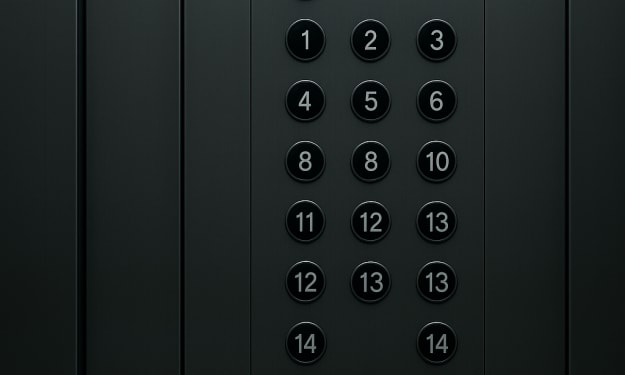
A New Job in a Tall Building When Farhan landed his new job at the prestigious Echelon Towers, he couldn’t believe his luck. The company was top-notch, the pay was solid, and the office was on the 14th floor of a sleek high-rise downtown. It was the kind of job you tell your relatives about with pride. On his first day, he wore his best shirt, arrived ten minutes early, and stepped into the building’s shiny chrome elevator. He pressed 14, watching the soft blue light blink. But something strange caught his eye. The elevator panel read: G, 1, 2, 3, 4, 5, 6, 8, 9… Farhan frowned. Where’s 7? --- A Missing Floor At lunch, curiosity got the better of him. He asked his new coworker, Sana, about the missing floor. “Oh,” she said with a shrug, “there’s no 7th floor here.” “That’s what I saw,” he replied. “But why?” “Old superstition, maybe?” she guessed. “Like how some buildings skip the 13th floor. Who knows? I just take the stairs most days.” Still, something didn’t sit right with Farhan. The building was modern, logical, precise. Skipping a floor felt like a glitch in a place built for perfection. --- An Accidental Stop Two weeks into the job, Farhan worked late. The office was empty, the halls quiet. He packed his bag, yawned, and called the elevator. As the doors slid open, he stepped in and pressed G for ground. But instead of going down, the elevator jerked. It stopped. The panel read: 7. His breath caught. There was no button for 7. Yet here he was. The doors opened slowly. A dim corridor stretched before him. Dust floated in the stale air. The lights were low, flickering. Farhan should’ve stayed inside. Should’ve pressed Close. But curiosity wins over caution more often than it should. --- The Forgotten Floor The hallway looked abandoned. Old wooden doors lined both sides. There were no signs, no office numbers, no nameplates. He took cautious steps. A soft humming echoed down the corridor, like electricity buzzing through faulty wires. Then he heard it: Click. A door creaked open on its own. Inside was a room frozen in time. Old filing cabinets, rotary phones, typewriters. Paper scattered across desks like people had left in a hurry — and never returned. He picked up a paper dated May 1974. Farhan felt a chill run down his spine. This was impossible. The building was constructed in 1998. --- Whispers in the Dark He turned to leave but found the corridor darker now. The flickering lights had gone out behind him. And then… footsteps. Not his. Steady, slow, deliberate. Farhan backed away, heart pounding. A whisper crawled through the silence: “You’re not supposed to be here…” He spun around. No one there. He ran back to the elevator. Pressed the button. Pressed it again. Nothing. The hallway seemed longer now, warped, like the building was breathing — stretching. He banged on the doors, panic rising in his chest. Then the panel blinked. G. The elevator door opened. Bright lights. Normal panel. Normal floor numbers — minus 7. He rushed in and didn’t look back. --- A Closed Mouth Gathers No Dust The next morning, Farhan told no one. Not his boss. Not Sana. But he did his research. He found no blueprints for a 7th floor. No old articles. Nothing. Like it never existed. He even asked building security. “Sir,” the guard said firmly, “Echelon Towers has no 7th floor. It never did.” “But I was—” The guard gave him a look that said, Drop it. Farhan nodded and walked away. --- One Last Glance A month later, Farhan quit the job. He told people it was too stressful. Not the right fit. But the truth was, every night he worked late, the elevator would pause. Just for a second. Right between floors 6 and 8. Once, when he glanced at the panel, he saw a flash — just a glitch — but he swore it read: "Welcome back." He never took that elevator again. --- Still There The Echelon Towers still stands. People go to work. Ride the elevators. Live their normal lives. But every once in a while, late at night, someone hits the button for floor 8… …and the elevator stops on a floor that doesn’t exist.
By GadgetGroundabout a year ago in Fiction
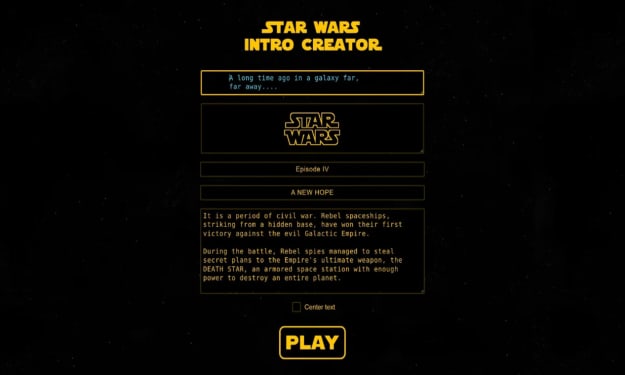
How to Create Your Own Star Wars Crawl Intro. AI-Generated.
Creating your own Star Wars intro crawl has never been easier. For fans looking to add that iconic opening sequence to their videos, there are several options available online. The classic yellow text scrolling against the backdrop of space has become one of cinema's most recognizable sequences, and now you can make your own version with a star wars intro creator.
By Anant Mantriabout a year ago in Fiction