Fan Fiction
"I Randomly Have a New Career Every Week": A Dynamic Blend of Comedy, Growth, and Social Commentary
• Introduction: One Man, Endless Professions In a world where people spend decades mastering one career, imagine waking up every Monday with a completely new job—and the skills to do it flawlessly. That’s the wild, exhilarating, and often hilarious reality for Lin Yi, the protagonist of the Chinese manhua I Randomly Have a New Career Every Week (我每周随机一个新职业).
By Akib Akhterabout a year ago in Fiction
Thou Shalt Not Be Rude to Wait Staff
The queue stretches, and stretches, and stretches. Our hero cannot bear to look up at it. He couldn't see the end of it if he did, and not just because the sinking sun would be glinting in his eyes. It stretches down the hillside and winds out of sight.
By L.C. Schäferabout a year ago in Fiction
The Sculptor of Silence
In a quiet village tucked between misty hills and ancient woods, lived a young man named Elian. Like many in the village, he spent his days wandering the trails, staring up at the stars, and asking the same question that had echoed through generations: “What is my purpose?” Elian was a seeker. He sought meaning in the clouds, answers in books, wisdom from elders. He visited temples, meditated for hours, even climbed to the top of the Windspire—a jagged peak the villagers believed brought visions to the worthy. However, he returned empty-handed each time. One afternoon, as he sat by the riverside, skipping stones and sighing with frustration, an old woman approached. Her back was bent like a bow, her hands speckled with clay, and her eyes shimmered with something that felt like certainty. “You look like a man waiting for something,” she said. “I’m waiting for purpose,” Elian replied. “Everyone says it’s out there. I’ve searched, but all I find is silence.” The woman chuckled. “Silence is not absence. It’s invitation.” She placed a lump of clay in his hands. “Come,” she said. Elian followed her to a modest hut on the edge of the woods. Inside, shelves were lined with strange, beautiful sculptures—twisted forms, laughing faces, sorrowful creatures. They weren’t perfect. Some were cracked. Others tilted awkwardly. But all of them seemed to breathe. “This is what I do,” the woman said. “I shape the silence.” Elian watched her knead the clay, her fingers moving without hesitation. It wasn’t graceful, but it was alive. Something in him stirred. “But how do you know what to make?” he asked. “I don’t,” she said. “I start. The rest follows.” She handed him a small block of clay. “Stop seeking. Start shaping.” For weeks, Elian returned to the hut. At first, his hands fumbled. He made crooked bowls, wobbly figures, lumps that looked like nothing. But the old woman never criticized. “It’s not about making something great. It involves creating something. Slowly, Elian began to feel it—the quiet thrill of bringing form from formlessness. He stopped asking what his purpose was and started pouring himself into the clay. His thoughts, his fears, his dreams—they all surfaced through his fingers. One day, while sculpting, he paused. Before him stood a figure—tall, uncertain, one hand reaching forward, the other curled to the chest. It looked just like him. Imperfect, confused… but becoming. The elderly woman surveyed the scene. “That’s your first true creation.” Elian blinked. “What do you mean? I’ve made dozens.” “Those were practice. This one… came from within.” In that moment, Elian understood. All his life he had been chasing answers like wind—trying to catch something invisible, intangible. But when he stopped chasing and started creating, the answers had found him. Years passed. The old woman passed on. Elian inherited the hut, the tools, and the silence. He became the village sculptor—not because of fame or talent, but because his creations spoke to people. They saw themselves in his work: the hesitant child, the grieving mother, the restless traveler. Travelers still visited the Windspire, still asked the stars for purpose. Some stopped at Elian’s hut, curious about the sculptures. He welcomed them all. Some he taught. Others just watched. He would answer those who inquired about how he found his calling: “I stopped seeking meaning and started making meaning. Life isn't about finding what’s already there. It’s about shaping what isn’t yet.” One day, a young girl named Lira came to him, eyes full of questions, palms empty. “I don’t know what I’m meant to do,” she whispered. He smiled, handed her a lump of clay, and said, “Good. Then you’re ready to begin.”
By It's Nikkoabout a year ago in Fiction
Love's Not-To-Do List
Love's no suppose to do list- things not to do in Love! We need to be honest and direct. Most people are not really in love, but rather, they have become addicted psychologically. They slap a name on it, ''Love'', when they are in fact systematically eroding their own future, peace and self-worth. Here are some things you should stop doing:
By Rohitha Lankaabout a year ago in Fiction
"Echoes of the Battlefield". AI-Generated.
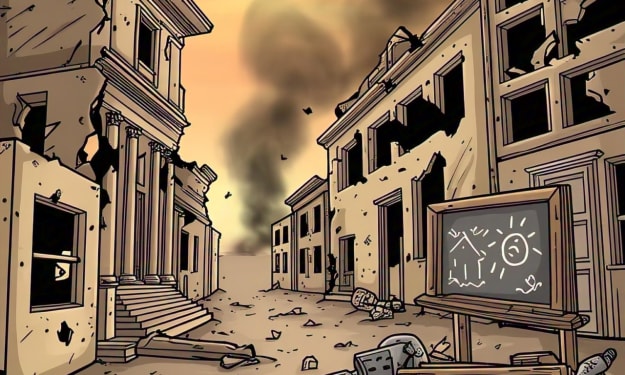
The wind howled through the broken windows of what used to be a school. Bullet holes riddled the chalkboard, and scorched desks lay overturned across the floor. In the middle of it all stood Captain Elias Ward, rifle slung over his shoulder, staring at the remnants of a child’s drawing on the wall — a house, a sun, and stick-figure smiles. It wasn’t always like this. Two years ago, the Republic still stood tall, proud and unbroken. Cities hummed with life, and Elias, then a teacher, taught history to restless children who doodled in the margins of their notebooks. He had no desire for war. But when the regime from the North crossed the border, turning towns to rubble, his pen was no longer enough. The government called for every able-bodied citizen to fight. Elias answered. Now, the man who once taught lessons about wars past had become a weapon in a war of the present. He turned away from the drawing as Sergeant Rana approached, her face smeared with soot and worry. “They’re regrouping by the river,” she said, voice low. “Drones spotted a convoy heading our way. We have maybe an hour.” Elias nodded. “Evacuate the wounded. Hide the supplies. We hold them here.” “They outnumber us,” she replied quietly. “We make them pay for every inch.” --- The sun was beginning to set, casting a blood-red glow over the shattered town of Kersin. Soldiers moved in silence. Some prayed. Some smoked. Others stared at photographs from a life they feared they’d never return to. Elias checked on each of them, offering what little encouragement he could. At the far end of the ruined main street, Private Kellan, just nineteen, was setting up a makeshift barricade. Elias crouched beside him. “You ever see combat before this?” he asked. Kellan shook his head. “Joined last month. Didn’t think it’d be like this.” “It never is,” Elias said. “But you’re here. You’re ready. That’s what counts.” In the distance, the sound of engines roared. “They’re coming,” someone whispered. --- The first wave hit just after dusk. Enemy troops poured into the streets like a black tide, backed by armored trucks and drones buzzing overhead. Gunfire shattered the silence. Rockets screamed through the air, lighting the night in orange and red. Elias fought from the front, his rifle barking with deadly rhythm. He moved like a ghost between ruins, shouting orders, dragging the wounded to cover. Around him, comrades fell — some screaming, some in eerie silence. Sergeant Rana held the western flank, her squad barely holding under pressure. Smoke filled the air, thick and choking. Every breath burned. Hours passed. Then came the second wave. A wall of fire crashed through their defenses. Elias felt the ground shudder as a nearby building exploded, sending debris flying. A shard of metal tore across his cheek. He wiped the blood away and kept moving. By midnight, they had retreated to the town square. Of the 120 soldiers who had held Kersin, fewer than 30 remained. “Fall back to the tunnels,” Rana said, limping. “We can regroup beneath the chapel.” Elias looked around. The square was filled with the dead and dying. But the flag of the Republic still fluttered above the courthouse. If they left now, the enemy would claim the town. He hesitated. Then nodded. “Go. I’ll hold the line.” “You’ll die.” “Maybe. But not today.” --- Elias fought alone for the next twenty minutes. He ducked behind fallen statues, sniping advancing soldiers with ruthless precision. He remembered each of his students as he fired. Clara with her science projects. Milo who loved planes. Their faces gave him strength. Eventually, silence fell. And then — footsteps. He raised his weapon, heart pounding. But it was Kellan, face pale, dragging a wounded comrade. “I couldn’t leave you, sir.” Elias wanted to argue. But he just nodded. Together, they lit the final charge — a trap laid beneath the square. As the enemy flooded into the center, Elias gave the signal. Flames erupted, swallowing tanks and soldiers alike. The ground shook violently. Then — silence. Smoke curled skyward. Elias and Kellan, coughing and burned, fled into the tunnels beneath the chapel. --- Three days later, reinforcements arrived. The enemy had retreated. Kersin was saved — for now. Elias sat on the chapel steps, his arm in a sling. Rana sat beside him, silent. “We lost too many,” he said. “We held the town,” she replied. “That means something.” He looked around. The flag still waved. Civilians were returning. A child walked past, dragging a broken toy tank. “It means everything,” Elias whispered. --- One Year Later The war dragged on, but Kersin remained free. Elias returned to his old classroom, rebuilding what had been lost. The bullet holes had been plastered over, the desks repaired. He now taught a new generation — not just of history, but of hope. Of what it meant to fight not for revenge, but for the right to live free. Sometimes, in the quiet moments, he still heard echoes of the battlefield. Screams, explosions, the weight of loss. But he kept teaching. Because in the end, war is not just about fighting. It’s about remembering why you must never stop fighting for peace.
By "TaleAlchemy"about a year ago in Fiction
In Search of Love. AI-Generated.
In the heart of a bustling city lived a young writer named Ali, who carried a thousand stories in his mind but a strange emptiness in his heart. He was well-known for his soulful writing — tales soaked in emotions, dreams, and love. Yet ironically, the one thing he wrote most about — love — was the one thing he had never truly experienced.
By Akhter khanabout a year ago in Fiction
"The Weight of Struggle"-
Hard Times The wind howled through the empty streets, carrying with it the scent of rain and decay. A storm was coming, and with it, the weight of the world seemed to press down harder on Lucy’s shoulders. The world felt like it had been battered by years of struggles and setbacks, just as she had.
By Muhammad Azeemullahabout a year ago in Fiction
"The Utopian Dream of Sultana"
Sultana's Dream: A Vision of Tomorrow The sun dipped below the horizon, casting a warm, golden glow over the sprawling city of Rayona. Towering structures of glass and greenery intertwined with the vibrant pulse of life, creating a harmonious blend of nature and technology. At the city center stood a grand monument, shaped like an open book, symbolizing knowledge and progress.
By Muhammad Azeemullahabout a year ago in Fiction
"The Mind of a Genius"
Elliot sat alone in his dimly lit room, his fingers gliding across the dusty keys of an old piano. The melody was hauntingly beautiful, drifting through the small apartment like a whisper from a different time. Outside, the world moved at its usual frantic pace, but inside, everything was still.
By Muhammad Azeemullahabout a year ago in Fiction
The Lightning Code (2025) Review: A Teen Sci-Fi Adventure Sparked by Tesla’s Legacy
In a cinematic world often saturated with reboots, remakes, and predictable superhero sagas, The Lightning Code arrives as a breath of fresh, electrified air. Released on May 9, 2025, and directed by Kali Bailey, the film introduces a compelling blend of teenage ambition, historical mystery, and the ever-relevant clash between innovation and exploitation.
By Kevin Hudsonabout a year ago in Fiction