Fan Fiction
VOID. Content Warning.
What if everything you know exists inside a boundary you cannot see? Not a wall. Not a limit you can touch. But a condition. An invisible frame that defines what is real, what is possible, and what is allowed to be understood.What if?
By Kelly Munala Brookes5 months ago in Fiction
Hide And Seek
Written by (Matiullah) 1. A Game Full of Joy Once there was a group of children who lived in a small village. They were very close friends and loved to play together every evening. Their favorite game was hide and seek. Every day after school, they gathered near a big tree in the center of the village and started their game. They laughed, ran, and enjoyed every moment. For them, this game was not just fun, but also a way to forget all worries. 2. The Rules of the Game One child was chosen as the seeker. He had to close his eyes and count till twenty while others went to hide. After counting, he would shout, “Ready or not, here I come!” Then he would search for all his friends hiding in different places like behind trees, walls, and small houses. 3. A New Boy in the Village One day, a new boy named Ali came to the village. He looked shy and quiet. The children saw him sitting alone near his house. One of the boys went to him and said, “Do you want to play with us?” Ali smiled and said, “Yes, I would love to.” The children welcomed him warmly and included him in their game. 4. First Game Together That day, Ali became the seeker. He closed his eyes and started counting. All the children ran quickly to find good hiding places. Some hid behind trees, some behind walls, and some inside empty huts. Ali finished counting and started searching. He looked everywhere carefully. But he could not find anyone easily. 5. A Strange Silence After some time, Ali found two children, but the rest were still hiding. Suddenly, he noticed that everything became very quiet. There was no sound of laughter or movement. He started feeling a little worried. He called out, “Where are you all?” But no one replied. 6. Searching with Fear Ali continued searching. He went behind houses, near the tree, and even checked the small garden. After some time, he found all the children sitting quietly together behind a big wall. Ali asked, “Why are you all hiding here together?” One boy replied, “We were just playing and staying silent to make the game more difficult.” Ali smiled but still felt something strange. 7. A Lesson Hidden in the Game The next day, they played again. This time, another boy became the seeker. Ali went to hide behind a small hut. While hiding, he saw an old man walking slowly on the road. The old man looked tired and weak. He sat down near the tree. Ali watched him quietly. 8. Kindness Over Game Ali forgot about the game for a moment. He came out of his hiding place and went to the old man. He asked, “Are you okay?” The old man replied, “I am tired and thirsty.” Ali quickly ran to his house, brought water, and gave it to him. The old man drank the water and blessed him. 9. Friends Get Angry Meanwhile, the seeker found all the children except Ali. They started looking for him and finally saw him near the old man. One boy said, “Why did you leave the game? You spoiled it!” Ali calmly replied, “Helping someone is more important than winning a game.” 10. Understanding the Truth The children became silent. They realized that Ali was right. Games are for fun, but helping others is a real responsibility. They all went to the old man and asked if he needed anything else. 11. A New Way of Playing From that day, their game changed a little. They still played hide and seek, but now they also helped anyone in need. If they saw someone in trouble, they stopped their game and helped first. Their friendship became stronger, and their hearts became kinder. 12. The Meaning Behind Hide and Seek One day, their teacher asked them, “What do you learn from your games?” Ali answered, “Hide and seek is not just a game. It teaches us that sometimes people are hidden in problems, and we should try to find and help them.” The teacher smiled and said, “That is a beautiful thought.” 13. A Simple Game, A Big Lesson The children understood that life is also like hide and seek. Sometimes happiness hides, sometimes problems hide, and sometimes people hide their pain. We must learn to find truth, help others, and never ignore someone in need. Conclusion Hide and seek is a simple game, but it can teach big lessons. It teaches patience, observation, and most importantly, kindness. A person who only plays for winning learns nothing. But a person who understands others becomes truly wise. Moral: Life is like a game of hide and seek—always look for chances to help others, not just to win.
By Matiullah k5 months ago in Fiction
The Lantern of Silent Valley
Far beyond the edge of crowded cities, where maps begin to fade into blank paper, there was a place called Silent Valley. No one agreed on whether it was real or just a story people told to feel less alone at night. But everyone who had ever heard of it knew one thing: if you entered Silent Valley with a heavy heart, you never came out the same.
By Vincent Hale5 months ago in Fiction
The Brave Sheep and the Mighty Lion
In the heart of a vast green valley, surrounded by tall mountains and thick forests, lived a small white sheep named Snowy. Unlike the other sheep in the flock, Snowy was curious, brave, and always eager to explore the world beyond the grassy hills.
By Vincent Hale5 months ago in Fiction
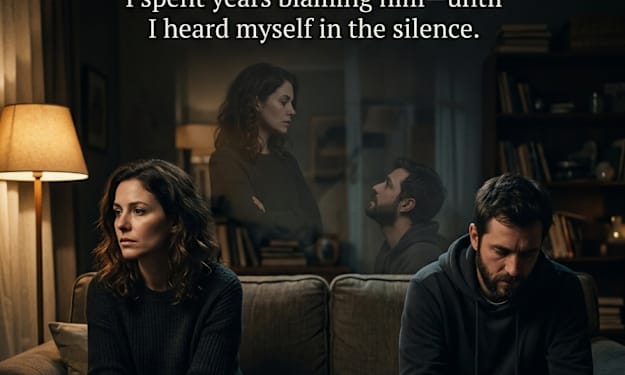
The Day I Realized I Was the Problem
The Day I Realized I Was the Problem I used to think my husband didn’t listen. That was the story I told myself. The one I repeated to friends over tea, to my sister over late-night calls, even to myself in the quiet moments when the house finally settled. He didn’t listen. He didn’t care. He didn’t try. It sounded clean. Simple. Easy to believe. “Men are like that,” my friend Nadia would say, shaking her head. “You have to accept it.” I nodded every time, feeling understood, justified. Because it wasn’t just one thing. It was everything. The way he checked his phone when I was talking. The way he answered with “hmm” instead of real words. The way he forgot things I told him—important things, like the appointment I had been nervous about, or the story I had repeated twice already. It felt like I was invisible in my own home. And the worst part? I kept trying. I tried to talk more. Explain better. Choose the right time. The right tone. The right words. Nothing worked. So eventually, I stopped trying. Silence is not quiet. Not really. It’s loud in ways people don’t notice at first. It shows up in the way you put plates on the table without looking at each other. In the way you sit on opposite sides of the room, both pretending you’re just tired. In the way small questions—“Did you eat?” “Are you coming home early?”—replace real conversations. That’s where we were. Living together, but not really living with each other. And in my mind, it was his fault. The day it changed wasn’t dramatic. There was no shouting. No breaking point. Just a small moment. I was in the kitchen, cutting vegetables, when he walked in. He looked tired. More tired than usual. “I had a long day,” he said. I didn’t respond. Not because I didn’t hear him. I heard every word. I just didn’t feel like answering. He waited for a second, maybe two. Then he said, “They’re making changes at work.” Again, I stayed quiet. I told myself he didn’t deserve my attention. Not after all the times he had ignored me. So I kept cutting, the knife hitting the board a little harder than necessary. “I might lose my position,” he added, his voice lower now. I paused for a fraction of a second. Then continued. He stood there a little longer. I could feel it, even without looking at him. The waiting. The hesitation. And then he left. Just like that. That night, he didn’t say much. He ate quietly. Sat quietly. Slept early. I noticed it, of course. But I didn’t react. Part of me felt satisfied. Now he knows what it feels like. That’s what I told myself. The next morning, I found his message. Not a dramatic one. Not emotional. Just a simple line: “I tried to talk to you yesterday.” That was it. No accusation. No anger. Just… a fact. I read it once. Then again. Something about it felt different. Not because of what it said—but because of what it didn’t. There was no blame in it. No “you never listen.” No “you don’t care.” Just a quiet observation. And for the first time, I didn’t feel defensive. I felt… uncomfortable. I started replaying the moment in my head. Him standing in the kitchen. His voice, slightly uncertain. “I had a long day.” “They’re making changes at work.” “I might lose my position.” I had heard every word. And I had chosen silence. It’s easy to ignore someone when you believe you’re right. It’s harder when you start to question that belief. I sat there, holding my phone, and realized something I hadn’t allowed myself to see before. He had been trying to talk. And I had done exactly what I accused him of doing. The thought didn’t settle immediately. I resisted it. It’s not the same, I told myself. He does it all the time. But the more I thought about it, the weaker that argument became. Because the truth was, I had stopped listening long before that day. Not just with my ears—but with my attention, my patience, my willingness to understand. I had built a story where he was always wrong. And once you believe a story like that, you stop seeing anything that doesn’t fit it. I remembered all the times he had tried, in small ways. Asking how my day was, even if I answered shortly. Sitting next to me, even when I stayed distant. Bringing things home he thought I might like. I had dismissed all of it. Because it wasn’t enough. Or maybe because it wasn’t the way I wanted it. That realization didn’t feel empowering. It felt heavy. Because blaming someone else is easy. Taking responsibility is not. That evening, I did something I hadn’t done in a long time. I waited for him. Not just physically—but mentally. When he walked in, I didn’t stay in the kitchen. I didn’t pretend to be busy. I sat in the living room and looked up. He seemed surprised. “Hi,” he said. “Hi,” I replied. There was a pause. A familiar one. But this time, I didn’t let it stretch. “How was your day?” I asked. Simple words. Nothing special. But I meant them. He hesitated, like he wasn’t sure if this was real. Then he said, “It was… complicated.” I nodded. “Do you want to talk about it?” Another pause. Then he sat down. He didn’t say everything at once. It came slowly. In pieces. Work stress. Uncertainty. Fear he hadn’t voiced before. And for once, I didn’t interrupt. I didn’t prepare my response while he was speaking. I just listened. At some point, I realized something quietly unsettling. This wasn’t new. He had always been this person. I had just stopped seeing him. Later that night, after the conversation had ended and the house was quiet again, I sat alone and thought about everything. Not just that day. But all the days before it. All the moments I had ignored. All the times I had chosen silence over understanding. I had spent so long believing I was reacting to him. That I hadn’t noticed how much I was shaping what we had become. The truth wasn’t comfortable. It didn’t make me feel strong or justified. It made me feel responsible. And maybe that was the point. Because for the first time, I understood something clearly. If I had the power to make things worse… Then maybe, just maybe, I had the power to make them better too.
By Abdul Muhammad 5 months ago in Fiction
Andreas Szakacs on Michael: An Actor’s Reflection on Legacy, Performance, and Emotion
As an actor, I didn’t approach this film as a historian or critic. I approached it as someone trying to understand performance, emotion, and the weight of becoming a legend. And in that sense, the film offers more questions than answers.
By Andreas szakacs5 months ago in Fiction