Fan Fiction
the heart beneath the stone
In a world not quite like ours, where magic clung to the air like mist and forgotten dreams lay buried beneath layers of time, there existed a statue of a man unlike any other. He sat motionless in an abandoned garden, his form carved from flawless stone, every muscle, every line etched with heartbreak and precision. His eyes were closed, and his face wore an expression of deep sorrow, as though he had seen too much and felt too deeply. His chest bore a single, jagged crack—right where his heart should be. And through that crack, if one looked closely, a faint glimmer of red pulsed like a dying ember.
By Alex Farnandoabout a year ago in Fiction
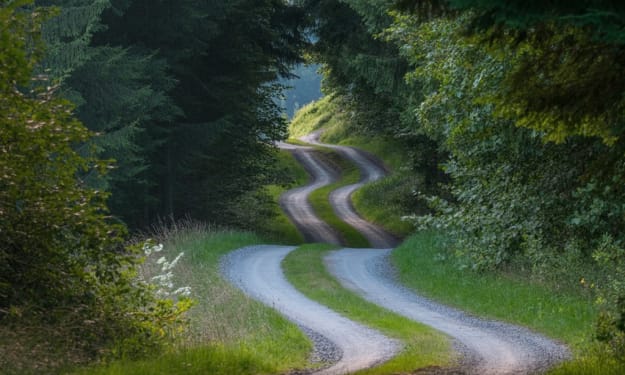
"The Long Way Around"
We sketch out our dreams in bold ink — a clear vision of what we want, where we’re headed, and how long it should take to get there. We imagine we’ll follow a clean path from point A to point B. Graduate by this age. Land a job by that one. Find love. Settle down. Climb the ladder. Check off each goal like a to-do list. But the truth is, life doesn’t care about our timelines. For many of us, things don’t go according to plan. We miss exits, make wrong turns, circle back, stall out, and sometimes start completely over. It’s easy to feel like we’re behind. Like we took too long. Like we somehow failed. But what if we didn’t fail at all? What if we were just taking the long way around? That phrase — “the long way around” — used to sound like a curse to me. Like a euphemism for being lost or late or lagging behind everyone else. But with time, I’ve come to see it differently. Now, I think of it as the scenic route. The path full of growth, unexpected detours, surprising lessons, and hidden beauty you wouldn’t see if you were speeding through. The long way around might not be efficient. But it can be extraordinary. My own journey has been anything but direct. I graduated college with a degree I don’t use. I changed careers twice. I fell in love, got my heart broken, and then fell in love again — in an entirely different way, when I wasn’t even looking. I’ve lived in places that didn’t feel like home until I left them. I’ve quit jobs without a plan, taken risks that didn’t pay off, and made decisions that scared the life out of me. And yet, somehow, all of those winding roads have brought me here — not where I thought I’d be, but somewhere meaningful all the same. Along the way, I’ve met people I never would have encountered if I’d stuck to the script. I’ve had conversations that shifted my perspective. I’ve experienced setbacks that cracked me open in ways that led to something better. It hasn’t always been easy. In fact, sometimes it’s been painful. But growth often hides inside those detours. There’s wisdom in the slow path. When we rush through life, focused only on getting to the “next” thing, we miss what’s happening now. We forget that value isn’t just in outcomes — it’s in the experience. The long way teaches patience. It invites reflection. It humbles us. It reminds us that we don’t need to have everything figured out to be moving in the right direction. I used to look at people who seemed to have it all together and feel like I was failing. The ones who climbed fast, hit milestones early, checked all the traditional boxes. But what I’ve learned is that everyone has their own version of the long way — even if it doesn’t look like mine. Some journeys wind quietly, inward. Others are loud and messy and public. There’s no one right way to live a life. One of the most liberating things I’ve realized is that there is no “behind” — not really. Time isn’t a race. Life doesn’t grade us on punctuality. It rewards presence, authenticity, and resilience. Taking the long way around has helped me define success for myself. It’s no longer about hitting benchmarks on someone else’s timeline. It’s about alignment — about living a life that feels honest and rich, even if it looks different from the one I once imagined. If you’re in a season where things feel slow or uncertain, I hope you give yourself grace. Maybe you’re not lost. Maybe you’re just in the middle of becoming. And maybe becoming takes time. Sometimes the long way offers what the shortcut never could: depth. Perspective. Strength. A chance to rebuild on your own terms. So take your time. Sit with the questions. Wander. Get curious. Pause when you need to. Start over if you must. The path might not be straight, but that doesn’t mean it’s wrong. The best stories are rarely the neatest ones. They’re the ones full of pivots and plot twists, of valleys and summits and wide-open skies you never saw coming. The long way around might just be the path that leads you to the most unexpected, most meaningful version of your life. And when you look back, you might realize: it was never about getting there fast. It was about becoming someone worth arriving as.
By Kaleem Ullahabout a year ago in Fiction
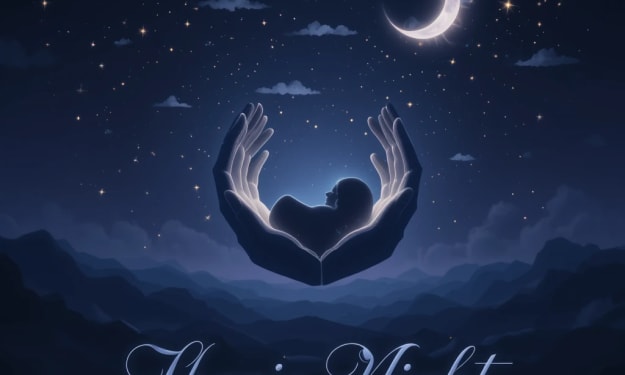
In the Arms of the Night
The next morning, sunlight streamed through Mira’s window, casting warm patterns on the floor. Yet, despite the brightness of day, her mind kept drifting back to the night before — that profound quiet, the comforting darkness, the stars watching silently like ancient guardians.
By Esther Sunabout a year ago in Fiction
I Quit!
To Whom It May Concern (presumably one of the sentient cacti in HR): I am writing this letter to formally tender my resignation from Invertech Solutions Inc., effective immediately, or whenever the office stops spinning sideways on Wednesdays. I’ve tried to make this decision with clarity, rational thought, and at least three kinds of herbal tea, but alas, no chamomile in this universe could prepare me for the continuing existential carnival that is working at Invertech.
By V-Ink Storiesabout a year ago in Fiction
The Porch Light Still Glows ( today I miss my mom)
Today, I miss my mom. There’s nothing significant about the date. It’s not Mother’s Day, not her birthday, not even the anniversary of her passing. It’s just a regular Thursday in May, the kind of day she used to call “good porch-sitting weather.” The kind of day she’d pour two glasses of sweet tea and say, “Come sit with me for a spell.” She’s been gone for almost four years now, but grief doesn’t care about the calendar. It shows up when it wants—softly, suddenly, and without warning. Today, it showed up in the middle of my lunch break, when I spotted her favorite sunflowers blooming by the fence. I grew up in a small town in Kentucky, where the summers are sticky and the people wave when they pass you on the road. Mom was the heart of our home—always baking, always humming Patsy Cline, always reminding me to say “please” and “thank you” and “don’t forget to write your grandma a thank-you note.” She taught me how to balance a checkbook, how to drive on gravel roads, and how to fry chicken the right way.
By Dr Gabriel about a year ago in Fiction
The Peculiar Pet Pageant of Puddlebrook
The air in Puddlebrook wasn't just thick with anticipation; it was thick with the scent of damp dog, questionable birdseed, and enough nervous sweat to fill a small pond. It was the day of the annual Peculiar Pet Pageant, the town's most prestigious (and utterly ridiculous) event. The grand prize? The coveted Golden Leash trophy, a tarnished brass leash shaped vaguely like a sausage. And bragging rights, which in Puddlebrook, were far more valuable than gold. This year, the competition was particularly… spicy.
By Mian Nazir Shahabout a year ago in Fiction
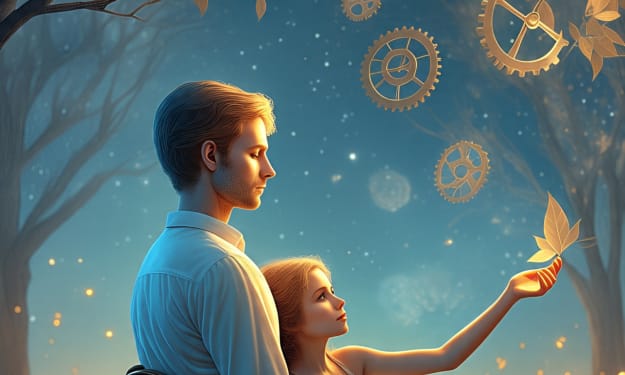
The Infinite Loop of Us
Julian had spent the last five years learning how to manipulate time—not to become rich, not to alter history, but to save his marriage. The first time he lost Emily, it was subtle. A missed anniversary dinner here, a forgotten conversation there. He always thought there would be time to fix it—until one day, there wasn't. She left him with a quiet, tearful goodbye and a single phrase that haunted him more than any temporal paradox ever could: “I just don’t feel seen anymore.” That night, alone in his cluttered lab, Julian activated the loop. Version One lasted a week. He returned to the moment a year before she left. He bought flowers, cooked her favorite meals, complimented her eyes like he used to when they first met. She smiled. But it wasn’t enough. The spark fizzled again, and she slipped away. Version Two lasted a month. He learned to listen—really listen. He responded with thoughtful questions, sat with her in silence, touched her hand when she needed it most. But she could still sense it—an artificial thread sewn through his intentions. He was trying too hard, not being himself. Version Thirteen lasted nearly a year. It was his best attempt yet. He’d mapped every argument, every silence, every sigh. He thought he had it mastered. But love, he learned, wasn’t a line of code to be debugged. It was messy, unpredictable, and human. “Julian,” Emily had said in that version, “I don’t know what’s changed in you, but it’s like... you’re chasing something. And I don’t want to be a goal you’re trying to achieve. I want to be your partner.” And just like that, she was gone again. Each loop left a scar on his memory, a residue of failure that accumulated like cosmic dust. He began to forget which version he was in. Time bent around him like glass under heat, warping reality into a blur of missteps and do-overs. It wasn’t until Version Twenty-One that he did something different. He stopped trying. He didn’t recite rehearsed lines or cook a perfect dinner. He didn’t avoid the fight about her career or their mismatched schedules. Instead, he let the conversation happen. He let the silence hang. And when she cried about feeling like she had to be the one holding everything together, he didn’t try to fix it. He just held her. They sat on the kitchen floor that night, backs against the refrigerator, two humans unraveling the knot they’d become. “Why now?” she asked. “Why does this feel different?” Julian took a breath, the weight of twenty failed timelines pressing down on his chest. “Because I stopped trying to control the story. I realized I’ve been trying to edit our love like it was a machine. But it’s not. It’s alive. And sometimes... it breaks.” She looked at him, really looked at him—for the first time in what felt like lifetimes. “That’s the most real thing you’ve ever said,” she whispered. He didn’t loop after that. He let the days roll forward, uncertain and raw. They had fights. Some ended in slammed doors. Others in laughter. They built new habits. Morning coffees with eye contact. Evening walks without phones. Honest conversations about therapy, about starting over. Julian decommissioned the machine. He buried the time circuit in their backyard with a simple note: Some things are worth living once. A year passed. Then two. Emily didn’t leave this time. Instead, one spring morning, she stood beside him in the garden, hands in dirt, planting a lemon tree. “I want roots,” she said. “Here. With you.” He nodded, unable to find words. For a man who had all of time in his hands, this moment felt eternal.
By Syed Kashif about a year ago in Fiction
three laughing monkey
Deep in the heart of the jungle, where the trees whispered secrets and the rivers chuckled over stones, lived three of the most mischievous monkeys anyone had ever met—Bobo, Kiki, and Zuzu. These three were the jungle’s prank champions, known far and wide for their playful tricks and loud laughter.
By Alex Farnandoabout a year ago in Fiction
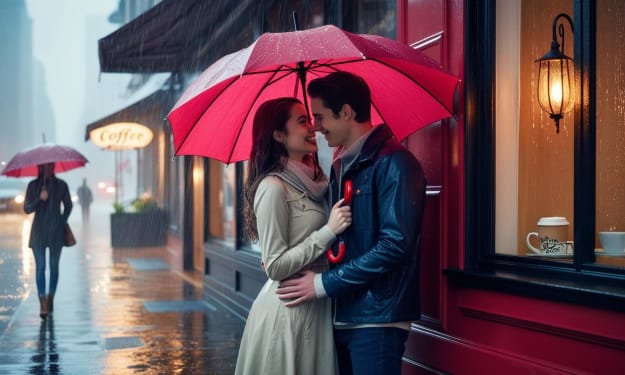
The Little Red Umbrella That Changed Everything
It was a gray morning in the middle of October. The rain had started falling early, and the streets of the city were wet and shiny. People hurried along the sidewalks, umbrellas in hand, heads down, trying to stay dry.
By Muhammad Farhad Khanabout a year ago in Fiction
The Silent Symphony of Space: A Journey Beyond Earth. AI-Generated.
When we gaze up at the night sky, we are looking into a vast, silent arena of cosmic activity. Space, though often perceived as a dark and empty void, is teeming with mysteries, wonders, and phenomena that defy our everyday experiences on Earth.
By Sharmin Akterabout a year ago in Fiction