Fan Fiction
Stardust and ashes. Content Warning. AI-Generated.
The world ended in whispers—not fire or flood, but silence. On the last night Earth breathed clean air, Juno kissed Ari under the flickering remains of an aurora, remnants of a dying magnetic field. Above them, satellites fell like dying stars.
By Mokhele Sedukuabout a year ago in Fiction
Flowers on the Pavement
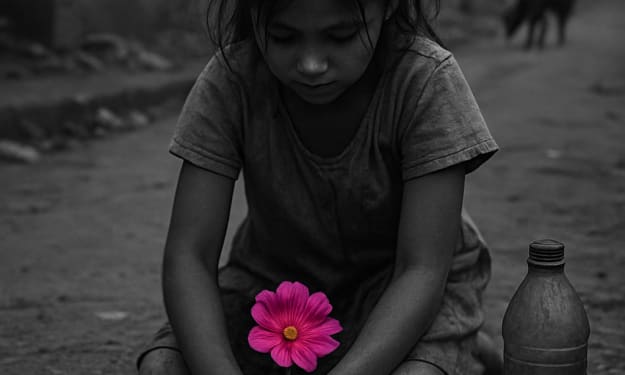
The van jerks to a sudden halt, throwing my shackled body forward — my forehead smacks the metal wall. No apology. No pause. Just silence… except for the shallow breathing of the others inside. A beam of light slices through a rusted crack in the door, brushing my face like a whisper from a world I once belonged to. Outside, the air shimmers with heat and dust. Faded graffiti bleeds down concrete walls. Stray dogs dig through heaps of forgotten lives. Then — movement. A girl. Kneeling by the roadside. She can’t be older than ten. A dirty pink dress. Scraped knees. Eyes that have seen too much. She’s planting something. Between cracks in the broken pavement. A single flower. Bright. Whole. Alive. She cups the fragile stem with both hands, shielding it from the ugliness around her. Then pours water from a battered plastic bottle — just enough. Just enough. She doesn’t see us. Doesn’t know her quiet defiance has been witnessed. But I see her. And I will not forget. This is the street they bring the condemned down. Where shadows are longer than lives. Where names are erased before voices fade. And yet — she plants. Not in ignorance. But in defiance. A flower not meant to grow here. The van shudders back into motion. Chains rattle. Dust rises. But I don’t look away. Not until she — and her small rebellion — disappear behind rusted metal. I lean my head back. A tear rolls down my cheek, warm against the cold wall. That flower wasn’t for decoration. It was a rebellion. A funeral. A prayer. Maybe even a promise. I close my eyes and hold onto it. I don’t know how much time I have left. But I know now: If she still believes life can bloom here — maybe so can I.
By Still Writingabout a year ago in Fiction
The Snow
There is something timeless about snow. It arrives not with thunder or fanfare, but with a soft, silent insistence. In its stillness lies an extraordinary power — to transform, to conceal, and to speak without words. The snow does not shout. It whispers.
By FAIZAN AFRIDIabout a year ago in Fiction
The Clever Fish Who Outsmarted the Net
In the vast, sunlit waters of the River Dhansiri, fish of all sizes darted through the current, living their lives with joy and freedom. Among the many, there lived a sharp-witted fish named Tuna — not large or particularly fast, but clever beyond measure.
By Nauman Khanabout a year ago in Fiction
The Fault in Our Stars
Hazel Grace Lancaster was sixteen, living with terminal thyroid cancer that had spread to her lungs. Every breath was a struggle, made easier only by an oxygen tank she carried everywhere. Her world was limited—books, TV, occasional classes, and the constant presence of her parents, who tried to keep her spirits up despite the looming truth. Life felt like a waiting room before death, until everything changed at a support group meeting in a church basement. That was where she met Augustus Waters. Augustus, or “Gus,” was seventeen—handsome, witty, and in remission after losing a leg to osteosarcoma. He had a confidence and charm Hazel hadn't seen in a long time. He joked, flirted, and looked at her like she wasn’t just a sick girl—but a person with fire and meaning. From their first conversation, Hazel knew this boy was different. They exchanged books. Hazel gave Gus her favorite novel, An Imperial Affliction, by the mysterious author Peter Van Houten. The book ended mid-sentence, unresolved, and Hazel always wondered what happened to the characters afterward. Gus was captivated by the story too and promised to help her find the ending. Their friendship quickly blossomed into something more. They talked for hours, laughed at dark jokes only cancer kids could understand, and shared their fears. Hazel was afraid of hurting people by dying. Gus was afraid of being forgotten. Determined to give Hazel the answers she longed for, Gus reached out to Van Houten, who lived in Amsterdam. To their surprise, the reclusive author responded—though cryptically. With the help of a cancer charity, Gus arranged a dream trip to Amsterdam for them both, with Hazel’s mom tagging along. In Amsterdam, romance bloomed fully. They walked along canals, visited the Anne Frank House, and finally met Van Houten. But the meeting was a disaster. Drunk and bitter, the author refused to answer Hazel’s questions. The fictional world she’d clung to unraveled. But even as her dream crumbled, Gus stood beside her. He kissed her in the attic of Anne Frank’s house, surrounded by history and pain, defying the cancer that tried to erase joy from their lives. Then Gus told her the truth. His cancer had returned. It had spread everywhere. He was dying. Hazel’s world shattered. She had tried so hard not to fall in love, not to burden anyone with her death—but now she was the one who would have to watch someone she loved slip away. They returned home. Gus’s health declined rapidly. He became weaker, unable to care for himself. Hazel visited him every day, cherishing each moment even as the fear of losing him tightened around her chest. Gus had once dreamed of being a hero, of doing something extraordinary. But now, confined to a wheelchair, vomiting and exhausted, he wondered if his life had meant anything at all. But to Hazel, he was already extraordinary. Gus died eight days after his pre-funeral, a mock ceremony he arranged where he asked Hazel and their friend Isaac to give eulogies while he was still alive. He wanted to hear what people would say about him. Hazel told him that she would always love him, even in pain. “You gave me a forever within the numbered days.” After his death, Hazel discovered that Gus had secretly written to Van Houten, asking him to help Hazel find peace after he was gone. Moved by Gus’s words, Van Houten reached out again—this time sober—and shared a bit of his own pain: the novel Hazel had loved was inspired by his own daughter, who died of cancer. He apologized and left her with a letter. In it, Augustus wrote: > “You don’t get to choose if you get hurt in this world... but you do have some say in who hurts you. I like my choices. I hope she likes hers.” Hazel read the words over and over, tears falling, a quiet smile on her face. She liked her choices too. --- 🌟 Moral of the Story The Fault in Our Stars is not just a story about illness. It’s a story about living fiercely in the face of death, about finding light even in darkness. It teaches us that love is worth the pain, and even a short life can be filled with meaning, if lived truthfully and with heart.
By SULAIMAN SHAHabout a year ago in Fiction
After The Sunset The Stars As My Witness. Content Warning.
She loved how the sunset tainted the sky but not as much as the sunrise brought the earth to life. She hated what came after the beautiful sunset, the moon. The moon always forced her to brisk down nightmare lane. It had been many years since the incident and it always felt like she was going through it over and over again once the moon rose bringing the wicked to life. She was tired of the way she had been living, making men pay for a sin they didn't commit or know of but could you blame her they felt the closest to him she’d ever get to and she always thought she would feel better this way but lying to yourself can only take you so far, for her not so far. Even if she tried to avenge her innocence she would lose and no one would help her because she had become a monster like him feared by all the men and women in the neighbouring kingdoms. That was the closest thing to respect and power she had gotten to, fear. Meanwhile, in a kingdom that was oceans and lands away, her death was being plotted by a brave young man who wanted to make a name for himself since he couldn't do so with wealth. He had made empty brags of how he would kill her and bring her head as a gift instead of horses everyone was going to give to the King, the king of the kingdom that had welcomed him and his mother with open arms but closed hearts years ago. He didn't think anyone would dare him to because it was a dangerous journey and no one had lived to tell the tale, but that was exactly what the king wanted, her head or him dead. The king didn't care what would've happened, all he wanted was the young man’s mother as his wife and the only way was to cut the man out of the picture even if it meant death. If he went on the journey he was dead either way. It was either her wrath would kill him or the King’s betrayal using the gift to kill him. He didn't know this but he knew he wasn't going to die. Little did he know when his path finally collided with hers their lives wouldn't be the same and the sunset would be a reminder. She knew her days were numbered and that one day the sunset might set on her existence. Would anyone miss me or feel pain? She always wondered. She wanted to be accepted by more than just her family but no one dared to get to know her, unfortunately, her curse did not allow anyone the opportunity even if they wanted to or were daring. At least the curse is protecting me from the wicked men that roam this land, She would often console herself when she ran into her shadow on the walls of her cave or her reflection in ponds, or the ground that felt like it trebled as she walked because the animals and creatures would scatter when they sensed or saw her close. “Don't worry” The voices from her hair would hiss “They would have scattered before this” and they were right. Even before the curse when she was as beautiful as the nymphs and looked like the gods all came together to carve every inch of her with beauty and perfection, the animals would still scatter. However, as the animals scattered all the dangerous animals and creatures she would have scattered from before the curse bowed to her presence as Pegasus and Chrysaor followed behind her. She was Medusa, the gorgon, Athena’s once most valued priestess and He was Perseus, the demigod, son of Zeus.
By Ropafadzo Thokozani Zinyuke (Fadzo) about a year ago in Fiction
The Lazy Princess Who Outsmarted Everyone
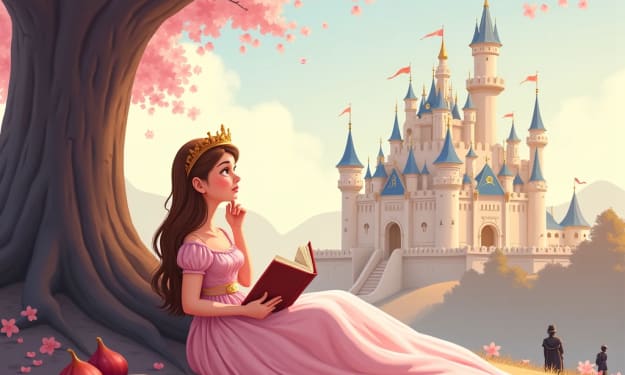
In the heart of the lush Kingdom of Liora, nestled between the Sapphire Mountains and the Sea of Whispers, there lived a princess who was known far and wide—not for her beauty, though she had it. Not for her kindness, though she possessed that too. No, Princess Liana was famous for something quite different:
By Nauman Khanabout a year ago in Fiction
Death or Love. Content Warning.
Under the burning twilight of a kingdom falling into chaos, a lone warrior named Ean strode through a scarred battlefield. His eyes, filled with fierce resolve, mirrored the raw intensity of his spirit—a spirit that had chosen the honorable death of fighting for a dream over the lingering pain of love.
By Edge Alexanderabout a year ago in Fiction
The Last Cup of Tea
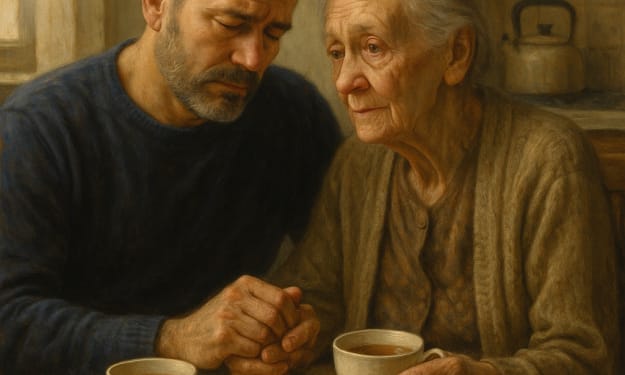
The kettle whistled gently, its familiar song filling the tiny kitchen. It was 6:45 a.m., just as it had been every morning for the last thirty-two years. Samuel stood by the counter, waiting. He was no longer the boy who used to sit cross-legged at the kitchen table, legs too short to touch the floor, watching his mother move through her morning routine like a silent symphony. He was a man now—tall, broad-shouldered, with grey already whispering into his beard. But in this kitchen, in this moment, he felt like a boy again. His mother, Evelyn, sat at the table wrapped in her favorite cardigan, hands resting on the floral-printed tablecloth she’d sewn herself when Samuel was ten. Time had not been kind to her body, but her eyes—those deep hazel pools—still held the same warmth, the same unspoken strength. “Is it ready?” she asked, voice soft and brittle like dried leaves. Samuel nodded and poured two cups. The scent of chamomile filled the air, comforting and nostalgic. He placed one cup in front of her, and one in front of himself. They sat in silence, the kind that only years of shared life could build. “You remember when we used to drink tea and read poems on Sundays?” she asked, a wistful smile tugging at her lips. He nodded, throat tight. “You always chose the sad ones.” “Sad poems are the most honest,” she said. “They don’t try to pretend.” He watched her cradle the cup in both hands, as if it were something sacred. His chest ached. Not from sadness alone, but from the weight of what he hadn’t said yet. She knew, of course. Mothers always do. “You’re leaving tomorrow,” she said, not as a question. He nodded again. “The job in New York… it’s everything I worked for.” She looked at him with so much pride it nearly crushed him. “You deserve it, Sam. You’ve always deserved more than this little town could offer.” He reached for her hand. It was thinner now, skin paper-like, veins like blue rivers. But it was the same hand that had wiped his tears, held him through fevers, and taught him how to hold a pencil. “I just hate the thought of you being alone,” he whispered. “I’m not afraid of being alone,” she replied. “I’m afraid you’ll forget the sound of my voice.” “I never could.” She smiled again, though her eyes welled with tears. “Promise me something, Sam.” “Anything.” “No matter how busy life gets, no matter how far you go—make a cup of tea once in a while. Sit down. And remember me.” He swallowed hard, nodding. “I promise.” They sat there for a long time, sipping slowly, letting memory wrap itself around them like a warm blanket. Outside, the world stirred. But inside, time stood still. That evening, he packed the last of his boxes. She helped where she could, folding a sweater, labeling a book. They didn’t talk much. They didn’t need to. The next morning, he hugged her tighter than he ever had. Her small frame pressed into his chest, her breath warm against his neck. “I love you, Mom.” “I love you more, my boy.” He left, heart heavy but full. Years passed. New York was everything he’d hoped—and nothing like he’d imagined. Success came, accolades followed, and the pace of life drowned out the quiet rituals of the past. But every Sunday morning, without fail, he boiled water. He poured a single cup of chamomile tea. And he sat by the window, eyes closed, listening. For her voice in the quiet. For her love in the steam. And in those moments, she was never far.
By Dr Gabriel about a year ago in Fiction