Fan Fiction
Ash and Oath”
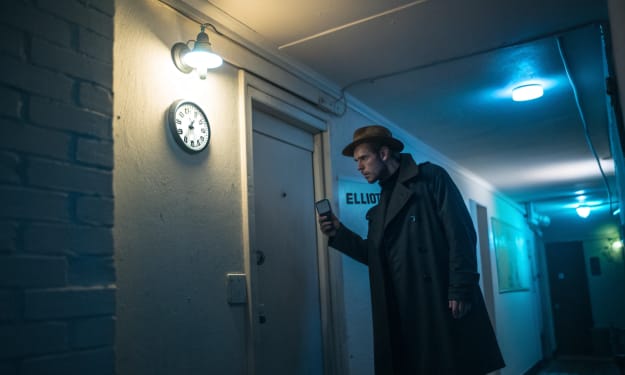
They had passed beyond the reaches of the eastern wood, where wind moved like ghosts through burnt pines and the earth still bore black scars from fire unquenched. The boy, wide-eyed and silent, held close his dwarvish bow, though he had not loosed a single shaft. Night was nearing. “We’ll camp by the Runebreak,” the knight said, gazing at the ancient stones that jutted from the vale like a broken crown. “There’s water still. Cold, but clean.” Uurnik nodded but did not speak. He had grown quieter as they neared the heart of the realm. The dwarf's mind, always turning, seemed wound in thought—gears behind his eyes. That night, fire danced low. Ellowyn sang a song of her people, soft and sorrowful, in a tongue long and lilting. It was not meant for men, but the knight listened nonetheless, the song folding over him like a cloak. Uurnik stirred. “That tongue… it has not been sung in these lands since before the war of the Shattered Trees. Do you know what you carry, my lady?” Her voice trailed off. “My father’s house is gone. Who else is left to carry it?” The dwarf nodded gravely. “Then carry it you must.” The knight watched the stars through a veil of old sorrow. “Do you think the queen will hear us?” “She will,” Uurnik said, tossing another rune-etched log into the fire. “But hearing is not the same as believing. And belief is not the same as acting.” As the fire crackled low, a sound came on the wind. A shuddering, distant cry. Not beast. Not man. The boy’s eyes widened. Ellowyn turned toward the east. “Is it another drake?” she asked. “No,” said the knight. He stood, hand at the hilt of his blade. “Not yet. But something foul stirs. I feel it.” They slept in turns. But the knight did not close his eyes. --- The queen’s halls stood wreathed in sapphire banners and towers shaped like lifted spears. Ithilion was not yet burned, but it was a city tensed for doom. Archers paced walls; the commoners moved as though under weight. And within the throne hall, fear had a name. Queen Ysareth. She sat cloaked in white and silver, a woman whose crown seemed to burden more than bless. “You slew Mêmraahq?” she asked, disbelief bitter in her tone. “I did,” said the knight, his voice even. “Many have claimed such things,” the queen replied. “And yet, the skies still darken with wings.” Ellowyn stepped forward. “He does not lie. And we bring proof.” She drew forth the dragon’s tooth. The court murmured. The queen stared. Uurnik took a step. “Lady Queen, this is no tale spun by firelight. We come with warning, not praise. The drakes grow cunning. They strike not only for hunger. They strike for wrath. There is judgment in them.” Queen Ysareth stood. “Judgment? For what crime?” The knight met her gaze. “Perhaps for forgetting who they were… and what we have become.” Silence fell. Then: “And what would you ask of Ithilion?” “Not banners. Not swords,” said the knight. “Only counsel. And a path through the southern waste. There is one yet might help us. An ancient one.” The queen’s brow furrowed. “You speak of the Oracle.” He nodded. “I will grant this,” she said. “But beware—she sees not with love, nor kindness.” Ellowyn’s hand touched his. “I need neither,” the knight said. “Only truth.” --- End of Part II --- Want to keep building this world? Here are a few follow-up prompts you could try: Write the scene in the Oracle’s temple. Flash back to the knight’s battle with Mêmraahq. Explore a moment from Ellowyn’s past as a noble of Eletheme. Show Uurnik alone, crafting the bow he gives the boy. Introduce a new party member who joins them for the journey south. How is my fiction please 🥺 said in comment
By fazilat bibiabout a year ago in Fiction
**The Thorny Devil’s Guide to Surviving Haters**
### *How to Thrive in a World That Wants to Eat You* Life isn’t easy when you’re a tiny, slow-moving lizard in the middle of the Australian outback. Everywhere you turn, something wants to eat you—birds, snakes, even other lizards with poor dietary judgment. But the thorny devil? This little armored warrior doesn’t just *survive* the haters; it *thrives*. And you can too.
By Kabeer ullah about a year ago in Fiction
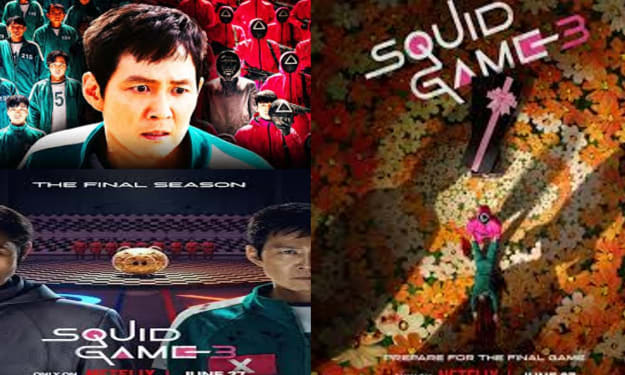
Squid Game final season review – an ending so WTF it entirely beggars belief
After a wild new player is forced to join the game without consent, the action gets even more operatic and bloodthirsty. But if you can get on board with the twists – and that’s a big if – you will not believe what happens in the last minute
By SHYAKA MARSabout a year ago in Fiction
A Day in the Life of My Anxiety
The first thing I notice is the weight. It hits before my eyes even open — a sinking heaviness on my chest, like something is pressing down to keep me in bed. My mind hasn’t even said good morning yet, but my body already knows: it’s going to be one of those days.
By wilson wongabout a year ago in Fiction
When the moon stopped rising
When the Moon Stopped Rising No one noticed it the first night. The sky was clouded, and most people were tucked into their glowing rectangles of distraction—phones, tablets, televisions. But the astronomers noticed. They watched the lunar feed glitch, then go black. The moon had vanished. By the second night, headlines screamed “Where Is the Moon?” Panic settled in like a low fog. Tides swelled unpredictably, swallowing shorelines and vomiting up forgotten shipwrecks. Animals grew restless—wolves howled in disoriented confusion, and migratory birds flew in circles. Children stopped sleeping. Grown men forgot how to cry and simply stared at blank skies with red, twitching eyes. Governments issued statements. "An optical illusion," some said. "An atmospheric anomaly." But no satellites could find it. It wasn’t hiding. It was gone. And slowly, the world began to break. --- Dreamwalker. That’s what they called her. Her real name was Mera, and she had never been like everyone else. Since childhood, her dreams weren’t just dreams—they were places. Sometimes beautiful, sometimes terrifying, but always real. She could walk in others' dreams too, though most locked her out with walls of noise and trauma. But now, in this moonless world, people began to dream of the same thing. The same place. Mera saw it first: a scorched desert of gray, dust-filled air, a sky of endless black, and above her—a massive, chained orb screaming in silence. The moon wasn’t gone. It was trapped. --- News of Mera spread fast. Her drawings of the chained moon matched what hundreds began to see in their dreams. Governments scoffed. Scientists dismissed it. But ordinary people… they started to believe. A quiet movement formed—those who followed Mera called themselves The Nightbound. They believed the moon was crying for help, and only dreamwalkers like Mera could reach it. Each night, Mera returned. The dream was always the same. A ruined temple of bone and dust stood beneath the suspended moon. Blackened chains anchored it to invisible corners of the dreamworld. And always, a figure waited at the temple’s steps: a child made of stars. “You remember us,” the child said one night. “Who are you?” Mera asked. “We are the parts of the mind left behind when the world stopped dreaming,” the child said. “The moon is not just a rock. It is memory. It is balance. The world needed rest, needed darkness. Now… now it is unraveling.” Mera began to understand. The moon was more than light. It was a boundary, a rhythm, a mother of dreams. Its absence was turning people mad not just from lack of sleep, but from the collapse of something far deeper: the unconscious connection between the earth and the mind. --- Outside the dream, chaos brewed. Sleep-deprived drivers turned highways into death strips. Oceans surged with a madness of their own. A second sun appeared in the sky for one terrible hour—then blinked out. People stopped dreaming altogether. And those who could still sleep? They screamed in their sleep. Mera knew time was short. She gathered the Nightbound and taught them to enter the shared dream. It required focus, stillness, and a willingness to let go. On the seventh night of no moon, Mera walked into the dream temple with twelve others. The star-child greeted them, face flickering with old light. “Why is it chained?” Mera asked. “Because you forgot what it means to be still. To rest. To feel the cold and know you are alive. The moon begged to be remembered, but you lit your cities and drowned its song.” “So how do we free it?” someone whispered. The child extended his hand, and twelve dreamers stepped forward. One by one, they disappeared into the dust—offering a piece of their waking selves. Each chain groaned, cracked, and broke. Mera was the last. --- Back in the waking world, her body never moved again. But that night, the clouds parted. And the moon rose. Not as it once was, but larger—deep silver and etched with dark scars that hadn’t been there before. It glowed with a kind of sorrow. The tides settled. Sleep returned to people like rain to parched soil. But Mera never woke. Some say you can still see her—if you stare too long at the moon. A shimmer. A figure. Walking slowly across its surface, barefoot in dust. They call her the Keeper now. And every month, when the moon waxes full, dreamers gather in silence. Not to pray. But to remember. That even the sky can go mad… When the world forgets how to sleep.
By Hammad younasabout a year ago in Fiction
The Thorned Crown – Chapter One: The Whispers in the Hall
The rain came down like spilled silver, cold and punishing, hammering the old stone keep of Dunsrow Hold. Inside, the halls breathed a quiet dread — torches flickering against moss-darkened walls, wind sighing through broken shutters, and footsteps too hesitant for a castle that once echoed with feasts and banners.
By Gift Wesley Sageabout a year ago in Fiction
The World That Whispered Back
The World That Whispered Back It began on a Wednesday—the kind of day that folds into the week unnoticed, carrying no special weight. Samuel woke, like he did every day, to the sound of his alarm clock whispering monotony. The sky outside was gray. Not angry-gray, nor soft-gray. Just… gray. The sort of gray that makes you forget what color ever felt like.
By VoiceWithinabout a year ago in Fiction
The Clockmaker's Secret
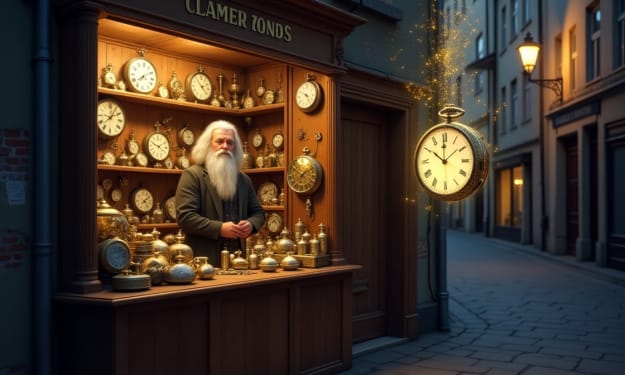
It was the kind of shop that didn’t exist on maps. Tucked between a crumbling bakery and a graffiti-stained bookstore on Alder Street stood Horatius & Sons Clockworks, a narrow, dusty storefront with a single cracked window and a door that creaked like it hadn’t opened in years. The sign above was faded to near invisibility, the gold leaf worn off by time and weather. Yet inside, clocks ticked in perfect harmony — a symphony of time, waiting to be heard. Lena found the shop by accident — or so she thought. She had wandered Alder Street for no real reason, her feet moving on their own after another sleepless night filled with dreams she couldn’t remember. Something about the gentle ticking from inside the old shop pulled her forward, like the echo of a heartbeat calling her home. She pushed open the door. The sound of the city vanished behind her. Inside, the air smelled of polished wood, old paper, and brass. Clocks of every size and style filled the room — cuckoo clocks, ornate grandfather clocks, tiny golden wristwatches under glass. Time itself seemed to echo off the walls. Behind the counter stood an old man, tall and silent, with silver hair slicked neatly back. He looked up with eyes that sparkled like still water. "You're late," he said calmly. Lena blinked. "Excuse me?" "You've come for the watch, haven't you?" "I… no. I was just passing by." He smiled — not unkindly, but with the tired understanding of someone who had seen this moment before. "They all say that at first." He turned, reached beneath the counter, and placed a small, velvet-lined box in front of her. Inside lay a silver pocket watch with intricate etchings. Its cover was engraved with a strange symbol — like a circle caught in the act of opening. She hesitated. "I can’t afford something like this." He shook his head. “It isn’t for sale. It’s yours. It always was.” Lena’s fingers trembled as she lifted the watch. It was warm — unnaturally warm — like someone had just been holding it. --- That night, her world began to shift. She opened the watch at midnight. The second hand ticked once, and the room… paused. The street noise outside dulled. The humming of her refrigerator softened to a whisper. The blinking light of her router stopped mid-blink. Time had slowed. Then came the visions. Flashes. A woman running through a war-torn street with the same watch around her neck. A boy crying beside a frozen lake. A man burning letters by candlelight. Each of them — different lives, different eras — carried the same watch. Was she dreaming? Hallucinating? Or remembering? --- She returned to the shop the next day, heart pounding. "You knew," she said. “The visions. The way the world stops. You knew this would happen.” The Clockmaker nodded, adjusting the hands of a wall-mounted timepiece. “The watch finds its keeper when time bends beyond repair. You felt the fracture, didn’t you? In your dreams.” "What am I supposed to do?" He glanced at a blueprint pinned to the wall — a strange diagram of time as a branching tree, some limbs circled in red, others crossed out entirely. “Time is not a straight line,” he said. “It’s a living, breathing force. And sometimes it breaks. When that happens, it needs someone who can feel the ripples. Someone who can repair the wounds.” Lena stared at him, trying to find logic in his words. “I’m not special. I work in IT. I’m scared of escalators. I’m—” “Human,” he interrupted. “Which is what makes you perfect for the job.” --- Over the following weeks, Lena trained. She learned to move inside seconds, how to use the watch to read moments before they happened. She visited places where time slipped — alleys that reset themselves, towns where people remembered events no one else experienced, staircases that led to different decades depending on when you stepped. And she fixed them. One by one. Using the watch, and her instincts. Each time she did, a scar formed on the inner lid of the watch — a tiny notch that glowed for a second, then vanished. She was becoming something new. Something ancient. --- Then, one morning, the shop was gone. She ran to Alder Street, her coat flapping behind her, only to find a blank wall where the shop used to be. No ticking. No sign. No door. Just bricks. She fell to her knees, tears stinging her eyes, and placed her hand on the wall. And then she saw it. A single word, etched faintly behind a loose brick: “Fix what was broken.” --- For the next year, Lena wandered the world. Not aimlessly — but purposefully, following the vibrations she had learned to feel. She stepped into slivers of lost time, reversed moments that were never supposed to happen, saved people who didn’t know they needed saving. And with every mission, the watch grew warmer. Lighter. Almost alive. One day, deep in the Swiss mountains, she came across a frozen lake she had never seen but recognized immediately. From the vision. A boy stood at the edge. Crying. Without thinking, Lena opened the watch. Time slowed. She stepped forward, reached for him — and the world shifted. --- Later, the boy asked her who she was. She smiled and said, “Just someone trying to keep the clocks running.”
By Shehzad khanabout a year ago in Fiction