Fan Fiction
The City Where Everyone Forgets Their Name
No one remembers arriving. The City has no welcome signs, no maps, no borders — just a quiet street that stretches endlessly in both directions, and a thick, humming silence that follows you like a shadow. Everyone here is... pleasant. Gentle smiles. Hollow eyes. Voices like distant echoes. But no one remembers who they were before. They say your name is the first thing to go. It starts with forgetting how to sign it. Then you hesitate when introducing yourself. Soon, it’s not just your name — it’s the birthday that used to matter, the address you called home, the song that always made you cry. People here don’t panic when they forget. That’s the strange part. They shrug, smile faintly, and say, “Maybe it wasn’t important anyway.” I wasn’t like them. Not at first. I woke up on a park bench with a ringing in my ears and a journal in my lap. Just one entry: “Don’t forget who you are. Fight the forgetting.” It was my handwriting, I was sure of it. But no name signed beneath it. For weeks, I wandered the City, clutching that journal like a lifeline. I asked people questions. Where are we? Why can’t we leave? Who are you? They would tilt their heads and smile like I’d told a joke they couldn’t quite remember the punchline to. Then one day, I met a man who claimed he almost remembered. He was sitting on the edge of the fountain in the center of the city, eyes fixed on the water as if it held his reflection from a life long buried. His coat was worn, but his gaze was sharp — sharper than the rest. “I think I was a teacher,” he whispered. “A teacher?” I asked, my heart tightening. “What did you teach?” He shook his head slowly. “I don’t know. But I still dream about chalkboards and empty desks. It feels... important.” I showed him my journal. He blinked down at the page. “Fight the forgetting,” he read aloud. “Yes... yes, that sounds right.” That night, I dreamed of a woman with sunlit hair and the scent of lavender. She called me something — something soft, something familiar. But when I woke, the name vanished like breath on glass. The forgetting had started. My journal began to feel heavier in my hands, like it was the only proof I still existed. I wrote down dreams, flashes of memories, the man by the fountain, the sound of lavender. Every detail, no matter how small. Then the City began to change. The streets, once calm, started to shift. Signs appeared in strange symbols. People walked in loops, repeating the same sentences. I watched as the man from the fountain sat on the same bench, day after day, his face slowly losing its spark. One morning, he didn’t remember me. “Do I know you?” he asked, kindly, with an emptiness that nearly broke me. I wanted to scream. To shake the City until it gave me back my name, my past, my truth. Instead, I wrote: “Even if I forget everything, I will remember that I wanted to remember.” And somehow, that kept the fog from swallowing me whole. Not long after, I found a doorway. It wasn’t grand or glowing. Just a plain wooden door at the edge of an alley I swear hadn’t existed the day before. A small plaque above it read: "Only those who still know they’ve forgotten may pass." My hands trembled as I reached for the handle. I didn’t know my name. I didn’t know where I came from. But I knew I had lost something. And I still wanted it back. That was enough. The door creaked open. Behind it — light. Not blinding, but soft. Familiar. Like the lavender-scented woman. Like the sound of my own name whispered from a distant childhood. I stepped through. The City did not disappear. It stayed, for others. But for me — for the one who kept remembering to remember — the forgetting ended. And as I walked forward, the first thing that came back to me was this: I had never truly been alone.
By Firdos Jamalabout a year ago in Fiction
She Waited Every Thursday. But No One Ever Came.
Every Thursday at 4:07 PM, I sit on the same park bench. Same time. Same spot. Same drink — peach bubble tea with extra pearls. I always order two. One for me. One for you. Even now. Yours sits unopened on the bench beside me. I never touch it. That’s the rule. That’s your seat. Whether you show up or not. ---
By Hamid khanabout a year ago in Fiction
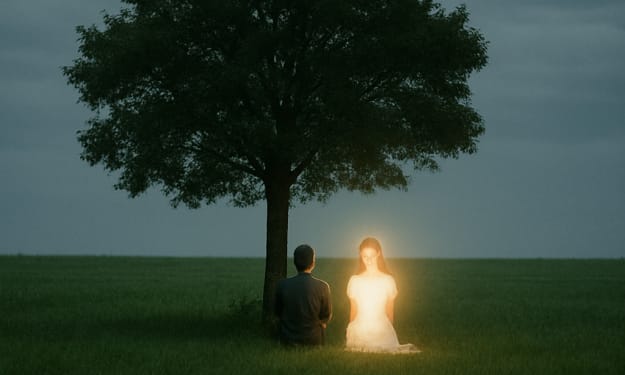
The Girl Who Only Existed in My Dreams. AI-Generated.
I always thought dreams were just meaningless flashes – quiet visitors in the night that left before dawn. But everything changed when she began appearing, night after night, as if she belonged in the quiet corners of my mind. The first time I saw her was on an unusually cold summer night. I remember walking down a narrow street lined with old brick houses, the streetlights flickering softly in the silent breeze. She stood under one of those lights, wearing a simple white dress, her hair falling over her shoulders like midnight silk. She was looking at the sky, searching for something she had lost long ago. When she turned to me, the world fell silent. Her eyes were filled with sadness, but in them, I saw a calmness that quieted my own restless heart. I woke up that morning with her image lingering behind my eyelids. I told myself it was just a dream – beautiful but fleeting. But the next night, she returned. This time, we sat together on a park bench under a full moon. Its silver light washed over her face as she spoke softly about her loneliness, about waiting for someone to find her. I wanted to ask her who she was, where she came from, but before I could, my alarm shattered the moment, dragging me back into my silent room. Days turned into weeks, and each night she visited me. She wasn’t just a dream character anymore. She became real to me. Her name was Aira. She told me about her childhood, how she used to read by the window during rain, her favourite jasmine flowers, her fear of thunderstorms, and her dream of travelling to the mountains. She would smile when she spoke of small joys – hot tea on winter mornings, the smell of old books, the warmth of holding someone’s hand. I never told anyone about her. How could I explain that the girl I loved only existed behind closed eyes? One night, I gathered the courage to ask her why she came to me. Her eyes filled with tears as she whispered, “Because you’re the only one who sees me.” Her voice trembled as she added, “I’m trapped between dreams and life. Every morning when you wake up, I fade a little more. I don’t want to disappear.” That morning, I woke up crying. All day, everything felt muted. My friends laughed at lunch, my colleagues talked endlessly about deadlines and meetings, but I could only think of her fading away while I walked under fluorescent lights and grey skies. The next night, I found her by a quiet river. She wasn’t wearing white anymore. She wore a sky-blue dress, and her hair was tied in a loose braid. She looked tired, like someone who hadn’t slept in days. I sat beside her and held her hand. It felt cold, like touching morning dew on grass. I noticed tiny scars on her wrist, fading like forgotten stories. “Please don’t leave me,” I whispered. She smiled faintly. “You can keep me alive, but only if you remember me when you’re awake. Promise me you won’t forget.” “I promise,” I said, squeezing her hand as if that alone could keep her there forever. She closed her eyes, leaning her head on my shoulder, and for the first time, we sat in silence without fear of her fading. That was the last night I saw her. For weeks after, she didn’t come. I waited, hoping to find her under a streetlight or by the river, or walking barefoot through the parks of my dreams. But every morning, I woke up alone. Sometimes I wonder if she was just a figment of my tired imagination. But then I walk past blooming jasmine flowers in hidden corners of the city, or see the moon cast silver light on quiet streets, and I feel her beside me again. They say dreams are meaningless, but I know she was real. Maybe not in this world of crowded buses and flickering screens, but in that quiet place between sleep and morning, she existed. And as long as I remember her, she still does.
By IFZAL AMINabout a year ago in Fiction
The Night She Slept Under the Stars. AI-Generated.
Riya sat on the cold marble floor of her balcony, hugging her knees to her chest. The city was alive with a thousand fluorescent lights blinking in glass towers, but her tiny rented apartment felt like a silent tomb. Her phone lay beside her, screen cracked, displaying the last message from her ex: “You’re too much to handle.”
By IFZAL AMINabout a year ago in Fiction
The Last Minute A Story of Dying . Content Warning.
The noise was the first to leave him. He could see the lips of his daughter, feel the tremble of her hand on his, but could no longer hear her. Not the soft whisper of her voice. Not the garbled sob in her throat. Not the quiet beep of the machines. As if life itself had lowered the level, as if the world was backing away quietly, waiting to release.
By Dr Haider ali shamsherabout a year ago in Fiction
Letters from My Future Self
Letters from My Future Self by [Zia Urrhman] March 17, 2025 I woke up to an empty inbox, as always. No new messages from clients. No notifications from social media. Just a plain, sterile "Inbox (0)" staring back at me, mocking me like it had every morning for the past six months.
By Zia Urrehmanabout a year ago in Fiction
The king
As evening set foot upon the city walls, the guard standing at the small window of the grand gate twirled his mustache. At the same time, under the wings of birds returning home, the traveler standing near that small window brushed the dust off his clothes. He took a deep breath, struck his walking stick firmly against the ground, cleaned his native shoes with the feather slung over his shoulder, and spat out a phlegm-laden cough caked with dust from the road. He swung the bundle in his hand a little, then reached into the long pocket stitched into his shirt under his right arm. Finding his coins safe, he smiled — and a leaf from some distant tree fell from the salt-and-pepper hairs of his beard. He moved forward. The guard, still twirling his mustache, paused for a moment. Then it seemed as if there was a stir behind the window — the sound of footsteps, weapons, and faint laughter suddenly broke upon it like a small invasion. The traveler now had one foot forward and one behind. The guard placed his mouth near a tiny hole in the window and asked, "Who goes there? Man or creature?" The laughter behind the window grew louder. The guard picked up something like a horn and blew into it, producing a conch-like sound that echoed all around. In that swirling resonance, the birds perched on nearby trees fluttered their wings — and in the very next moment, closed their eyes as if nothing had happened at all. “Sir, where have you come from? What is your purpose in coming here?” “I have come from very far away, after a long journey, to meet the King.” “A long, faraway journey... the King? But why do you want to meet the King?” “That, I will tell only the King.” The guard leaned back and said something to someone behind him, “Here we go, another case.” Once again, a fountain of laughter erupted behind the window. The traveler—seeming to shrink a little—spat on the ground and looked intently at the guard. “I want to come inside. Let me in.” “It’s evening now, sir,” the guard said. “The gate will open only in the morning.” “So until then, where am I to go? What should I do?” Pointing to a side, the guard replied, “See there? Many like you—men and wanderers—are camped out, waiting for the gate to open in the morning.” “But I... my matter is urgent. I must meet the King very soon.” “First, you’ll need a special entry permit just to get inside the city. After that, you must get an audience pass from the royal office to meet the King. Just wait here. Wait for morning.” Seeing the traveler persist, the guard suddenly winked mysteriously and said in a low voice, “Well... there is one way.” “What is it?” “Come closer.” The traveler leaned in. The guard whispered something in his ear. The traveler recoiled in shock. “A bribe? But I’m against that!” “Then fine—step back, I’m closing the window.” “No, no, wait! My matter isn’t personal. I was sent…” the traveler stammered. “Oh brother! Will you keep stuttering or say something useful? Don’t waste my time. Get lost and join the others.” “Wolves?” the traveler shuddered. He thought for a moment, then placed a few roasted chickpeas on the guard’s hand. The guard laughed and pushed them away. The traveler then produced a monkey-head coin. The guard flipped it in his palm and quickly opened the window. “Come in, brother.” The traveler stepped inside. The window shut behind him. Inside the city, lights shone brightly. Men, women, the elderly, and children all moved about. Loud music played at roadside eateries. The aroma of various foods filled the air. The traveler felt hungry. He sat down and ate his roasted chickpeas. Feeling thirsty, he approached a hotel. A large, dark-skinned man sat at the counter. “Water!” the traveler said, dryly. “If you want water, show me the dog-head coin.” “Water has a price?” he griped. “Keep your ‘where you come from’—if you want water here, bring out the dog-head coin.” He reluctantly placed the coin on the counter. A clay cup filled with water was handed to him. He drank, returned the cup, and wiped his wet hands on his beard. A large crowd had gathered nearby. He glimpsed a street performer breathing fire, with people tossing bull-head coins at him. Dodging the crowd, the traveler bumped into a uniformed man with black stripes on his shoulders. “Where are you heading? You don’t have an entry permit?” The traveler realized he’d forgotten to get a permit. The uniformed man demanded to see it. “I entered illegally?” He was grabbed roughly and dragged into a long corridor, then a large room. A bulky man in a blue uniform dozing behind a desk opened his eyes. “What’s this?” “This one’s illegal—no permit.” “Speak up!” the blue-uniformed man demanded. “The gate guard let me in without a permit.” the traveler explained. The man laughed. “So you greased his palm, huh? And me? If you place two vulture-head coins, I’ll issue a retroactive permit. Otherwise, jail.” Terrified, the traveler handed over a vulture-head coin, and complied with the demand for two donkey-head coins. He got the official permit and relief washed over him. Exhausted, he collapsed at the stable by the inn, sweating in the heat, too tired to move until night. He didn’t eat or have coins left except for a single lion-head gold coin, his tribe’s emblem. He wouldn’t give that up as a bribe. Torn between returning home and fulfilling his mission, he wandered until he reached a bustling alley. An aging, fair-skinned woman beckoned him from a low platform. “You’re a traveler, yes?” “Yes, ma’am. I am.” “You look so tired. If your pockets are heavy, come—I’ll give you comfort.” “My pockets are empty,” he said. “I’m thinking of leaving this cruel city at dawn.” “The magic of this royal city turned me to stone. I was once human, now a puppet, a wild wandering soul.” “Come, come. Just follow me tonight.” He followed her to a modest, jasmine-scented room. She washed his face, cleaned his beard, offered him naan and kebabs. He ate despite his protests. She listened and wept. “I may be a courtesan, but I’m a woman too, and I can help you meet the king. But you must promise: when you return home, mention me to your people—a discarded woman from this unkind city who helped you. That will be my reward.” He nodded. She set to work: arranged new clothes, shoes, shaved him, gave him the lion-head coin—reminding him only the king was legally allowed to keep it. She gave him additional coins: bat, lizard, jackal, mole, rat, alley cat, mongoose, and mountain crow head coins, to bribe officials. He thanked her. She, with tears, bid farewell. He set out that night. With the coins, he passed every obstacle and reached the king’s chamber. The king said, “I hear you have a lion-head coin. Legally only the king may possess it. Hand it over, then present your petition.” The traveler paused, smiled, then laughed. “Why are you laughing?” asked the king. “I laugh because… if simply possessing a lion-head coin makes one the king, then…” “With a poisonous smile, the traveler leapt like a leopard and grabbed the king by the neck.” ☆☆☆
By Muhammad umairabout a year ago in Fiction
The Second Shelf
The house smelled like time. Not dust, exactly, though it was everywhere. More like old paperbacks, lavender soap, and the faintest trace of cinnamon — the kind Dad used to sprinkle in Mom’s coffee when she wasn’t looking. I hadn’t stepped foot inside since the funeral, and even now, I hesitated in the doorway like a guest in my own childhood.
By MIne Story Nestabout a year ago in Fiction
The Boy Who Borrowed Time
The Worst Morning Ever Leo Winters was having the worst morning of his entire life. He missed the school bus. He spilled chocolate milk on his math homework. His big science project—the volcano—fell apart. And when he got to school (late), his best friend Olivia was mad at him because he forgot to save her a seat at lunch yesterday. “Can this day just end already?” he groaned, flopping down under the jungle gym at recess. But then he heard a voice say: “Would you like to borrow an hour?” Man The voice came from an old man sitting on a nearby bench. He wore a gray suit, shiny black shoes, and had a small silver pocket watch in one hand. Leo stared. “Borrow… what?” The man smiled like he’d been waiting for Leo. “Time, of course. You can borrow an hour from tomorrow. Use it to fix today. Or redo something. Or even skip a part you don’t like.” Leo blinked. “You mean, like… I get extra time today?” The man nodded. “One hour. But you must return it by sundown tomorrow. Time doesn’t like being short.” Leo laughed. “Is this a prank?” The man flipped the watch open and held it out. Tick. Tick. Tick. Leo took it. And everything changed. As soon as Leo took the watch, the world froze. Everyone stopped moving. Even the birds in the sky looked like stickers glued to the air. Leo could move freely. He ran back home, fixed his volcano project, rewrote his homework, and even put Olivia’s favorite cookie in her lunchbox as a surprise. When he clicked the watch again, the world resumed. And everything started going perfectly. He wasn’t late. His project got an A. Olivia smiled and said, “You’re the best!” And for the first time ever… Leo felt ahead of the day. Borrowed Time The next day, Leo found the watch still in his pocket. He couldn’t help it—he used it again. And again the next day. And the next. He borrowed hours to: Study for tests he forgot about Sneak in extra sleep Fix arguments before they started Even redo video game levels he messed up Every time, life got easier. And cooler. But one night, he forgot to return the hour. It was cloudy. The sunset was hidden. He figured, “I’ll just give it back tomorrow.” He shouldn’t have done that. The First Crack That morning, Leo woke up to find his reflection smiling at him… before he smiled. He rubbed his eyes. Weird. At school, Olivia said, “You already told me that,” even though he hadn’t. He tried to use the watch—but it was ticking backwards. Fast. And the next hour he borrowed? Felt shorter. Like it lasted only 40 minutes. The Time Collector That night, the old man appeared again—this time, in Leo’s bedroom. He wasn’t smiling. “You’re in time-debt, Leo,” he said. “You owe seven hours. Time is… not pleased.” “I’ll return them!” Leo said quickly. “Just tell me how.” “It’s not that simple anymore. You’ve used what wasn’t yours. Now the time you borrowed… will try to collect you.” “What does that mean?” But the man vanished. And Leo’s clock hands started spinning on their own. Skipped The next day, things got stranger. His breakfast vanished from the plate before he touched it. At school, he blinked—and suddenly it was math class, with no memory of lunch. Olivia said he ignored her at recess, but he wasn’t even there. Time was skipping him—taking back chunks of his life. He tried to stay awake that night, but it was no use. The watch ticked loudly. He closed his eyes for one second… …and woke up two days later. The Hourglass Room Desperate, Leo opened the watch’s back and found a tiny map etched inside. Following it led him to the town’s oldest clock tower. Inside, behind a dusty curtain, was a door. He stepped through—and found himself in a huge, glowing room filled with floating hourglasses. Some big. Some small. Some nearly empty. In the center was a massive one with his name etched in the glass. Sand poured from the top faster than it should. Suddenly, shadows in the shape of clocks crept forward. Time was alive. And it wanted him. The Deal Just as the shadows reached for him, the Watch Man appeared again. “You must give something back,” he said. “An hour is worth more than you know.” Leo thought hard. “Take my lunch breaks!” he begged. “Take my Saturdays!” “No,” said the man. “Not trades. Sacrifice. Choose a memory. Something you love.” Leo’s eyes filled with tears. “My birthday party,” he whispered. “The one when I turned 10. You can have it.” The Watch Man nodded. One hourglass vanished. The sand slowed. And the shadows backed away. Returned Leo woke up at home. Everything felt… normal. The watch was gone. He rushed to Olivia. “Do you remember my 10th birthday? The cake that looked like a dragon?” She blinked. “You never had a dragon cake.” His heart sank. It had worked. The hour was gone forever. But so was the memory. He had paid back time. Epilogue: The Lesson Leo never saw the Watch Man again. But sometimes, when a day feels too long, he remembers what it cost to make time stretch. Now, he just lives it. Even the bad days. Because time is a gift—not something to borrow. And he’s never late for sunset. Ever again.
By Lucien Hollow about a year ago in Fiction