Fan Fiction
Animal Farm (George Orwell) - Chapter-10 (last) (Novel)
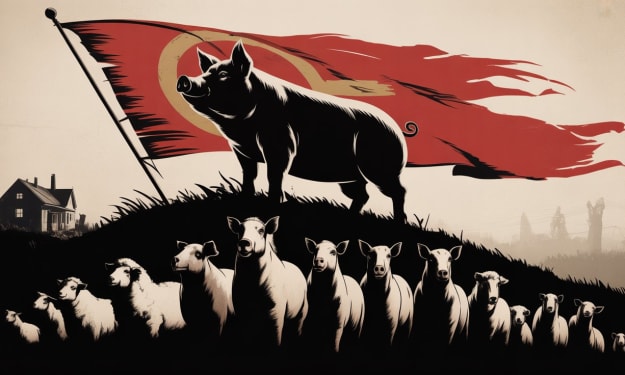
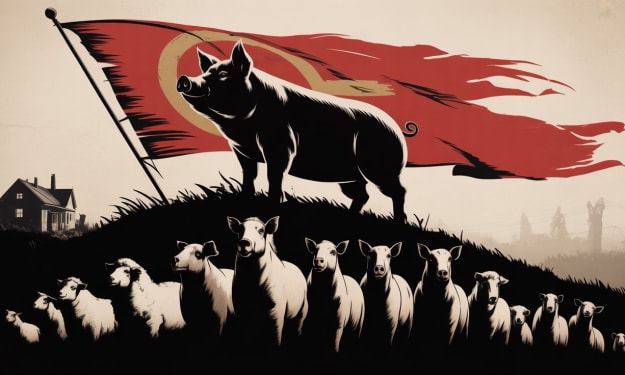
Years have passed since the animals first rose up and drove Mr. Jones from Manor Farm. The seasons change, and the once bright hope of revolution has faded into a grim reality. The animals of Animal Farm, now completely under the control of Napoleon, find themselves living under a government that is disturbingly similar to the one they sought to overthrow. Their dreams of equality and freedom have been replaced by oppression, manipulation, and betrayal.
By Echoes of Lifeabout a year ago in Fiction
Animal Farm (George Orwell) - Chapter- 7 (Novel)
The winter on Animal Farm is harsher than ever, and the animals are suffering greatly. Food is scarce, and the cold cuts deep into their bones, but Napoleon’s regime continues to press on. To maintain appearances and maintain control, Napoleon uses propaganda, deception, and brute force to suppress dissent and silence the truth.
By Echoes of Lifeabout a year ago in Fiction
Animal Farm (George Orwell) - Chapter- 6 (Novel)
As Animal Farm's second year of freedom begins, the animals face new hardships and challenges. The winter is harsh, and food supplies are dangerously low. Nevertheless, Napoleon insists that work on the windmill must continue without a break, promising to lighten their burden once it is completed. The animals work harder than ever, often toiling from dawn to dusk, but their rations are reduced and the cold bites harder. Boxer, the hardworking carthorse, adopts his new maxims with even greater dedication: "I will work harder," and "Napoleon is always right." His strength and passion become the backbone of the farm's efforts, but even Boxer begins to tire.
By Echoes of Lifeabout a year ago in Fiction
Animal Farm (George Orwell) - Chapter- 1 (Novel)
The story begins at Manor Farm, owned by Mr. Jones, a carefree and often drunk farmer. One evening, Old Major, a highly respected 12-year-old middle-white boar, calls a meeting of all the animals in the large barn. Old Major has had a strange dream and wants to share it with everyone. News of the meeting spreads quickly through the farm, and the animals gather eagerly to hear what Old Major has to say.
By Echoes of Lifeabout a year ago in Fiction
Memoirs of a Dream That Never Ended
Memoirs of a Dream That Never Ended The story I could only live with my eyes closed. --- It began, as all dreams do, without warning. I remember waking up inside it—or what felt like waking. I stood barefoot on a black sand beach, the air thick with the scent of rain that hadn’t fallen yet. The sky pulsed a shade of blue I don’t think exists anywhere else—deeper than twilight, but not yet night. There were no stars. Just a single moon hanging far too low, almost touching the sea. I thought I was dreaming. Then I realized I couldn’t remember falling asleep. Every step I took left a glowing footprint behind me, which vanished seconds later like it had never been there. The waves hummed. Not crashed. Hummed, like some forgotten lullaby sung from the throat of the ocean. And even though I was alone, I didn’t feel lonely. It felt like the place was waiting for me. Or maybe I had been waiting for it. I walked for what could’ve been hours or minutes. Time didn’t follow rules here. I found a house made of driftwood and mirrors. It had no door, but when I stepped inside, I was instantly inside my childhood bedroom. The same posters on the walls. The glow-in-the-dark stars still faintly clinging to the ceiling. A copy of a book I never finished reading was still on the desk. I picked it up and opened to the first page—and my name was there, handwritten, but I don’t remember ever writing it. I started to think this dream wasn’t just mine. That maybe it belonged to all the versions of me I had left behind. Each time I “slept” in the dream, I woke up in another layer. A city made entirely of books where the people whispered in paper rustles. A floating train that stopped at invisible stations. A forest where the trees grew upside down and birds recited poetry with voices like my mother’s. I stopped questioning it. There was a peace in surrendering. The rules of the real world—gravity, time, memory—had softened here like old wax. But eventually, I began to forget things. It started small. My phone number. The smell of coffee. The way sunlight feels on closed eyelids. I forgot my sister’s voice. My father’s laugh. I couldn’t remember the last time I felt cold. One night, I stared into a mirror hanging in a hallway made of clouds. My reflection blinked a second after I did. Then it tilted its head and asked, “Why are you still here?” I didn’t have an answer. The dream didn’t end. I never woke up. --- People like to say, “You’ll know when you’re dreaming.” That your mind will scream the clues: clocks that don’t work, hands that change, stairs that loop forever. But when you’ve been inside a dream long enough, it doesn’t feel like a dream anymore. It feels like life. It becomes memory. So I started writing. Not on paper—there was no paper here—but in the sky, on walls, in ripples of water. I etched the pieces of who I was in the world I came from. My name. The street I grew up on. The freckles on my first love’s shoulder. I buried truths inside the landscapes, hoping if I lost myself completely, some future version of me would find the breadcrumbs. Sometimes, I heard voices from the waking world. Like echoes through water. A woman crying. A man shouting. A beep… rhythmic and distant. I didn’t recognize any of it, not really. But something in me flinched with every sound. One night, I met someone else. She said her name was Elara, and she’d been here “for lifetimes.” She didn’t remember her real face anymore, just how her mother’s hands felt when she braided her hair. I asked her if she missed being awake. She smiled sadly and said, “Maybe I never was.” --- I don’t know how long it’s been now. Time has unraveled itself into thread, and I’m walking its length without counting. But here’s what I do know: The dream has layers. And some part of me still fights to rise through them. Some part of me still wants to wake up. I think that’s why I’m writing this—not to be read, but to be remembered. If you find this, if these words somehow drift into your mind while you sleep, maybe it means I’m getting close. Maybe it means dreams are doors, and some doors can be opened from both sides. Or maybe you’re dreaming, too. And if you are… tell me how to wake up. Because I’m starting to forget again. Because I’m afraid this isn’t a dream anymore. Because the moon has started speaking in my voice. Because I saw myself walking the other way last night—and I didn’t stop to say helloitten hello.
By Muhammad Umarabout a year ago in Fiction
The Silence After the Sirens
The Silence After the Sirens By [waseem khan] The sirens had stopped. In this city, that meant nothing. It didn’t mean safety. It didn’t mean peace. It meant only that the immediate threat had passed, that the missiles had landed—somewhere. That buildings had either fallen or miraculously remained standing. That the dust would settle again, and that those still breathing would count their blessings by candlelight.
By waseem khanabout a year ago in Fiction
The Sky and the Fang
In the heart of a dense, untamed valley surrounded by cliffs and whispering winds, lived an eagle known as Rael. With feathers the color of burnished gold and eyes that could pierce through fog, Rael was not just any eagle—he was the silent ruler of the skies, feared and revered by creatures across the mountains. Far below, slithering through shadows and beneath sun-warmed rocks, lived Sereth, a massive serpent whose skin shimmered like oil and whose venom could kill in minutes. Unlike Rael, Sereth ruled the underworld of the wild—not through flight, but through fear. For years, the eagle and the snake lived separate lives. One ruled above, the other below. They never crossed paths. Nature had drawn invisible lines between them—until the day a drought fell upon the valley. Water became scarce. Ponds dried into cracked mud, and prey became rare. The eagle soared farther each day, and the snake slithered longer through the brittle grass in search of food. Desperation pushed both predators closer to the riverbed that remained as the valley's last source of life. One morning, Rael circled the riverbed, his shadow gliding across the dry stones. His sharp eyes caught sight of a small hare drinking near the water. Just as he tucked his wings and dived, something else moved. Fast. Silent. Deadly. Sereth had also found the hare. As Rael extended his talons, Sereth struck upward from the underbrush, fangs flashing. Their bodies collided mid-attack, the hare escaping in a blur of fur. For a moment, time stood still. Talons met scales. Wings beat against coils. The wild held its breath. Rael managed to break free, rising high with the snake’s venom barely grazing his feathers. But the encounter had ignited something deeper: a rivalry, a war between sky and soil. Over the next few weeks, the eagle and the snake clashed more than once. Rael attacked from the sky, swift and silent. But Sereth had learned to read the shadows. He would flatten himself against the stones, wait patiently, then strike with terrifying precision. It became more than survival. It became pride. Rael, the eagle, began training differently. He practiced mid-air stops, sharper dives, more agile maneuvers. In the wind tunnels near the cliffs, he honed his wings like a warrior polishing his sword. Sereth adapted as well. He began using tree roots for cover, learning to anticipate the eagle's patterns. He would leave decoy movements to mislead his aerial rival. The valley turned into a war zone. Smaller animals avoided the riverbed, afraid to be caught between the two. Even the wind seemed to whisper their names—Rael and Sereth—like ancient spirits caught in an eternal duel. Then came the final day. The sun hung low and red like a blood moon. The riverbed shimmered faintly, reflecting the tension in the air. Rael flew above, scanning the terrain. Below, Sereth lay coiled near a boulder, motionless. Rael dove with unmatched speed, faster than ever before. Sereth did not move. Not an inch. Just as Rael stretched his talons, Sereth uncoiled in a blur, his mouth open, fangs ready. But this time, Rael had learned. At the last second, he twisted mid-air, dodging the strike, grabbing Sereth not from above, but from behind—talons locking onto the serpent's midsection. The snake twisted violently, wrapping around Rael’s legs. The eagle screamed, wings thrashing, trying to rise. The two wrestled mid-air—a knot of feathers and scales—until, with all his might, Rael flung himself higher. The struggle rose above the treetops. Snakes are not meant for the sky. As altitude increased, Sereth’s grip weakened. Air thinned. The eagle climbed with pure defiance, dragging his foe higher. Finally, above the highest peak, with clouds brushing their bodies, Rael let go. Sereth plummeted. The snake twisted, turned, hissed—until he vanished into the canopy below. Rael landed on a cliff edge, exhausted and bleeding. One leg wounded, wings trembling, but alive. Victorious. The valley returned to silence. Weeks passed. The river returned. So did the prey. The drought ended. Rael healed slowly, now limping slightly when he perched, but his wings remained mighty. No one saw Sereth again. But the legend remained. The animals whispered it in their nests and burrows. The eagle who took the sky and the snake who dared challenge it. A story not just of survival, but of adaptation, honor, and knowing when to rise and when to let go. In time, younger eagles would ask Rael why he fought. Was it for food? Territory? Glory? He would simply answer, “Because the sky must always remember what the ground can never understand.” And then he would soar—his wings stretched, the horizon endless—over a valley that once burned with battle, and now breathed peace.
By Muhammad Usamaabout a year ago in Fiction
The Stranger Who Paid for My Silence
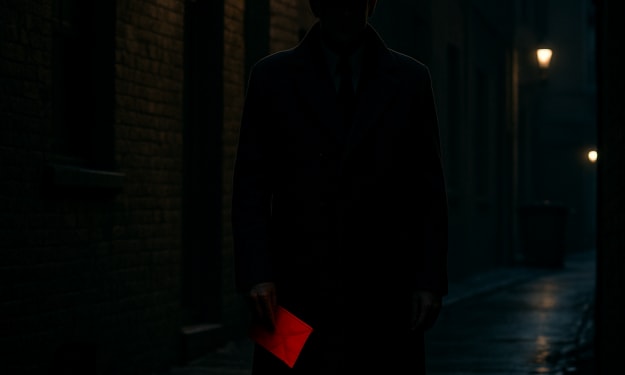
It began with a knock. Not the polite kind. Not the impatient kind either. This one was deliberate. Soft. Three slow taps that echoed louder than they should’ve in the stillness of 2:17 a.m. I sat up in bed, heart thudding louder than the knock itself. I live alone in a small flat above a closed electronics shop. Nobody visits me. Not at this hour. Not ever, really. I peered out the window and saw nothing. The narrow alley was swallowed in shadows, lit only by a flickering streetlamp that gave off more buzz than brightness. Another knock. I hesitated, then opened the door. A man in a black overcoat stood still as stone. No emotion. No urgency. Just... stillness. He held out a thick envelope and said, “Forget what you saw.” I stared at him. “I didn’t see anything.” His eyes narrowed. “Not yet.” Before I could say another word, he dropped the envelope into my hands and walked away, swallowed by the shadows as quickly as he had appeared. --- Inside the envelope were five crisp one-hundred-pound notes. No message. No instructions. I waited until morning before I told anyone — which is to say, I didn’t. Instead, I walked the alley where he had vanished. Nothing unusual. No blood, no signs of a struggle, no footprints. Just a quiet street pretending nothing had happened. I told myself to ignore it. Maybe it was a prank. Maybe it was a mistake. But the next night, I saw it. --- I had stepped outside for air, trying to convince myself the whole thing had been a dream. That’s when I noticed the blinking red light — a small security camera I never installed, positioned just above the alley exit. It wasn’t there before. I followed its line of sight. And saw the stain. Blood, dark and dried, partially hidden behind a dumpster. I moved closer, and that’s when I saw the shoe — just one. Women’s. Red, with a broken strap. There was no body. Just silence and the growing certainty that I had stepped into something far beyond coincidence. --- The next day, I received a letter in my mailbox. No name. No return address. “Keep quiet. Or we’ll come for what we paid for.” --- I told myself it wasn’t worth the risk. I didn’t know anything for certain. I wasn’t involved. Maybe someone else already called the police. Maybe the shoe meant nothing. But I couldn’t sleep. I started checking the alley every night, waiting for something to return. Or disappear. One night, I noticed the shoe was gone. The blood, too. And the camera? Disconnected. Like it had never been there. I stopped receiving letters. No more money. No more knocks. Just a deep, slow unraveling of my peace. --- Weeks passed. I went back to work, pretending I wasn’t watching every stranger’s face on the street, wondering if one of them knew. Or was watching me. Then the dreams began. A woman, face hidden, standing at the foot of my bed. Silent. Pointing to the door. Sometimes she cried. Other times, she held an envelope in her hand. A red shoe dangling from her fingers. One night, I followed her. In the dream, the door opened to the alley. I stepped outside. The man in the black coat waited for me. But this time, his hands were empty. “You kept the money,” he whispered. “Now pay the price.” I woke up screaming. --- I started carrying the envelope with me everywhere. As if holding it gave me control. As if I could reverse what I hadn’t done. And then one evening, while walking past a charity shop, I froze. In the window display was a familiar red shoe. Not a pair. Just one. Broken strap. Faded sole. I rushed inside. “Where did this come from?” I asked the old woman behind the counter. “Oh, people drop things off all the time,” she replied. “That one came in a black bag last week. Anonymous donation.” I bought it for 50p. And placed it next to the envelope on my nightstand. --- I never did go to the police. Not because I was afraid of being accused — but because I knew, deep down, they’d find nothing. No camera. No man in black. No record of anyone disappearing. Just me. And my silence. --- It’s been six months now. Sometimes, I hear footsteps outside my door, but when I check, there’s no one. Other nights, I wake up to see the red shoe has moved an inch closer to the edge of the nightstand. I push it back. But every time I do, I feel like I’m pushing her further away. --- You might ask why I never spent the money. Maybe I’m waiting for him to come back. Maybe I’m hoping someone else will knock on my door, this time asking me to speak — not to stay silent. Or maybe, deep down, I know the truth: Some payments don’t settle the debt. They only buy the quiet. And silence, I've learned, has a sound all its own. ---
By Muhammad Riazabout a year ago in Fiction
The Great Pajama Heist: Or How I Accidentally a Whole Town in My Underwear
"The Great Pajama Heist: Or How I Accidentally a Whole Town in My Underwear" Chapter 1: The Man in the Polka-Dot PJs Barry Bumble thorn was a man of simple pleasures: stamp collecting, birdwatching, and his prized possession—378 pairs of pajamas. As Snoreville’s most enthusiastic librarian, he lived a quiet life… until the night he became a criminal mastermind. It started innocently. Barry had volunteered to organize the town’s first-ever Pajama Swap Meet at the community center. But when he accidentally knocked over a display of “donated” onesies, he panicked. In a sleep-deprived haze, Barry stuffed his arms into a kangaroo pouch onesie, tripped over a laundry basket, and emerged dressed as a rogue marsupial. The crowd cheered. Someone yelled, “Encore!” Barry fled, but not before grabbing a suspiciously large duffel bag labeled MAY CONTAIN NAP-related ITEMS .
By Wings of Time about a year ago in Fiction
The Silent Goodbye. AI-Generated.
I still remember that morning as clearly as if it happened yesterday. The sun was rising lazily, casting golden streaks across our small living room. I woke up to the smell of chai boiling in the kitchen, the radio playing an old Kishore Kumar song in the background.
By IFZAL AMINabout a year ago in Fiction
Viral Fame at Any Cost
🌐 Introduction There’s always one. You know the type. They show up out of nowhere, an ordinary human with a camera and an algorithmic dream, suddenly everywhere — TikTok, YouTube, Instagram, your aunt’s Facebook feed. Their face haunts your “For You Page,” their catchphrase is on a t-shirt at Target. It’s the modern fairy tale: obscurity to omnipresence, with a sprinkle of chaos theory and a dash of digital fairy dust.
By Karl Jacksonabout a year ago in Fiction
A Thousand Splendid Suns
There are stories that live inside books, and then there are stories that live inside people. This is one of the latter. I met her in a moment of absolute chaos. The kind of moment where life breaks apart in slow motion—where the world becomes unrecognizable and grief wraps itself around your ribs like wire. We were strangers then. Just two women standing in the rubble of what used to be our homes.
By Muhammad Saleemabout a year ago in Fiction