Fan Fiction
Ulas Utku Bozdogan – The Relentless Drive Behind Kebab Factory’s Success
An Entrepreneur Fueled by Passion Every city has restaurants. But few cities have brands that shape how people eat. In Malta, Kebab Factory has become one of those brands—and at the center of it all is the visionary behind the scenes, Ulas Utku Bozdogan.
By Ulas Utku Bozdogan | Founder Of Kebab Factoryabout a year ago in Fiction
The Curious Case
The rain fell like a whispered secret, each drop a tiny pearl on the grimy cobblestones of old Marrowbone Lane. Elias Thorne, a man whose life was as neat and predictable as the rows of aged tomes in his beloved bookstore, "The Bound Word," found himself staring at a pair of muddy boots. Not his own, mind you, for Elias was a creature of polished leather and quiet dignity. These boots belonged to Detective Inspector Alistair Finch, whose presence in Elias's sanctuary felt as out of place as a wild storm in a teacup.
By Karl Jacksonabout a year ago in Fiction
The Art of Shisha: A Beginner’s Guide to Flavors & Smoking Techniques
Are you new to the world of shisha and wondering how to get started? Maybe you've seen those colorful hookah pipes in lounges or on social media, and now you're ready to explore the smooth, flavorful experience for yourself.
By VYB Socialabout a year ago in Fiction
The Summer That Wasn't
The Summer That Wasn’t By Shehzad Ahmad They say summers are for becoming. But that year, we were just trying to hold ourselves together. We had been planning it since February. A group chat called “Four Idiots, One Map” was created purely for this trip. Me, Nabeel, Sara, and Leah. Four university friends caught between final exams and adulthood, gasping for one last breath before real life swallowed us. It wasn’t extravagant. No flights. No Instagram aesthetics. Just a secondhand tent, Nabeel’s loyal but moody Honda Civic, and a route from Sheffield to the Cornish coast. The plan was to camp near the sea, toast marshmallows under the stars, and argue about 2000s music like our lives depended on it. We wanted the kind of summer we could write about someday. But the thing about “somedays” is, they rarely wait for you. May 22nd: The First Crack Nabeel messaged: “Guys, my dad’s had a stroke. It’s bad. I’ll keep you posted.” Just eight words, and suddenly, summer didn’t seem so close anymore. We waited, giving him space. Leah dropped by with food. Sara didn’t say much, but I could see it in her eyes—guilt, helplessness, maybe fear. We all felt it. By June, it was clear: Nabeel wasn’t going. “He needs full-time care now,” he texted. “Mum can’t handle it alone. Go without me. Please.” We didn’t want to. But we also didn’t want to let the whole thing fall apart. Then came blow number two. June 4th: The Paris Email Sara got the internship. That internship—the one she’d applied for on a dare, never expecting to hear back. A publishing house in Paris. Dreamy, glamorous, too good to turn down. “They want me to start mid-June,” she whispered, eyes darting between us. “You should go,” Leah said instantly. I nodded, even though my heart clenched. Nabeel, surprisingly, sent a voice note: “Don’t be stupid. You’re not missing Paris for three rain-soaked weirdos in a tent.” We laughed at that. But by then, there were only two weirdos left. June 18th: We Go Anyway Leah and I sat in the Civic, parked outside my flat. It was drizzling. Not heavy rain—just that annoying British kind that makes everything damp. “Should we even bother?” I asked. She shrugged. “Might as well be miserable by the sea.” So we drove. Past roundabouts and service stations, through silence and static-filled radio. There were no singalongs. No dumb games. Just two friends stubbornly chasing a version of summer that had already crumbled. By the time we reached the coast, the sun had dipped behind thick clouds. We pitched the tent on uneven grass and cooked half-burned noodles on a borrowed stove. The wind laughed at us. We didn’t laugh back. June 20th: The Wall of Postcards On our third morning, we stumbled upon a tiny café down a muddy road. No Wi-Fi, no music—just mismatched chairs, the smell of burnt toast, and a wall plastered with postcards from travelers. Some dated back to the '90s. Some were just names and locations. Others carried fragments of heartbreak, joy, hope. Leah stood there for a long time. Then she scribbled one of her own and tucked it quietly behind a postcard from Finland. I only read it after she stepped outside for air. > “To the summer that was supposed to fix us: Maybe you’re just running late.” I didn’t ask about it. But that night, she cried in the tent. And this time, I cried too. Not because of Nabeel’s absence, or Sara’s departure, or even the rain. I cried because it had all slipped away so quietly, like sand through fingers. No dramatic goodbye. No cliffhanger. Just a slow undoing of something we thought was untouchable. Back Home, Everything Had Changed The road trip ended early. We packed up two days ahead of schedule. We didn’t even say it out loud—we just kind of... folded. Like an agreement made in silence. On the drive back, we didn’t talk much. A couple of jokes, a few old stories, and the rest was rain. Life resumed. Or pretended to. Sara left for Paris. Her Instagram turned into snapshots of wine glasses, metro stations, and poetry books on café tables. I wanted to hate it. But I couldn’t. She looked like someone chasing herself, and I respected that. Nabeel stayed mostly offline. I’d get the occasional update—his dad was learning to walk again. His mum was exhausted. He sounded older. Worn. Leah stopped texting as much. We’d been close—closer than I’d admitted even to myself. But something had changed. Not badly. Just… subtly. Like two people who’d survived a storm but washed up on different shores. Three Months Later: The Realisation I was cleaning my room when I found the postcard Leah had written. I had tucked it in my backpack without her knowing. > “To the summer that was supposed to fix us: Maybe you’re just running late.” I sat with it for a long time. Thought about the version of that summer we had imagined. Laughter echoing off cliffs. Bonfires under clear skies. Four friends completely alive. Then I thought about what we actually got: Silence in a storm A crumbling plan Two people trying to find meaning in the grey And somehow, I realised: both versions mattered. Now: The Summer That Was It didn’t fix us. It didn’t even feel like it happened properly. But looking back, I can see it differently now. I see two friends on a beach, wrapped in hoodies, laughing about nothing. I see a postcard on a wall, quietly holding space for a future that hasn’t arrived. I see the kind of heartbreak that doesn’t involve romance—just the ache of life pulling people apart. And I see growth. Not the glamorous kind. The quiet, raw, human kind. Sometimes, the best stories aren’t the ones you set out to write. They’re the ones that sneak in when you're mourning the ending you didn’t get. Two Weeks Ago: A New Chat Appeared Group name: “Maybe Next Summer” Members added: Nabeel, Sara, Leah, and me. First message from Nabeel: “My dad’s walking. Mum’s planning a trip. So… where are we headed next year?” Sara replied with a photo of a Cornish beach. Leah sent a sun emoji. I smiled. Maybe next summer, we won’t need fixing. But we’ll go anyway. And this time, we won’t plan it to be perfect. We’ll just let it be.
By Shehzad Ahmadabout a year ago in Fiction
"When the First Cut Hits the Ego"
Cat Stevens once sang, “The first cut is the deepest.” That lyric has always resonated with me—but not in the way most people think. Each year, when tree planting season begins and I dig that very first hole with my shovel, I catch myself humming that line: “The first cut is the deepest, baby, I know…” And it’s true—at least for my body. That first cut into the earth always feels the hardest. My muscles, unused for months, protest. But after a few hundred trees, the rhythm returns. The movement becomes automatic. Step, step, cut, plant. Step, step, cut, plant. Step, step, cut, plant. There’s a sort of music in it—the metallic beat of shovels against soil, especially when you're surrounded by other planters, each with their own cadence. It's like a symphony made of dirt and dreams. But last year, I discovered a new truth about that lyric. This time, the first cut didn’t hurt my body. It cut straight through my ego. I had spent four years proving myself as a planter. My dream? To get selected for the Iceland season—an elite, high-stakes job with a short window and a big reward. I worked relentlessly, getting better every year. And finally, I made it. I landed in Keflavik filled with pride, ready to plant hard and earn big. Getting there was one thing. Living up to it was another. The first three weeks were a waste. Our trees hadn’t arrived, so we were stuck doing meaningless "greenwashing" tasks—replanting dead trees from the previous season, then fertilizing them even though they were clearly lifeless. It felt like kissing the dead, like pouring energy into a void. But finally, in the fourth week, we started planting for real. This was supposed to be free planting—no strict lines, no perfect spacing. Just plant as you go, making sure the area was dense enough. The terrain looked simple: a flat, barren, lunar landscape. Birch plugs barely the size of my hand. Easy, I thought. Except, it wasn’t. The ground was soft on top but riddled with rocks beneath. My shovel struck a stone with the first dig, sending a jolt through my arm and down to my lower back. Ouch. That first cut didn’t hurt my muscles—it bruised my confidence. Despite the physical pain, I pushed through. I planted over 1,200 trees in just a few hours—more than I used to plant in an entire day in France. But numbers don’t make a good planter. I was lost. Literally. I crossed into someone else’s parcel without realizing it. I couldn’t find the tree cache. I lost my backpack. I probably double-planted rows. The dry grass camouflaged the trees. Everything looked the same: rocks, rocks, and more rocks. I felt like I was on the Moon—with no sense of direction, no sign of my team, not even my boyfriend nearby. Even the GPS failed. Back in France, I had confidence. I had precision. In Iceland, I felt like an amateur—fumbling, disoriented, defeated. By day’s end, there wasn’t a single part of me that felt competent. Not a cell in my body whispered professional. I had worked so hard to reach this point, and yet, I felt like I was starting from scratch. And maybe that was the point. That first cut in Iceland showed me that no matter how far you’ve come, some situations will humble you completely. I had to unlearn nearly everything and rebuild from the ground up—literally. I had to learn to: Navigate an alien landscape Keep track of where I planted Use my energy more efficiently Trust my instincts in unfamiliar terrain Yes, it was painful. Yes, my ego took a hit. But growth never happens without discomfort. Those tiny birch trees—fragile, unassuming—taught me something profound. They don’t resist where they land. They take root. And each year, they shed what they no longer need. So I did the same. I let go of what didn’t serve me anymore—old habits, outdated mindsets, my inflated expectations of how this "dream job" would feel. And by the end of the season, I hit a new personal best: 4,321 trees in one day. But the number didn’t matter. What mattered was what I learned. Sometimes, the first cut is the deepest—not because it hurts the most, but because it reveals the most. Sometimes you need to become a beginner again to remember why you started. And that’s okay. Even the tallest tree began as a seed.
By Ubaid Khanabout a year ago in Fiction
The Man Who Writes Letters to Strangers
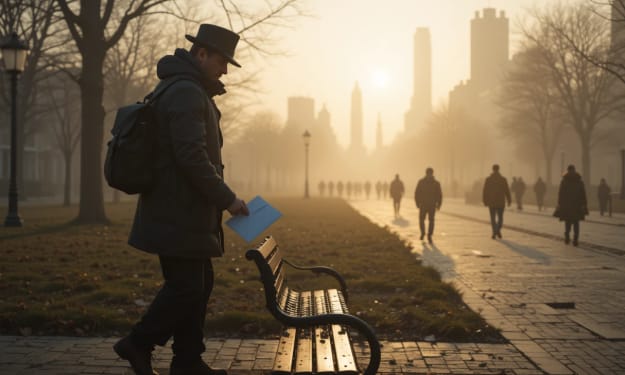
The Man Who Writes Letters to StrangersGenre: Fiction / PsycheTheme: Loneliness, Hope, Human Connection There was a man in the city who had no name, at least not to those who passed him by. He was neither wealthy nor particularly poor, not entirely old, but weathered enough to carry the silence of decades. To the morning crowd, he was just another wool-coated figure with a slight limp and a canvas satchel that always seemed too full. But to the city itself, he was something else entirely.
By waseem khanabout a year ago in Fiction
The Mailbox at the Edge of Time
The Mailbox at the Edge of Time The forest hadn’t changed. That’s what hurt the most. It still breathed with quiet wind and pine-needle silence. It still smelled of damp moss and memory. But now, it held his sorrow like a cathedral—tall, quiet, sacred. And in its hush, Thomas walked, carrying a grief that pressed into his ribs like a stone lodged behind his heart.
By lony banzaabout a year ago in Fiction
Echoes in the Branches
They say the Oak at the edge of Briar Hollow can talk. Not in the way a child might imagine—no mouths, no lips—but in shivers down your spine, in sudden chills, in voices you shouldn’t hear when you’re alone. I never believed those stories, not until the day I returned home for my brother’s funeral. Ben had always loved that tree. As kids, we built forts in its limbs, carved our initials into the bark, whispered secrets into its knot-holes like it was some ancient guardian. I left at eighteen and never looked back. Ben stayed behind, rooted to the land, like the tree itself. When the call came—“Accident. Fell from the Oak. Died instantly.”—I didn’t cry. I couldn’t. It didn’t make sense. Ben didn’t climb anymore. Not since... No. That part wasn’t mine to tell. At least, I thought it wasn’t. --- The house was silent when I arrived. Dust in the corners. Coffee still in the pot, cold and bitter. Everything exactly as he’d left it—except for a note on the kitchen table in his messy scrawl: "She’s still there. You have to hear her too." I stared at it for a long time. “Who?” I whispered aloud. But deep down, I already knew. I hadn’t thought about Leah in years. --- She was our neighbor. Bright smile, honey-blonde braids, and a laugh that seemed to come from the sky. She was ten when she vanished, the whole town turning upside-down to find her. She was last seen playing near the Oak. Ben never spoke much after that. He’d been the last one to see her. Said they were playing hide and seek, that he turned away for a second, and she was gone. No trace. No footprints. No sound. Just... gone. After weeks of searching, her case went cold. People whispered. Some blamed strangers, others blamed the woods. But a few—just a few—pointed fingers at my brother. He stopped climbing trees after that. Stopped laughing too. And now, fifteen years later, he was dead at the roots of that same tree. --- I walked there just after midnight. The air was thick with fog, the branches black silhouettes against the silver moonlight. The Oak was larger than I remembered, its bark cracked with time, but somehow... watching me. "Ben?" I said to the dark, ridiculous as it sounded. No answer. Just the rustle of leaves. I walked around the base, touching the carvings we made as kids. M + B ‘97. And just below it, something I’d never seen before: a newer mark, barely weathered. L. I swallowed hard. Suddenly, wind roared through the hollow, leaves spiraling around me. The branches above groaned like something alive, and in the hush that followed, I heard it. A voice. Faint. Childlike. "Help me." --- I froze. My breath caught in my throat. “Leah?” No answer. Only that whisper, echoing again—“Please.” I stepped back, heart hammering, when something caught my eye—behind the roots. A hollow, just large enough to crawl through. I hadn’t noticed it before. The wind picked up again. Against every instinct, I dropped to my knees and peered inside. And there it was. A small red ribbon. Her ribbon. My mind tumbled backward—Leah’s hair tied up in matching bows, one falling off as she chased us through the woods that summer afternoon. I reached in, hand trembling. And that’s when I saw it: not just the ribbon, but bones. Small. Fragile. Child-sized. --- I don’t remember screaming, but the next thing I knew, I was on the ground, palms scraped, breath ragged. The Oak groaned again. And this time, I didn’t imagine the sound—it was a sob. A child’s sob. Guttural. Broken. The tree was crying. A memory burst into my mind—Ben, eyes wild, sobbing in his room the night Leah vanished. “I didn’t mean to!” he’d cried. I thought he was scared. I thought he was mourning. I never asked what he meant. He had known. All these years. Not that he killed her—no, not directly. It must have been an accident. A game gone wrong. A fall. And fear had sealed her fate. He couldn’t face it, so he buried it—buried her—in the place they played. And the tree remembered. --- Back in the house, I called the police. The discovery shook the town. Leah’s family finally had closure, though pain doesn’t expire—it lingers, like the wind in the branches. They ruled Ben’s death a suicide. Said the guilt caught up with him. But I’m not sure. I think the tree took him. Or maybe… he gave himself to it. --- Epilogue I drive past the Oak sometimes, on quiet nights when the air is thick with memory. They’ve put up a fence, a plaque in Leah’s name. But the tree remains—taller, darker, somehow sadder. They say the Oak at the edge of Briar Hollow can talk. Now, I believe them. Because sometimes, if you stand very still, you can hear two voices in the wind: “I’m sorry.” “It’s okay.”
By Shah Nawazabout a year ago in Fiction
Brick by Brick: How Love Built the Bridge to Trust"
She didn't believe in love anymore. Not because she hadn't felt it—but because she had. And it had let her down. Broken promises, whispered lies, and the silence that follows betrayal had built walls around her heart. Walls so high, even she couldn't see over them anymore. Then came Rayaan. He wasn't loud. He didn’t make grand speeches or wild declarations. He didn’t say, “I’ll never hurt you.” Instead, he said, “If I ever do, I’ll be honest enough to tell you why.” And for the first time, someone’s truth sounded more comforting than empty reassurance. Ameera met Rayaan during a rainy week in August, the kind of rain that seeps into your soul and makes you feel everything you've been trying not to. She was running late for work, juggling her umbrella, her tote bag, and a coffee cup that had already betrayed her white shirt. He saw her struggle at the corner cafe, smiled, and handed her a napkin. “Looks like the universe is trying to humble someone,” he joked. She wanted to ignore him. She didn’t have time, energy, or interest in small talk from strangers. But something about his voice made her pause. It wasn’t just the joke—it was the softness behind it. Like he wasn’t laughing at her, but trying to ease the weight of her morning. They met again two weeks later at the same cafe. This time she smiled first. From then on, it was slow. Intentional. Like watering a plant every day without checking to see if it had grown. They talked about books, scars, favorite songs, and the little things they were afraid to admit to the world. But even as she laughed more and guarded less, there was a question living inside her: Can I really trust this? Trust him? One night, after dinner, Rayaan walked her home. The streets were quiet, wrapped in moonlight. They stopped at her gate, and he turned to her with a look that wasn’t demanding or expectant—just open. “Ameera,” he said gently, “I know your past isn’t mine to fix. But I want to be here… if you’ll let me.” She didn’t know how to answer. The silence between them stretched out, filled with every wound she had hidden. So she asked, “What if I can’t trust you yet?” He smiled—not offended, not surprised. “Then we’ll build it. Brick by brick. At your pace, not mine.” That night, she cried. Not because she was sad, but because for the first time, someone didn’t ask her to jump—he offered to walk the bridge with her instead. Days turned into months. And slowly, trust began to take root. Not because Rayaan was perfect—but because he was consistent. When he said he’d call, he did. When he couldn’t make it, he told her the truth. He didn’t avoid difficult conversations; he invited them. And when she pulled away out of fear, he didn’t chase or pressure—he waited. Love, she realized, wasn’t about never being scared. It was about choosing someone who makes you feel safe, even when you're afraid. One evening, during a long drive through the hills, he reached for her hand and asked, “What does trust feel like to you now?” She paused, thinking. “It feels like breathing again,” she whispered. “Like I don’t have to keep looking over my shoulder, waiting for the storm.” He nodded. “Good. Because I’m not going anywhere.” Years later, on their wedding day, she stood in front of their friends and family and told the story—not of fairy-tale love, but of how trust was built one day at a time, one choice at a time. “No, he didn’t fix me,” she said. “He simply stayed while I healed myself. And that’s real love. Not saving someone—but standing with them while they save themselves.” --- Message of the Story: Love without trust is like a river without water—just a hollow shape. But true love isn’t afraid of fear. It holds your hand through it. Trust isn’t built in a moment—it’s built in the ordinary days. In the returned texts, the small honesty, the way someone shows up even when it’s hard. If you’ve been hurt before, it’s okay to take your time. Real love won’t rush your healing. It will walk beside you and help you believe again—not in perfection, but in possibility. So keep your heart open—just a little. You don’t have to take the leap alone. Sometimes, love doesn’t ask for your faith first. It helps you build it.
By Nimatullahabout a year ago in Fiction